The Smart Packing List for Korea: What to Bring vs. What to Buy

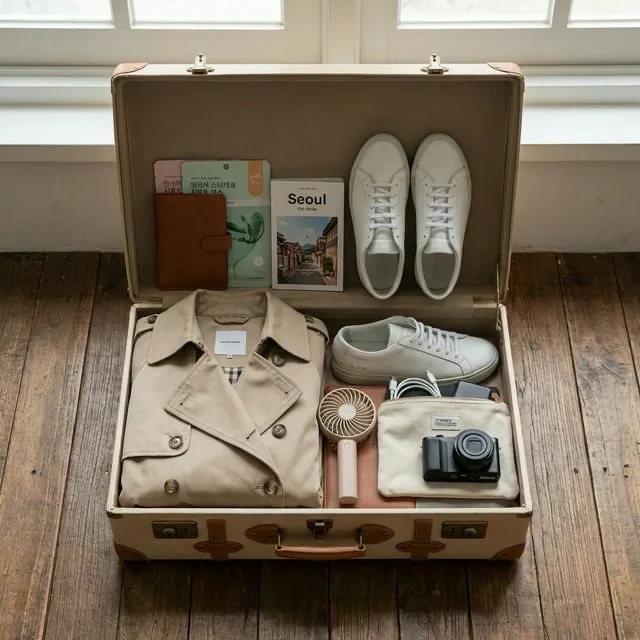
Most packing lists tell you to bring everything. That is a mistake. Korea is one of the world's great shopping destinations, and if you stuff your suitcase full of items you can buy cheaper and better on arrival, you will spend your entire trip hauling weight you did not need and scrambling for space on the way home. The golden rule for Korea: if you can buy it at Olive Young or Daiso, don't pack it.
The Strategic Packing Philosophy for Korea
South Korea has a peculiar effect on travelers: you arrive with a full suitcase and leave with two. The country's retail infrastructure is extraordinary. Convenience stores (CU, GS25, 7-Eleven) are open 24 hours and sell everything from phone chargers to blister bandages. Olive Young, the Korean beauty chain, stocks skincare, health supplements, and personal care products that outperform most Western equivalents at a fraction of the price. Daiso sells every household item imaginable for 1,000 to 5,000 KRW.
This means your packing strategy should be fundamentally different from what you'd use for, say, a trip to rural Europe or Southeast Asia. Rather than packing for every contingency, you pack lean for the essentials and trust Korea's retail ecosystem to fill the gaps. The result: a lighter bag, more room for purchases, and no checked luggage fees on the way there.
Before diving into seasonal specifics, there is one category that requires planning ahead: sizing. If you wear clothing above Korean XL (roughly a US/EU Large) or shoes above men's 285mm (US 11) or women's 255mm (US 8.5), Korean stores will often not carry your size. This is the one area where you cannot rely on buying locally — more on this below.
What to Leave at Home: The "Buy in Korea" List
| Item Category | Bring From Home | Buy in Korea (Olive Young / Daiso) | Why |
|---|---|---|---|
| Toiletries | Clinical anti-perspirant, specific dental floss | Shampoo, body wash, sheet masks, sunscreen | K-beauty is cheaper and higher quality locally; Western deodorant is hard to find. |
| Electronics | Dual-voltage charger, Type C/F adapter | Hair dryer (if 110V-only at home), portable fan | Korea uses 220V round pins; 110V appliances blow fuses. |
| Clothing | Plus-size clothing (>XL), shoes >285mm | Thermal layers, socks, stylish basics | Korean retail sizing runs small and shoe sizes top out early. |
| Medicine | Prescriptions with doctor's note, inhalers | Basic pain relievers, cold remedy, bandages | Convenience stores and local pharmacies carry basic OTC meds easily. |
These are the items travelers routinely over-pack that are available in Korea at lower cost and frequently higher quality.
Personal Care Products
Shampoo, conditioner, body wash, and lotion — Korean accommodations almost universally provide these. Even budget guesthouses and capsule hotels stock small bottles. If you run out mid-trip, Olive Young, Innisfree, The Face Shop, and countless pharmacies carry an overwhelming selection of hair and skin products. A bottle of premium TONYMOLY or COSRX moisturizer costs 8,000 to 15,000 KRW.
Sunscreen — Korean sunscreen technology is genuinely world-class. Products like Anessa, Beauty of Joseon, and Round Lab SPF formulas are lighter, more comfortable to wear, and often more effective than comparable Western products. Buying sunscreen in Korea is actively recommended, not just acceptable. Leave yours at home.
Sheet masks and face masks — These are the ultimate Korean airport souvenir, and they are everywhere in bulk packs. Bringing sheet masks to Korea is like bringing pizza to Italy.
Makeup (most of it) — Unless you use very specific products you cannot live without, Korean cosmetics like Romand, Peripera, Laneige, and Innisfree cover every need at dramatically lower prices than their Western counterparts.
Umbrella — A decent umbrella costs 8,000 to 12,000 KRW at any convenience store. The transparent plastic variety has become a Seoul aesthetic in its own right. Leave yours.
Travel-size toiletries in general — The 100ml liquid rule for carry-on has conditioned travelers to bring small versions of everything. In Korea, this wastes precious luggage space. Check a bag or buy on arrival.
Electronics and Accessories
US/UK-only hair dryers and straighteners — Korea runs on 220V. A 110V appliance plugged into a Korean outlet will either blow a fuse or destroy itself within seconds. Most modern hair dryers and straighteners are dual-voltage (check for "100-240V" on the label), but single-voltage devices should stay home. Korean convenience stores sell travel hair dryers cheaply, and most hotels provide them built into the bathroom.
Rechargeable handheld fans (summer) — These small USB fans that collapse into a stand are ubiquitous in Korean convenience stores and Daiso from May through August for 8,000 to 15,000 KRW. There is no reason to bring one.
Portable Bluetooth speakers — Available everywhere in Korea, often at better prices.
The "Must Bring" List: Hard to Find or Substandard in Korea
These are the items you genuinely should not skip.
Health and Personal Care
Deodorant (strong anti-perspirant) — This is the single most important item on this list. Due to a genetic variant common in East Asian populations, many Koreans produce less body odor and have less need for strong deodorant, which means the Korean market does not stock the clinical-strength anti-perspirants that many Western travelers rely on. What is available tends to be light spray deodorant or natural crystal deodorant. If you use a standard stick anti-perspirant, bring enough for your entire trip plus a few days' buffer.
Any prescription medication — Bring your full supply plus extra, in original packaging with documentation. While Korean pharmacies are excellent and pharmacists often speak English, matching foreign prescriptions or generic drug names can be complicated.
Western toothpaste (if needed) — Korean toothpaste often features bamboo salt, ginger, or other herbal flavors rather than the sweet mint standard in Western markets. If you have a strong preference, bring yours. Sensodyne is available at some larger pharmacies, but it is not reliably stocked.
Contact lens solution (specific brands) — Standard saline is easy to find, but specific formulas for sensitive eyes or specialty lenses may not be available.
Microfiber travel towel — Many Korean accommodations, particularly guesthouses, minbak (homestays), and budget motels, provide only small hand-towel-sized drying cloths. If you prefer a full-sized bath towel experience, a compact microfiber travel towel solves the problem while taking minimal space.
Clothing and Footwear
Comfortable, broken-in walking shoes — Seoul involves an enormous amount of walking. The city averages 15,000 to 25,000 steps per day for active tourists, across uneven stone streets in historic districts, steep hillside neighborhoods like Ihwa Village and Bukchon, and long subway corridors. New shoes will destroy your feet. Wear your most comfortable, already-broken-in shoes, preferably with good arch support.
Slip-on shoes or shoes that come off easily — Korean culture requires removing shoes frequently: at traditional restaurants with floor seating, at temple complexes, at some guesthouses and cultural spaces, and at jimjilbang (Korean sauna/bathhouse facilities). Shoes with laces slow everyone down and create social friction. Pack at least one pair of easily removed footwear. Loafers, slip-on sneakers, or sandals work well.
Plus-size clothing and large shoes (if applicable) — Korean fashion retail is primarily designed for smaller Korean body types. Most chain stores (Zara and H&M excluded) cap their sizing at Korean XL, which translates to approximately a US/EU Large. Extended sizes exist but require dedicated shopping at specific outlets, which is time-consuming and unreliable. If you wear above a US L in tops or pants, or above a men's US 11 / women's US 8.5 in shoes, bring your wardrobe from home.
Spring Packing Guide (March to May)
Spring in Korea is among the most beautiful travel seasons on the calendar — cherry blossoms peak in late March to mid-April, followed by forsythia, azalea, and wisteria through May. The weather is mild but highly variable, ranging from 5°C cold mornings in early March to 22°C afternoons by late May.
Spring Clothing Strategy
Layering is everything. The Korean spring morning can feel like winter, and the same afternoon can feel like early summer. The single biggest mistake spring travelers make is packing either too warm or too light. The solution is a three-layer system: a moisture-wicking base layer, a mid-layer (light sweater or long-sleeve shirt), and an outer layer (light jacket or trench coat).
Recommended spring layers:
- Base: 2-3 breathable long-sleeve shirts (moisture-wicking)
- Mid: 1-2 light sweaters or cotton cardigans
- Outer: 1 light jacket (windbreaker, thin down jacket, or structured blazer)
- Bottoms: Mix of light jeans, chinos, and one warmer option for cold days
- Footwear: White sneakers are the quintessential Seoul spring shoe; bring comfortable ones
Yellow Dust Season (Hwangsa)
Late winter through spring brings hwangsa (황사) — fine yellow dust blown from China and Mongolia — and PM2.5 pollution spikes that can affect respiratory health. During high-pollution days, outdoor activity becomes uncomfortable without a quality mask. Korean KF94 masks (the Korean equivalent of N95/FFP2) are widely available at convenience stores and pharmacies for 500 to 1,000 KRW each. There is no need to bring masks from home; stock up locally when you arrive and check the AirVisual app daily for air quality readings.
Spring Checklist
- Light jacket or trench coat (packed, not worn)
- 2-3 layering tops
- Comfortable walking shoes for cobblestone streets
- Light cardigan for cool evenings
- Deodorant (your own supply)
- Comfortable day bag for cherry blossom picnics
If you're planning your trip around peak bloom season, the Korea cherry blossom spring itinerary covers the best viewing spots and timing across the country.
Summer Packing Guide (June to August)
Korean summer is hot, humid, and often rainy. The monsoon season (jangma, 장마) typically arrives in late June and runs through mid-July, bringing extended periods of heavy rainfall. Post-monsoon August is Korea's peak heat: temperatures regularly hit 33-35°C with humidity that makes the air feel substantially hotter.
The paradox of Korean summer: you are often cold. Korean air conditioning is aggressive to the point of requiring a light jacket in every restaurant, convenience store, cinema, and shopping mall. You will step outside and immediately start sweating, then step inside and immediately start shivering. Pack accordingly.
Summer Clothing Strategy
Fabric is critical. Cotton absorbs sweat and stays wet. Linen breathes and dries quickly. Dry-fit athletic fabrics wick moisture away. For outdoor activities in Korean summer, linen and technical fabrics dramatically outperform cotton in comfort.
Recommended summer clothing:
- Tops: Light linen shirts, dry-fit t-shirts, thin button-downs (avoid cotton t-shirts as primary wear)
- Bottoms: Linen trousers, cotton-linen blend shorts, loose jogger-style pants
- Layers for indoors: Always carry a light cardigan or thin long-sleeve layer in your bag for the AC
- Rain gear: A compact packable rain jacket is far better than an umbrella for navigating the city during monsoon. Buy a cheap umbrella locally if needed.
- Footwear: Breathable mesh sneakers or sandals. Waterproof sandals are excellent for rainy-day urban walking.
Heat and Hydration in Summer Seoul
Korean convenience stores stock an enormous variety of electrolyte drinks, iced coffee, and cold teas that make hydration easy and enjoyable. The Pocari Sweat sports drink is the local electrolyte standard. Most subway stations have water fountains. Heat exhaustion is a real risk in peak August heat — plan intensive outdoor activities for early morning and late afternoon, and take shelter during the hottest midday hours.
Summer Checklist
- Lightweight linen or dry-fit clothing (avoid cotton-heavy packing)
- Compact packable rain jacket
- Light cardigan for air-conditioned spaces
- Sunscreen (or buy superior Korean formula on arrival)
- Deodorant (critical in summer heat)
- Comfortable breathable footwear
- Portable power bank (heavy phone usage in summer)
Autumn Packing Guide (September to November)
Many seasoned Korea travelers consider autumn the ideal season. The humidity breaks after the summer monsoon, temperatures settle into the 15-25°C range, and the country's mountains and parks transform into spectacular foliage displays from mid-October through November. Seoraksan National Park, Naejansan, and even the hills of Bukhansan near Seoul become major autumn travel destinations.
The weather during autumn is perhaps the most consistently pleasant of any Korean season. Early September retains some summer warmth, October is ideal for all activities, and November requires progressively warmer clothing as temperatures begin dropping toward winter.
Autumn Clothing Strategy
Similar layering approach to spring, but shifted warmer. Early autumn (September) feels like late summer. Late autumn (November) requires genuine winter preparation. For an October visit — the sweet spot — a medium-weight jacket and versatile mid-layers cover almost everything.
Recommended autumn layers:
- Base: Moisture-wicking long sleeves
- Mid: Medium-weight sweaters or fleece
- Outer: Medium-weight jacket (field jacket, light puffer, or structured coat)
- For hiking: Pack moisture-wicking hiking socks, as your regular socks will be miserable on Korean mountain trails
Korean outdoor brands like Blackyak, K2, and Kolon Sport make excellent gear available locally if you want to upgrade your hiking kit while in Korea. The autumn foliage itinerary has suggestions for the best mountain day trips.
Autumn Checklist
- Medium-weight jacket
- 3-4 layering tops (mix of short and long sleeve)
- Comfortable hiking shoes or trail sneakers
- Light gloves for November mornings
- Moisture-wicking socks (essential for hiking)
- Deodorant
Winter Packing Guide (December to February)
Korean winter is colder than most Western travelers expect. Seoul sits at a similar latitude to Istanbul or Madrid, but unlike those cities, it receives cold Siberian air masses directly through Manchuria and North Korea, regularly pushing temperatures to -10°C or below in January and February. Wind chill can make it feel considerably colder.
The saving grace is Korea's extraordinary indoor heating culture. Traditional Korean ondol floor heating means floors are warm and cozy. Hotels, restaurants, shopping malls, and subway stations are kept quite warm. The challenge is the transition between outdoor cold and indoor warmth, which requires packing with thermal regulation in mind.
Winter Clothing Strategy
The puffer coat is the Korean winter uniform. From November through March, most Koreans wear long padded down coats that cover the thighs or reach the knees. These coats are sold everywhere in Korea at excellent prices (SPAO, Top Ten, and department store sales offer quality options from 50,000 to 150,000 KRW), so if you don't own one and are visiting in winter, buying locally is a genuine option.
However, for the first day before you have a chance to shop, you need adequate outerwear from the start.
Recommended winter clothing:
- Base layer: Thermal underwear (Uniqlo Heattech or equivalent — Uniqlo is extensively available in Korea but bring base layers for day one)
- Mid layer: Fleece or medium-weight sweater
- Outer layer: Down coat or heavy puffer, knee-length preferred
- Accessories: Warm beanie, scarf, and gloves are essential — Korean winters are windy
- Footwear: Waterproof boots with insulation for snowy days; Seoul gets meaningful snowfall in January and February
Ondol and Temperature Regulation
Korean heated floors mean indoor environments are often quite warm in winter, which creates an overheating problem if you're wearing multiple layers. Clothing that is easy to remove and pack small (rather than bulky sweaters that won't fit in a day bag) works better. A packable mid-layer that compresses into its own pocket is worth seeking out before your trip.
For ski resort visits at places like Yongpyong or High1, proper ski gear rental is available on-site, so there is no need to travel with full ski equipment. See the winter in South Korea guide for resort details.
Winter Checklist
- Heavy down coat (or plan to buy one in Korea)
- Thermal base layers
- Warm beanie and gloves
- Scarf
- Waterproof boots
- Moisture-wicking mid-layers
- Deodorant
Technology and Documents Checklist
Power and Connectivity
Power adapter (Type F — two round pins): Korea uses the European Type F standard at 220V. If you're coming from the US, UK, or Australia, you need an adapter. Bring one; airport versions are expensive. The same adapter works in most of continental Europe.
Portable power bank (10,000 mAh minimum): A day in Seoul involves heavy phone use — Naver Maps navigation, translation apps, food photography, and transportation apps drain batteries quickly. A 10,000 mAh power bank covers one full phone recharge. A 20,000 mAh bank covers two days without needing to find an outlet.
eSIM or Korean SIM card: Download and activate an eSIM before departure to have data immediately on landing. Popular options include Airalo, Ubigi, and dedicated Korea travel eSIMs available from Korean carriers online. If you prefer a physical SIM, they are available at major Incheon Airport SIM card booths immediately after customs. The Korea connectivity guide covers eSIM setup and the best apps to install before arrival.
International driving permit (if needed): If you plan to rent a car, particularly for trips to Jeju Island, obtain an international driving permit from your national automobile association before leaving home. Korean rental companies accept these alongside your home country license.
Documents
- Passport (valid for at least 6 months beyond your departure date)
- Travel insurance documentation
- Accommodation booking confirmations (useful for immigration on arrival)
- Emergency contact and embassy information
- For tax refunds: carry your passport when shopping, as most eligible retailers require it for immediate VAT refund processing at point of sale. The Korean tax refund guide explains the full process.
Health, Beauty, and Pharmacy
What to Stock Up On in Korea
Sunscreen: As mentioned, Korean SPF formulations are world-class. Use your trip as an opportunity to try Round Lab Birch Juice Moisturizing Sunscreen, Beauty of Joseon Relief Sun, or Anessa Perfect UV products. You will likely never go back.
Sheet masks: Buy in bulk at Olive Young. A box of 10 quality sheet masks runs 8,000 to 15,000 KRW — a fraction of Western prices for the same products.
Hangover remedies: Korean convenience stores stock a range of haejangguk (hangover) drinks — small bottles of concentrated herbal remedy taken before or after drinking. Condition is the most popular brand. These are not available outside Korea easily and make excellent souvenirs.
Collagen and supplements: Korean beauty supplements are extensively developed and readily available at much lower prices than in Western markets.
Medical Preparedness
Korea has an excellent healthcare system, and medical care is both high-quality and relatively affordable for travelers. Neighborhood pharmacies (yak-guk, 약국) are ubiquitous, and pharmacists often have working English. Carry a basic first aid kit including:
- Pain reliever (your preferred brand)
- Antihistamine (for allergic reactions, insect bites)
- Blister treatment (your feet will need it)
- Motion sickness medication if needed (useful for ferry trips to islands)
- Feminine hygiene products in your size/brand (Korean supermarkets stock these but sizes vary)
Cultural Packing Considerations
Shoe-Removal Culture
Korean culture involves frequent shoe removal. You will take your shoes off at:
- Traditional restaurants with ondol floor seating
- Most Buddhist temples and some Confucian shrines
- Some guesthouses and hanok accommodations
- Jjimjilbang (public bathhouses and saunas)
- Some private homes
This means your sock game matters. Pack a week's worth of clean socks and make sure they do not have holes. Walking around a traditional Korean restaurant in socks with a hole is genuinely mortifying.
Dress Codes and Korean Fashion Culture
Koreans dress up significantly compared to the casual wear standard in many Western countries. In Seoul especially, looking put-together is the norm at cafes, restaurants, and most public spaces. While no one will turn you away for wearing athletic wear, you will feel noticeably underdressed in many contexts.
Pack at least two or three smart-casual outfits — clean jeans and a neat top, a simple dress, or a collared shirt — for evenings out, upscale restaurants, and neighborhoods like Gangnam or Cheongdam where dress standards are higher. Korean fashion is also worth exploring while you're there; the understanding Korean sizing guide helps navigate what fits before you shop.
Temple Visits
When visiting Buddhist temples, conservative dress is appreciated. Shorts above the knee and sleeveless tops are technically acceptable at most temples (they are tourist-accessible) but covering up is respectful. Many temples loan covering garments at the entrance, but it is better to plan ahead. For temple stay experiences, the temple stay etiquette guide covers what to expect.
Luggage Strategy
Carry-On vs. Checked Luggage
For trips under one week, carry-on only is feasible if you pack lightly and plan to do laundry. Korean laundromats are easy to find in most neighborhoods, coin-operated, and cost about 3,000 to 5,000 KRW per wash.
For trips over a week — or any trip involving significant shopping — check a bag. The purchase problem is real: even restrained shoppers typically acquire 5 to 10 kilograms of goods over a week in Korea. Olive Young runs, traditional market purchases, clothing finds, and K-beauty hauls add up fast.
The "Empty Space" Strategy
The single most valuable item in your checked luggage may be a packable tote bag or a collapsible duffel. When your shopping exceeds your main bag's capacity (and it will), this provides an overflow option that can be checked on the way home or carried as a second personal item.
Transport from Incheon
Upon arrival, large luggage can be transported via the airport limousine bus, AREX train, or taxi. For complete arrival logistics including customs, immigration, and transport options into central Seoul, the Incheon Airport arrival guide covers every scenario.
Master Packing Checklist
Documents and Finance
- Passport (valid 6+ months)
- Travel insurance documents
- Credit/debit cards (notify your bank before travel)
- Small amount of Korean Won cash (for market shopping and taxis)
- eSIM activated or plan for airport SIM
Electronics
- Type F power adapter (220V)
- Portable power bank (10,000 mAh minimum)
- Phone and charging cable
- Earphones or earbuds
Clothing (adjust for season)
- 5-7 tops (season-appropriate layering)
- 3-4 bottoms
- 1-2 smart-casual outfits
- 1 outer layer (jacket, coat, or both depending on season)
- 7+ pairs of socks (intact, no holes)
- Comfortable broken-in walking shoes
- Slip-on shoes or footwear easy to remove
- Underwear (7 days worth)
Health and Personal Care Checklist
- Deodorant (full supply from home)
- Prescription medication (full course plus extra)
- Basic first aid kit
- Any preferred toothpaste flavor
Optional but Recommended
- Packable tote bag or collapsible duffel (for shopping overflow)
- Microfiber travel towel (if concerned about accommodation towel sizes)
- Reusable water bottle
Korea rewards the traveler who arrives prepared but not over-packed. Leave room in your bag, leave the items Korea can provide at home, and focus on your arrival logistics instead.
Once you've landed, our Incheon Airport Arrival Guide will get you into the city in under 90 minutes. Don't forget to grab your T-Money Card immediately for easy transit, and learn how to get 6-7% back on your shopping as you fill those empty suitcase spots. For a full roadmap of what to do with your gear, follow our Ultimate 10-Day South Korea Itinerary for First-Timers.