Incheon Airport Survival Guide: From Landing to Seoul in 90 Minutes

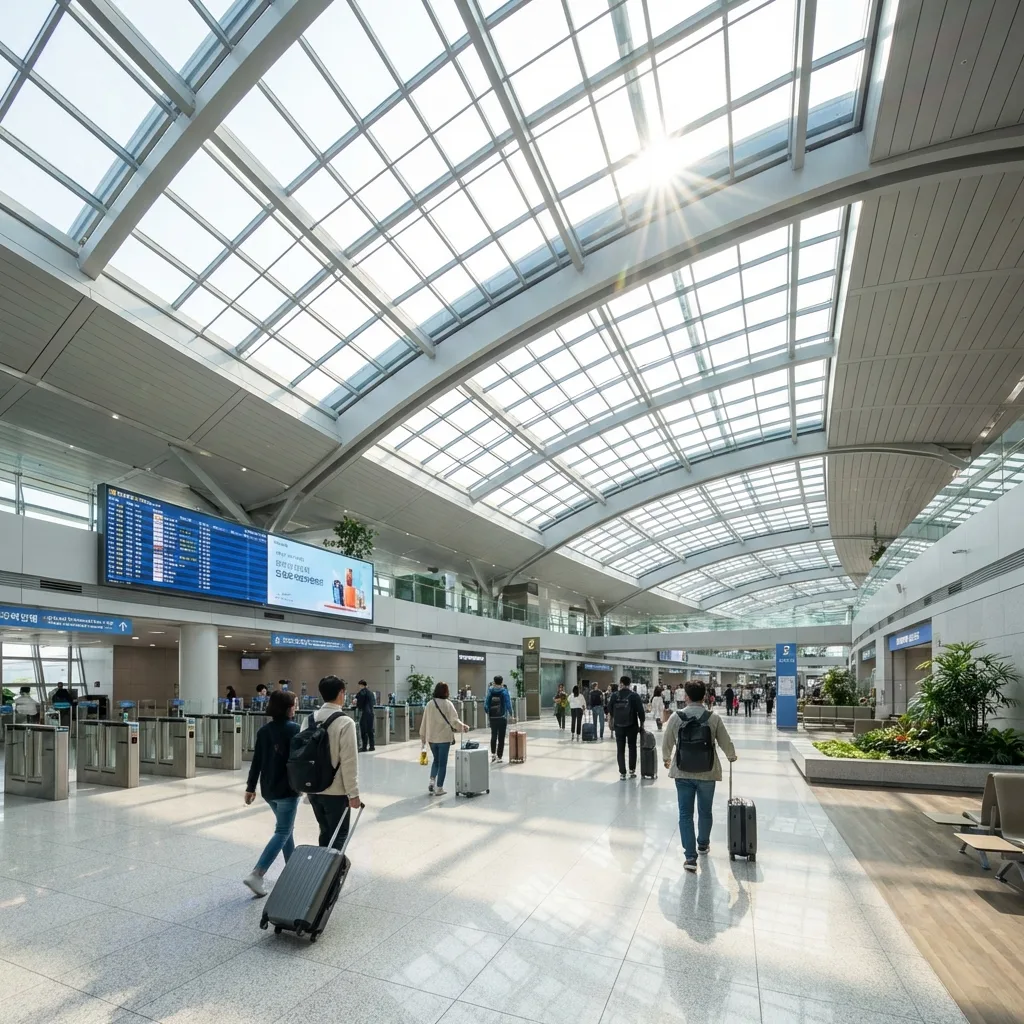
Incheon International Airport (ICN) is consistently voted one of the best airports in the world. It is clean, efficient, and massive. However, "massive" also means it can be overwhelming.
Your goal is simple: Get from the airplane seat to your hotel bed as fast as possible. If you follow the signs blindly, it might take 2.5 hours. If you follow this guide, you can do it in 90 minutes.
Here is your step-by-step arrival strategy for 2025.
1. Speed Through Immigration (The "Smart Pass" Hack)
The longest line you will face is immigration. But you can skip the queue.
The "Smart Pass" (Mandatory for Speed)
Incheon Airport introduced the Smart Pass system. It uses facial recognition to let you use the "Express Lane" (autozones) for departure and arrival.
- Action: Download the "ICN SmartPass" app before you fly.
- Register: Scan your passport NFC and take a selfie.
- Result: Look for the designated Smart Pass lane. (Note: Foreigners can use it for departure, but arrival availability varies by nationality/visa. Check the app for the latest "Arrival" support).
Q-Code & e-Arrival Card
- Q-Code (Health): As of late 2025, this is optional for most countries. Check if your departure country is on the "Watch List." If yes, get the QR code.
- e-Arrival Card: You used to fill out a yellow paper card. Now, you can submit the Korea e-Arrival Card online before you board. It saves you from scrambling for a pen on the plane.
2. The Arrival Hall Checklist
Once you pass customs (Green lane = nothing to declare), you enter the Arrivals Hall (1F). Do not rush to the train yet. You need three things:
Before You Even Get to Customs: The Baggage Belt
After clearing immigration, follow the signs to the Baggage Claim area. The belt number for your flight is displayed on the large overhead monitors. Look for your flight number — do not assume. At Incheon, the baggage claim area is enormous and the correct belt can be a 3-minute walk from the immigration booths.
Average wait times are reasonable: most bags appear within 20–35 minutes of landing. However, if you are on a large wide-body aircraft (A380 or 777) arriving during peak morning hours (07:00–10:00), add another 10–15 minutes. Use this time productively — fill out any remaining paperwork or get the e-Arrival Card submitted if you have not done so already.
Pro tip: Identify your bag clearly. A bright luggage tag or a strip of colored ribbon on the handle saves you from the dreaded "identical black suitcase" situation. Korean travelers are generally meticulous, so an unclaimed bag will not be tampered with, but mistaken pickups do happen.
The Customs Declaration Process
Korea operates a straightforward two-channel customs system:
- Red Lane (Declaration Required): Use this if you are carrying goods exceeding the duty-free allowance (USD 800 equivalent), more than 1 liter of alcohol, more than 200 cigarettes, or cash/negotiable instruments exceeding USD 10,000.
- Green Lane (Nothing to Declare): The fast lane. The vast majority of tourists use this. Walk through confidently.
Customs officers do conduct random checks in the green lane, so do not treat it as completely hands-off. Have your passport accessible. If you purchased duty-free items on the way in, those count toward your USD 800 allowance, not separately.
Collecting Your Duty-Free Purchases
This trips up a surprising number of first-time visitors. If you bought items at the in-flight duty-free shop or ordered from the Incheon Airport duty-free counters before your departure, you pick them up after you clear immigration and customs — not before.
Look for the Duty-Free Collection Counters in the arrivals area, located near Exits 6 and 9 in Terminal 1 and near Exit 5 in Terminal 2. You will need your passport and your duty-free receipt. Collection counters typically operate from 07:00 to 22:00. If you land outside these hours, some counters remain staffed — check signage.
The Three Things You Must Get
- Connectivity (SIM/WiFi):
- Go to the counter you pre-booked with (SKT, KT, LGU+). They are usually near Exit 10 or Exit 6.
- Tip: If you have an eSIM, you can skip this step and walk straight out!
- Cash (Won):
- Find a Global ATM. Withdraw about 50,000 KRW (~$40). You need this for the T-Money card.
- T-Money Card:
- Go to the CU or GS25 convenience store inside the terminal.
- Buy a card (4,000 KRW) and load 20,000 KRW on it.
2.5. Terminal 1 vs Terminal 2: The Crucial Difference
Here is the mistake that adds 40 minutes to more people's arrivals than any other single error. Incheon has two separate terminals, and they are not next to each other.
If you walk out of arrivals and spend 20 minutes looking for a bus stop or train station that does not seem to match what you read online, there is a good chance you are at the wrong terminal.
Which Airlines Use Which Terminal?
Terminal 1 (T1) handles the majority of international carriers, including:
- All Star Alliance members (United, Lufthansa, Singapore Airlines, etc.)
- SkyTeam carriers (Air France, KLM, Delta, etc.)
- Most low-cost carriers (Air Asia, Jeju Air, Jin Air, etc.)
- British Airways, Cathay Pacific, Emirates, and most Middle Eastern carriers
Terminal 2 (T2) is primarily a Korean Air hub and handles:
- Korean Air and all SkyTeam partners when Korean Air is the operating carrier
- Delta (codeshares on Korean Air flights)
- Air France and KLM (on certain routes operated by or through Korean Air)
- Garuda Indonesia
The rule of thumb: If your ticket was issued by or operated on Korean Air metal, you are almost certainly at Terminal 2. If you are unsure, check your boarding pass — the terminal is usually printed on it, or check the Incheon Airport website before you fly.
The Free Shuttle Train Between Terminals
If you land at the wrong terminal for your onward transport needs — or if you need to get to the correct AREX station — the Incheon Airport Shuttle Train runs between T1 and T2 and is completely free.
- Journey time: approximately 18 minutes
- Frequency: every 5–8 minutes during peak hours, every 12 minutes overnight
- Location: Follow signs to "Transportation Center" on the basement level (B1) of either terminal
- Operating hours: 05:00 to 23:30 approximately (last shuttle varies by season)
Do not confuse this shuttle train with the AREX — they are different systems running on different tracks. The shuttle is free and stays within the airport complex. The AREX costs money and takes you into Seoul.
Where Each Terminal's AREX Station Is Located
Both terminals have their own AREX station:
- T1 AREX Station: B1 level, follow signs to "Transportation Center." This is the older station and has been operational since 2007.
- T2 AREX Station: Also B1 level, integrated into the terminal building. The T2 station is newer (opened 2018) and slightly more streamlined.
If you land at T2 but want the limousine bus routes that originate from T1, take the free shuttle first. Same logic applies in reverse. Plan this into your 90-minute target accordingly — the shuttle adds about 25 minutes including wait time.
3. The Great Debate: AREX Train vs. Limousine Bus
Now, how do you get to Seoul?
Option A: AREX Express Train (The Speedster)
- Best for: Solos, Couples, Staying near Seoul Station or Hongdae.
- Pros: No traffic jams. Guaranteed 43 minutes to Seoul Station. Cheaper (approx 11,000 KRW).
- Cons: The Stairs. Seoul subway stations have many stairs. Dragging a 20kg suitcase is a workout.
- Ticket: Buy at the orange kiosks in B1 floor.
Option B: Airport Limousine Bus (The Comfort King)
- Best for: Families, Heavy Packers, Staying in Gangnam or Myeongdong.
- Pros: The driver loads your luggage. You sit in a reclining leather seat. It drops you right in front of major hotels.
- Cons: Expensive (17,000 ~ 18,000 KRW). Traffic can delay you (60-90 mins).
- Ticket: Ticket booth outside (or pay with T-Money on the bus).
3.5. The KTX Option: Going Beyond Seoul
Most airport guides stop at Seoul. But a significant number of visitors to Korea are not actually heading to Seoul at all — they are heading to Busan, Daegu, Daejeon, or another city on the KTX high-speed rail network. If that is you, this section is worth reading carefully before you buy your AREX ticket.
How It Works: AREX to Seoul Station, Then KTX
The AREX Express Train terminates at Seoul Station, which is also the main KTX hub for southbound routes. This is the key transfer point. The AREX and KTX stations at Seoul Station are connected, but they are on different levels — plan about 10–15 minutes to transfer between platforms, collect your luggage, and reach the KTX boarding area.
The critical strategic point: you cannot just show up and hope for a KTX seat. KTX trains between Seoul and Busan fill up fast, especially on weekends and public holidays. Book your KTX ticket in advance through KORAIL's website or app, or at the ticketing counters at Seoul Station.
Approximate Times and Costs from Incheon Airport
| Destination | Total Journey Time | Approximate Cost |
|---|---|---|
| Busan (Suseo or Seoul Station KTX) | ~3.5–4 hours | 68,000–90,000 KRW |
| Daegu | ~2.5–3 hours | 50,000–65,000 KRW |
| Daejeon | ~1.5–2 hours | 35,000–45,000 KRW |
| Gwangju (via KTX-Honam) | ~3–3.5 hours | 55,000–70,000 KRW |
These figures include the AREX leg from Incheon to Seoul Station (~11,000 KRW) plus the KTX fare. Prices vary by class (standard vs. first-class) and how far in advance you book.
The Direct Bus Alternative for Busan
For Busan specifically, there is an Express Bus option directly from Incheon Airport that some travelers prefer. It takes longer (4.5–5 hours, subject to traffic) but drops you closer to downtown Busan without requiring a transfer. Departure is from the first floor bus terminal of both T1 and T2. Cost is roughly 30,000–35,000 KRW. If you are arriving on a clear weekday morning, this can be a reasonable option. On a Friday afternoon in summer? Take the KTX.
4. Avoiding Taxi Scams
If you take a taxi, follow these rules:
- Go to the Official Taxi Stand: Do not follow touts inside the terminal ("Taxi sir?").
- Colors Matter:
- Orange/Silver: Standard metered taxi.
- Black: "Model" (Deluxe) taxi. More expensive, better service.
- "International Taxi" (Orange with sign): Flat rates available, driver speaks English.
- Uber: You can use the generic Uber app to call a taxi to the specific pickup zone (usually slightly away from the main taxi line).
4.5. Luggage Storage & First Day Strategies
Landing at 07:00 with a check-in time of 15:00 is one of the most common and most frustrating scenarios in travel. You have eight hours, a city full of things to see, and a 20kg suitcase chained to your leg. Here is how to handle it like a professional.
Airport Luggage Storage
Incheon offers staffed Left Luggage counters and self-service lockers at both terminals.
- Location in T1: 1F Arrivals Hall, near Exits 4 and 9. Additional lockers in B1 near the AREX station.
- Location in T2: 1F Arrivals Hall, near Exit 3 and Exit 6.
- Staffed storage hours: Generally 07:00–22:00, with some counters open 24 hours at T1.
- Cost (staffed): Approximately 4,000–6,000 KRW per bag per day depending on size.
- Cost (lockers): Small locker ~3,000 KRW/4 hours; large locker ~5,000 KRW/4 hours.
For multiple bags or large suitcases, the staffed counter is the better value. Do not try to cram a 28-inch suitcase into a small locker — it will not end well and you will have wasted the locker fee.
Luggage Delivery Services: The Civilized Option
Several services allow you to send your luggage directly from the airport to your hotel, arriving the same day (usually by 18:00–20:00 if you drop off by 10:00).
- KoreaDC and Airport Luggage Delivery counters are located in the arrivals area of both terminals.
- Cost is typically 15,000–25,000 KRW per bag depending on size and destination district within Seoul.
- This is genuinely one of the best travel investments in Korea. You walk out of the airport with nothing but a daypack, explore freely, and find your bags waiting at the hotel when you check in.
The delivery service works best if you have pre-booked accommodation and the hotel is comfortable receiving luggage before guest arrival (most mid-range and upscale hotels in Seoul are — confirm with a quick email before you fly).
A Smart First Day Strategy
If your hotel check-in is in the afternoon, here is a recommended approach:
- Drop bags at luggage delivery or airport storage (10 minutes).
- Take the AREX to Seoul Station or Hongdae.
- Eat a proper meal — the airport food is good but overpriced for what it is, and Seoul has extraordinary cheap food the moment you exit the station.
- Walk, explore, visit a café in a neighborhood you want to see.
- Head to your hotel area around 14:30, pick up your bags from the hotel lobby (if you used delivery), and check in at 15:00.
This is infinitely better than sitting in the airport lobby for six hours guarding your luggage while watching departure boards.
5. Late Night Arrivals (12 AM - 5 AM)
If you land after midnight, the trains stop.
- Night Bus: Look for N6000 (to Gangnam) or N6001 (to Seoul Station).
- Taxi: Night surcharge applies (20-40% extra).
- Capsule Hotel: Darakhyu (Terminal 1 & 2). Highly recommended if you have a morning connection, but it books out months in advance.
6. What NOT to Do at Incheon Airport
Incheon is an excellent airport. It is also very good at parting you from your money and your time if you are not paying attention. Here are the most common mistakes — consider this section the one that justifies reading the whole guide.
Mistake 1: Exchanging All Your Money at the Airport Currency Counter
The exchange counters in the arrivals hall are convenient. They are also consistently offering rates 5–8% worse than what you will get at a bank in Seoul or from a Global ATM. On a $1,000 exchange, that is $50–80 lost before you have even left the airport.
What to do instead: Withdraw only what you need for the first few hours (50,000–100,000 KRW) from a Global ATM. Exchange the rest at a bank or licensed money changer in Myeongdong or Insadong, where rates are competitive.
Mistake 2: Using Your Home Country's Roaming Plan
Paying $15–20 per day for roaming data when a Korean SIM card costs 15,000–30,000 KRW for 10 days of unlimited data is a math problem with an obvious answer. Do not let inertia or convenience override the calculation.
Korean mobile data is fast, cheap, and works everywhere — including rural areas and underground subway stations where some foreign carriers' roaming drops out entirely.
Mistake 3: Skipping Smart Pass Pre-Registration
The Smart Pass app takes about 8 minutes to set up at home. Not setting it up means you stand in the regular immigration queue, which during peak hours (especially summer and Chuseok holidays) can stretch to 45–60 minutes. Pre-registration is the single highest-leverage action you can take before flying to Korea.
Mistake 4: Not Knowing Your Terminal Before You Arrive
Covered in detail above, but worth repeating as a mistake in its own right: confirm your terminal from your boarding pass before you land. Do not assume. The free shuttle between T1 and T2 exists precisely because this is a common problem, but using it costs you 25–30 minutes you did not plan for.
Mistake 5: Buying AREX Tickets Without Checking for Discounts
The AREX Express Train has a full-price ticket (approximately 11,000 KRW to Seoul Station), but there are legitimate discounts available:
- Round-trip discount: Buy both legs at once and save about 10%.
- Korail Pass holders: Pass holders can use the AREX at a reduced rate or included fare depending on pass type.
- Credit card promotions: Some Korean bank cards and certain international Visa/Mastercard promotions offer discounts on AREX. Check the kiosk screen before paying.
Mistake 6: Assuming the Limousine Bus Has Frequent Departures
Airport limousine buses to major hotel zones in Seoul run roughly every 20–30 minutes, not every 5 minutes. If you just missed a bus, you are waiting 20–30 minutes at an outdoor bus stop, often in heat, humidity, or rain. Check the departure board before committing to the bus over the AREX.
Mistake 7: Forgetting to Confirm the Hotel's Luggage Acceptance Policy Before Using Delivery
If you opt for the luggage delivery service (which is recommended), the service requires a confirmed destination address and assumes someone can accept the bags. Budget guesthouses and capsule hotels sometimes do not have reception staff on duty to accept deliveries. Confirm via email or phone before you pay for the delivery service — not after.
Final Summary
- Download Smart Pass App.
- Submit e-Arrival Card online.
- Pick AREX (Speed) or Bus (Comfort).
With your transportation from the airport sorted, your next step is mastering the T-Money Card for city-wide travel and deciding between a SIM Card or Pocket WiFi for constant connectivity. If you're heading straight to the biocities, check our KTX Booking Guide to secure your seat, or see how to fit it all into our Ultimate 10-Day South Korea Itinerary.