Mastering the T-Money Card: Your Key to Korea's Transit (and More)

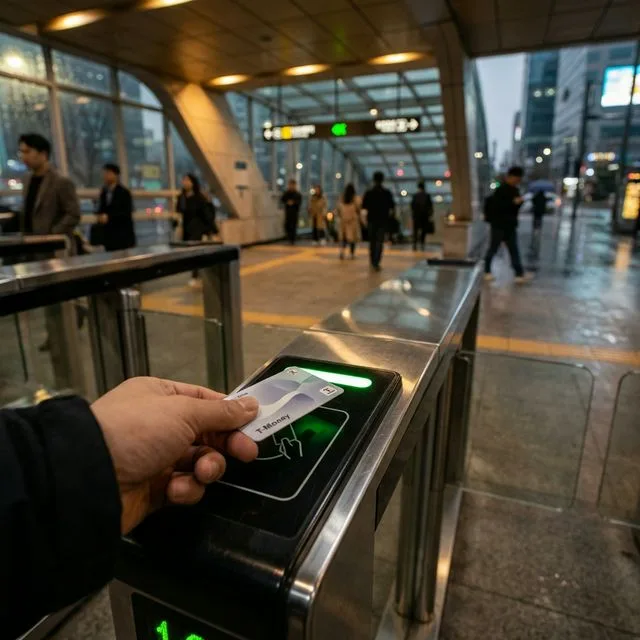
If you try to buy a single-journey subway ticket every time you ride, you will go insane. You will stand in line. You will fumble for coins. You will pay a deposit. You will have to return the card to get your deposit back.
Do not do this.
Instead, buy a T-Money Card. It's like the Oyster Card in London or the Octopus Card in Hong Kong, but better. It works on subways, buses, taxis, and you can even use it to buy banana milk at CU.
Here is everything you need to know about the most important piece of plastic in your wallet.
1. What is a T-Money Card?
It is a rechargeable smart card used for:
- Transport: Subway (Nationwide), Bus (Nationwide), Taxi.
- Shopping: Convenience stores (GS25, CU, 7-Eleven), Vending machines, Lockers, Public phones (if you can find one).
Why you need it:
- Cheaper: Fares are slightly discounted compared to cash/single tickets.
- Transfers: You get free transfers between subway and bus (within 30 mins). You cannot get this discount with cash.
The T-Money Ecosystem: How Big Is It?
Here is a number that should settle any remaining debate: T-Money is accepted across 16 cities throughout South Korea. We are talking Seoul, Busan, Daegu, Incheon, Gwangju, Daejeon, Ulsan, and the surrounding provinces — essentially everywhere you are likely to go as a traveler.
The scope of the network is genuinely impressive:
- Intercity buses: Many express bus routes between cities accept T-Money at the terminal gates.
- KTX high-speed trains: You can use T-Money to purchase tickets at station vending machines (though it does not work as your actual boarding pass on the train itself — you still get a printed ticket).
- 50,000+ convenience stores: If there is a GS25, CU, 7-Eleven, or Emart24 in your sightline, you can pay with your card.
- Seoul Bike (따릉이): The city's public bike-sharing network uses T-Money for ride payments. Rent a bike to ride along the Han River? Tap your card.
- Parking lots: Many municipal and privately operated parking garages accept T-Money at exit gates.
- Hiking trail vending machines: Yes, this is real. You are halfway up Bukhansan, you need a sports drink, and there is a vending machine that accepts your transit card. Korea thought of everything.
For comparison: most transit cards in other countries work on trains, buses, and maybe a few shops. T-Money is woven into the fabric of daily life in a way that will make you wish your home city had something equivalent. It is not an exaggeration to call it the most practically useful card in your wallet while you are in Korea.
2. Buying Your Card: Where & How Much?
You don't need to go to a special office. They are everywhere.
Locations
- Incheon Airport: Arrival Hall vending machines or the convenience store (CU/GS25).
- Convenience Stores: Any GS25, CU, 7-Eleven, Emart24 nationwide.
- Subway Stations: Vending machines near the gates.
Cost
- Standard Card: 2,500 KRW (~$2.00). This is just for the card itself (balance is 0).
- Character Cards: 4,000 - 5,000 KRW. Want a card with a Kakao Friend or BTS member on it? It costs a bit more but works the same.
T-Money Card Varieties: Which Should You Buy?
Not all T-Money cards are created equal — or rather, they all work equally, but some are considerably more fun to carry. Here is a breakdown of your options:
The Standard White Card The utilitarian choice. Plain design, 2,500 KRW, gets the job done. If you are the type of person who immediately puts a case on your phone and never thinks about it again, this is your card.
Character Collaboration Cards Korea's love of IP licensing has produced an enormous range of collectible T-Money cards. At any given time you will find cards featuring Kakao Friends (Ryan the lion is perpetually popular), BTS members, Hello Kitty, and whatever K-drama is currently dominating the cultural conversation. These cost 4,000–5,000 KRW and function identically to the standard card. Many travelers buy one as a souvenir that also pulls double duty as their transit card — which is genuinely clever, because you are going to carry it for the whole trip anyway.
Wearable T-Money Products This is where things get interesting. T-Money technology has been embedded into:
- Wristbands: Useful for theme parks and days when you don't want to carry a wallet.
- Rings: A slim NFC ring that you tap against the reader like a contactless payment. The look on the turnstile attendant's face when you tap your ring and walk through is priceless.
- Phone Stickers: A thin adhesive sticker you attach to the back of your phone. Works exactly like a physical card. Tap your phone against the reader. This is the option I'd recommend for people who already use their phone for everything — one less thing to fish out of your pocket at the turnstile.
T-Money Pay (App) For Android phones with NFC, there is a T-Money Pay app that turns your phone into a virtual T-Money card. You load it via the app, you tap your phone, done. This is genuinely convenient. The critical caveat: it is not compatible with most foreign iPhones (Apple's NFC restrictions and regional app availability make this unreliable for non-Korean Apple devices). If you have an Android phone, check compatibility before your trip. If you have an iPhone, get a physical card or the sticker.
Checking Your Balance
This is worth knowing before you learn it the hard way — specifically, the way where the turnstile blocks you while fifty people queue up behind you.
Option 1: Tap at any transit gate. The display screen shows your remaining balance for about two seconds after you tap. Make a habit of glancing at it.
Option 2: Ask a convenience store cashier. Hand them the card and mime a questioning expression. They will scan it and tell you. This works even without language — you can just say "balance?" and they will understand.
Option 3: The T-Money app. Download the T-Money app (available on both Android and iOS, though the iOS version is more limited), hold your card near your phone's NFC reader, and it will display your current balance and recent transaction history.
The practical rule: check your balance every morning before leaving your accommodation, and top up if you are below 5,000 KRW. Running out mid-journey is not a catastrophe, but figuring out where the nearest convenience store is while standing on a bus is annoying.
3. The Golden Rule: Charging (Cash Only!)
This is where 90% of tourists get stuck.
You CANNOT charge a T-Money card with a credit card at most machines. Ticket machines in subway stations only accept Korean Won (Cash).
How to Charge
- Subway Machines:
- Place card on the "Reload" pad.
- Select amount (e.g., 10,000 KRW).
- Insert cash.
- Wait for the beep.
- Convenience Stores:
- Hand card to cashier.
- Say: "Man-won (10,000) chung-jeon hae-ju-se-yo" (Please charge 10,000 won).
- Give them cash.
Note: Some very new machines accept cards, but don't count on it. Always keep 10,000 KRW notes handy.
How Much to Load: A Daily Budget Guide
One of the most common questions from first-time Korea travelers is how much to put on the card. Here are the actual numbers:
| Fare Type | Average Cost (Seoul) |
|---|---|
| Single subway ride | 1,400 – 1,700 KRW |
| Single bus ride | 1,300 – 1,500 KRW |
| Taxi (short trip, 2–3 km) | 4,000 – 6,000 KRW |
| Airport Railroad (AREX, Seoul Station) | 9,500 KRW |
What this means for loading amounts:
A typical tourist day in Seoul involves 4–6 transit trips (subway to a neighbourhood, bus to a specific street, subway back, bus to dinner, etc.). That works out to roughly 6,000–9,000 KRW per day in transit costs if you are doing things efficiently with transfers.
- 2–3 day trip: Load 20,000 KRW. This covers your transit comfortably with a small buffer for convenience store purchases.
- 5–7 day trip: Start with 30,000 KRW and top up once mid-trip. Do not load 50,000 KRW upfront — if you lose the card, that balance is gone.
- Day trips from Seoul: If you are taking the AREX to Incheon Airport and heading to Busan on KTX, budget separately for those. The AREX alone is 9,500 KRW each way from Seoul Station.
The psychological trick that works: think of 10,000 KRW notes as "transit top-up units." Each 10,000 KRW note is roughly 6–7 transit trips in Seoul. Load accordingly.
The Cash Withdrawal Strategy
Since charging T-Money requires cash, and cash requires ATMs, you need a plan. The good news: Korea has ATMs everywhere. The bad news: not all of them accept foreign cards.
Where foreign cards reliably work:
- Global ATMs inside subway stations (look for the blue "Global ATM" sign — these are specifically set up for foreign cards).
- ATMs inside convenience stores (GS25, CU, 7-Eleven all have ATMs — the 7-Eleven machines in particular have an excellent reputation for accepting foreign Visa and Mastercard).
- KEB Hana Bank and Woori Bank ATMs in tourist-heavy areas.
The optimal arrival strategy:
- At Incheon Airport, withdraw 50,000–100,000 KRW from the Global ATMs in the arrivals hall (they have some of the best foreign card compatibility in the country).
- Immediately buy your T-Money card at the CU or GS25 and load 20,000–30,000 KRW onto it.
- Keep your remaining cash in small denominations — specifically 5,000 and 10,000 KRW notes. These are your top-up units and your street food currency. Vending machines and some older convenience store T-Money reload machines struggle with 50,000 KRW notes.
This approach means you arrive in Korea with cash in hand, a charged transit card, and no dependency on finding a working ATM while you're tired and jet-lagged.
4. Navigating Like a Pro: Tap On, Tap Off
Using the card is simple, but there is one rule you must follow.
The Procedure
- Subway: Tap at the turnstile entering. Tap at the turnstile leaving.
- Bus: Tap when you enter (front door). Tap when you exit (back door).
Why Tap Off on Buses?
If you forget to tap off when you leave the bus, the system doesn't know how far you traveled. The Penalty: You will be charged the maximum possible fare (or double fare) the next time you tap. Always tap off, even if the "Transfer" voice doesn't say anything.
The "Hwan-seung" (Transfer)
If you transfer from Subway line 2 to a Blue Bus within 30 minutes, you will hear "Hwan-seung im-ni-da" (Transfer). Cost: 0 KRW (or a small difference fee). This saves you tons of money.
The Transfer Window in Detail
The transfer system is one of T-Money's greatest gifts to your budget, and it has more nuance than the basic "30 minutes" rule suggests. Here is the complete picture:
Standard transfer windows:
- Subway to bus, or bus to subway: 30 minutes
- Bus to bus: 30 minutes
- These apply on weekdays and weekends alike
Extended transfer windows (this is where it gets good):
- Between 9 PM and midnight: The window extends to 60 minutes. This accounts for the fact that late-night buses run less frequently.
- After midnight (night owl buses): Also 60 minutes. Late-night routes (N-buses) cost more than daytime buses, but the transfer discount still applies.
The single most important detail that nobody tells you:
The transfer clock starts ticking from the moment you tap OFF, not from when you tap on. Read that again.
If your subway journey takes 25 minutes — say, from Hongdae to City Hall — and you tap off at City Hall station, you now have 5 minutes to find your connecting bus and tap on. Not 30 minutes total from when you started. Five minutes from when you exited.
In practice: check your onward bus connection on Naver Maps before you board the subway. If the transfer timing is going to be tight, take an earlier subway train or accept that you will pay a second fare. Sprinting through a subway station while checking your phone is a fast track to a bad day.
Multi-leg journeys: You can transfer multiple times within a single journey, as long as each transfer happens within the window. A subway + bus + bus combination is common in outer Seoul and is perfectly valid for discounted transfer chains.
Taxi Payment
T-Money works in all official taxis — the standard orange taxis, the black deluxe (모범) taxis, and the international taxis (dark blue, with English-speaking drivers available). This is genuinely useful at the end of a long day when you do not want to deal with cash.
How it works:
- Get in the taxi, give your destination.
- The T-Money reader is typically in the passenger seat area, near the headrest or mounted on the divider.
- When you arrive, the driver will tell you the fare. Tap your card on the reader.
- The display confirms the deduction. Done.
Important exception: Taxi payments do not trigger the transfer discount. Your transit "journey" effectively resets when you take a taxi. If you tap off a bus, take a 10-minute taxi ride, then want to board the subway — that is a new fare at full price regardless of timing. Taxi is a convenience, not a transfer vehicle.
One more practical note: taxis in Korea are metered and regulated. The fare on the meter is the fare you pay. If a driver quotes you a flat fee before starting the meter, get out and find another taxi.
5. Refunds: Leaving Korea
If you have money left on the card at the end of your trip, you can get it back.
- Balance under 20,000 KRW: Go to any convenience store. They will refund the cash on the spot (minus a 500 KRW service fee).
- Balance over 20,000 KRW: Much harder. You have to visit the T-Money HQ.
- Card Cost: The initial 2,500 KRW for the card is non-refundable. Keep it as a souvenir or give it to a friend visiting Korea next.
5b. Lost or Damaged Card
This is the section people skip until they need it desperately. Do not be that person.
If you lose your T-Money card:
The uncomfortable truth: if you have an anonymous standard card (which is what most tourists buy), the balance is not recoverable. The card is not linked to your identity in any way. Whoever finds it can use the remaining balance, or it sits in a lost-and-found forever. This is one of the few genuine downsides of the T-Money system.
This is why the loading strategy matters:
- Never put more than 20,000–30,000 KRW on the card at once.
- Think of it like carrying cash: only carry what you need for the day or two ahead.
If you are a long-term visitor: T-Money offers card registration on their website (tmoney.co.kr), which links your card to your identity and theoretically allows balance recovery if lost. This requires a Korean phone number and some patience with the Korean-language interface. For a short-term tourist, it is not worth the setup time.
If your card is damaged:
Physical damage — cracked card, bent, water-soaked — is more recoverable than loss. Take your damaged card to any convenience store. The cashier can often scan the chip with a dedicated reader and transfer the remaining balance to a new card. This works more often than you'd expect, even with visibly damaged cards. Success depends on whether the chip survived, so do not run it through a washing machine and expect miracles.
If your card stops working at turnstiles:
Sometimes cards demagnetize or develop minor faults. First step: try a different turnstile or a different subway station — occasionally the reader is the problem, not the card. If multiple readers consistently reject it, the card itself is faulty. Take it to a convenience store for the balance transfer process described above.
6. T-Money vs. Climate Card (2025 Update)
Seoul recently launched the Climate Card (Gihoo-donghaeng Card).
- What it is: Unlimited transit pass for Seoul.
- Tourist Passes: 1-Day (5k), 3-Day (10k), etc.
- Who is it for? If you plan to ride the subway/bus more than 3-4 times a day, get the Climate Card.
- Limitation: It only works in Seoul. If you go to Busan or take the Airport Railroad Express (AREX), you still need T-Money.
My Verdict: Buy a T-Money card. It's the universal key to Korea. If you stay in Seoul and move a lot, buy a Climate Card pass later, but T-Money is essential for airport travel and convenience stores.
The Full Comparison: Every Card Worth Knowing
Korea now has a surprisingly rich ecosystem of transit payment options. Here is the complete picture so you can make an informed decision instead of panic-buying the wrong pass at the airport.
Once the card is in your wallet, the next step is knowing where to use it. For the full system overview, read the complete guide to public transportation in South Korea. If you are deciding between passes rather than just learning T-Money, compare them directly in K-Pass vs. Climate Card vs. T-Money. For airport arrivals, pair this with the Incheon Airport arrival guide, and for city navigation after check-in, continue with the Seoul subway and bus guide.
| Card | Cost | Coverage | Transfer Discount | Best For |
|---|---|---|---|---|
| T-Money | 2,500 KRW + balance | Nationwide | Yes | Everyone, always |
| Climate Card (Tourist) | 5k–15k KRW flat | Seoul only | Unlimited within Seoul | Seoul-heavy stays, 4+ rides/day |
| Discover Seoul Pass | 30k–90k KRW | Seoul transit + attractions | Yes (transit) | Museum-heavy itineraries |
| Korea Tour Card | ~4,000 KRW + balance | Nationwide | Yes | Tourists wanting minor perks |
| K-Pass | Korean bank account required | Nationwide | 20–53% cashback | Korean residents only |
Climate Card (기후동행카드)
Seoul's unlimited transit pass is genuinely excellent value for the right traveler. A 30-day card is available for residents, but the tourist versions come in 1-day (5,000 KRW), 3-day (10,000 KRW), and 7-day (variable) options. If you are spending a full week in Seoul and taking 5–6 rides a day — which is easy to do if you're bouncing between Hongdae, Insadong, Myeongdong, and the Han River parks — the unlimited pass pays for itself quickly.
The hard limitation bears repeating: it does not work on the AREX express train to/from Incheon Airport. You will still pay 9,500 KRW each way on AREX with a separate T-Money tap. If you are arriving and departing through Incheon, budget for this separately.
Discover Seoul Pass / Korea Tour Card
These are prepaid tourist cards that bundle transit access with free or discounted entry to attractions (Gyeongbokgung Palace, Lotte World, various museum entry, etc.). They make sense if your itinerary is packed with paid attractions that are included in the pass. Run the math: add up the normal entry fees for every included attraction you actually plan to visit. If the total exceeds the pass cost, buy the pass. If you are spending most of your time wandering neighbourhoods and eating, they are probably not worth it.
K-Pass (K-패스)
This is Korea's newest national transit card, designed for frequent commuters and residents. It gives 20–53% cashback on monthly transit spending, scaled by how much you spend. The cashback tiers are generous — students and low-income users get the highest rates. The catch: it requires a Korean bank account to receive the cashback, which means it is effectively unavailable to tourists. It is worth mentioning because you will see it advertised in subway stations and might wonder what it is. The answer: not for you, unless you live there.
The Clear Decision Guide
Stop overthinking it. Here is the flowchart:
Arriving at Incheon Airport for a trip anywhere in Korea: Get T-Money first. Always. Non-negotiable.
Spending 1 day in Seoul: Get a 1-Day Climate Card tourist pass (5,000 KRW) plus a T-Money card for the airport trip. Use Climate Card for everything in Seoul, T-Money for AREX.
Spending 3–5 days almost entirely in Seoul, heavy transit use (5+ rides/day): Get a 3-Day Climate Card. Also carry T-Money for airport, convenience stores, and taxi payments.
Spending 7+ days traveling across multiple Korean cities: T-Money is your primary card. Period. Busan's subway, Gyeongju's buses, Jeju's taxis — T-Money covers all of it. Do not complicate your trip with multiple cards.
Living in Korea for more than a month: Look into K-Pass after opening a Korean bank account. It will save you meaningful money on commuting costs over time.
The through-line in every scenario: you need T-Money. It is the one card that works everywhere, does everything, and costs less than a cup of coffee. Every other card is an addition to your wallet, not a replacement.
Final Thoughts
The T-Money card is more than a ticket; it's your lifeline. It buys your water when you're thirsty, gets you to your hotel, and pays for your taxi when you're tired. Put it in your phone case (or use the sticker version). Don't lose it!
With your transit card ready, make sure you also have the digital tools to match: download the 5 Hidden Gem Apps for Korea and learn how to get the best Currency Exchange rates to stay within budget. For those planning a coastal escape, check out our Summer Beach Guide, or start mapping out your entire trip with our Ultimate 10-Day South Korea Itinerary.