Getting Around Tokyo: Trains, IC Cards & Navigation Apps

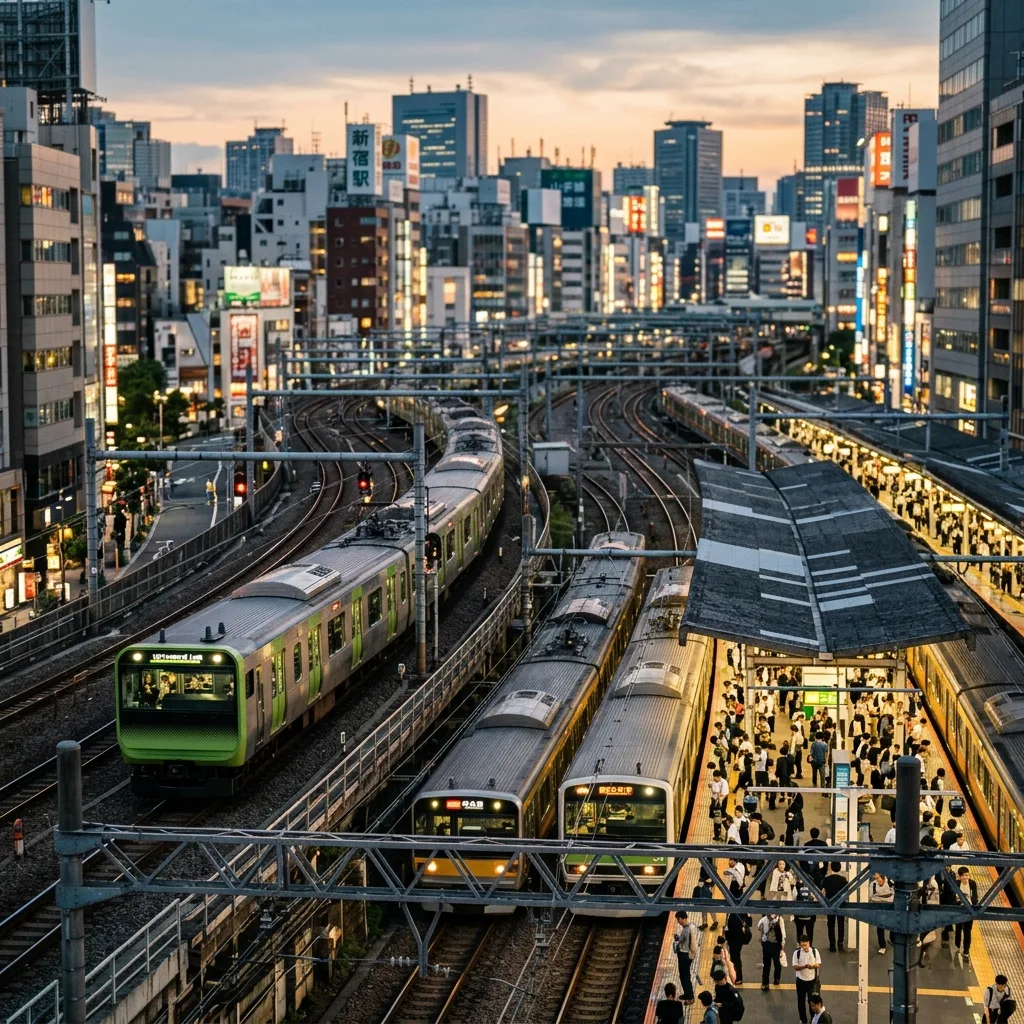
Tokyo has one of the most extensive, punctual, and (at first glance) intimidating public transit systems on the planet. Hundreds of lines, thousands of stations, multiple competing operators — yet once you understand the core logic of how it all fits together, you'll be gliding across the city with the same ease as a local. The trick is knowing which card to carry, which app to open, and how to stop overthinking the fare map.
Whether you're sprinting between Shibuya and Akihabara or making a slow morning run to Harajuku, Tokyo's trains will get you there in minutes. This guide covers everything you need: the IC card system, how to read fares, the best day passes, and the navigation apps that actually work in Japan's notoriously complex network.
Understanding Tokyo's Train Network
Tokyo's transit system is a layered puzzle of operators, lines, and fare zones that confuses even return visitors. Once you understand the structure, it clicks immediately.
At the broadest level, trains in Tokyo are run by three major groups: JR East (Japan Railways), Tokyo Metro, and Toei (Tokyo Metropolitan Government). All three operate within the city, their lines often running parallel or intersecting at major hubs. You may start a journey on JR East at Shinjuku, transfer to Tokyo Metro at Otemachi, and finish on a Toei line in Asakusa — and your IC card handles the entire ride without you thinking about it.
JR East and the Yamanote Line
For first-time visitors, the JR Yamanote Line is the backbone of Tokyo travel. This green loop line circles the city's core, connecting every major neighborhood: Shinjuku, Shibuya, Harajuku, Harajuku, Ikebukuro, Akihabara, Ueno, and Tokyo Station. It runs approximately every 2–4 minutes during peak hours and takes about 65 minutes to complete the full loop.
In March 2026, JR East raised fares for the first time since the company's founding in 1987. The new starting fare for the Yamanote Line and other JR urban routes is ¥160 per IC card ride (up from ¥150). Fares remain distance-based: short hops of 1–3 km start at ¥160, medium distances of 7–10 km cost around ¥180–¥200, and longer rides across the loop can reach ¥280 or more. IC card fares are consistently 5–10 yen cheaper than buying paper tickets.
Tokyo Metro and Toei Subway
The Tokyo Metro network has 9 lines covering most of central Tokyo. The Toei Subway adds 4 more. These two systems are separately operated, which matters for day passes (more on this below). Together they serve virtually every corner of the city not reached by JR.
Base Tokyo Metro fares start at ¥180 for very short rides and scale up based on distance. A cross-city journey from Shibuya to Ueno (around 7 km) costs roughly ¥250–¥280 on the Metro. If you're transferring between Metro and Toei on a single ticket, a combined-fare surcharge applies — using an IC card avoids some of this friction.
IC Cards: Suica and Pasmo
An IC card is a rechargeable contactless smart card that replaces individual paper tickets across virtually every train, subway, bus, and tram in greater Tokyo. Tap in at the turnstile, tap out when you exit, and the exact fare is deducted automatically. No need to calculate the fare or buy a ticket at a machine.
The two IC cards used in Tokyo — Suica (issued by JR East) and Pasmo (issued by the metro operators) — are functionally identical for transit. Both work on JR, Tokyo Metro, Toei, buses, monorail, and most private railways. Both can also be used for convenience store purchases, coin lockers, and vending machines throughout the country.
Which Card Should You Get?
The short answer: it doesn't matter. Pick whichever is more convenient to buy when you arrive.
The longer answer:
- Suica is sold at JR ticket machines in every major JR station. It's also available as a digital card on iPhone or Android via the Suica app — meaning you can set it up before you land.
- Pasmo is sold at Tokyo Metro and Toei station machines, and also has a digital option (Pasmo Passport app).
Both cards are accepted everywhere the other is, and both can be charged at any convenience store (7-Eleven, FamilyMart, Lawson) as well as at ticket machines.
Welcome Suica vs. Regular Suica
For short-stay tourists, there's a dedicated card called the Welcome Suica, available at JR East Travel Service Centers at Narita and Haneda airports. Unlike the regular Suica:
- No ¥500 deposit required — the card costs exactly what you load (typically ¥1,500 starter value)
- Valid for 28 days from the date of purchase
- Cannot be refunded for leftover balance at the end of your trip
If you're staying longer than 28 days, or want to keep the card for future visits, get a standard Suica (¥500 deposit, fully refundable at any JR East window).
Pasmo Passport is the Metro equivalent of the Welcome Suica — no deposit, tourist-friendly, valid for 28 days. It's sold at select Tokyo Metro stations.
How to Buy and Charge an IC Card
- At the airport (Narita or Haneda), look for the JR East Travel Service Center or the IC card vending machines near the train gates.
- On the machine, select your language (English is available), choose "Suica," set your initial charge amount, and pay.
- To recharge: use any ticket machine (look for the "Charge/チャージ" option) or pay cash at the register of any convenience store — hand the cashier your card and the amount you want added.
- Mobile option: Set up Suica or Pasmo via their respective apps. This links to Apple Pay or Google Pay and lets you top up remotely.
Keep your card balance above ¥500 at all times — running out mid-journey is inconvenient but not disastrous. If your balance drops below the minimum required fare at the exit gate, you'll need to use the "Fare Adjustment" machine nearby.
Day Passes and Multi-Day Passes
If you're doing a lot of sightseeing in one day, a flat-rate day pass can easily beat pay-per-ride costs.
Tokyo Metro 24/48/72-Hour Tickets
These passes grant unlimited rides on all Tokyo Metro lines only (not JR or Toei) for the selected time window from first use:
| Pass | Price |
|---|---|
| 24-hour | ¥600 |
| 48-hour | ¥1,000 |
| 72-hour | ¥1,500 |
These are excellent value. A single Metro round-trip costs around ¥500 or more, so the 24-hour pass pays off after 2–3 rides. Available at airport counters, Tokyo Metro station ticket machines, and select convenience stores.
Tokyo Subway Ticket (Metro + Toei Combined)
This pass covers all 13 Metro and Toei lines, unlocking a larger portion of the network:
| Pass | Price |
|---|---|
| 24-hour | ¥900 |
| 48-hour | ¥1,400 |
| 72-hour | ¥1,700 |
Worth it if you'll be hopping between Metro and Toei lines in the same day.
JR Tokyo Wide Pass
For visitors planning day trips to Nikko, Kamakura, or further on JR Shinkansen and limited express trains, JR also offers regional passes. These are better value for excursions outside central Tokyo than for city travel alone.
When to Use a Pass vs. IC Card
Calculate your expected rides before defaulting to a pass. If you're spending a day in one neighborhood — say, exploring Shinjuku and Harajuku, then dinner in Shibuya — you may only make 4–5 rides and come out ahead just paying per ride. If you're bouncing across multiple districts, a pass wins.
Navigation Apps for Getting Around Tokyo
Tokyo's transit complexity is exactly where good apps shine. Three tools are worth having on your phone.
Google Maps
In 2026, Google Maps handles Tokyo's transit better than ever. Enter your destination, tap "Directions," select the train icon, and it will:
- Show multiple route options with total travel time, number of transfers, and total cost
- Display which platform number to use and which car to board for the best exit position
- Update in real time if there's a delay or service disruption
Google Maps works offline for walking directions if you've pre-downloaded the Tokyo map area. Its one limitation: it sometimes defaults to the quickest route rather than the cheapest, and may miss JR Pass–covered options if that's relevant to you.
NAVITIME Japan Travel
Japan Travel by NAVITIME is the app serious Tokyo transit planners use. It handles the full complexity of the network more explicitly than Google Maps, including:
- JR Pass mode (filters to only show routes covered by your pass)
- Timetable lookup for specific trains
- Offline route viewing
- Detailed transfer information including walking distances within stations
NAVITIME is especially useful when Google Maps gives you a confusing result with 3+ transfers. NAVITIME will show you why each route is structured the way it is.
Tokyo Metro App (Tokyo Subway Navigation)
The official Tokyo Metro Subway Map & Route app covers Metro, Toei, and the Yamanote Line. It works fully offline once you download it — crucial when you arrive at a station with weak data signal. Features include:
- Interactive route planner
- Timetables for each line
- Station facilities (elevators, exits, nearby landmarks)
It's less powerful than NAVITIME for complex routes across multiple operators but is rock-solid for pure subway navigation and works without any data connection.
Jorudan (Japan Transit Planner)
A backup option worth knowing: Jorudan provides detailed timetables for every train, bus, and tram across Japan. It's particularly useful when you're trying to catch a specific departure time rather than "the next train." The English interface is clean and reliable.
Practical Tips and Common Mistakes
Avoid paper tickets whenever possible
Ticket machines ask you to select your destination fare before printing a ticket — this requires reading the fare map posted above the machines, which is overwhelming for newcomers. IC cards eliminate this entirely. Always use a Suica or Pasmo.
Watch your card balance at peak times
If your IC card balance drops below the minimum fare, the exit gate will reject you. You'll need to use a "Fare Adjustment" (精算) machine near the exit. It's a mild inconvenience — feed in cash or another card and it prints a ticket that opens the gate. Keep ¥500–¥1,000 buffer on your card at all times.
The last train is real
Tokyo trains stop running between roughly midnight and 5 a.m. The exact last train time varies by line, but if you're out late, check the last departure time before you get too comfortable at the bar. Taxis exist but are expensive — a cross-city cab ride can easily cost ¥3,000–¥5,000.
IC cards at convenience stores
Suica and Pasmo work at virtually every convenience store register in Tokyo (and increasingly across Japan). This is useful for exact-change purchases — swipe the card instead of fumbling for coins.
Transferring between operators
When you take a route that crosses from JR to Metro or Toei, your IC card automatically calculates the combined fare. You do not need to tap out between systems mid-journey as long as you stay within the fare gate. Only tap when you enter and when you finally exit.
Exit numbers matter
Tokyo stations can be enormous. Shinjuku Station has over 50 exits spread across multiple underground levels and street-level openings. Shibuya, Ikebukuro, and Tokyo Station are similarly labyrinthine. When someone gives you directions in Tokyo, they will always specify an exit number (e.g., "Exit B2" or "South Exit"). Pull up your destination in Google Maps before leaving the train and note the recommended exit — it can save 10–15 minutes of aimless wandering above and below ground.
Rush hour is intense — but manageable
Tokyo's rush hours run roughly 7:30–9:30 a.m. and 6:00–8:30 p.m. on weekdays. During these windows, Yamanote Line trains are genuinely packed — staff sometimes push passengers in at major stations. If you can avoid traveling during peak hours with large luggage, do so. Outside rush hour, trains are comfortable and uncrowded throughout most of the day. Mornings on weekends are calm enough that you'll get a seat nearly anywhere.
Frequently Asked Questions
First-Day Transit Mindset
If Tokyo's network feels overwhelming on day one, keep the goal embarrassingly simple: make one successful round trip, then stop thinking of the system as foreign. Pick a hotel, a breakfast spot, and one major sight. Use Google Maps or NAVITIME, watch how the platform signs match the app, and pay attention to the exit number you came out of. That single repetition teaches you more than a thousand route diagrams.
Once that first trip works, the rest of the city becomes pattern recognition. The rail network stops being a maze and starts becoming a habit.
Do I need to buy a separate ticket for JR and the subway? No. Your Suica or Pasmo IC card covers JR, Tokyo Metro, and Toei Subway automatically. The fare is calculated seamlessly at the exit gate regardless of how many operators your route used.
Can I use my IC card outside Tokyo? Yes. Suica and Pasmo are accepted on most transit systems throughout Japan, including Osaka, Kyoto, Hiroshima, and many others. They also work on Shinkansen for IC card–designated local fares (not long-distance bullet train journeys).
What if I run out of money on my IC card inside the station? Use the "Fare Adjustment" (精算) machine near the exits. Insert cash or another payment and it will issue a fare adjustment ticket that opens the gate.
Is the JR Pass worth it for Tokyo alone? Probably not. The JR Pass covers JR lines only (not Metro or Toei), and for city travel within Tokyo, IC card fares are usually cheaper than the pass's daily cost. The JR Pass makes financial sense if you're also traveling between cities — Tokyo to Kyoto, for example.
Are there apps that work without data in the Tokyo subway? Yes. The Tokyo Metro app and NAVITIME both have offline modes once downloaded. Google Maps also works offline for walking directions with a pre-downloaded map. Download before you land or before you go underground.
Conclusion
Getting around Tokyo comes down to three things: get an IC card (Suica or Pasmo, your choice), load ¥2,000–¥3,000 onto it before you start exploring, and open NAVITIME or Google Maps when you need to route a trip. The system is intimidating on paper and intuitive in practice — within a day of arrival, tapping through turnstiles will feel automatic. Most visitors are surprised by how quickly Tokyo transit becomes second nature, even on a first trip to Japan.
For more on planning your time in Tokyo, see the Ultimate Tokyo Travel Guide 2026: Everything First-Timers Need to Know. If you want to understand which neighborhoods to base yourself in, Tokyo Neighborhoods Guide: From Shinjuku to Shimokitazawa covers the trade-offs district by district. And if you're watching your yen, Tokyo on a Budget: Cheap Food, Free Attractions & Affordable Stays shows how far the savings add up when you're riding IC card fares instead of taxis.
Now load your card, pick your exit number, and go.