Hongdae Night Market: Seoul's Youth Culture Food Hub

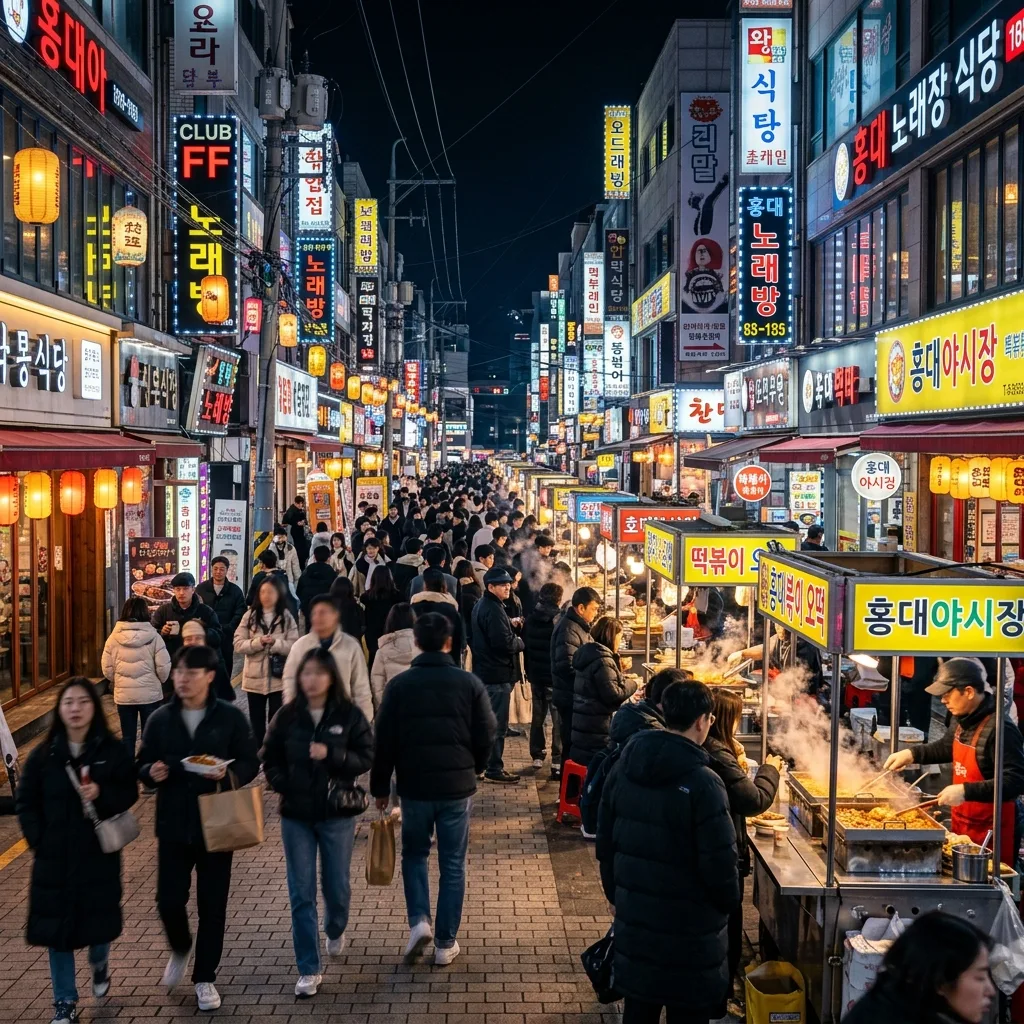
You step out of Hongik University Station onto a street already humming with bass lines and the sizzle of hotteok batter hitting a griddle. By 8 PM on a Saturday, the block between Exit 9 and the playground is a controlled explosion of sound and smell: a dance crew draws a three-deep crowd in Zone 4, a ceramics vendor adjusts her display of earrings two stalls down, and a vendor is stacking tornado potatoes on a stick while a queue of twenty people waits patiently. Hongdae is not Seoul's most photogenic neighborhood — it is its most alive.
Hongdae (홍대) takes its name from Hongik University (홍익대학교), one of South Korea's premier art and design schools. For decades, the area around campus has attracted the kind of creative energy that student rents and loose zoning allow: indie bands, graffiti muralists, underground clubs, and art markets. Today, it has evolved into one of Seoul's most concentrated entertainment districts, drawing domestic day-trippers, K-pop fans, international backpackers, and design-school graduates in equal measure. But unlike the polished commercial spectacle of Myeongdong, Hongdae retains something messier and more interesting — the sense that whoever showed up tonight might actually be making something new.
This guide covers everything you need to make the most of Hongdae's night market and street culture: what the Free Market actually is, where the best food stalls are, how to time your visit for peak busking energy, and the practical logistics of getting there and back.
What Is the Hongdae Night Market?
Hongdae does not have a single official "night market" the way Gwangjang or Dongdaemun do. Instead, it operates as an ecosystem of three overlapping layers: a formal weekend arts market, a daily strip of street food vendors, and a network of busking zones maintained by the local district. Understanding the difference helps you plan your visit correctly.
The Hongdae Free Market (홍대 자유시장) is the cultural anchor — a curated arts-and-crafts market held every Saturday from March through November, roughly noon to 6 PM, in the Hongdae playground area and surrounding streets. It was established in 2002 and is now one of Seoul's longest-running independent markets, where sellers must be the creators of what they sell: no resellers, no mass-produced goods. You will find ceramic mugs, handmade jewelry, illustrated prints, leather goods, hand-bound notebooks, and accessories that genuinely do not exist anywhere else.
The food stall strip runs parallel to the Free Market and operates on a different schedule — it ramps up from late afternoon and peaks between 7 and 10 PM, continuing on a reduced scale past midnight on Fridays and Saturdays. These are not market vendors but permanent or semi-permanent street carts, clustered along the main pedestrian roads around the subway station.
The busking zones are the glue. Hongdae's Red Road (the pedestrian strip) is divided into official performance zones, and these are the stages for everything from solo acoustic guitarists to nine-person K-pop dance covers to fire dancers. No ticket required, no RSVP — just show up.
The Hongdae Free Market: Indie Art You Can Take Home
The Saturday Free Market is what separates Hongdae from every other night-out neighborhood in Seoul. Entry is free. You can browse for thirty minutes or three hours, and the vendors — mostly in their twenties and thirties — are almost always happy to explain what they made and why.
When it runs: Every Saturday, March through November. Hours are approximately 1:00 PM to 6:00 PM, though setup begins around noon and some vendors stay later if foot traffic continues.
What you'll find: The market is divided loosely by medium. Jewelry and accessories dominate the east side of the plaza; ceramics, illustrated goods, and textiles fill the center. Prints and zines occupy a rotating corner near the entrance. Prices are reasonable given that each piece is handmade — expect ₩5,000 to ₩15,000 for small jewelry items, ₩15,000 to ₩40,000 for ceramics, and ₩3,000 to ₩8,000 for prints and postcards.
What makes it different: Unlike the flea markets at Namdaemun or the souvenir rows of Insadong, the Free Market vendors are required to present identification as creators. The result is a market with a real indie aesthetic rather than a curated simulation of one. If you find something you like, there is a reasonable chance the artist is sitting three feet away and will remember making it.
The market coexists with afternoon buskers, so the soundtrack shifts as you browse — an indie duo near the entrance, a contemporary dance performance in the center, a puppeteer drawing a crowd of children at the far end.
Street Food at Hongdae: What to Eat and What to Skip
The food stall scene in Hongdae is less curated than Myeongdong Street Food: What to Eat and Where to Find It but arguably more interesting — you are eating alongside Korean university students rather than tourists, which tends to keep prices and portions honest. Here is what is worth your time.
The Must-Try Stalls
Tornado Potato (회오리 감자): A spiral-cut potato fried on a skewer, dusted with your choice of seasoning — cheese powder, spicy Korean BBQ, sour cream, or original salt. One skewer runs ₩3,000–₩4,000 and is enormous. Eat while walking; they cool down fast.
Hotteok (호떡): The essential Korean street pancake. The Hongdae version tends to be filled with cinnamon brown sugar and crushed peanuts, sealed and pressed on a flat griddle until the outside is dark and crisp. Around ₩1,500 per piece. Find the stalls with the longest queues — the turnover keeps them fresh.
Egg Bread (계란빵): A small, slightly sweet bread bun baked with a whole egg cracked on top, cooked in a mold until the egg is set. Portable, warm, and filling. Around ₩1,500–₩2,000.
Korean Corn Dog (핫도그): Not a fair-food corn dog — these are encased in a rice-batter or ramen-noodle crust, sometimes with a half-dog, half-mozzarella stick inside, finished with sugar and ketchup or mustard. The texture contrast (crunchy coating, molten cheese, salty sausage) is genuinely good. Budget ₩3,000–₩5,000.
Tteokbokki (떡볶이): Chewy rice cakes in gochujang sauce — the defining Korean street snack and a dish with more regional variation than most visitors expect. The Hongdae versions tend toward sweeter, creamier sauces compared to the sharper red of traditional pojangmacha stalls. A small cup costs ₩3,000–₩4,000. For a deeper breakdown of this dish and other Korean street staples, see The Ultimate Korean Street Food Guide: Tteokbokki to Tornado Potato.
Squid Skewers (오징어구이): Grilled whole squid or squid rings on a skewer, brushed with spicy-sweet sauce. A classic Korean street food that tastes better outdoors than in any restaurant. ₩5,000–₩8,000 depending on size.
Sit-Down Options Near the Market
For a proper meal before or after the market, the streets one block off the main pedestrian strip have dense clusters of Korean BBQ restaurants. Samgyeopsal (pork belly) and galbi (short ribs) are the area specialties. Most restaurants are open until 1 or 2 AM, making them ideal for a late dinner after the busking crowds peak. Budget ₩15,000–₩25,000 per person including rice and banchan.
Busking Zones: Where to Watch Live Performances
Hongdae's busking culture is not casual busking — it is organized, regulated, and in many cases professionally competitive. The Mapo District Office manages a system of designated performance zones along the Hongdae pedestrian road (unofficially called the Red Road), and performers apply in advance for slots.
Zone Breakdown
Zone 1 — Near KT&G Sangsangmadang: This is the high-energy zone, best known for K-pop dance cover crews. Groups of four to twelve perform synchronized choreography to backing tracks, with full costume and lighting. Crowds here can grow to 200–300 people on a Saturday night. Performances typically run 30–45 minutes, with a 10–15 minute changeover.
Zones 3 & 4 — Near Hongik University Station Exit 9: These two zones host a different energy — acoustic guitarists, indie vocalists, small bands. The performances are more intimate. This is where you are more likely to catch an emerging artist before they have a following rather than an established crew.
Zone 2: Intermittently active in 2026 due to maintenance rotations; check day-of for availability.
Peak hours: 6:00 PM to 10:00 PM daily, with the highest density of performers and spectators on Friday and Saturday nights.
All performances are free to watch. Tipping is not expected but appreciated — most performers have a collection box or bag visible at the front.
After Dark: Clubs, Pojangmacha, and 24-Hour Food
Hongdae transitions into a different neighborhood after 10 PM. The street food stalls wind down or pivot to late-night snacks; the club district — concentrated on the streets immediately east of the playground — comes alive.
The Hongdae club scene is among Seoul's most accessible for international visitors. Most clubs operate a ₩10,000–₩20,000 cover that includes one drink, and the music ranges from K-pop and K-hip-hop to techno and house depending on the venue. Unlike Gangnam clubs, which have stricter dress codes and higher minimum spends, Hongdae is casual — showing up in jeans and sneakers is entirely normal.
For late-night food, the area around the club district has several pojangmacha (포장마차) — canvas-roofed street stalls serving soju, beer, and snacks like fried dumplings, spicy rice cakes, and grilled fish cake skewers. These are open until 2–4 AM and serve as the unofficial after-club dining option. A round of snacks and drinks for two people costs ₩15,000–₩25,000.
Fried chicken (치킨) delivery and 24-hour chicken restaurants are also omnipresent in Hongdae. Korean fried chicken — twice-fried, extraordinarily crisp — is a separate and serious category from the street food options above, and a whole chicken with beer (the famous "chimaek" combination of 치킨 and 맥주) is a reasonable way to end an evening.
Practical Guide
Hours
- Hongdae Free Market: Saturdays, March–November, approximately 1:00 PM – 6:00 PM
- Street food stalls: Daily, approximately 4:00 PM – midnight; until 2–3 AM on Fridays and Saturdays
- Busking zones: Daily performances, peak 6:00 PM – 10:00 PM
- Clubs: Open from approximately 10:00 PM to 5:00 AM
Getting There
Hongdae is one of the most transit-accessible neighborhoods in Seoul.
- Subway Line 2 (Green): Hongik University Station (홍익대입구역). Exits 9 is the primary exit for the pedestrian street and Free Market area; Exit 3 is closer to the club district.
- Airport Railroad (AREX) & Gyeongui–Jungang Line: Both stop at Hongik University Station, making Hongdae directly reachable from Incheon International Airport without a transfer. Travel time from the airport is approximately 43 minutes.
- Bus: Multiple city bus routes stop along Yanghwa-ro (양화로), one block south of the main pedestrian strip.
From central Seoul neighborhoods: approximately 15 minutes by subway from Myeongdong (Line 2 via City Hall), 20 minutes from Dongdaemun.
Costs
The Hongdae experience is low-cost by design — most of the best things are free. Budget roughly:
- Street food snacks: ₩10,000–₩15,000 per person
- Sit-down Korean BBQ: ₩15,000–₩25,000 per person
- Club entry: ₩10,000–₩20,000 (includes one drink)
- Late-night pojangmacha: ₩8,000–₩15,000 per person
Tours and Experiences
If you want a guided introduction to Hongdae's food scene before exploring independently, Klook and MyRealTrip both list small-group street food walking tours departing from Hongik University Station. These typically run 2–3 hours, cover 5–7 food stops, and cost ₩30,000–₩50,000 per person. Booking in advance is recommended for weekend departures.
Tips and Common Mistakes
Go on a Saturday between March and November. The Free Market only runs on Saturdays within this window. If you visit on a Sunday or outside the season, you will get the food stalls and busking but miss the art market entirely — which changes the character of the visit significantly.
Arrive between 5 and 7 PM. This catches the tail end of the Free Market while the street food stalls are at full density and the busking zones are warming up. By 8 PM, Zone 1 will have its largest crowd.
Bring cash for the Free Market. Many independent vendors at the arts market do not accept cards, or accept only Korean bank-linked QR payment systems. ATMs are available at Hongik University Station and in convenience stores along the main strip. Having ₩50,000–₩100,000 in cash gives you flexibility.
Card payment works fine for most food stalls. The street food vendors have largely adopted card readers and QR payments; cash is welcome but rarely required.
The area gets very crowded on Saturday nights. If you are visiting with children or have mobility considerations, the crowds between 8 and 10 PM can be genuinely difficult to navigate. Arriving before 6 PM or after 10:30 PM means more space and easier movement.
Don't ignore the side streets. The main pedestrian strip is where the highest concentration of visitors gathers, but the surrounding blocks — particularly to the north toward Yonsei University — have independent coffee shops, vintage clothing stores, and smaller live music bars that reward wandering.
Compare Hongdae to other food market neighborhoods. Hongdae's strength is atmosphere and live culture; for pure food variety, Gwangjang Market Food Guide: Seoul's Oldest Traditional Market offers a deeper dive into traditional Korean ingredients and prepared foods in a covered market format.
Frequently Asked Questions
Is there an entrance fee for the Hongdae market area? No. The pedestrian streets, busking zones, and Free Market are all free to enter and browse. Costs apply only to food, shopping, and optional experiences like club entry.
What is the best day to visit Hongdae? Saturday, without question, if the Free Market is important to you. For nightlife and street food only, Friday night is equally good and slightly less crowded than Saturday.
Is Hongdae safe at night? Yes. Hongdae is one of Seoul's most active nightlife areas, with high foot traffic and police patrols through the night. Standard precautions apply — keep your phone in a front pocket in dense crowds and stay aware of your surroundings near the club district after midnight.
What time does the Hongdae Free Market close? Around 6:00 PM, though some vendors pack up earlier if foot traffic drops or weather turns. The market does not operate during December, January, and February.
Can I visit Hongdae on a day trip from another Korean city? Yes. KTX trains from Busan reach Seoul Station in approximately 2.5 hours; Hongdae is about 20 minutes by subway from Seoul Station. A same-day round trip from Busan with several hours in Hongdae is feasible.
Conclusion
Hongdae offers something Seoul's more polished entertainment districts don't: genuine youth culture in motion. The Saturday Free Market is one of the few places in the city where independent artists sell directly to buyers, busking zones put emerging performers in front of real audiences, and the street food exists because students have been eating here for thirty years. It is accessible, inexpensive, and good regardless of whether you arrive in the afternoon for the market or at midnight for the clubs.
The practical case for visiting is simple: Hongik University Station on a Saturday evening costs nothing to enter and has something for every kind of traveler — food explorers, live music fans, design enthusiasts, nightlife seekers, and anyone who wants to see what Seoul looks like when it is not performing for the camera.
Plan your evening around the Zone 1 busking peak at 8 PM, eat your way through the food strip first, and leave time to wander the side streets before or after the main crowd.