Myeongdong Street Food: What to Eat and Where to Find It

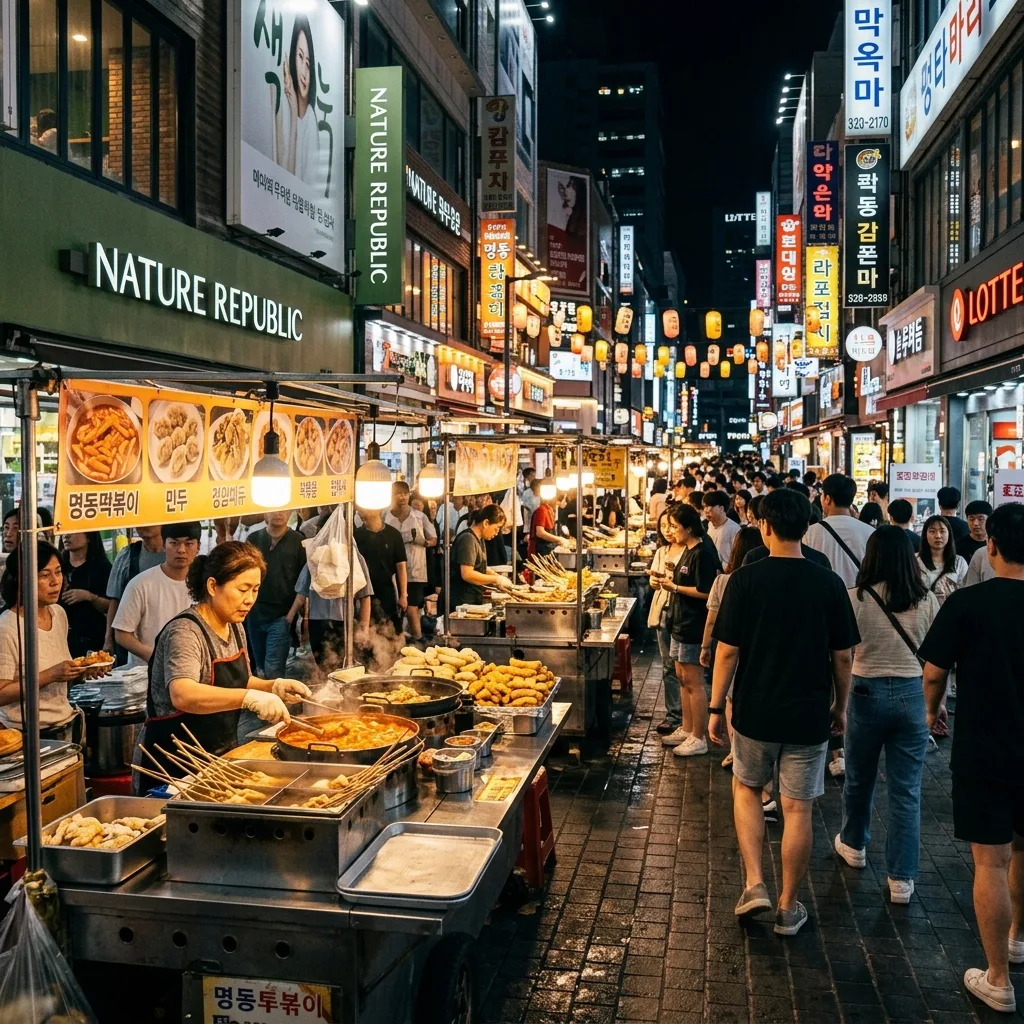
Every evening in Seoul, a transformation happens in Myeongdong. The daytime shopping district — all glass storefronts and K-beauty boutiques — gives way to a corridor of sizzling grills, steaming pots, and vendors calling out in four languages at once. The smell hits you before you see the stalls: caramelized sugar, gochujang, frying dough. If you've never navigated a Korean street food district before, Myeongdong can feel overwhelming. This guide cuts through the noise to tell you exactly what to eat, what to skip, what it costs, and where to find the best stalls.
What Is the Myeongdong Street Food Market?
Myeongdong's street food scene operates along a single pedestrian corridor that runs from Exit 6 of Myeongdong Station toward Myeongdong Cathedral, roughly 600 meters of vendors spilling into several side alleys. Between 150 and 200 stalls set up here on any given evening, making it one of the densest street food concentrations in Seoul.
The market has existed in some form for decades, but the current incarnation — with its mix of Korean classics, Instagram-friendly novelties, and occasional international flavors — solidified in the 2010s. Vendors begin arriving around 4:00 PM, with full operations typically under way by 5:30 PM. Stalls run until around midnight, though most stop taking customers by 11:00 PM.
Prices here run slightly higher than neighborhood pojangmacha (street tent bars) or traditional markets like Gwangjang. A reasonable budget for a filling street food dinner is 15,000–25,000 KRW per person, depending on how much you order.
The Essential Myeongdong Street Foods
Tteokbokki (떡볶이) — Spicy Rice Cakes
Tteokbokki is arguably the defining Korean street food. Chewy cylinder-shaped rice cakes (tteok) are simmered in a bright red gochujang sauce along with fish cakes (eomuk) and boiled eggs. The sauce is sweet, spicy, and deeply savory all at once — a combination that has made this dish a national obsession since the 1950s.
Current price: 4,000–5,000 KRW for a cup serving with fish cake and one boiled egg.
In Myeongdong, you'll find tteokbokki at nearly every other stall. Look for vendors with large flat pans of sauce actively bubbling; fresh-made sauce is always better than reheated. Some vendors add ramen noodles (rabokki) or cheese on top — both worth trying if you see them.
If tteokbokki is new to you, start with a small portion. The spice level in Myeongdong tends to be calibrated for tourists, so it's typically milder than what you'd get in a local neighborhood — but it still has real heat.
Hotteok (호떡) — Sweet Filled Pancakes
Hotteok is a chewy fried pancake filled with brown sugar, cinnamon, and crushed nuts that melt into a caramel-like syrup when cooked. Bite into one too eagerly and you'll burn your chin with molten filling — a Myeongdong rite of passage.
Current price: 1,500–2,000 KRW per piece.
This is one of the cheapest and most satisfying things you'll eat in Korea. Vendors cook hotteok on wide flat griddles using small metal presses to flatten the dough. You want to buy one that was just pressed — the exterior should be golden with a slight crunch, and the inside should be liquid with sugar. A good hotteok takes about two minutes to cool enough to eat without disaster.
Green tea hotteok (with red bean paste and matcha) and spicy hotteok (with glass noodles and vegetables) have grown popular, but the classic cinnamon-brown sugar version is the one that defines the dish.
Tornado Potato (회오리 감자)
One of Myeongdong's most recognizable sights is the tornado potato — a whole potato spirally cut and deep-fried on a skewer, fanned out into a continuous spiral chip. Seasoned with cheese powder, spicy powder, or occasionally squid ink, it's as much about the visual as the flavor.
Current price: 4,000–5,000 KRW per skewer.
Tornado potatoes are universally popular with first-time visitors, and the photo opportunity is obvious. Flavor-wise, they're essentially a thin, crispy chip in an elaborate shape — satisfying, but not the most complex thing you'll eat here. The cheese powder version tends to be the crowd favorite. Eat them while walking; they stay crispy for about 10 minutes before going limp.
For more context on where tornado potatoes fit in the wider landscape of Korean street snacks, see The Ultimate Korean Street Food Guide: Tteokbokki to Tornado Potato.
Gyeran-ppang (계란빵) — Egg Bread
Gyeran-ppang is a sweet bread baked in a rectangular mold with a whole egg cracked on top and cooked until just set. The combination of soft, slightly sweet dough and a savory egg center is unusual but immediately compelling. These sell especially fast on cold evenings.
Current price: 1,500–2,000 KRW per piece.
The vendor makes a difference here. Look for stalls with a fresh batch just out of the mold — the underside should be evenly golden and the egg should be fully set but not rubbery. Some vendors add ham or cheese, which improves the savory-sweet balance considerably. This is a good starter before heavier items.
Eomuk (어묵) — Fish Cake on a Skewer
Fish cake skewers simmered in a light anchovy broth are the most understated food on this list and possibly the most satisfying. The broth is served alongside for dipping or sipping — it's warm, mildly savory, and functions almost as a palate cleanser between richer street foods.
Current price: 1,000–2,000 KRW per skewer; broth is typically free.
Eomuk has been Korean street food for generations, and in Myeongdong it gets a bit lost among flashier options. That's a mistake. When the evening is cool (and Seoul evenings in spring and autumn absolutely are), a cup of eomuk broth with two or three skewers is exactly what you need between bites of tteokbokki and tornado potato.
Grilled Squid (오징어구이)
Whole squid, cleaned and marinated, grilled directly over charcoal or a gas flame and served on a skewer. The result should be tender with a slight char, with sweet-spicy sauce brushed on during cooking.
Current price: 5,000–8,000 KRW depending on size.
This is a higher-commitment purchase in Myeongdong because it takes a few minutes to prepare and needs to be eaten while fresh. Find a stall where you can see the squid on the grill and watch it being made — vendors who pre-cook and hold squid in warmers produce noticeably inferior results. A good grilled squid in Myeongdong is genuinely excellent; a bad one is rubbery and forgettable.
Lobster Skewers and Premium Shellfish
Myeongdong's signature "premium" street food items — lobster tail skewers, scallops, and large prawn skewers — are a relatively recent addition aimed squarely at tourists willing to pay a premium for Instagram content.
Current price: 10,000–15,000 KRW for lobster or scallop skewers.
Worth ordering? That depends on your expectations. The seafood quality varies considerably by vendor, and you're paying a significant markup over what you'd pay in a fish market or sit-down restaurant. That said, a freshly grilled lobster tail skewer with butter and garlic is genuinely good. If you want one, identify a stall with active turnover — fresh product rotating quickly is the only guarantee of quality at this price point.
Myeongdong Street Food Map: Where the Best Stalls Are
Main Alley (Myeongdong 2-ga Pedestrian Street)
The primary food corridor runs from Myeongdong Station Exit 6 toward the cathedral. This stretch has the highest density of vendors and is where most first-time visitors spend their time. It's also the most crowded section between 7:00 PM and 9:00 PM.
Key landmarks along this stretch:
- Near the station entrance: Heavier concentration of snack vendors — egg bread, hotteok, tornado potato.
- Mid-alley: Tteokbokki and eomuk stalls tend to cluster here, along with seafood skewers.
- Closer to the cathedral: Slightly fewer stalls, slightly less crowded, better for sitting on the curb and eating without being jostled.
Side Alleys (Left of Main Corridor)
The left-side alleys branching off the main pedestrian street are consistently underused by tourists. Vendors here typically have shorter queues, similar menus, and occasionally lower prices because they're competing less aggressively for foot traffic. If you want to actually enjoy your food without standing in a crowd, explore here first.
What to Avoid on the Right Side
The right-side branches near the main shopping streets tend to have stalls oriented toward walk-past browsing rather than eating. They're not bad — just less interesting. Stick to the center corridor and its left branches.
Practical Guide: Everything You Need to Know Before Going
Hours
Street food stalls in Myeongdong begin setting up around noon, but the full market experience doesn't materialize until late afternoon. Peak operation runs from approximately 5:30 PM to 11:00 PM. After 9:30 PM, crowds thin and you can move more freely; after 11:00 PM, many vendors start packing up.
The sweet spot for experienced visitors is 6:00–7:00 PM — enough vendors are operating to give you good variety, but the peak dinner rush hasn't arrived yet, so queues are manageable.
Getting There
Subway: Myeongdong Station (Line 4, Exit 6) puts you directly at the entrance to the main pedestrian food corridor. This is the easiest approach.
From명동역: Walk straight out of Exit 6 and you'll hit the first food stalls within 30 meters.
From nearby neighborhoods: Myeongdong is walkable from Insadong (about 15 minutes on foot), Euljiro (10 minutes), and Namdaemun Market (10 minutes).
Budget
| Item | Price Range (KRW) |
|---|---|
| Hotteok | 1,500–2,000 |
| Gyeran-ppang (egg bread) | 1,500–2,000 |
| Eomuk (fish cake skewer) | 1,000–2,000 |
| Tteokbokki (cup) | 4,000–5,000 |
| Tornado potato | 4,000–5,000 |
| Grilled squid | 5,000–8,000 |
| Lobster/scallop skewer | 10,000–15,000 |
A realistic budget for a satisfying tour of the market: 15,000–20,000 KRW per person covers tteokbokki, hotteok, egg bread, and a grilled item. Add another 5,000–10,000 if you want to try premium seafood.
Cash vs. Card
Many street food stalls in Myeongdong are cash-only. While card acceptance has grown, particularly among newer and larger vendors, assume cash is required and bring at least 30,000–40,000 KRW per person. Kakao Pay and Samsung Pay are accepted more broadly than foreign credit cards at smaller stalls.
ATMs are available inside the Myeongdong Underground Shopping Center (accessible from the subway) and at most convenience stores (GS25, CU, 7-Eleven) along the corridor.
Tips and Common Mistakes
Don't Eat Your Way Down the Main Alley All at Once
The most common mistake in Myeongdong is impulse-buying at the first stall for everything you want. The result is that you're stuffed by the halfway point and miss better versions of the same things further along. Walk the full corridor first, note what looks interesting, and then double back to buy.
Follow the Korean Customers
Stalls with Korean customers — particularly Korean twentysomethings, who are not easily fooled by tourist-grade food — are reliably better than stalls staffed to attract foreign visitors. This is especially true for tteokbokki and grilled squid. A long line of Korean students is a stronger quality signal than any signage.
Eat Tteokbokki Last
Tteokbokki is very filling and heavy. If you eat it first, you won't have appetite for anything else. Prioritize lighter items — egg bread, eomuk, hotteok — and save the rice cakes for the end.
Check Sauce Freshness
Tteokbokki sauce thickens and dries out as the evening progresses. By 10:30 PM, some stalls have sauce that's been cooking for six hours — thick, over-reduced, and less balanced. If the sauce looks dry and caked around the edges of the pan, skip it. Fresh sauce should be glossy and fluid.
Side Alleys Have Shorter Queues
As mentioned above: the left-side alleys off the main corridor have just as much variety and a fraction of the wait. If you see a 15-minute queue for tteokbokki on the main alley, walk 50 meters into a side street and buy from a vendor with no queue. The product is often identical.
Bring Napkins
Street food in Myeongdong is saucy. Vendors typically provide thin tissue napkins, but they're woefully inadequate for anything involving gochujang. Bring pocket tissues.
Pace Yourself With Heat
If you're sensitive to spice, start with hotteok and egg bread before moving to tteokbokki. The spice level in tourist-facing Myeongdong is calibrated lower than at local neighborhood pojangmacha, but it's still real heat. Eomuk broth is a good coolant between spicy bites.
How Myeongdong Compares to Other Seoul Street Food Spots
Myeongdong is the easiest and most accessible street food experience in Seoul — but it's not the most authentic or the most diverse. Here's a quick comparison:
Gwangjang Market (30 minutes by subway): Seoul's oldest traditional market, with a covered food hall that has operated for over a century. Prices are lower, food is more traditional (bindaetteok pancakes, mayak kimbap, yukhoe raw beef), and the atmosphere is closer to how Koreans actually eat. Worth doing separately, not as a substitute. If you're planning your Seoul food itinerary, A Foodie's Guide to Seoul: Top 15 Must-Try Street Foods covers the full landscape across neighborhoods.
Namdaemun Market (10 minutes on foot): Adjacent to Myeongdong, Namdaemun skews older and more local. The street food here — galchi jorim (braised cutlassfish), dak galbi, kalguksu noodle soup — is hearty and cheap. Fewer tourists, less English signage.
Insadong Ssamziegil (15 minutes on foot): Smaller, artisan-oriented market in Insadong's courtyard. Higher-end snacks and craft items rather than quantity. Better for light grazing than a full street food evening.
For a full overview of Seoul's neighborhoods and how to structure your time across them, see The Ultimate Seoul Travel Guide: Where to Stay & What to See.
FAQ
What time do Myeongdong street food stalls open?
Vendors begin setting up from around noon, but the full market is typically operating by 5:30–6:00 PM. If you're arriving in the morning or afternoon, you'll find some stalls but not the full experience. Evening hours — particularly 6:00–9:00 PM — are when Myeongdong is at its best.
Is Myeongdong street food expensive?
By global standards, no. Most individual items cost 1,500–5,000 KRW (roughly $1–$4 USD). Premium items like lobster skewers run 10,000–15,000 KRW but are avoidable. A satisfying dinner of four or five items costs around 15,000–20,000 KRW per person.
Do Myeongdong food stalls accept credit cards?
Some do, but many don't. Assume cash is required and bring at least 30,000–40,000 KRW. Korean digital payments (Kakao Pay, Samsung Pay) have wider acceptance than foreign cards at smaller stalls.
Is the street food in Myeongdong authentic Korean food?
It's real Korean food, but it's calibrated for a broad audience — spice levels are often toned down, and premium seafood items like lobster skewers are a tourist-oriented invention rather than a traditional dish. For more traditional Korean street food, Gwangjang Market is the better destination.
When is the best time to visit Myeongdong for street food?
6:00–7:00 PM hits the ideal balance: vendors are fully set up, product is fresh, and crowds are manageable. Peak congestion is 7:30–9:00 PM, when the main alley becomes difficult to navigate. After 9:30 PM, queues shorten significantly.
What's the most must-try food in Myeongdong?
Tteokbokki and hotteok are the two dishes most inseparably associated with Korean street food culture. If you eat nothing else in Myeongdong, eat both of these. For a wider sense of what Korea's street food tradition looks like beyond Myeongdong, the Myeongdong Shopping Guide: Best Beauty Brands and Street Food covers the broader district context.
Conclusion
Myeongdong's street food market is one of the most accessible introductions to Korean food culture in Seoul — not the most authentic, but the most approachable. The core dishes (tteokbokki, hotteok, egg bread, fish cake skewers) are genuinely excellent, the prices are fair, and the atmosphere on a busy evening is one of those chaotic sensory experiences that sticks in the memory long after the trip ends.
Go in with a plan: walk the full corridor first, buy from vendors with Korean customers, start light and end with tteokbokki, and explore the side alleys. Do those things and you'll eat significantly better than a visitor who just grabs the nearest thing.
Myeongdong is also a good starting point before branching out to Seoul's other food districts — Gwangjang for traditional market food, Mangwon-dong for local neighborhood eats, or the Noryangjin Fish Market if you want raw seafood. The city rewards curiosity, and your appetite in Korea will outlast your itinerary.