The Ultimate Korean Street Food Guide: Tteokbokki to Tornado Potato

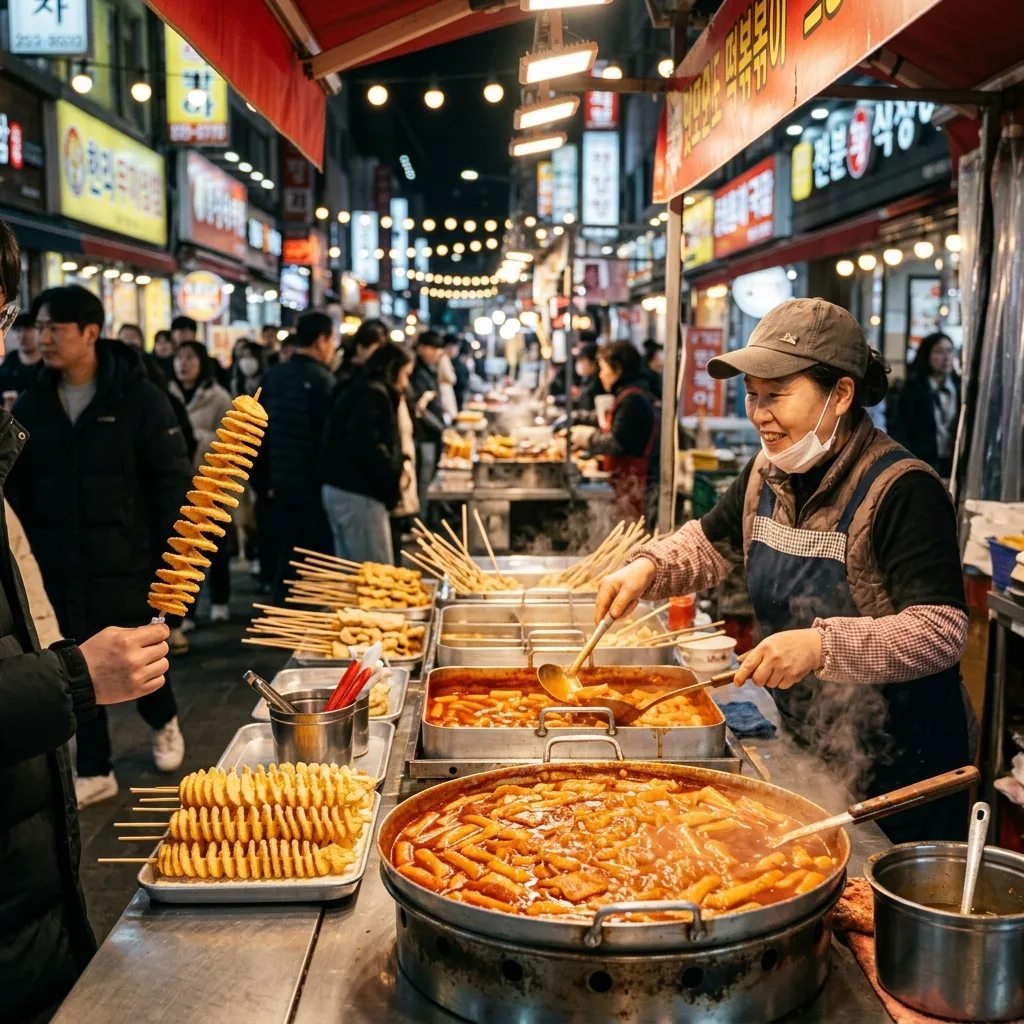
Seoul's streets smell like possibility. Walk through Myeongdong on a Friday evening and you'll pass vendors frying hotteok in pools of oil, teenagers spearing tornado potatoes off wooden skewers, and grandmothers ladling out tteokbokki so spicy it makes your eyes water in the best way. Korean street food is not a side attraction — it is the attraction, and knowing what to order before you land will completely change how you eat your way through Korea.
This guide covers every essential Korean street food you need to try, where to find the best versions in Seoul, how much to budget, and which rookie mistakes to avoid. Whether you're spending one week or one month in Korea, this is the eating strategy that will make every snack stop count.
What Makes Korean Street Food Different
Korean street food — called pojangmacha culture when it involves the classic tented stalls — isn't just fast food eaten standing up. It's a centuries-old social institution that connects neighborhoods, generations, and seasons. The food you eat on a Seoul sidewalk at 10 PM has roots in market culture going back to the Joseon Dynasty, when traveling merchants set up temporary stalls to feed workers and shoppers passing through.
What sets it apart from street food elsewhere in Asia is the balance of flavors. Korean street food oscillates between aggressively spicy and intensely sweet, between chewy textures and crispy ones, between salty and savory umami. A snack run in Seoul isn't a single flavor — it's a rotation of contrasts that keeps you reaching into your pocket for more coins.
Today, street food in Korea has split into two tracks: the traditional market-based stalls found in places like Gwangjang Market and Namdaemun, and the modern "instagrammable" format popularized in tourist corridors like Myeongdong and Hongdae. Both are worth exploring, and each has its own pricing logic. For more on where to eat beyond the stalls, check out A Foodie's Guide to Seoul: Top 15 Must-Try Street Foods for a full breakdown of Seoul's dining scene.
The Essential Lineup: Korean Street Foods You Must Try
Tteokbokki (떡볶이) — The National Street Food
Tteokbokki is the anchor of Korean street food culture. Chewy cylindrical rice cakes (tteok) simmered in a sauce of gochujang (fermented chili paste), fish cake, and sometimes anchovy broth — it's spicy, slightly sweet, deeply savory, and impossible to stop eating. In 2026, a standard portion at a street stall runs ₩3,000–₩5,000 (roughly $2.25–$3.75 USD).
The dish comes in several regional and stylistic variations:
- Gungmul tteokbokki: A soupier, slightly milder version from the Sindang-dong neighborhood, Seoul's historical tteokbokki capital.
- Rabokki: Tteokbokki mixed with instant ramen noodles — a popular hybrid that stretches the portion and adds slurpable texture.
- Gireum tteokbokki: A stir-fried, oil-based variation that's less soupy and slightly more nutty, popular in Busan.
- Rose tteokbokki: A modern version with cream sauce mixed into the gochujang base, mellowing the heat significantly. Common in cafes rather than street stalls.
Where to eat it: Sindang-dong Tteokbokki Town (신당동 떡볶이 타운) is the pilgrimage site for tteokbokki purists. For the street stall experience, any pojangmacha tent in Myeongdong or Insadong will serve a solid version.
Rookie mistake: Don't ask for it "not spicy" — the entire flavor profile depends on gochujang. If heat is a concern, ask for ddeokbokki deol maeun geot (덜 매운 것) — slightly less spicy.
Hotteok (호떡) — The Sweet Pancake That Disappears in Two Bites
Hotteok is a pan-fried stuffed pancake filled with a mixture of brown sugar, cinnamon, and chopped peanuts or sunflower seeds. The outside crisps in oil while the interior turns into a molten pocket of caramelized sweetness. In winter, hotteok queues stretch around the block. In summer, vendors pivot to a green tea or red bean variety that's slightly less rich.
A single hotteok costs ₩1,500–₩3,000 at most stalls. At Hongdae's popular vendors, prices stay around ₩1,500–₩2,000. At tourist-oriented stalls in Myeongdong, expect to pay closer to ₩2,500–₩3,000.
The vendor technique matters here. The best hotteok are pressed in a ring mold that creates a uniform thin edge and a thick molten center. Bad hotteok are too thick, under-caramelized, and doughy rather than chewy. The giveaway of a good stall: a steady queue and a vendor who presses the pancakes with practiced confidence.
Where to eat it: The Namdaemun Market hotteok stalls are legendary among locals. Hongdae's street food strip near the park exit also has some of Seoul's most consistent vendors.
Tornado Potato (회오리 감자) — The Most Photogenic Street Food in Korea
A whole potato spiraled onto a skewer, deep-fried to golden crispness, then dusted with your choice of flavoring — tornado potato is the street food that broke the internet before "instagrammable food" was even a phrase. The technique is deceptively simple: a potato is threaded onto a wooden skewer, a specialized slicer cuts it in a continuous spiral, and then the spiral is stretched out and dropped into hot oil.
Prices in 2026 run ₩4,000–₩5,000 per skewer. Some premium vendors offer larger sizes or specialty toppings (cheese sauce, honey butter, spicy mayo) at the higher end.
Flavor options typically include:
- Original (소금): Sea salt — lets the potato flavor come through cleanly
- Cheese (치즈): Powdered cheese topping, the most popular choice
- Spicy (매운맛): Chili powder seasoning
- Honey butter (허니버터): The sweet-salty trend that swept Korea in the mid-2010s and never really left
Where to eat it: Myeongdong's main pedestrian street has tornado potato stalls every 50 meters. Hongdae and Insadong also have reliable vendors. The gimmick factor is high, but the food genuinely delivers — crispy, salty, satisfying.
Tip: Eat it immediately. Tornado potato loses its crunch within five minutes as steam softens the spiral. Do not attempt to walk and shop with one — it needs your full attention.
Odeng / Eomuk (오뎅/어묵) — The Underdog of Street Snacks
Odeng (also called eomuk) is processed fish cake threaded onto flat wooden skewers and simmered in a light anchovy broth. It's the quietest item on this list — no crunch, no visual drama, no Instagram moment — but regulars know it's one of the most satisfying cold-weather street foods in Korea.
What makes odeng special is the broth. You don't pay for the broth — it's free to drink while you eat, served in small cups at the stall. The broth is mild, savory, and warming, and drinking it between bites of fish cake creates a complete, simple snack experience that costs almost nothing. Expect to pay ₩500–₩1,500 per skewer.
Hotdog (핫도그) — The Korean Corn Dog
Korean hotdogs — often labeled "Korean corn dogs" abroad — have little in common with their American counterpart. They're sausages or mozzarella cheese sticks (or both) coated in a thick batter that can include rice flour, panko breadcrumbs, or even ramen noodles, then deep-fried and finished with ketchup, mustard, and a dusting of sugar.
The sugar is not a mistake. The contrast between savory cheese or sausage and a slight sweetness on the crust is a distinctly Korean flavor move. The most popular variety combines half sausage and half mozzarella on a single stick — the cheese stretches dramatically when you pull it apart, which is exactly why every vendor selling these has a camera-ready moment built into the product.
Prices range ₩2,000–₩4,000 depending on filling. Myungrang (명랑핫도그) is the most well-known chain and has locations across Seoul.
Bungeoppang (붕어빵) — The Seasonal Fish-Shaped Pastry
Bungeoppang (fish bread) is Korea's answer to Japanese taiyaki — a fish-shaped waffle filled with sweetened red bean paste. It's a winter-only food; vendors disappear completely during summer and reappear when the temperature drops below 10°C. Finding a bungeoppang cart on a cold Seoul evening feels like discovering a secret the city keeps just for the season.
The exterior is crispy, the red bean filling is dense and subtly sweet, and three pieces cost about ₩1,000. Some modern variants fill them with sweet potato, custard cream, or chocolate, but red bean (팥) remains the classic.
Gyeranppang (계란빵) — Egg Bread
Gyeranppang is a small oblong bread baked in a mold with a whole egg cracked on top and baked into the dough. It's soft, savory, and lightly sweet — a savory-sweet snack that confuses first-timers and delights them immediately. Like bungeoppang, it skews toward cold-weather consumption, though it's available year-round from dedicated vendors.
One piece costs ₩1,000–₩2,000. It's filling enough to count as a light breakfast if you grab two on your way to the subway.
Where to Eat Street Food in Seoul
Myeongdong (명동)
Myeongdong is the tourist epicenter of Seoul street food. The main pedestrian street fills with vendors every evening from around 5 PM, selling everything covered in this guide plus Korean BBQ skewers, lobster tails (on the pricier end), and giant strawberries dipped in chocolate. Prices here run 10–30% higher than elsewhere, but the density and variety are unmatched.
Best time to visit: 6–9 PM on weeknights, when all stalls are operational but crowds are still manageable. Weekends get extremely crowded after 7 PM.
For a full guide to the neighborhood's shopping and food scene, Myeongdong Shopping Guide: Best Beauty Brands and Street Food covers both the eating and spending sides of an afternoon there.
Gwangjang Market (광장시장)
Gwangjang Market is Seoul's oldest traditional market and the most authentic street food destination in the city for travelers who want to eat like a local rather than like a tourist. The covered market runs along a long central corridor flanked by market stalls selling fabric and vintage clothing, with the food vendors concentrated at either entrance and in the basement.
The specialties here are bindaetteok (mung bean pancakes, pressed to order on large flat griddles, ₩5,000–₩6,000) and yukhoe (Korean beef tartare, ₩15,000–₩20,000 per portion). Both are worth the price. The market stalls don't have menus — vendors will wave you over and point at whatever's freshest.
Hours: Most food stalls open around 9 AM and run until 11 PM. The market overall opens earlier (7–8 AM) but the main food corridor gets busy from lunch onward.
How to get there: Take Seoul Metro Line 1 to Jongno 5-ga Station (종로5가역), Exit 8. The market entrance is a 3-minute walk.
Hongdae (홍대)
Hongdae's street food scene runs parallel to its nightlife — it gets louder, more experimental, and more crowded the later it gets. The area around Hongik University attracts younger locals who favor the inventive and the photogenic over the traditional. Tornado potato stalls here are particularly popular, as are Korean corn dogs and more experimental fusions.
Best time: After 7 PM. The full street food experience here is nighttime-specific.
Insadong (인사동)
Insadong attracts a different crowd than Myeongdong — more domestic tourists, more cultural interest, more traditional aesthetics. The street food here leans into novelty: calligraphy-decorated snacks, traditional sweet rice drinks (sikhye), and seasonal items. The Ssamziegil courtyard within Insadong has a curated mix of street food vendors worth exploring.
Budgeting for Korean Street Food
Korean street food is one of the best deals in Asia for the quality and variety you get. A rough budget guide for a dedicated street food afternoon:
| Item | Typical Price (₩) | USD Equivalent |
|---|---|---|
| Tteokbokki (1 portion) | 3,000–5,000 | $2.25–$3.75 |
| Hotteok (1 piece) | 1,500–3,000 | $1.10–$2.25 |
| Tornado Potato (1 skewer) | 4,000–5,000 | $3.00–$3.75 |
| Korean Corn Dog (1) | 2,000–4,000 | $1.50–$3.00 |
| Odeng (2–3 skewers) | 1,000–3,000 | $0.75–$2.25 |
| Bungeoppang (3 pieces) | 1,000 | $0.75 |
| Gyeranppang (1 piece) | 1,000–2,000 | $0.75–$1.50 |
A full street food run sampling 4–5 items will typically cost ₩10,000–₩20,000 ($7.50–$15 USD), depending on which neighborhood you're in. Myeongdong prices trend toward the top of these ranges; local neighborhood markets and pojangmacha tents trend toward the bottom.
For a complete breakdown of daily travel costs in Korea, How to Travel South Korea on a Budget: $35/Day Survival Guide (2025) has the full picture — accommodation, transport, and eating strategy together.
Practical Tips and Common Mistakes
Pay in cash. Most street food stalls are cash-only. Korean won in small denominations (₩1,000 and ₩5,000 notes) will serve you far better than a card. ATMs are widely available across Seoul; GS25 and CU convenience store ATMs reliably accept foreign cards.
Go on weekdays when possible. Myeongdong on a Saturday night is genuinely overwhelming. The same stalls on a Tuesday evening are relaxed, and vendors sometimes give slightly more generous portions because they're not rushing through a queue.
Skip the "premium" upcharges at tourist stalls. Any stall advertising lobster tail or Wagyu beef skewers in Myeongdong is targeting tourists specifically. The core street foods — tteokbokki, hotteok, odeng — are where the value and the cultural experience actually lives.
Eat odeng in winter. It technically exists year-round, but odeng in July feels incongruous. The broth-drinking, the warmth, the simplicity of it — it's a cold-weather experience by design.
Don't overfill early. Korean street food is best experienced as a slow rotation over two to three hours. If you eat three portions of tteokbokki at your first stall, you won't have room for bungeoppang three blocks later. Pace yourself.
Carry napkins. Tornado potato is greasy. Tteokbokki sauce will stain. Street food stalls sometimes have napkins, often don't. Travel-size tissue packs are your friend.
FAQ
Is Korean street food safe for people with gluten intolerance? Most traditional street foods contain wheat flour or soy sauce with wheat. Tteokbokki uses rice cakes (naturally gluten-free) but the sauce often contains soy. Odeng fish cake contains wheat flour. Cross-contamination at shared stalls is also a real risk. If you have celiac disease, communicate clearly at sit-down restaurants rather than relying on street stalls.
What's the best neighborhood for street food in Seoul? For variety and convenience, Myeongdong. For authentic market atmosphere, Gwangjang Market. For nightlife-adjacent fun, Hongdae. First-timers usually do Myeongdong first; repeat visitors migrate toward Gwangjang.
Can I eat Korean street food as a vegetarian? With effort. Odeng contains fish. Tteokbokki broth often uses anchovy stock. Hotteok is typically vegetarian (check for lard in the dough at traditional stalls). Tornado potato and Korean corn dogs with just cheese are vegetarian-safe. Ask vendors directly — most will understand the concept of chaesogokcheui (채식주의).
How spicy is tteokbokki? Standard tteokbokki is moderately to significantly spicy — a 6 or 7 out of 10 by most Western scales. Sindang-dong's original-style tteokbokki (gungmul style) is actually milder, a 4–5, because it's broth-based rather than paste-heavy. Rose tteokbokki is the gentlest version.
Is the street food in Korea the same as Korean-American food? No. Korean-American cuisine (think Korean BBQ chains, Korean fried chicken, bibimbap bowls) has evolved significantly toward American palates. Street food in Korea is more traditional, less sweet overall, and often simpler in presentation. The tteokbokki you eat in Seoul is spicier and less sweet than versions adapted for US markets.
Conclusion
Korean street food is one of the most accessible and rewarding eating experiences in Asia. The prices are low, the variety is extraordinary, and the cultural context running underneath each dish gives every snack a depth that goes well beyond the ingredient list. Whether you're standing outside Gwangjang Market eating freshly pressed bindaetteok or spiraling through a tornado potato on a Myeongdong sidewalk, the experience of eating in Korea starts long before you sit down at a restaurant.
Come hungry, bring cash, wear something you don't mind getting sauce on, and work your way down this list. You won't finish it in one trip — which is exactly the point.
For a broader look at Seoul's eating culture beyond the street, the Ultimate Seoul Travel Guide covers neighborhoods, logistics, and the full spectrum of where to eat and what to see during your stay.