Beijing Food Guide: Peking Duck, Jianbing & Night Market Snacks

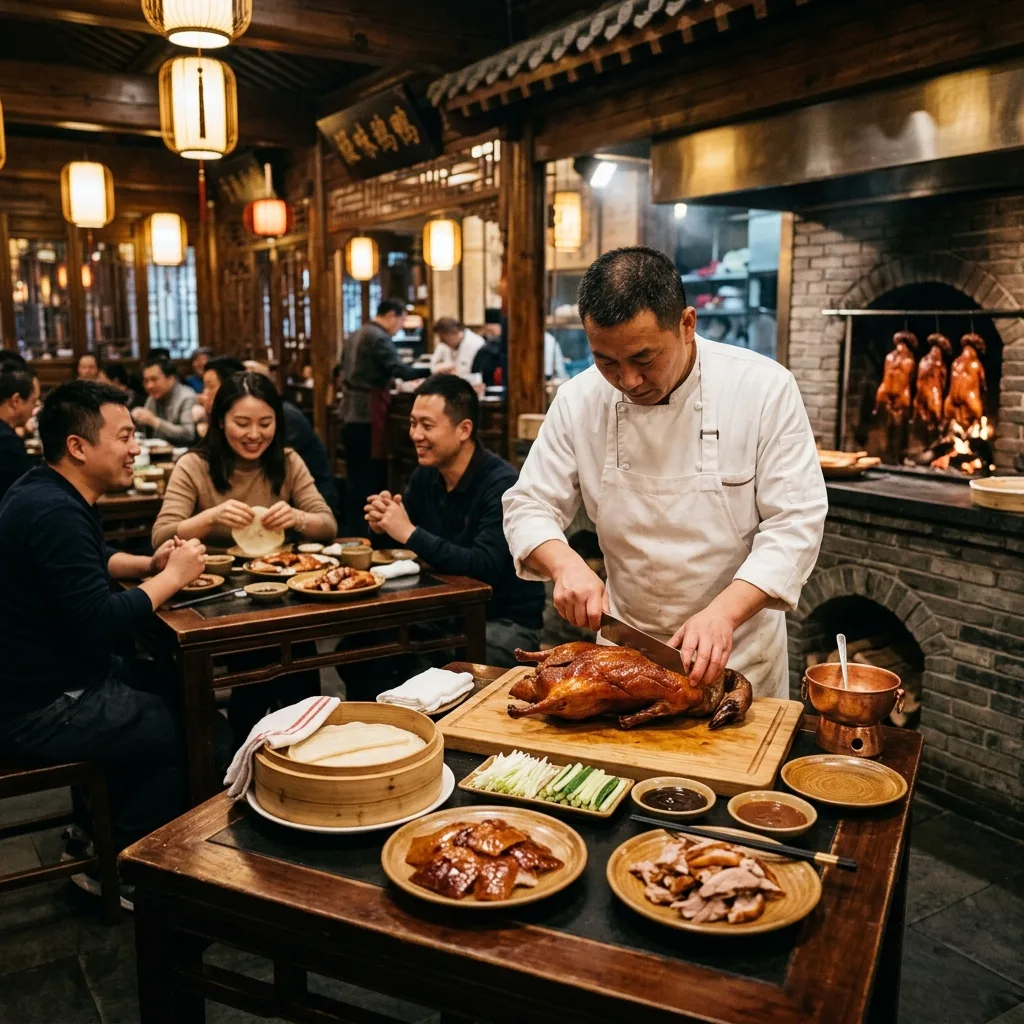
Nobody warns you that eating in Beijing is its own kind of itinerary. You'll walk into your first Peking duck restaurant unsure whether to order half or whole, whether the pancake roll goes sauce-first or duck-first, and why a dish that looks so simple costs three times what you expected. Then breakfast happens — a street vendor cracks an egg onto a thin mung bean crepe at 7 a.m., folds it into a perfect parcel, and hands it to you for less than two dollars. By day two, you're not sightseeing between meals. You're eating between sights.
What Makes Beijing's Food Scene Different From the Rest of China
Beijing's food culture is inseparable from its imperial history. The capital absorbed culinary traditions from across China for centuries, and what emerged is a cuisine that balances hearty northern flavors — wheat noodles, lamb, sesame paste, vinegar — with refined court-era dishes built for pageantry as much as taste. Peking duck sits at the pinnacle: a dish engineered over 600 years to produce crackling mahogany skin with a thin layer of fat that renders clean in the oven.
That history matters when you're eating here. It explains why roast duck restaurants take their craft with almost ceremonial seriousness, why hutong breakfast carts have regulars who've been coming for decades, and why a bowl of zhajiangmian (noodles with fermented soybean paste) tastes different in Beijing than anywhere else in China. The city has a food identity, and once you understand it, ordering gets easier and meals get significantly better.
Before diving into what to eat, check the Ultimate Beijing Travel Guide: Great Wall, Forbidden City & More for a full overview of planning your trip — it pairs well with this food guide for structuring your days.
Peking Duck: Beijing's Most Famous Dish
The History Behind the Lacquered Skin
Peking duck — Beijing kaoya (北京烤鸭) — traces its origins to the imperial kitchens of the Ming dynasty, where royal chefs roasted specially bred ducks in closed ovens fired with fruit wood. The technique spread to the city's restaurants in the 19th century, and by the time Quanjude opened its doors in 1864, the dish had already become synonymous with Beijing itself.
What separates Peking duck from other roasted meats is the preparation process. Ducks are air-pumped between the skin and the fat layer, then glazed with maltose syrup, and hung to dry before roasting. This technique ensures the skin separates from the fat during cooking, rendering it thin, crisp, and almost translucent. The result is the signature lacquered skin — a deep mahogany color with a satisfying crack when tapped with a chopstick.
How to Eat Peking Duck Correctly
Most restaurants serve Peking duck as a tableside carving ritual. A skilled chef will slice the duck into 100+ thin pieces at your table, separating the prized skin-with-fat from the meatier sections. The proper eating order:
- Skin first, plain. The best bites are the pure skin pieces — eat them immediately while they're hot and crackling, with nothing else. Don't waste the first few slices on a pancake.
- Build your rolls. Take a thin steamed pancake (bao bing), spread a thin layer of sweet bean sauce (tian mian jiang), add two or three strips of cucumber and scallion, lay duck slices on top, and fold.
- Use the carcass. A whole duck yields a leftover carcass that restaurants can turn into duck soup (ya tang) — order it at the end of the meal. Some restaurants include it; others charge ¥30–50 extra.
Common mistake: drowning the roll in sauce. A thin smear is all you need. Over-saucing masks the subtle flavor of the skin and makes the pancake soggy.
Where to Eat Peking Duck in Beijing (With 2026 Prices)
Quanjude (全聚德) — The Legacy Choice The most famous name in Peking duck history, with branches across Beijing since 1864. The Qianmen flagship is the original and worth visiting at least once for the institution of it. The duck (¥288–¥338 per bird) is roasted in a traditional open-flame oven, giving it a slightly smokier flavor profile than closed-oven versions. Average spend: ¥190 per person including sides. Tourist-heavy atmosphere, but the technique is genuine.
Dadong (大董) — The Upscale Modern Choice Chef Dong Zhenxiang's restaurants elevated Peking duck to fine dining. His proprietary "crispy and non-fatty" method reduces the fat layer through selective breeding and a modified roasting process, producing a duck that's lighter and more refined. A whole duck costs ¥398 and includes condiments; sides are priced separately. Michelin-recognized, beautifully presented, and genuinely different from the old-school versions. Reserve ahead — walk-ins are rare.
Liqun Roast Duck (利群烤鸭店) — The Hutong Hidden Gem Tucked inside a hutong alley near Qianmen, Liqun is a cramped, chaotic, and brilliant old-school roast duck experience. The dining room has maybe ten tables. The owners are blunt. The duck costs around ¥120 per person and comes with no frills. Book by phone weeks ahead — it's legitimately full. The charcoal-roasted flavor is different from the fruit-wood versions and has its own devoted following.
Bianyifang (便宜坊) — The Budget-Friendly Classic The oldest surviving Peking duck restaurant in Beijing, founded in 1416, and predates Quanjude by 400 years. Bianyifang uses a closed-oven焖炉 (menlu) method — ducks are roasted with residual heat rather than open flame, producing skin that's slightly softer and a different texture than the Quanjude style. Average spend: ¥100 per person. Excellent value, less tourist traffic.
Quick Price Reference:
| Restaurant | Duck Price | Avg Per Person | Style |
|---|---|---|---|
| Quanjude | ¥288–¥338 | ¥190 | Open flame, smoky |
| Dadong | ¥398 | ¥250+ | Light, modern |
| Liqun | Included | ¥120 | Charcoal, traditional |
| Bianyifang | Market price | ¥100 | Closed oven |
Jianbing: Beijing's Breakfast Crepe
What Is Jianbing?
If Peking duck is Beijing's formal dining peak, jianbing (煎饼) is its daily ritual. Every morning, street vendors across the city set up flat iron griddles on carts and spend the breakfast rush making these thin, savory crepes to order. The base is a thin batter made from mung bean flour and wheat flour, poured onto a hot griddle and spread into a wide circle. An egg (sometimes two) is cracked on top and spread across the surface. Then comes the toppings: hoisin sauce, chili paste, scallions, cilantro, and a crispy fried cracker (baocui) or youtiao (fried dough stick) folded in for crunch. The whole thing is folded into a rectangular parcel and handed to you in a paper sleeve, usually within 90 seconds.
The result is somewhere between a savory crepe and a breakfast burrito — crispy in the middle, soft at the edges, and spicy-sweet-herby all at once. It's one of the most complete street food bites anywhere in Asia.
Jianbing Variations to Know
Standard jianbing — one egg, baocui cracker, standard sauce. About ¥6–¥8. Double egg — richer, more filling. Add ¥2. Youtiao version — uses a fried dough stick instead of baocui, which is chewier rather than crunchy. Different texture profile. No cilantro — if you're cilantro-averse, say bu yao xiangcai (不要香菜). Vendors are used to the request.
Jianbing prices are among the most stable in Beijing's street food scene: ¥6–¥15 depending on toppings and neighborhood. Anything above ¥15 is a tourist-facing premium version.
Where to Find the Best Jianbing
Jianbing is almost impossible to find after 10 a.m. — vendors pack up once the breakfast rush ends. Your best strategy is to head toward any busy subway station entrance between 6:30 and 9 a.m. Lines form naturally around the best carts; follow them.
The hutong neighborhoods offer some of the best jianbing because residents form the primary customer base — quality stays high. The Beijing Hutong Experience: How to Explore the Old Alleyways has a full breakdown of which hutong areas to explore, including several where morning food culture is particularly strong. Nanluoguxiang and Wudaoying Hutong have well-regarded morning stall scenes.
Other reliable areas include:
- Guomao subway exits — high-volume business district, multiple competing jianbing carts per block
- Drum Tower area — local neighborhood feel, consistent quality
- Near Tsinghua and Peking University — student-area prices, fast service
Beijing's Night Market Food Streets
The Current Reality: What's Open and What's Closed
Many travel guides still reference the Donghuamen Night Market as Beijing's premier night food destination. It permanently closed in 2016 due to sanitation concerns and urban development. If you see it recommended as a current option, the source is outdated. The experience has shifted — and honestly improved — across several alternative food streets.
Wangfujing Snack Street
Located off the main Wangfujing shopping boulevard in central Beijing, this narrow pedestrian lane concentrates dozens of food stalls selling Beijing snacks and more theatrical "exotic" bites (scorpions, starfish, silkworms) that are as much a photo opportunity as actual food. Open roughly 6 p.m. to 9 p.m. for the main stall section; the surrounding Wangfujing area operates 24 hours with sit-down restaurants.
What to eat here: tanghulu (sugar-coated hawthorn fruit skewers), chuanr (lamb skewers), oysters, stinky tofu, and the theatrical novelty items if you're curious. Don't expect the most authentic or cheapest food — this street is tourist-oriented. Treat it as an introduction to Beijing street food, not the definitive version.
Qianmen Street and Dashilar
The Qianmen area, directly south of Tiananmen Square, combines old Beijing architecture with food and retail. Dashilar (大栅栏) is the pedestrian hutong alley running off Qianmen Street that houses historic shops and snack stalls. The food is more embedded in local life here than at Wangfujing. Lamb buns, sesame flatbread (shaobing), and bowls of douzhir (fermented mung bean juice — an acquired taste and a Beijing rite of passage) are all findable in this area.
Qianmen is also near the Forbidden City Tickets & Visitor Guide: What to See and Skip, making it a natural stop for afternoon and evening eating after a full day at the palace complex.
Jiumen Snack Street (九门小吃)
Located near Houhai Lake, Jiumen Snack Street was created as a dedicated space for traditional Beijing snacks that were being displaced by urban development. Vendors here specialize in old-style Beijing foods:
- Douzhir (豆汁儿) — the fermented mung bean juice that Beijingers consider a cultural litmus test. Sour, pungent, and genuinely polarizing.
- Jiaoquan — crispy fried dough rings, classically eaten alongside douzhir.
- Aiwowo — sticky rice balls filled with sweet bean paste, a Qing dynasty imperial snack.
- Miancha — millet porridge topped with sesame paste and salt, thick and warming.
Hours: roughly 10 a.m. to 10 p.m. daily. The Houhai Lake area is lively in the evening, so combining Jiumen Snack Street with a lakeside walk is a practical pairing.
Other Essential Beijing Street Eats
Beyond the three main districts, these dishes appear across the city and are worth tracking down:
Zhajiangmian (炸酱面) — hand-pulled noodles topped with a slow-cooked pork and fermented soybean paste. The definitive Beijing noodle dish. Available at dedicated noodle shops for ¥25–40.
Chuanr (串儿) — lamb skewers seasoned with cumin and chili. Common at street stalls and night barbecue restaurants from early evening.
Shaobing youtiao — a flatbread stuffed with a fried dough stick. A breakfast combination more filling than jianbing alone.
Tanghulu (糖葫芦) — hawthorn berries (or strawberries, kiwi, grapes) lacquered in hard candy. Sold by street vendors citywide in winter and autumn, increasingly year-round.
Practical Guide to Eating in Beijing
How to Get Around Food Areas
| Area | Nearest Subway | Line |
|---|---|---|
| Wangfujing Snack Street | Wangfujing Station | Line 1 |
| Qianmen / Dashilar | Qianmen Station | Line 2 |
| Jiumen Snack Street | Shichahai Station | Line 8 |
| Liqun Roast Duck | Qianmen Station (10 min walk) | Line 2 |
| Dadong (Tuanjiehu branch) | Tuanjiehu Station | Line 10 |
Reservations and Booking
- Liqun: Call ahead (weeks in advance for weekends). Phone reservations only; no online booking.
- Dadong: Book via the restaurant's WeChat mini-program or through hotel concierge. Fills quickly on weekends.
- Quanjude and Bianyifang: Walk-ins usually possible at off-peak hours (before 6:30 p.m. or after 8:30 p.m.).
Payment
Mobile payment (WeChat Pay or Alipay) dominates in Beijing — many street vendors and smaller restaurants no longer keep change. Foreign visitors can link international credit cards to WeChat Pay or Alipay through the apps' foreign card support introduced in 2023. Alternatively, carry ¥100–200 in small bills for street food and casual dining.
Budget Expectations
| Category | Expected Spend |
|---|---|
| Street breakfast (jianbing + drink) | ¥10–¥20 |
| Casual lunch (noodles or dumplings) | ¥25–¥50 |
| Night market snacking | ¥50–¥100 |
| Peking duck meal (budget option) | ¥100–¥150 per person |
| Peking duck meal (mid-range) | ¥200–¥300 per person |
| Dadong (premium) | ¥350–¥450 per person |
Tips & Common Mistakes
Don't order a whole duck for two people on your first try. A half duck (半只, ban zhi) plus a few side dishes is ample for two people and reduces waste if you're not sure how much you'll eat. Most restaurants offer half-duck portions at roughly 55–60% of the whole price.
Arrive early at street food carts. By 9 a.m., jianbing vendors are winding down. By 9:30, the best carts have sold out. Set your alarm and make breakfast a deliberate stop.
Skip the Donghuamen Night Market listings. It's gone. Any app or guide pointing you there is outdated.
Eat douzhir at least once. Fermented mung bean juice is an acquired taste — slightly sour, slightly funky — and a genuine piece of Beijing food culture. You may not enjoy it, but you'll understand why Beijingers are defensive about it.
Don't confuse Sichuan or Cantonese restaurants with Beijing food. The city has excellent restaurants representing every Chinese cuisine, but if you want specifically Beijing flavors, look for restaurants specializing in lu cai (鲁菜, Shandong cuisine, which heavily influenced imperial Beijing cooking) or restaurants specifically advertising Beijing cai (北京菜). The tourist areas have plenty of generic "Chinese food" that won't give you the city's actual culinary identity.
Learn two phrases. "Zhe ge yao yi ge" (这个要一个) — "I'll have one of this" with pointing — handles most street food ordering. "Bu yao la de" (不要辣的) — "not spicy" — is useful if you're heat-sensitive, though Beijing cuisine is generally milder than Sichuan or Hunan.
FAQ
How much does Peking duck cost in Beijing? Expect ¥100–¥450 per person depending on the restaurant. Budget options like Liqun and Bianyifang run ¥100–¥130; mid-range spots like Quanjude average ¥190; Dadong and premium restaurants run ¥350–¥450 with sides.
Is it safe to eat Beijing street food? Generally yes, with common-sense precautions. Look for high-turnover stalls with visibly fresh ingredients, cooked food served hot, and long queues of local customers. Avoid anything that's been sitting out in warm weather. Jianbing made to order in front of you is one of the safer street food options anywhere in Asia.
What is the best time to visit Wangfujing Snack Street? Early evening between 6 p.m. and 8:30 p.m., when stalls are stocked and the area is lively but not yet overrun. Weekday evenings are quieter than weekends.
Can vegetarians eat well in Beijing? Yes, with some navigation. Buddhist vegetarian restaurants (zhai cai) are scattered across the city and serve creative meatless versions of Chinese classics. Look for signs with 素食 (suíshí). Temple restaurants near major Buddhist sites are reliable options. Most jianbing can be made without meat, and noodle shops typically have vegetable-only options.
Do I need to tip at restaurants in Beijing? No. Tipping is not customary in China, including at upscale restaurants. Service is included in the listed price. Leaving a tip is not offensive, but it's not expected or necessary.
Conclusion
Beijing's food scene rewards the deliberate eater. It has the landmark dish — Peking duck — that justifies planning a meal weeks in advance, and it has the effortless morning ritual of jianbing from a street cart that costs less than a bus ticket. In between, there are centuries of imperial and working-class traditions layered over each other: hutong noodle shops, snack streets, lake-adjacent barbecue spots, and hole-in-the-wall roast duck restaurants that seat ten people and have no sign.
The key is pacing. Eat light on days you're visiting dense sightseeing areas, and eat intentionally on days when food is the actual plan. Both days will be good. The city has enough to eat.
For context on planning your full trip, the Ultimate Beijing Travel Guide: Great Wall, Forbidden City & More covers logistics, neighborhoods, and day-trip planning from the capital. Pair it with this guide and you'll have both the itinerary and the meals sorted before you land.