Ultimate Beijing Travel Guide: Great Wall, Forbidden City & More

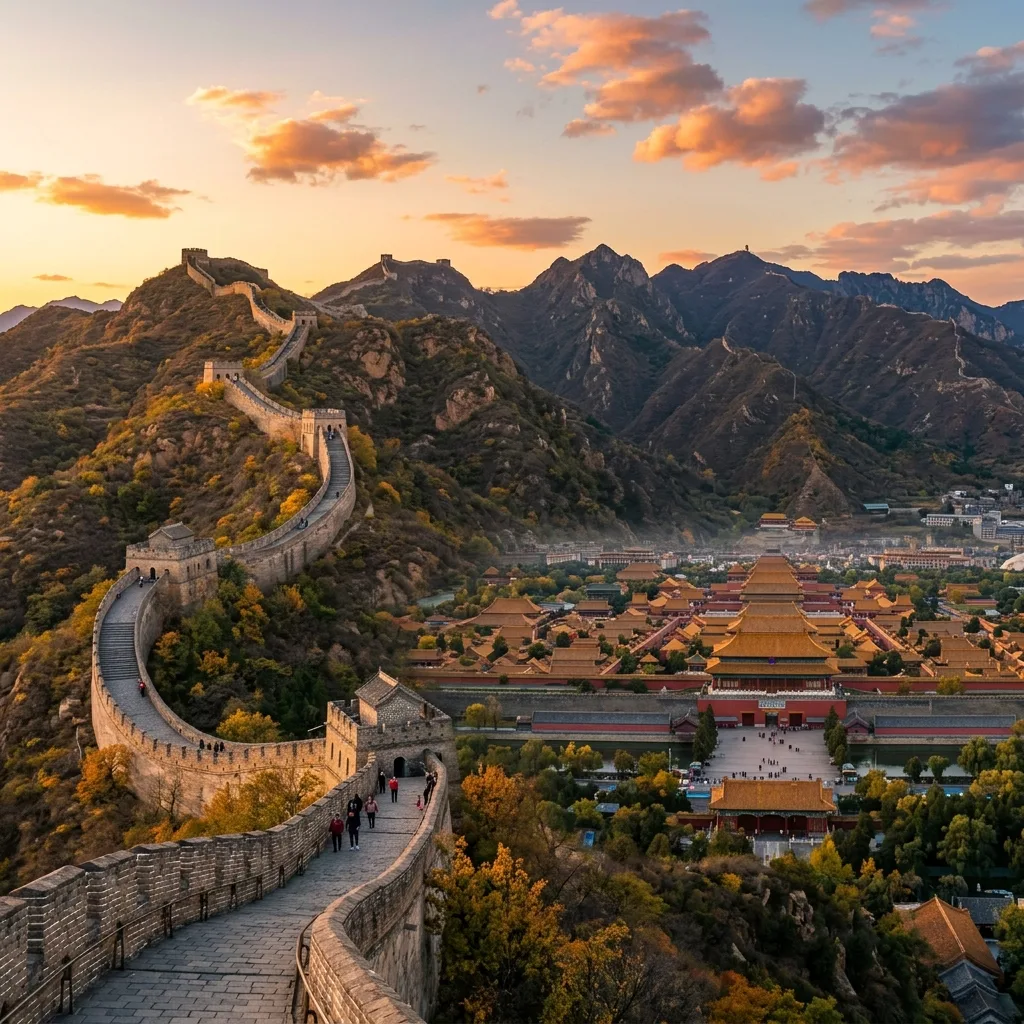
Beijing does not ease you in gently. From the moment you step off the subway at Tiananmen East and the Forbidden City's vermillion wall looms into view, the scale of China's capital hits you at once — imperial, chaotic, ancient, and relentlessly modern all at the same time. This guide cuts through the noise to give you exactly what you need: current ticket prices, transport directions, visa rules for 2026, and the honest tips that most travel articles leave out.
Whether you have three days or a full week, Beijing rewards the traveler who comes prepared. Ticket quotas sell out weeks in advance, subway lines branch in every direction, and the sheer number of "must-see" sights can paralyze even seasoned travelers. Read this first, then book your flights.
Getting Into China: Visa Rules for 2026
One of the most common reasons travelers put Beijing off is visa anxiety — and in 2026, that anxiety is largely unnecessary. China has dramatically expanded its visa-free and transit-free programs.
30-day visa-free entry is now available to passport holders from dozens of countries, including most of Europe, Australia, New Zealand, Canada, and several South American nations. The policy runs through at least December 31, 2026. Check the current list against your passport before assuming you qualify — the eligible country roster does shift.
240-hour (10-day) transit visa-free applies to citizens of 55 countries transiting through 65 designated ports. This is the "stopover" category: as long as you hold an onward ticket to a third country, you can spend up to ten days in designated areas including Beijing, Shanghai, Xi'an, and Guangzhou. For many travelers routing through East Asia, this is all the time needed to knock out Beijing's major sights.
Standard tourist visa (L-visa) remains the path for nationalities not covered by the above. Apply at your nearest Chinese embassy or consulate; processing typically takes 4–7 business days.
Passport validity: Your passport must be valid for at least six months beyond your entry date.
Arrival registration: Hotels register you automatically. If you stay with a local family or friend, you must visit the nearest police station within 24 hours to register your temporary residence.
Online entry card: As of November 2025, you can fill in your entry information online before arrival via the NIA's official platform or the "NIA 12367" app, saving time at immigration.
Planning a multi-country trip that adds Korea? The entry rules are quite different — see the South Korea Visa Requirements 2025: K-ETA, Exemptions & Entry Rules guide for a direct comparison.
The Forbidden City (Palace Museum)
The Forbidden City is the single most visited monument in the world — and for good reason. For 500 years, this 72-hectare complex of 980 buildings was the home of the Ming and Qing emperors, a closed world that ordinary Chinese could never enter on pain of death. Today it receives roughly 19 million visitors annually, which creates both an extraordinary atmosphere and some serious logistical challenges you need to plan around.
The core experience runs along a north-south central axis from the Meridian Gate (Wu Men) through the Hall of Supreme Harmony, Hall of Central Harmony, Hall of Preserving Harmony, the Inner Court, and out through the Gate of Divine Prowess to Jingshan Hill. Budget two to three hours for this route alone. The eastern route takes you through the Treasure Gallery; the western route passes the Clock and Timepiece Gallery — both worth adding if you have the time.
Tickets and Hours
| Season | Dates | Hours | Admission |
|---|---|---|---|
| High season | Apr 1 – Oct 31 | 8:30 AM – 5:00 PM | CNY 60 |
| Low season | Nov 1 – Mar 31 | 8:30 AM – 4:30 PM | CNY 40 |
- Closed every Monday (and the day after national holidays).
- Last entry is one hour before closing.
- No on-site ticket sales — all tickets must be booked online in advance.
- Book at least 7 days ahead; popular time slots sell out further in advance during Golden Week (Oct 1–7) and Chinese New Year.
- Tickets for the Treasure Gallery (Zhen Bao Guan): CNY 10 extra. Tickets for the Gallery of Clocks and Timepieces: CNY 10 extra.
- Students aged 7–18: CNY 20. Seniors 60+: half price. Children under 6: free.
Book tickets: Klook – Beijing Palace Museum Ticket or the official Palace Museum website (pm.com.cn — Chinese interface, requires a Chinese phone number for registration, so Klook is easier for international visitors).
Getting There
- Subway: Line 1 to Tiananmen East (天安门东) — south entrance via Tiananmen Square. Line 1 to Tiananmen West (天安门西) for the west side.
- Walk through Tiananmen Square first: The square is massive (440,000 square meters) and sets the scale perfectly before you enter the gate.
Tips Most Guides Skip
- Enter from the south, exit from the north — this follows the historical processional route and drops you at the base of Jingshan Hill, where you can climb to the pavilion for the best overhead view of the entire complex.
- Go on a weekday in shoulder season (late March, early November) — crowd levels drop dramatically.
- Download the Palace Museum app before you arrive — it has room-by-room audio guides in English and maps the entire complex offline.
- The outer courtyards (south) are always crowded; the inner living quarters (north) are not — most visitors turn back before the Inner Court, which means the gardens and imperial apartments near the north gate are relatively peaceful even on busy days.
The Great Wall of China
No trip to Beijing is complete without it — and the section you choose matters more than most travel blogs admit. Here is an honest breakdown of the three main options accessible from Beijing.
Mutianyu — Best for First-Timers
Why it wins: Mutianyu is the best-preserved section near Beijing, with dramatic watchtowers, a modern cable car and toboggan, and significantly fewer crowds than Badaling. It is the section recommended by most expats and long-term Beijing residents.
- Admission: CNY 45 adults; CNY 25 for students aged 18–25 with valid ID; free for children under 6, seniors 60+, and active military.
- Cable car: CNY 140 round-trip (strongly recommended — the walk up is steep and poorly signposted from the base).
- Toboggan: CNY 100 one-way (the most fun way to descend).
- Hours: 7:30 AM – 6:00 PM (summer); 8:00 AM – 5:30 PM (winter). Check seasonal variations before visiting.
Getting there from Beijing: Take subway Line 5 to Dongzhimen, then bus 916 (express) to Huairou North Street, then a shared minivan or taxi to the Mutianyu entrance. Total travel time: 2 to 2.5 hours. Alternatively, book a direct shuttle from central Beijing via Klook or a private transfer — more expensive but far easier.
Time needed: Full day. Leave by 7:30 AM to arrive before the tour groups, and plan to return by 4 PM.
Badaling — Most Accessible, Most Crowded
Badaling is the closest section to Beijing (about 70 km northwest) and by far the most visited in the world. The infrastructure is excellent — wide walkways, full accessibility, restaurants on-site — but the crowds on weekends and holidays are overwhelming. Go on a Tuesday or Wednesday in November if you choose this section.
- Admission: CNY 40 in spring 2026.
- Hours: 6:30 AM – 5:00 PM (spring/summer); hours reduce in winter.
- Book tickets in advance at the official Badaling website or via a third-party platform — the daily visitor cap fills quickly on weekends.
Getting there: High-speed rail from Beijing Huangtudian station (Line S2) to Badaling station — 80 minutes, CNY 12.50. This is the most scenic and stress-free way to arrive.
Jinshanling — Best for Photography and Hiking
Jinshanling sees fewer visitors than either Mutianyu or Badaling, and the partially unrestored sections give it a more atmospheric, ruined quality that photographs beautifully at dawn. It is 130 km from central Beijing, making it a longer day trip, and the trail between Jinshanling and Simatai (where overnight camping is possible) is one of the best Great Wall hikes available.
- Admission: CNY 65.
- Best visited with a private car or organized tour given the distance.
Tiananmen Square
Most visitors walk through Tiananmen Square en route to the Forbidden City and underestimate how much time to spend here. The square itself is free and open daily (with periodic closures for national ceremonies). The Gate of Heavenly Peace (Tiananmen Tower) at the square's north end offers a ticket-admission climb (CNY 15) and views directly down the central axis toward the Forbidden City entrance.
The Mao Zedong Mausoleum, on the square's south side, is free but requires a reservation through the official WeChat mini-program. It is open Tuesday through Sunday, 8:00 AM – 12:00 PM. This is genuinely worth doing even if you have no particular interest in Mao — the ritualized atmosphere inside is unlike anywhere else in China.
Arrive at Tiananmen Square early (before 8 AM) to see the daily flag-raising ceremony, which draws crowds but is a remarkable spectacle, especially on national holidays.
Temple of Heaven
After the Forbidden City, the Temple of Heaven (Tian Tan) is Beijing's most architecturally significant site — and the one most likely to surprise you. The Hall of Prayer for Good Harvests (Qinian Dian), a three-tiered circular wooden structure built without a single nail, is genuinely one of the most beautiful buildings in East Asia.
- Admission: CNY 15 (park entrance only) + CNY 20 for the three main structures (Circular Mound Altar, Hall of Prayer, Hall of Abstinence). Combined ticket: CNY 35 in high season, CNY 30 in low season.
- Hours: 8:00 AM – 5:30 PM (last entry 4:00 PM).
- Tip: Arrive early to watch Beijing retirees in the cypress-shaded gardens doing tai chi, ballroom dancing, and traditional music — easily the most charming scene in the city and entirely free.
Summer Palace
The Summer Palace (Yi He Yuan) is a 3.4-square-kilometer imperial garden complex about 15 km northwest of the city center — the largest and best-preserved imperial garden in China. The complex centers on Kunming Lake, which was artificially excavated in the 12th century and expanded by Emperor Qianlong. The Longevity Hill behind the lake is topped by a Buddhist temple complex visible from far away.
- Admission: CNY 30 (low season) / CNY 50 (high season, Apr–Oct), plus separate tickets for some interior halls.
- Hours: 7:00 AM – 6:30 PM (summer), 7:30 AM – 5:30 PM (winter).
- Getting there: Subway Line 4 to Beigongmen station.
- Time needed: Half-day minimum; a full day if you want to walk the full circumference of Kunming Lake (about 3 km).
The Summer Palace is much less crowded than the Forbidden City and has a more relaxed atmosphere. Boat rides on Kunming Lake (CNY 20–45 depending on the route) are a highlight in summer.
Hutong Neighborhoods
Beijing's hutongs — narrow alleyways connecting courtyard residences (siheyuan) — are the living tissue connecting imperial heritage to contemporary city life. They are also the most under-visited category of attraction for foreign tourists who come with a checklist of famous monuments.
Nanluoguxiang is the most tourist-friendly hutong area: a 786-meter north-south lane lined with cafes, craft shops, and street food, connecting two subway lines (Line 6 and Line 8). It gets crowded on weekends but gives a good introduction to the scale and texture of hutong life.
Shichahai Lake area — the three linked lakes of Qianhai, Houhai, and Xihai — is more residential and less curated. Rent a bike and loop the lakeshore, then duck into the side alleys to find courtyard restaurants and local life that hasn't been packaged for Instagram.
Wudaoying Hutong near the Lama Temple is one of the quieter ones: independent coffee shops, a handful of excellent restaurants, and virtually no souvenir vendors.
For a structured introduction, cycle tours departing from the Drum and Bell Tower area run approximately 3 hours and cost around CNY 200–300 per person including guide and bike hire — worth it for the commentary that contextualizes what you're looking at.
Practical Guide
How to Get Around Beijing
The Beijing Subway is extensive (27 lines as of 2026), cheap (CNY 3–8 per journey), and the single best way to navigate the city. Buy a transit card (Yikatong) at any station for CNY 20 deposit — recharge as you go, surrender it at the end for a deposit refund. Most major sights sit within a 15-minute walk of a subway station.
Taxis and DiDi are available throughout the city. DiDi (China's Uber equivalent) is cashless and works with international credit cards via the DiDi app's international version. Download and register the app before you arrive — it requires a working phone number for SMS verification.
Walking is practical in the center but distances between attractions are deceptive on maps. The Forbidden City to the Temple of Heaven is 3 km; factor in this gap when planning your day.
Communication and Data
China blocks Google, WhatsApp, Instagram, and most Western social platforms. A VPN installed and tested before you enter China is essential if you need these services (they do not work once you are in the country and your VPN app stores are also blocked). Popular choices in 2026 include ExpressVPN and Astrill.
WeChat is indispensable for paying in China — many small restaurants, hutong shops, and attraction ticket systems accept only WeChat Pay or Alipay. International visitors can now link foreign credit cards to WeChat Pay, but the process can take a day or two to verify. Do this before your trip starts.
SIM cards: International roaming on a Korean or Western plan is expensive but works. Alternatively, a prepaid China SIM from China Unicom or China Telecom includes domestic data at reasonable rates; Hong Kong SIM cards (from networks like 3HK or CSL) often include China data and sidestep the VPN issue entirely.
Where to Stay
- Around Wangfujing / Dongcheng: Best location for the Forbidden City, Tiananmen, and the main hutong neighborhoods. Slightly pricier, but the walking access is worth it.
- Around the Drum Tower (Gulou): Quieter, more residential feel; excellent hutong access; 20 minutes by subway from the main sights. Boutique hotels and courtyard guesthouses are concentrated here.
- Near Sanlitun: Beijing's expat and nightlife hub — good if you want international restaurants and bar-heavy evenings, less ideal if sightseeing is the priority.
Budget Reference (2026)
| Item | Cost |
|---|---|
| Subway ride | CNY 3–8 |
| Street food lunch | CNY 15–30 |
| Sit-down restaurant (mid-range) | CNY 80–150 per person |
| Budget hotel (per night) | CNY 250–400 |
| Mid-range hotel (per night) | CNY 500–900 |
Beijing is significantly cheaper than Tokyo and comparable to Seoul for mid-range travelers. If you are building a broader Asia trip, the How to Travel South Korea on a Budget: $35/Day Survival Guide breaks down costs in the same framework.
Tips and Common Mistakes
Book the Forbidden City weeks in advance, not days. The daily cap is 80,000 visitors — it sounds like a lot until you realize that during October holidays it fills weeks out. Set a reminder the moment your Beijing dates are confirmed.
Do not try to fit the Forbidden City and the Great Wall on the same day. The Wall alone is a full-day trip from the city center. Spreading these across two days gives you time to actually absorb both.
Carry cash. WeChat Pay and Alipay dominate, but some hutong restaurants, smaller museums, and transport hubs still require it. CNY 500 in small bills is a sensible reserve.
Wear comfortable shoes with ankle support. The Great Wall sections near Beijing involve significant incline and uneven stone steps. The Forbidden City involves five to seven kilometers of walking on flat paving stones that get slippery in rain.
Air quality varies. Beijing's pollution has improved dramatically since the 2008 Olympics but still spikes in autumn and winter. Check the AQI (Air Quality Index) before planning outdoor days; anything above 150 makes the Great Wall a less pleasant experience and anything above 200 makes it inadvisable.
Avoid Golden Week (Oct 1–7) and Chinese New Year (Jan–Feb) if possible. Domestic tourism peaks at these times and the major sights become extremely crowded. If these are your only dates, add several days to your plans and book every ticketed attraction as far in advance as possible.
FAQ
Do I need a visa for Beijing in 2026? Many nationalities — including most European countries, Australia, and Canada — qualify for 30-day visa-free entry under China's expanded 2026 policy. Check the current eligible country list; the scheme runs through at least December 31, 2026.
How many days do I need for Beijing? Four to five days is the minimum to cover the major sights without feeling rushed. Three days is doable if you prioritize ruthlessly (Forbidden City, one Great Wall section, Temple of Heaven). A week lets you explore hutongs, day trip to the Summer Palace, and have meals at your own pace.
Is English widely spoken in Beijing? Less than in Seoul or Tokyo. Staff at major tourist sites and high-end hotels speak functional English. Beyond that, a translation app (Google Translate works offline with downloaded Chinese language packs, though Google itself is blocked — use it on airplane mode or via VPN) is invaluable.
Can I visit the Great Wall without a tour? Yes — Mutianyu and Badaling are both straightforward to reach by public transport. A tour makes logistics easier but is not necessary. The main advantage of a guided tour is transport from your hotel door and skip-the-line access at the ticket office.
What is the best time of year to visit Beijing? Late September to early November (avoiding Golden Week) and April to mid-June offer the most comfortable conditions: mild temperatures, lower pollution, and good light for photography. Winter (December to February) is cold but uncrowded, and a snow-dusted Forbidden City or Great Wall is stunning if you dress appropriately.
Conclusion
Beijing rewards preparation. The Forbidden City requires advance ticket booking. The Great Wall requires a full day, a good pair of shoes, and the wisdom to choose Mutianyu over Badaling. The hutongs reward aimlessness. All of it is easier to navigate once you understand the basic logistics laid out here.
If Beijing forms part of a broader Asia swing, Seoul is a natural companion city — two hours by air, a completely different aesthetic, and a travel culture that is more legible to first-time Asian travelers. The Ultimate 10-Day South Korea Itinerary for First-Timers is a useful next read once your Beijing plans are set.
Book your Forbidden City ticket first. Everything else can flex around it.