The Ultimate Seoul Travel Guide: Where to Stay & What to See
Seoul is massive, and that scale is the first thing that intimidates first-time visitors. At 600 square kilometers with nearly 10 million residents in the city proper — and 25 million in the greater metropolitan area — it is one of the largest urban concentrations on earth. The subway map alone looks like a circuit board. The question every traveler faces is the same: where do I start, where do I stay, and how do I see enough of this city to understand it in a finite number of days?
Understanding Seoul's Geography: The Han River Framework
Before diving into neighborhoods, internalize one geographical fact that explains almost everything about how Seoul is organized: the Han River (한강, Hangang) flows east to west through the center of the city, dividing it into two fundamentally different halves.
Gangbuk (강북, "North of the River") is the historical core of Seoul. This is where Joseon-era palaces, ancient temples, traditional hanok neighborhoods, and the original commercial districts are located. The ground here is older, the streets are narrower, the architectural vocabulary is a layering of pre-modern Korean, Japanese colonial, and mid-20th century influences. It is culturally denser and historically richer.
Gangnam (강남, "South of the River") was largely farmland until the 1970s, when the Korean government began a massive planned development that relocated government agencies and promoted high-rise residential and commercial construction. Today it is the financial, luxury, and corporate heart of the city — clean, modern, expensive, and physically wider in its boulevards and blocks. The K-pop entertainment industry is headquartered here; the plastic surgery medical cluster is here; the major luxury retail is here.
Most visitors benefit from spending the majority of their time in Gangbuk for historical and cultural immersion, with deliberate excursions south for specific purposes (high-end shopping, K-pop experiences, the COEX complex, Lotte World Tower).
Where to Stay: Neighborhood Guide
Myeongdong (명동): The Convenient Center
Myeongdong is the most common base for first-time visitors, and for good reason: its central location puts you within walking distance of major attractions, the airport bus network, and the Myeongdong subway station (Lines 4 and 2). It is also Seoul's densest tourist shopping district, with the namesake street packed with beauty brand flagships (Innisfree, The Face Shop, TONYMOLY, Etude), clothing chains, and a nightly street food market running along the pedestrian zone.
The honest assessment: Myeongdong is convenient but not representative of Seoul life. The street food prices are tourist-adjusted upward, the crowds on weekends are extraordinary, and you will not have particularly authentic experiences staying here. What you gain is logistics: easy transport connections, a large stock of hotels at competitive prices, and proximity to enough major sites to be a workable home base.
Best for: First-time visitors, travelers prioritizing convenience, those who want to do significant Korean beauty shopping.
Hotel range: Budget to luxury. Major chains (Lotte, Signiel, Josun) are represented alongside numerous mid-range options around 80,000 to 150,000 KRW per night.
Hongdae (홍대): Youth Culture and Nightlife
Named for Hongik University, which anchors the neighborhood, Hongdae (and its extending areas of Hapjeong and Mapo) represents Seoul's youth culture, arts scene, and nightlife in concentrated form. The streets around the university are dense with independent cafes, art supply shops, live music venues, vinyl record stores, vintage clothing shops, and the bars and clubs that run through the night on weekends.
Atmosphere: Loud, energetic, creative, and young. Street performances (busking) are legal and common in Hongdae's designated performance areas, drawing crowds on weekend evenings to watch everything from K-pop dance groups to jazz quartets to solo acoustic performers.
The practical reality: Hongdae is excellent for travelers in their 20s and 30s who want to experience Seoul's contemporary culture. It is less suited to those seeking quiet mornings or early-night schedules, as the neighborhood is genuinely active until 3-5 a.m. on weekends.
Best for: Young travelers, nightlife, independent music scene, affordable cafes and restaurants, K-pop culture adjacency.
Insadong (인사동) and Bukchon: Culture and Craft
The Insadong-Gyeongbokgung-Bukchon triangle in northern Seoul is the cluster most associated with traditional Korean culture accessible to tourists. Insadong's main street is lined with antique shops, ceramic studios, teahouses serving traditional drinks (ssanghwa-cha, sikhye, yuja-cha), gallery spaces, and restaurants specializing in Korean traditional food.
Gyeongbokgung and the surrounding palace district are the most significant historical sites in Seoul, and staying in this area puts you within walking distance of multiple UNESCO-relevant sites.
Best for: Culture-focused travelers, those interested in traditional crafts and arts, visitors who want walkability to major historical sites.
Gangnam (강남): Luxury and K-Pop
The Gangnam and Cheongdam areas south of the river offer Seoul's highest concentration of luxury hotels, designer retail, premium Korean restaurants, and the entertainment agencies behind major K-pop acts (SM Entertainment, YG Entertainment, and JYP are all in this general area). Apgujeong Rodeo Street is Seoul's fashion-forward retail corridor, with Korean and international designer brands alongside high-concept cafes.
Best for: High-end shopping, K-pop fans wanting proximity to agency buildings and fan cafes, travelers prioritizing luxury hotel experiences.
Seongsu-dong (성수동): The Designer Village
The neighborhood that has most transformed Seoul's cultural geography in recent years, Seongsu sits east of the river and was formerly a center for leather manufacturing and printing shops. The industrial infrastructure — warehouse spaces, workshop buildings, loading docks — has been converted into the city's most design-forward neighborhood. Artisan coffee roasters occupy former factory floors. High-concept restaurants take over workshop spaces. Major luxury brands (Dior, Comme des Garçons, Gentle Monster) open pop-up concept stores here that regularly become major viral moments in Korean social media culture.
Cafe Onion Seongsu (성수 어니언) is housed in a renovated 1970s factory building and is one of the most photographed cafes in Korea. Its industrial-preserved-as-aesthetic interior — exposed concrete, rusted metal, preserved signage from the building's industrial past — alongside excellent baking and coffee has made it a mandatory stop on most Seoul culture itineraries.
Best for: Design and cafe culture enthusiasts, Instagram-focused travelers, those interested in contemporary Korean creative culture.
The Classics: Historical Seoul You Cannot Miss
Gyeongbokgung Palace (경복궁)
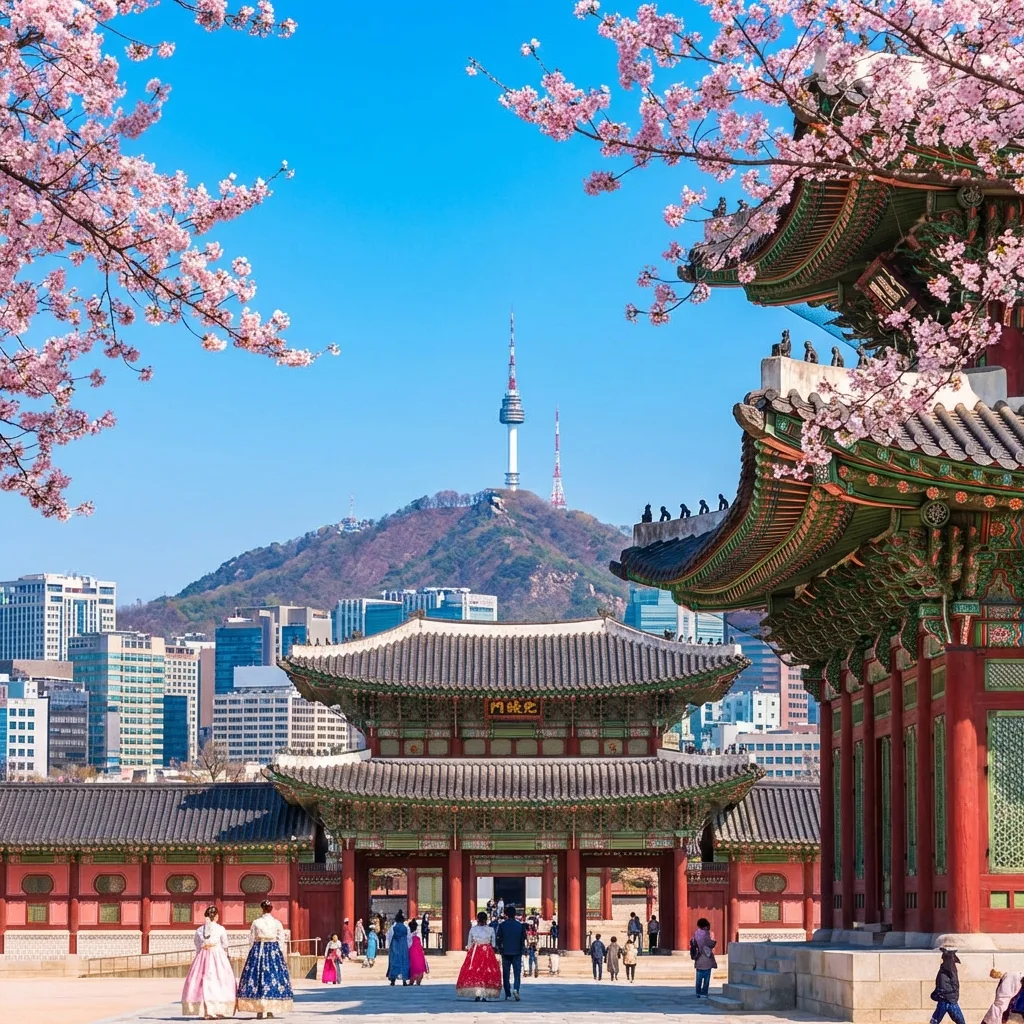
The primary royal palace of the Joseon dynasty, built in 1395 at the foot of Bugaksan Mountain, Gyeongbokgung is Seoul's most significant historical site and one of the most impressive palace complexes in Asia. At its peak, the complex contained over 500 buildings across a 500,000-square-meter compound. Japanese colonial authorities demolished the majority of these buildings in the early 20th century, and the current complex represents an ongoing multi-decade restoration effort that has rebuilt a substantial portion of the original buildings.
Key structures: Gwanghwamun Gate (the iconic main entrance, restored 2010), Geunjeongjeon (the main throne hall where royal ceremonies were conducted), Gyotaejeon (the Queen's quarters), and Hyangwonjeong (a beautiful pavilion on an island in a man-made pond within the complex grounds).
Practical details: Entry costs 3,000 KRW. The palace is closed on Tuesdays. Renting hanbok from one of the many rental shops in the surrounding neighborhood grants free entry. The changing of the royal guard ceremony at Gwanghwamun Gate occurs daily at 10 a.m. and 2 p.m. when the gate is open — this is a well-rehearsed and impressive performance.
Allow: 1.5 to 2.5 hours for a thorough exploration of the main grounds.
Bukchon Hanok Village (북촌 한옥마을)
Between Gyeongbokgung and Changdeokgung Palaces, Bukchon (literally "North Village") is a preserved neighborhood of traditional tile-roofed hanok houses that was historically home to the aristocratic yangban class. Unlike Jeonju's Hanok Village — which is primarily commercial and tourist-oriented — Bukchon is a functioning residential neighborhood where people actually live. This creates both its appeal (genuine atmosphere, non-staged architecture) and its etiquette requirements.
The critical etiquette rules: Bukchon receives millions of visitors annually, and the residents have increasingly pushed back against the noise and intrusion that tourist traffic brings. A specific code of visitor conduct applies: speak quietly and at low volume, do not photograph residents through open gates or windows, do not sit on steps or walls that belong to private residences. Several streets have official quiet hours starting at 5 p.m. The Seoul city government enforces these with staff in the late afternoon and evening.
The most photographed location is the alley on Gahoe-ro 11-gil, where a steep lane gives a view of multiple hanok rooftops against the modern city skyline in the background. Arrive before 9 a.m. on weekdays for the best light and minimal crowds.
Changdeokgung Palace and the Secret Garden (비원)
Less frequented than Gyeongbokgung and arguably more beautiful, Changdeokgung (창덕궁) was built in 1405 as a secondary palace and served as the primary royal residence for much of the Joseon period. Its UNESCO World Heritage designation acknowledges both the architectural quality of the main palace buildings and the extraordinary Huwon — the "Secret Garden" behind the palace complex.
The Huwon is 32 hectares of forested hillside, ponds, and pavilions designed as a naturalistic garden retreat for the royal family. Unlike the formal geometry of Chinese or Japanese palace gardens, it was designed to work with and around the existing natural topography, with structures placed to take advantage of specific views, shade, and water features rather than imposed on a grid. In autumn, the Huwon becomes one of the most spectacular foliage viewing destinations in Seoul, with centuries-old ginkgo and maple trees.
Important: The Secret Garden requires advance reservation and is visited in scheduled guided groups. Book through the Changdeokgung website at least 2-3 days in advance. The main palace is open without reservation; the Secret Garden tour is separate.
N Seoul Tower (남산타워)
The telecommunications and observation tower on Namsan Mountain (海拔 479m) is visible from most of Seoul and functions as the city's most recognizable landmark. The tower itself is somewhat dated inside, but the views from the observation deck on a clear day extend across the city to the surrounding mountains — the visual definition of Seoul's setting within a bowl of peaks.
The experience: Take the Namsan Cable Car (남산 케이블카) up the mountain rather than walking or driving — the cable car experience is part of the ritual, and the walk down through Namsan Park afterward is pleasant. Arrive at dusk to see the city lights activate across the panorama. The famous "love lock fence" where couples attach padlocks to fences and railings surrounds the tower base.
The New Seoul: Contemporary Destinations
Starfield Library at COEX (별마당 도서관)
Located inside the COEX underground shopping mall in Gangnam, the Starfield Library is an open-access public reading space — not an actual library in the checkout sense, but a curated collection of books across 13-meter tall shelves in a double-height atrium space. It is free to enter, open during mall hours, and genuinely beautiful.
The space has become one of Seoul's most-photographed interiors, with the vast bookshelves creating a visual impact that photographs dramatically better than almost any other interior in the city. Come on a weekday morning for the best photographic access; weekends bring significant crowd density that limits the clean shots.
The Hyundai Seoul (더현대 서울)
Opened in 2021 in Yeouido, The Hyundai Seoul quickly became one of the most discussed retail spaces in the world — not primarily because of the brands it carries but because of its architecture. The top floor contains a genuine indoor park ("Sounds Forest") with full-grown trees and natural light from a partially glass ceiling. Other floors feature large voids, indoor greenery, and art installations that make the typical department store experience feel different. The food basement level is an exceptional collection of Korean and international restaurant concepts.
Euljiro (을지로): The "Hipjiro" Transformation
The Euljiro neighborhood spent most of the 20th century as Seoul's industrial and printing district — narrow alleyways lined with hardware shops, metal fabricators, neon sign makers, and print houses serving the commercial and industrial needs of central Seoul. Beginning around 2017-2018, a wave of bars and restaurants began opening in the gaps between existing businesses, using the industrial aesthetic as a design language rather than something to be replaced.
The result is one of the most interesting bar neighborhoods in Seoul: authentic workshop spaces operating during the day, converted at night into venues where you can drink craft beer while surrounded by machinery and hand-painted signs. The neighborhood is colloquially called "Hipjiro" (힙지로, from 힙 "hip" + 을지로 "Euljiro"), and while the term has become somewhat overused, the reality on a Thursday evening — locals at plastic tables in narrow alleyways, the smell of metalwork mingling with food smells — remains genuinely distinctive.
Seoul Forest and the East Seoul Axis
Seoul Forest (서울숲) is a 595,000-square-meter park in the Ttukseom neighborhood, created from a former sewage treatment facility. It is the largest public park in central Seoul and a genuine green space — picnic-able lawns, deer enclosure, insect gardens, and waterway connections to the Han River. The adjacent Ttukseom Hangang Park and the broader riverside zone make this end of Seoul worth an afternoon, particularly combined with the Seongsu neighborhood (a 15-minute walk).
Practical Seoul: Getting Around
Seoul's subway system is one of the world's most comprehensive urban rail networks, with 23 lines covering the city and connecting to outlying cities. For visitors, the relevant lines cluster around 9 main arteries (Lines 1-9) plus a few specialized routes. A T-Money card loaded at any subway station or convenience store covers the subway, buses, and most local transit seamlessly.
For navigating Seoul like a local, download Naver Maps (네이버 지도) before arrival. It provides transit routing (including transfers, exit numbers, and walking directions to destinations from exits) and significantly outperforms Google Maps for Korean transit accuracy. The Seoul subway and bus guide covers the system in detail, including the T-Money setup and how to read transit directions.
Three-Day Seoul Itinerary
Day 1: Royal Seoul (Gangbuk Historical Core)
9:00 a.m. — Gyeongbokgung Palace opening. Rent hanbok from a nearby shop (10,000 to 25,000 KRW for 2-4 hours) for free entry and photos in the palace courtyards.
11:30 a.m. — Walk to Bukchon Hanok Village through the back streets north of the palace. Photograph the Gahoe-ro alley views. Walk quietly.
1:00 p.m. — Lunch in Insadong. Try a traditional Korean restaurant set meal (hanjeongsik) or simpler rice-based lunch. Browse the main street's gallery shops.
3:00 p.m. — Changdeokgung Palace (if you booked the Secret Garden tour in advance, afternoon sessions are available). Otherwise, explore the palace grounds and the nearby Jongno neighborhood.
5:00 p.m. — Namsan Cable Car up to N Seoul Tower. Walk the Namsan hill circuits. Wait for sunset from the tower observation deck.
7:30 p.m. — Myeongdong street food dinner (tteokbokki, Korean corn dogs, hotteok, steamed egg bread).
Day 2: Modern Seoul (Gangnam and the Han River)
9:00 a.m. — Starfield Library at COEX before weekday crowds arrive. Photograph the bookshelves in the low-crowd morning window.
11:00 a.m. — Lotte World Tower (롯데월드타워) Seoul Sky Observatory. At 555 meters, the observation deck on floors 117-123 is the highest in Korea. The glass-floor section on the sky deck requires an additional charge but is worth it.
1:00 p.m. — Lunch in Apgujeong or Cheongdam. Korean-style Italian, contemporary Korean cuisine, or ramen options abound.
3:00 p.m. — Walk the Cheongdam and Dosan Park luxury retail corridor. Window-shopping is fine; major brands are well-represented.
5:30 p.m. — Yeouido Hangang Park (여의도 한강공원). Pick up convenience store ramen (cooked in instant boiling water dispensers inside 7-Eleven and GS25), a bottle of makgeolli, and picnic supplies. Eat on the riverbank as the sun sets.
8:00 p.m. — The Hyundai Seoul department store evening visit.
Day 3: Seoul's Alternative Districts
10:00 a.m. — Seongsu-dong. Coffee at Cafe Onion Seongsu. Walk the surrounding streets of former leather workshops turned into design studios.
12:30 p.m. — Seoul Forest picnic or riverside walk.
2:30 p.m. — Hongdae afternoon exploration: independent record stores, vintage clothing, cafe-hopping, gallery spaces.
5:00 p.m. — Euljiro (Hipjiro) pre-dinner drinks at a converted workshop bar.
7:00 p.m. — Dinner in Hongdae or Mapo area. The live music venues in Hongdae open for evening performances around 8 p.m.; pick a genre and buy tickets at the door or via the venue's Instagram.
Seoul is not a city you understand quickly — it reveals itself in layers, each visit showing a different facet of a place that has absorbed 600 years of history and compressed them into a modern megalopolis. Three days gives you the shape; return trips fill in the depth.
Once you have experienced the immense scale of the capital, rely on The Ultimate Guide to Public Transportation in Korea to navigate your way toward the KTX station. From there, you can easily reach the Top 10 Must-Visit Cities Beyond Seoul to see how the rest of the country lives. If the urban energy of Seoul leaves you needing an ocean breeze, reading our Complete Guide to Busan or checking out the Best Summer Beach Escapes in Korea will give you excellent options for coastal relaxation.