Exploring Busan: A Complete Guide to South Korea's Coastal Gem

If Seoul is the polished, high-speed, high-achievement capital of Korea, Busan is its counterweight — louder, saltier, warmer in every sense. Korea's second city sits on the southeastern tip of the peninsula where the mountains meet the sea, a geography that forces the city's architecture and personality into a compressed, dramatic arrangement: hillside neighborhoods spilling toward harbor waters, beaches backed by skyscrapers, Buddhist temples clinging to sea cliffs. The people here are famously more direct, the dialect more pronounced, the food spicier, and the overall atmosphere one of a place that does not defer to Seoul's self-regard.
Busan is 330 kilometers from Seoul by road, but 2 hours 30 minutes by KTX from Seoul Station — a distance that makes it the most accessible domestic destination from the capital and the most common first excursion for visitors who want to see Korea beyond the capital. This guide covers the Visit Busan Pass (and how to calculate whether it saves you money), the city's district-by-district structure, every significant attraction, the three foods that define Busan's culinary identity, and a full 3-day itinerary built to use your time efficiently.
Getting to Busan
KTX from Seoul
The KTX Gyeongbu Line connects Seoul Station to Busan Station in approximately 2 hours 30 minutes. Trains run from early morning until late evening at intervals of 15 to 30 minutes during peak hours. Standard class fare is approximately 59,800 KRW one-way; first class (특실) runs about 84,000 KRW and provides wider seats and complimentary light refreshments.
Booking strategy: Weekend trains fill up fast — particularly Friday evening outbound (Seoul → Busan) and Sunday evening return (Busan → Seoul). Book at least 3 to 4 days in advance for weekend travel. Use the KorailTalk app or Trip.com if your international card fails at the official system. See the KTX booking guide for the complete process.
The SRT alternative: If you are staying in Gangnam, the SRT from Suseo Station reaches Busan 10 minutes faster and costs approximately 10% less. The tradeoff is the extra transit time to reach Suseo from anywhere outside Gangnam.
Orientation at Busan Station
Busan Station (부산역) is in the city's Dong-gu district, adjacent to the older commercial center of Nampo-dong and a 15 to 20-minute subway ride from the beach areas of Haeundae. Upon arriving, you can:
- Load cash onto a T-Money card at the station convenience store or ticket machines
- Pick up a free Busan city map from the tourism information counter in the arrivals hall
- Hop directly on Metro Line 1 (red line) for most city destinations
The Busan metro is smaller than Seoul's but sufficient for tourist navigation. A T-Money card works on all Busan buses and subway lines.
The Visit Busan Pass: Is It Worth It?
The Visit Busan Pass (VBP) is a prepaid attraction pass available in 24-hour and 48-hour versions. It provides free (or included) entry to over 30 attractions, typically covering entrance fees plus some transit.
Current pricing:
- 24-hour pass: approximately 49,000 KRW
- 48-hour pass: approximately 69,000 KRW
Key inclusions:
| Attraction | Normal Entry |
|---|---|
| Busan X The Sky Observatory | 27,000 KRW |
| Blue Line Park Beach Train | 7,000 KRW |
| Spa Land Centum City | 20,000 KRW |
| Lotte World Busan | 47,000 KRW |
| Songdo Cable Car | 15,000 KRW |
| Busan Museum of Art | 5,000 KRW |
The math: If your 2-day itinerary includes Busan X The Sky + Spa Land + Blue Line Park Beach Train, you have already recovered 54,000 KRW in value against a 49,000 KRW 24-hour pass cost. Add anything else and it pays for itself.
The Sky Capsule is NOT included — the premium capsule pods at Blue Line Park require separate booking regardless of pass ownership. The VBP covers the Beach Train (ground-level tram) but not the elevated capsule ride.
Where to buy: Online at visitbusan.net before your trip (recommended), or at the tourism information counter at Busan Station upon arrival. Pre-purchase is better because it guarantees availability during high-season periods.
District Guide: East Busan — The Miami Zone
The eastern areas of Busan — Haeundae and Gijang — represent the city's contemporary, luxury, and beach-culture face. High-rise hotels, international-standard spas, and the iconic coastal entertainment infrastructure are concentrated here.
Haeundae Beach (해운대 해수욕장)
Korea's most famous beach stretches 1.5 kilometers along a curved bay in northeastern Busan. The sand is golden-colored, the water temperature swimmable from June through September, and the surrounding neighborhood combines beachfront hotels, seafood restaurants, and the BEXCO convention center. During summer peak season (July and August), the beach is extraordinarily crowded — a genuine sea of umbrellas.
Outside peak summer, Haeundae's character changes: the beach is beautiful but calm, the boardwalk restaurants are accessible, and the neighborhood itself shows as a walkable, sophisticated coastal district rather than a resort-mode spectacle.
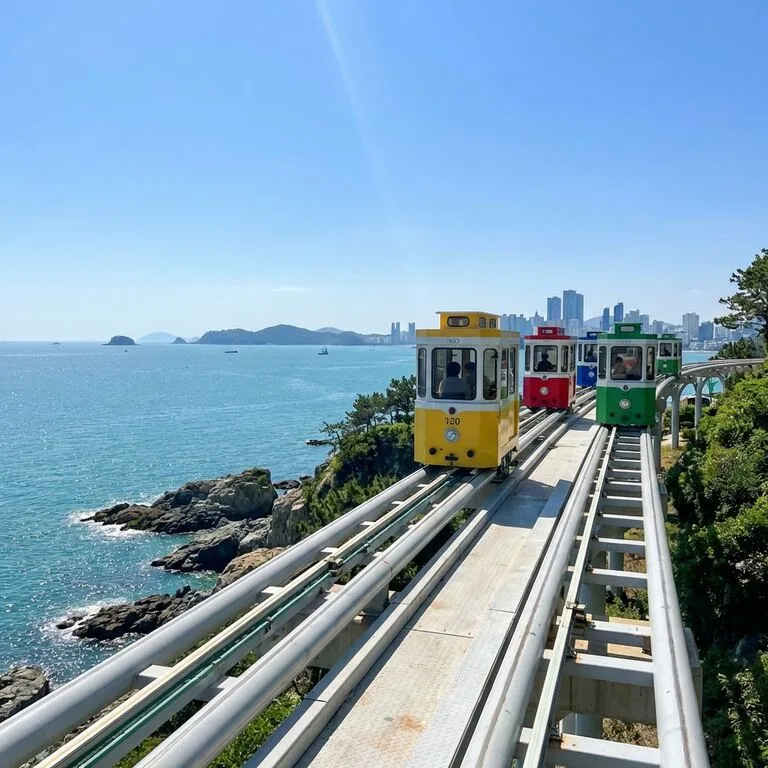
Haeundae Blue Line Park (해운대 블루라인파크)
The most Instagrammed attraction in contemporary Busan: a former coastal railroad track converted into a tourist attraction with two distinct ride options.
The Sky Capsule (스카이 캡슐): Enclosed, brightly colored 4-person pods that ride slowly along an elevated section of track, hovering above the ocean with glass windows on three sides. The ride covers approximately 4 kilometers of the most dramatic ocean-view section of the route.
Booking mandatory: Sky Capsule slots sell out 2 to 3 weeks in advance for weekend dates. Reservation opens on the Blue Line Park website; slots are released monthly. If you have not booked in advance, weekday availability is sometimes possible, but do not plan on walking up for a weekend capsule without a reservation.
The Beach Train (해변열차): A larger public tram that runs the full 4.8-kilometer route closer to ground level. Less dramatic than the capsule but included in the Visit Busan Pass and available without reservation. Good option for visitors who missed capsule slots.
Haedong Yonggungsa Temple (해동 용궁사)
Most Buddhist temples in Korea are located in mountain settings — quiet, forested, removed from coastal drama. Haedong Yonggungsa breaks every convention: built on a rocky sea cliff above crashing waves at Busan's northeastern coast, the temple complex is one of the most visually striking religious sites in the country.
Founded in 1376 and rebuilt multiple times (most recently in 1970), the temple cascades down the cliff face in a series of buildings and staircases directly over the water. Stone lions, pagodas, and Buddha figures occupy positions between the temple buildings and the sea. The sound of waves crashing against the rocks below mingles with chanting from the main hall.
Visit timing: Sunrise is the ideal time — the temple opens before dawn, the light is extraordinary, and the tour bus crowds have not arrived. Arriving at 6:00 to 7:00 a.m. gives you 30 to 45 minutes of near-solitude at what becomes a crowded attraction by 9:00 a.m. Entry is free.
Location: The temple is in Gijang, Busan's northern coastal district, approximately 20 minutes by taxi from Haeundae (around 15,000 KRW) or accessible by Bus 181 from Haeundae Station.
Spa Land Centum City (스파랜드)
Located inside the Shinsegae Centum City Department Store — certified by Guinness as the world's largest department store — Spa Land is the most comprehensive urban jjimjilbang (Korean sauna and bathhouse complex) in Korea. The facility covers 5,000 square meters and contains 18 different thermal spa pools, each themed with different minerals and temperatures.
What the spa offers:
- Indoor hot and cold mineral pools at various temperatures (34°C to 44°C)
- Outdoor jacuzzi-style pools
- Traditional Korean-style low-ceiling sauna rooms in different styles (charcoal, salt crystal, red clay, Himalayan salt)
- Full steam room complex
- Rest areas with sleeping capsules and lounge chairs
- Restaurant and cafe inside the facility
Cost: Approximately 15,000 to 22,000 KRW depending on day and time (peak pricing on weekends and evenings). Towels, robes, and jimjilbang shorts are included. The Visit Busan Pass covers entrance on a 24-hour or 48-hour pass.
Allow: 3 to 4 hours minimum for a meaningful spa experience.
District Guide: Old Busan — History, Culture, Markets
The western areas of Busan — Nampo-dong, Jung-gu, and Seo-gu — contain the city's historical heart, its fishing culture, and its most authentic neighborhood character.
Gamcheon Culture Village (감천 문화마을)
Built on a steep hillside above Busan's port district, Gamcheon began as a settlement established by followers of a shamanistic Korean religious movement (Taegeukdo) in the 1950s and subsequently became home to Korean War refugees. The tight hillside grid of small houses — now painted in pastel colors, connected by winding staircases, and scattered with commissioned murals, sculptures, and art installations — has been transformed into an open-air cultural gallery since 2009.
The comparison to Busan's "Machu Picchu" is local slang but visually apt: the stacked houses, the mountain backdrop, and the sea visible at intervals create a genuinely dramatic urban landscape. The combination of authentic residential neighborhood (people actually live here) and art village tourist infrastructure (maps, guided routes, art installations) is imperfect but compelling.
Navigation: The village distributes a stamping map at the entrance information point — a series of specific stops through the village where you can collect stamps as you walk. The full route takes 1.5 to 2 hours. The essential photo point is looking down from the upper streets toward the lower village with the harbor visible in the background.
Transit tip: The village sits high on a hill. Taking Bus Seo-gu 2 or 2-2 to the upper entrance and walking down is significantly easier than climbing from the lower entrance. Return to the city center via taxi from the main road.
Jagalchi Fish Market (자갈치 시장)
Korea's largest live seafood market occupies a complex on Busan's harbor waterfront, a few minutes from Nampo-dong. The ground floor is a wet market: dozens of ajumma (older women vendors) sell splashing fish from tanks and buckets — whole flatfish, live octopus, sea urchins, crabs, whelks, and varieties specific to Korea's southern coastal waters.
The second floor is a restaurant level: buy your desired seafood from the vendors downstairs and pay a small preparation fee to have it cooked immediately at one of the upstairs restaurants, or simply order a pre-assembled sashimi platter directly from the restaurant floor. San-nakji (산낙지, live octopus) is the food adventure specific to this market — the octopus is sliced while still moving and served with sesame oil. The pieces continue moving on the plate and need to be chewed thoroughly before swallowing. The flavor is fresh ocean and the texture is tender.
For the less adventurous: Standard sashimi platters (모둠회, modeumhoe) of mixed sliced fish are excellent and straightforward. A platter for two with banchan runs approximately 40,000 to 60,000 KRW at the restaurant level.
BIFF Square and Gukbap Alley (비프광장, 돼지국밥 골목)
BIFF Square is a pedestrian zone named for the Busan International Film Festival, which runs here each October. The square has a walk-of-fame style tile installation and a concentrated street food scene.
The definitive BIFF food: Ssiat Hotteok (씨앗 호떡) — a larger, stuffed sweet pancake filled with honey, sunflower seeds, and brown sugar. The Busan version is larger and seed-heavier than the Seoul style. Multiple stalls compete within 100 meters; the queue typically identifies the vendor worth waiting for. Price: 2,000 to 3,000 KRW.
Gukbap Alley is a street dedicated to a single dish: Dwaeji Gukbap (돼지국밥, pork rice soup). Several restaurants along this street open from early morning and serve continuously until late. This is lunch territory for Busan residents: a bowl of milky pork bone broth with sliced pork and rice, seasoned to preference with salted shrimp and garlic chives.
What to Eat in Busan: The Three Mandatory Dishes
Dwaeji Gukbap (돼지국밥) — Pork Rice Soup
Born from Korean War necessity — refugees who fled to Busan in the early 1950s made soup from the discarded pork bones provided by American military — Dwaeji Gukbap is now Busan's most iconic food. The soup itself is milky white from long-simmered pork bones, rich but clean, served with sliced pork on top and rice on the side or mixed in.
The critical technique: The soup arrives unseasoned. On the table are containers of saeujeot (새우젓, salted fermented shrimp), garlic, and green onions. Add these to your bowl to taste — the shrimp paste is the flavor element that defines Dwaeji Gukbap and distinguishes it from generic pork bone soup. Start with half a spoonful of saeujeot and adjust.
Price: 9,000 to 15,000 KRW per bowl.
Milmyeon (밀면) — Cold Wheat Noodles
During the Korean War period, traditional buckwheat for naengmyeon (cold noodles) was scarce in Busan. Resourceful cooks substituted wheat flour, creating a different noodle style — chewier, slightly yellow, with a different texture than the buckwheat version. Milmyeon is specifically a Busan food; it is difficult to find outside the city.
The soup version (물밀면) arrives in a cold, slightly spicy beef broth with the noodles, sliced cucumber, and half a boiled egg. The spicy mixed version (비빔밀면) is dressed with a gochujang paste and served with the same garnishes. Slurp the noodles cold on a summer day.
Price: 8,000 to 12,000 KRW.
Eomuk (어묵) — Busan Fish Cakes
Fish cakes are eaten across Korea, but Busan's fish cakes are the standard by which all others are measured. The higher fish content — Busan's proximity to the sea means fresher ingredients — and the traditional production methods of long-established Busan manufacturers result in fish cakes with a noticeably better texture and more pronounced seafood flavor than the mass-produced versions common in Seoul.
The most famous fish cake producer, Sam Jin Amook (삼진어묵), has a flagship store in the Gukje Market area that functions as both a shop and a food experience — baked fish cake formats, fish cake skewer varieties, and the classic soup version. A fish cake skewer at the store runs 1,000 to 3,000 KRW; take-home packed fish cakes for 10,000 to 30,000 KRW make excellent edible souvenirs.
3-Day Busan Itinerary
Day 1: Old Busan and Culture
10:00 a.m. — Arrive at Busan Station by KTX. T-Money card loaded, Visit Busan Pass in hand.
11:00 a.m. — Take Bus Seo-gu 2 to the upper entrance of Gamcheon Culture Village. Walk down through the village over 2 hours, stamping the map, photographing the stacked pastel houses.
1:30 p.m. — Taxi to BIFF Square. Ssiat hotteok snack. Lunch in Gukbap Alley — Dwaeji Gukbap with proper saeujeot seasoning.
4:00 p.m. — Walk to Jagalchi Fish Market. Browse the ground floor. Upstairs dinner of sashimi platter and milmyeon.
7:00 p.m. — Nampo-dong Night Market and evening walk.
Day 2: East Busan and Luxury
6:30 a.m. — Taxi to Haedong Yonggungsa Temple at sunrise. Temple complex, sea cliff walk.
9:00 a.m. — Taxi to Haeundae Blue Line Park. Sky Capsule (if pre-booked) or Beach Train. Ocean views.
11:30 a.m. — Haeundae Beach walk, beachfront area lunch.
2:00 p.m. — Spa Land Centum City. 3-hour thermal spa session. Included in Visit Busan Pass.
6:00 p.m. — Busan X The Sky observatory at the 98th floor of LCT Landmark Tower as the city lights come on.
8:00 p.m. — The Bay 101 — Busan's waterfront dining and nightlife area in the Marine City development, with illuminated bridge views.
Day 3: Gwangalli and Departure
9:00 a.m. — Gwangalli Beach (광안리 해수욕장). Smaller and less crowded than Haeundae, with dramatic direct views of the Gwangan Bridge (광안대교) — a 7.4-kilometer suspension bridge illuminated at night.
11:00 a.m. — Cafe hopping in the Gwangalli neighborhood. The area around the beach has excellent independent cafes with sea views.
1:00 p.m. — Sam Jin Amook fish cake store. Purchase souvenir fish cakes.
3:00 p.m. — KTX back to Seoul.
The KTX network makes Korea remarkably compact for travelers—distances that seem significant on a map collapse to afternoon excursions when you factor in two-hour train times.
Start by securing your KTX Tickets and mastering the T-Money system for local Busan buses. Since Busan is a culinary capital, don't miss our Foodie's Guide to South Korea, or see how to best allocate your time with our Ultimate 10-Day South Korea Itinerary.