A Foodie's Guide to South Korea: 10 Dishes & Markets You Can't Miss

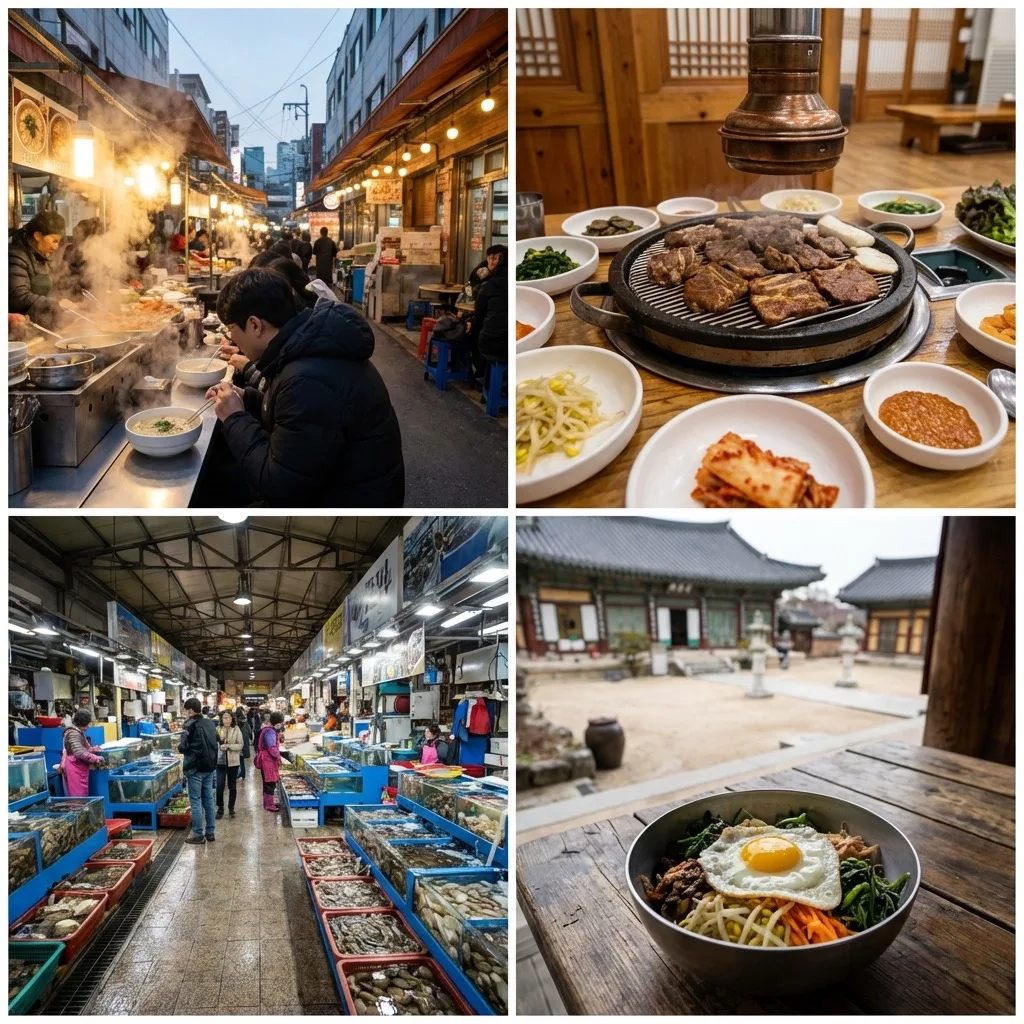
When people think of Korean food, they think of BBQ. And yes, grilling pork belly at your table while sipping soju is a religious experience.
But Korean food is so much more than meat on a grill. It's crispy mung bean pancakes sizzling on a griddle at 11 PM. It's bite-sized gimbap so good they call it "drug food." It's fried chicken so perfectly crunchy that an entire culture formed around pairing it with beer.
I've eaten my way through Seoul's markets, street tents, and hidden alleys. This is your no-nonsense guide to the dishes and places that will make you want to move to Korea just for the food.
1. The "Big 5" Dishes You Cannot Skip
These are the foundations. If you leave Korea without trying these, you didn't really eat Korean food.
Bibimbap (비빔밥)
What it is: A colorful rice bowl topped with vegetables, meat, a fried egg, and gochujang (red chili paste). You mix it all together.
- Pro Tip: Order Dolsot Bibimbap (served in a hot stone pot). The rice at the bottom gets crispy and caramelized.
- Where: Jeonju is the birthplace, but you can find great versions everywhere.
Korean BBQ (고기구이)
What it is: You grill your own meat at the table.
- Samgyeopsal (삼겹살): Thick-cut pork belly. Wrap it in lettuce with garlic and ssamjang.
- Galbi (갈비): Marinated beef short ribs. Sweet, savory, tender.
- Pro Tip: Don't fill up on meat. The real magic is in the banchan (side dishes) that keep appearing.
Kimchi Jjigae (김치찌개)
What it is: A bubbling hot stew made with fermented kimchi, tofu, and pork.
- Why it's great: It's spicy, sour, and comforting. Koreans eat this when they're hungover.
- Where: Literally anywhere. Even convenience stores sell instant versions that are shockingly good.
Tteokbokki (떡볶이)
What it is: Chewy cylindrical rice cakes smothered in a sweet-spicy gochujang sauce.
- Street Food King: This is the #1 street food in Korea. You'll see it everywhere.
- Pro Tip: Add fish cakes (eomuk) and boiled eggs for the full experience.
Korean Fried Chicken (치킨)
What it is: Double-fried chicken that is impossibly crispy.
- Yangnyeom (양념): Sweet-spicy glazed chicken.
- Garlic-Soy: Savory and garlicky.
- Classic: Just crispy, no sauce.
- Best Chains: Kyochon, BBQ Chicken, Pelicana.
2. Gwangjang Market: The Street Food Mecca
If you only visit one market in Seoul, make it Gwangjang Market (광장시장).
What to Eat
Bindaetteok (빈대떡) - Mung Bean Pancakes
Crispy, savory pancakes made from ground mung beans, fried on a massive griddle.
- How to eat: Dip it in soy sauce with vinegar and onions.
- Cost: ~5,000 KRW.
Mayak Gimbap (마약김밥) - "Drug" Gimbap
Bite-sized seaweed rice rolls. They're called "drug" gimbap because they're addictive.
- What's inside: Rice, pickled radish, carrot, sesame oil. Simple but perfect.
- Cost: ~3,000 KRW for a plate.
Yukhoe (육회) - Korean Beef Tartare
Raw beef mixed with sesame oil, soy sauce, and a raw egg yolk on top.
- Where: Buchon Yukhoe is the most famous stall.
- Is it safe? Yes. The beef is extremely fresh.
Kkwabaegi (꽈배기) - Twisted Donuts
Deep-fried twisted doughnuts coated in sugar. The lines are long, but they move fast.
3. Chimaek Culture: Chicken + Beer
Chimaek (치맥) is a portmanteau of chi-kin (chicken) and maek-ju (beer).
The Ritual
Koreans eat fried chicken with beer on:
- Rainy days (It's a thing. Don't ask why, just do it.)
- Weekend nights (Especially after 10 PM)
- While watching sports (Especially baseball or soccer)
How to Order
- Go to a chicken place (Kyochon, BBQ Chicken, or a local joint).
- Order "Half-Half" (반반): Half Yangnyeom (spicy-sweet), Half Original (crispy).
- Get a pitcher of draft beer (생맥주).
- Enjoy the crunch.
4. Pojangmacha: Late-Night Street Tents
Pojangmacha (포장마차) are tented street stalls that serve soju and snacks.
The Vibe
Think of it as Korea's version of an izakaya. You sit on plastic stools, drink cheap soju, and eat fried food. It's loud, smoky, and perfect.
What to Order
- Tteokbokki (떡볶이): Spicy rice cakes.
- Dakkochi (닭꼬치): Chicken skewers.
- Eomuk (어묵): Fish cakes on a stick, served in broth.
- Sundae (순대): Korean blood sausage (don't knock it till you try it).
Etiquette
- Sit down: Just grab a stool. The owner will come to you.
- Point at the menu: If you don't speak Korean, just point.
- Pay at the end: They'll tally up your skewers and bottles.
5. Other Must-Visit Markets
Myeongdong (명동)
Best for: Night street food.
- Korean Corn Dogs: Coated in crispy fries or ramen noodles.
- Hotteok (호떡): Sweet pancakes filled with brown sugar and nuts.
Namdaemun Market (남대문시장)
Best for: Traditional Korean dishes.
- Kalguksu (칼국수): Hand-cut noodle soup.
- Mandu (만두): Korean dumplings.
Mangwon Market (망원시장)
Best for: Local vibes (fewer tourists).
- Bindaetteok, Tteokbokki, and fresh produce.
6. Pro Tips for Food Adventurers
Spice Levels
Korean food can be SPICY. If you can't handle heat, say:
- "An-mae-weo-yo" (안 매워요) = "Not spicy, please."
Hygiene
Street food in Korea is generally very safe. Vendors are regulated, and turnover is high (food doesn't sit around).
Cash vs. Card
Many street stalls and markets are cash-only. Bring small bills (1,000 and 5,000 KRW notes).
Don't Be Afraid to Point
If you don't speak Korean, just point at what other people are eating. It works.
Final Thoughts
Korean food is an adventure. It's messy, spicy, and unapologetically bold. Don't just stick to restaurants. The best food is in the markets, the street tents, and the places where locals eat at 2 AM.
Ready to take your culinary adventure to the next level? If you're building your trip around discovering the best food spots, our Ultimate 10-Day South Korea Itinerary for First-Timers will perfectly structure your route. To easily find hidden gem restaurants and translate menus on the go, make sure you download these 7 Essential Apps for Traveling in South Korea. Finally, knowing the basic Cultural Etiquette in South Korea will help you confidently navigate traditional restaurants and dining experiences.
The Full Price Guide: What Food Actually Costs in Korea
One of Korea's greatest travel advantages is how affordable great food is. Here is a realistic 2026 breakdown.
| Food Type | Item | Street / Market Price | Restaurant Price |
|---|---|---|---|
| Street Food | Tteokbokki (1 serving) | ₩3,000–₩5,000 | ₩7,000–₩12,000 |
| Street Food | Hotteok (sweet pancake) | ₩1,500–₩2,000 | N/A |
| Street Food | Korean Corn Dog | ₩2,000–₩3,500 | N/A |
| Market Food | Bindaetteok (mung pancake) | ₩3,000–₩5,000 | N/A |
| Market Food | Mayak Gimbap (plate) | ₩3,000 | ₩5,000–₩8,000 |
| Market Food | Yukhoe (beef tartare) | ₩15,000–₩25,000 | ₩20,000–₩40,000 |
| Restaurant | Bibimbap | N/A | ₩9,000–₩16,000 |
| Restaurant | Kimchi Jjigae (set) | N/A | ₩8,000–₩14,000 |
| Restaurant | Korean BBQ per person | N/A | ₩18,000–₩40,000 |
| Restaurant | Korean Fried Chicken | N/A | ₩18,000–₩28,000 (half chicken) |
| Pojangmacha | Soju (1 bottle) + snacks | ₩5,000–₩15,000 total | N/A |
| Convenience Store | Full meal (gimbap + drink) | ₩4,000–₩7,000 | N/A |
Budget Summary: A traveler eating one street food meal, one sit-down restaurant meal, and one convenience store meal daily should budget ₩30,000–₩50,000 per day for food.
Regional Specialties Beyond Seoul
Seoul's food scene is extraordinary, but each Korean region has signature dishes that you simply cannot find in the capital in their authentic form.
Busan: Seafood and Milmyeon
Korea's port city is the seafood capital of the peninsula.
- Dwaeji Gukbap (돼지국밥): Pork bone broth soup served around the clock. Busan's version is milkier and richer than Seoul's interpretation. ₩9,000–₩12,000 at any of the famous restaurants near Busan Station.
- Milmyeon (밀면): Busan's answer to naengmyeon (cold noodles) — wheat-based rather than buckwheat, with a lighter, cleaner broth. ₩9,000–₩11,000.
- Eo-muk (어묵): Busan fish cakes are a completely different product from what you find elsewhere — thicker, springier, and fried to order in fish broth. Buy them on a stick at Nampo-dong market for ₩500–₩1,000 each.
Jeonju: The Food Capital
Jeonju is widely considered Korea's culinary capital, famous for:
- Bibimbap (비빔밥): Jeonju's version is in a different category from Seoul restaurant versions. Made with local Jeonju-style gochujang and yuk hoe (raw beef) on top. ₩12,000–₩20,000.
- Kongnamul Gukbap (콩나물국밥): Bean sprout rice soup — Jeonju's iconic hangover cure, served at 7 AM outside Nambu Market. ₩8,000.
- Jeonju Hanok Village Food Alley: A 300-meter stretch of traditional snack shops — maesil-cha (plum tea), jeon (savory pancakes), yuja-cha (yuzu tea), and seasonal desserts.
Gyeongju: Royal Court Sweets
As the ancient capital of the Silla dynasty, Gyeongju has a distinctive dessert culture:
- Hwangnam Bread (황남빵): Small round pastries filled with red bean paste. The original shop, Hwangnam Bakery (founded 1939), sells them at ₩3,000 for 3 pieces.
- Gyeongju Ssikhye: A sweet fermented rice punch, served cold, ₩2,000 at traditional market stalls.
Jeju: Island Exclusives
Jeju's isolation has preserved food traditions found nowhere else:
- Jeonbok Juk (전복죽): Abalone porridge — slow-cooked, deeply savory, pale green from the abalone liver. ₩12,000–₩18,000.
- Heukdomuk (흑돼지): Jeju black pork BBQ — a smaller, fattier breed than mainland pork, considered the finest pork in Korea. ₩18,000–₩25,000 per person at BBQ restaurants near Dongmun Market.
- Hallabong (한라봉): A hybrid Jeju citrus fruit, available November–March. Eaten fresh or as juice — the sweetest citrus you'll find in Asia.
A Breakfast-to-Midnight Eating Schedule
Korea's food culture operates around the clock. Here is how to eat like a local across the full day.
Breakfast (7–9 AM): Light and Functional
Koreans rarely do heavy breakfasts on workdays. The best options:
- Convenience store breakfast: GS25, CU, and 7-Eleven all sell fresh triangle kimbap (₩1,500), warm buns, and good coffee (Americano ₩1,500–₩2,000). The quality is genuinely good.
- Seolleongtang (설렁탕): Ox bone broth soup — mild, deeply restorative, served with rice and kimchi. Open 24/7 at dedicated restaurants. ₩10,000–₩13,000.
- Gimbap restaurant (김밥천국-style): The ubiquitous all-day menu places serve tuna kimbap, spam kimbap, and basic fried rice from 7 AM. ₩4,500–₩7,000.
Lunch (12–2 PM): The Best Value Meal
Office lunch culture means restaurants near business districts serve "Lunch Sets" (점심특선) from 11:30 AM–2 PM at 20–30% below dinner prices. A restaurant that charges ₩20,000 for dinner often sells the same dish for ₩13,000 at lunch.
- Dosirak (도시락): A traditional packed lunch — rice with multiple banchan (side dishes) in a compartmented container. Available at specialty shops near traditional markets.
- Sundubu Jjigae (순두부찌개): Soft tofu stew with your choice of seafood, beef, or pork. One of Korea's most popular lunch dishes. ₩9,000–₩13,000.
Dinner (6–9 PM): The Social Meal
Korean dinner is the day's main social event. Groups gather, order multiple dishes, and share over 2–3 hours.
- Korean BBQ restaurants come alive after 7 PM — arrive by 6 PM on weekends to avoid queues at popular spots.
- Gopchang (곱창): Grilled beef intestines — acquired taste, cult following. The best area is Mapo-gu Gopchang Street near Mapo Station.
- Samgyetang (삼계탕): Whole young chicken stuffed with rice, ginseng, and jujube, simmered in broth. Typically eaten in summer as a restorative meal. ₩16,000–₩22,000.
Late Night (10 PM–2 AM): The Second Dinner Culture
Korea has a genuine late-night food culture. Many restaurants serve until 1–2 AM, and pojangmacha tents often stay open until dawn.
- Ramyeon (라면): Instant ramen cooked at a pojangmacha is a late-night institution. With an egg and cheese added, it becomes "completed ramyeon" (sari ramyeon). ₩3,000–₩5,000.
- Dak-galbi (닭갈비): Spicy stir-fried chicken — a great late-night group meal. The Hongdae area has a dense cluster of dak-galbi restaurants open until 2 AM. ₩12,000–₩18,000 per person.
Dietary Considerations: Navigating Special Diets
Vegetarian and Vegan
Korean cuisine is heavily meat-based, but workable for plant-eaters with knowledge:
- Temple food (사찰음식): Korea's Buddhist temple cuisine is entirely plant-based and among the most refined vegetarian food in the world. The Sanchon restaurant in Insadong (₩40,000 fixed course) offers a full 12-dish temple food experience for travelers.
- Jeonju and Insadong neighborhoods have the highest concentration of vegetarian-friendly restaurants.
- Key phrase: "고기 없이 주세요" (Gogi eobsi juseyo) — "Without meat, please." This often still results in dishes containing fish sauce or anchovy stock. For true veganism, add: "생선도 없이" (Saengseon-do eobsi).
Halal
Seoul's Itaewon district has a halal certified restaurant cluster near the Seoul Central Mosque, including Itaewon Halal Food and Barami Restaurant. The Masjid Seoul (Seoul Central Mosque) publishes an updated list of nearby certified restaurants on its website.
Gluten-Free
Korean cuisine is challenging for celiac travelers — soy sauce (ganjang) contains wheat, and it appears in nearly every marinade, sauce, and seasoning. Tamari (wheat-free soy sauce) is available but rarely used in restaurants. Stick to:
- Grilled meat without marinade (sogeum-gui — salt-grilled)
- Steamed rice
- Clear soups without soy sauce base
Ordering Guide: Essential Korean Food Phrases
| Situation | Korean | Romanization |
|---|---|---|
| "One of these, please" | 이것 하나 주세요 | Igeot hana juseyo |
| "How spicy is this?" | 이거 얼마나 매워요? | Igeo eolmana maewoyo? |
| "Not spicy, please" | 안 맵게 해주세요 | An maepge haejuseyo |
| "Without meat" | 고기 없이 주세요 | Gogi eobsi juseyo |
| "The bill, please" | 계산서 주세요 | Gyesanseo juseyo |
| "Is this included?" | 이것도 포함되나요? | Igeotdo pohamoenayo? |
| "Delicious!" | 맛있어요! | Masisseoyo! |
| "Where is the bathroom?" | 화장실 어디예요? | Hwajangsil eodiyeyo? |
General Rule: Korean restaurant staff are accustomed to pointing-and-nodding communication with foreign visitors. A photo of what someone at the next table is eating, shown to the server with an enthusiastic nod, is universally understood and never considered rude.
Seasonal Food Calendar: What to Eat and When
Korea's food culture tracks the seasons more closely than almost any other cuisine in East Asia. Eating what's in season is both cheaper and better.
- Spring (March–May): Kkot-gye (flower crab) reaches its best quality in April. Dwaegi Gukbap transitions from its cold-weather peak to a lighter spring preparation. Fresh ssam (lettuce wraps) become the default at BBQ restaurants as greens hit their sweetest point.
- Summer (June–August): Samgyetang (ginseng chicken soup) peaks — Koreans eat hot soup on hot days, the logic being that matching your body temperature to the outside prevents heat shock. Patbingsu (shaved ice with sweet red beans) becomes the iconic summer dessert, available from every café and convenience store. Cold noodle dishes (naengmyeon, milmyeon, mul-hoe) are consumed in vast quantities.
- Autumn (September–November): Gejang (raw crab marinated in soy sauce or spicy sauce) reaches its peak in September — the crabs are fattest before winter. Chestnuts (bam), persimmons (gam), and sweet potatoes roasted on street corners define October's flavor profile. Kimchi-making season (Kimjang, late November) sees enormous quantities of fresh kimchi available at traditional markets.
- Winter (December–February): Yeontan-guk (slow-cooked meat stews) dominate. Hotteok (sweet filled pancakes) on street corners is a defining winter Seoul experience. Sikhye (sweet rice punch served cold, paradoxically, in winter) appears at traditional market stalls.
How to Choose What to Eat First
If your time is limited, do not try to "cover Korea" in one meal plan. Decide whether you want comfort, region, or spectacle.
Choose Comfort If
- You want soup, rice, or noodles
- You are arriving on a cold day or after a long flight
- You need a safe first meal in a new city
Choose Regional Specialty If
- You are in a city with one signature dish
- You want something you cannot easily find in Seoul
- You are already near a market or old district
Choose Spectacle If
- You want a memorable night market
- You care about the visual experience as much as the food
- You are okay with queues and crowds