Cultural Etiquette in South Korea: 7 Rules to Avoid Awkward Moments

Korea is one of the most welcoming countries for international visitors. Locals are famously patient with foreigners, and you won't be arrested or cast out for a minor cultural faux pas. However, South Korea is also a society of deep-seated traditions, governed by an intricate web of unwritten social contracts.
In 2026, as Korea's global cultural influence (Hallyu) reaches new heights, the locals appreciate more than ever when a visitor goes beyond the basics to understand the "why" behind the bow. You will get "side-eye" if you stick your chopsticks upright in your rice, or if you occupy a priority seat on a crowded subway while an elderly person stands nearby. These aren't just rules; they are symbols of Kibun (기분)—the shared emotional state and social harmony of the group.
Korean culture is built on Confucian values: respect for hierarchy, filial piety, and a collective responsibility for social "Face." Understanding these rules will not only make your trip smoother but will unlock doors to deeper, more genuine interactions that go beyond polite tolerance.
1. The Foundation: Bowing and Hierarchy
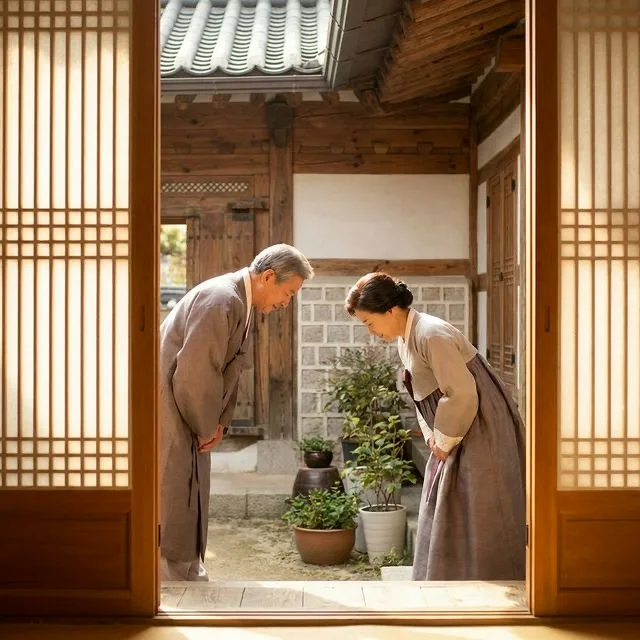
In the West, eye contact and a firm handshake are the hallmarks of confidence. In Korea, confidence is shown through humility. The bow is the most fundamental unit of Korean communication.
The Nuances of the Bow
Bowing is used for greetings, gratitude, apologies, and partings. The "depth" of your bow is a direct reflection of your respect for the other person’s social status relative to yours.
- The 15° "Casual" Bow: This is more of a rhythmic nod. Use this when entering a convenience store, passing a colleague in a hallway, or saying a quick "thank you" to a bus driver.
- The 30° "Respectful" Bow: This is the standard for most social interactions. Bend from the waist with your hands at your sides (or clasped in front for women). Use this for elders, teachers, or anyone you are meeting for the first time.
- The 45° "Formal" Bow: Reserved for showing deep respect to high-ranking individuals, during formal ceremonies, or when offering a sincere apology.
- The 90° "Extreme" Bow: Rarely expected from tourists. This is used in situations of profound gratitude or deep regret.
Pro-Tip: The "Double Hand" Handshake If a Korean offers a handshake, never respond with a one-handed, "Western-style" grip. Instead, use your left hand to support your right forearm or wrist while shaking. This indicates that you are putting your full effort and both hands into the interaction.
2. 2026 Digital Etiquette: Photography and Social Media
As a hyper-digital society, Korea has developed strict (and often legally enforced) norms regarding digital behavior. This is the area where modern travelers are most likely to run into trouble.
The "No-Lens" Culture
While Korea is one of the most Instagrammable places on earth, "candid" photography of strangers is a sensitive issue.
- Privacy Laws: In South Korea, taking a recognizable photo of someone’s face without their consent can lead to legal complaints under privacy protection acts. This is why you will notice that Korean news broadcasts and YouTube creators blur out almost every background face.
- Restaurant/Cafe Filming: Many high-end or "viral" cafes in Seongsu-dong or Hannam-dong have implemented "No-Filming" or "No-Commercial Photography" zones. Always check for signs before setting up a tripod.
- The "Model" Manners: If you are taking a photo of a friend and someone accidentally walks into the frame, it is polite to wait until they pass or to offer a small bow of apology for being in their way.
Silent Mode is Mandatory
Public transit is treated as a "shared quiet space."
- Phone Calls: Taking a phone call on a subway or bus is considered extremely rude. If you must answer, whisper and keep the call under 30 seconds.
- Shutter Sounds: Interestingly, by law, all smartphones sold in Korea must have a mandatory shutter sound when taking a photo to prevent surreptitious filming. Even as a tourist, using a camera in a very quiet space (like a library or a traditional temple) will draw negative attention.
3. High-Stakes Business Etiquette (Myeongham)
If you are in Korea for work in 2026, your business card (Myeongham) is more than just contact info—it is an extension of your professional identity.
The Business Card Ritual
- The Hand-off: Always present your card with both hands, with the Korean-translated side facing up and toward the recipient so they can read it immediately.
- The Reception: Accept their card with both hands. Do not grab it and stuff it into your pocket.
- The Study: Take 5-10 seconds to look at the card. Acknowledge their title (e.g., "Ah, Vice President Kim, thank you").
- The Placement: During a meeting, lay the cards out on the table in front of you in the order the people are sitting. This helps you remember names and shows you value their presence.
4. The Table Social Contract: Dining and Drinking
Korean dining is rarely a solitary affair; it is a communal ritual of sharing energy and food.
The Hierarchy of the First Bite
At any group meal, the "Dining Captain" is the eldest person or the highest-ranking official.
- Seating: The eldest should be seated in the "upper seat"—usually the one furthest from the door or facing the best view.
- The Start: No one picks up their utensils until the eldest person has started eating.
- The Pace: Try to match your eating speed to the group. If the eldest finishes, the meal is effectively over.
Utensil Taboos (Do Not Ignore)
- The Incense Trap: Never, under any circumstances, stick your chopsticks vertically into a bowl of rice. This mimics the way incense is offered to the dead at funerals. It is considered a "curse" or a dark omen at a dinner table.
- The Spoon-Chopstick Balance: Use your spoon for rice and soup, and your chopsticks for side dishes (Banchan). Do not hold both in one hand simultaneously.
- The "Lifting" Rule: Unlike in Japan or China, it is considered impolite to lift your rice or soup bowl off the table to eat. Keep the bowl on the table and use your spoon to bring the food to your mouth.
5. Pro-Level Entertainment: Noraebang and Drinking Games
If you survive dinner, you will likely be invited to a Noraebang (Karaoke Room) or a second round of drinks.
Noraebang Social Dynamics
Noraebang is not a performance; it is a bonding exercise.
- Sharing the Mic: Never "queue" three songs in a row. Let everyone have a turn.
- The Tambourine Duty: If you aren't singing, your job is to lead the applause or play the tambourine rhythmically to support the current singer.
- Song Choice: In 2026, K-Pop classics (Big Bang, SNSD) are always safe bets. If you can sing a simple Korean chorus, you will be a legend for the night.
2026 Drinking Games
To truly "read the room" (Nunchi), you might be dragged into a drinking game.
- Titanic: A small shot glass is floated in a large glass of beer. Players take turns pouring a tiny bit of Soju into the shot glass. The person who sinks the shot glass must drink the entire "Mekju-Soju" (Somaek) mixture.
- Baskin Robbins 31: Players take turns saying up to three consecutive numbers (e.g., "1, 2"). The person who is forced to say "31" must take a drink.
6. The 2026 Gift-Giving Guide (The Kim Young-ran Act)
Gift-giving in Korea is a complex dance of reciprocity. In 2026, the laws regarding gifts for public officials and teachers (the Kim Young-ran Act) have become even more strictly monitored.
| Scenario | Recommended Gift | Cultural Note |
|---|---|---|
| Visiting a Home | High-quality fruit, luxury cookies, or imported tea. | Avoid sets of 4 (the number 4 sounds like 'death'). |
| Business Meeting | Small items from your home country (local snacks, artisanal goods). | Wrap in bright colors (red/yellow/gold). Avoid green or black. |
| Thanking a Teacher | Nothing expensive. A handwritten card is best. | Direct gifts of value over ₩3,000 are often illegal for teachers to accept. |
| New Business/House | Potted plants or toilet paper/detergent. | Toilet paper symbolizes "bubbles" of wealth and things "unrolling" smoothly. |
7. Major 2026 Festivals: Seollal and Chuseok
If your trip falls on these dates, the social rules change.
Seollal (Lunar New Year) - Feb 17, 2026
- Logistics: Expect a "ghost town" in Seoul as everyone heads to their hometowns. Book your KTX tickets months in advance.
- Etiquette: If invited to a Seollal meal, you may see Sebae (formal bowing to elders). You are not expected to do it, but if you do, it’s a sign of incredible respect.
Chuseok (Harvest Festival) - Sept 24-27, 2026
- Rituals: This is a time for Charye (ancestor rites).
- Traveler Tip: Palaces like Gyeongbokgung usually offer free entry to anyone wearing Hanbok during this period.
8. Temple Stay: Ancient Etiquette for Modern Seekers
A Temple Stay is a 2026 travel "bucket list" item, but it requires a very specific set of behaviors.
The Temple Life Cycle
- The Entry: Pass through the "One Pillar Gate" (Iljumun). This symbolizes leaving the worldly world behind.
- The Bow: Whenever you see a monk or enter the main Buddha hall, offer a "Hapjang" (press palms together and bow slightly).
- The Dining (Barugongyang): You must eat in complete silence. Most importantly, you must finish every grain of rice. Monks take water and a piece of radish at the end to "clean" the bowl and drink the remaining water. No waste is permitted.
- The Silence: From 9:00 PM (Temple curfew) until the early morning 3:30 AM prayer, silence is strictly enforced.
9. Shoes and Space: The Threshold of Respect
In Korea, the physical boundary between "outside" and "inside" is a spiritual one.
The Removal Ritual
- Homes: Never, under any circumstances, wear shoes inside a Korean home. Even if the host says "It's okay," it’s often a test of your awareness. Always remove them at the Hyungwan (foyer).
- Temples and Some Restaurants: If you see a pile of shoes or a wooden shoe rack, follow suit.
- The "Socks" Standard: Ensure your socks are clean and free of holes. In 2026, many trendy "sit-down" cafes in Hanok villages still require shoe removal.
The Sacred Threshold
When entering a traditional building, never step directly on the raised wooden threshold (Mun-teok). Traditionally, it was believed that the spirit of the house resides there, and stepping on it brings bad luck. Step over it instead.
10. Public Behavior: The Shared Silence
Korea is a densely populated society that survives on a "social contract of collective peace."
Public Transport (Subways and Buses)
- Priority Seats: Even on a completely empty 2:00 AM train, do not sit in the seats reserved for the elderly, disabled, or pregnant. Locals will genuinely look at you with confusion or disdain.
- The Backpack Swing: During rush hour (8-9 AM, 6-7 PM), it is polite to wear your backpack on your front or place it between your legs. "Backpack striking" others in a crowded car is a major faux pas.
- The Whisper Standard: Keep conversations to a minimum. If you are with a group of friends, speaking at a "Western" volume will make the entire car uncomfortable.
Escalator Flow
- The Standing Side: In Seoul, stand on the right. The left side is a "high-speed" lane for people rushing to catch their train. In Busan, the rule is often the same, but always watch the person in front of you.
11. Gift Giving: Reciprocity in 2026
If you are invited to a Korean's home, showing up "empty-handed" is a sign of poor upbringing.
What to Bring
- The Classics: A nice cake from a local bakery (Paris Baguette or Tous Les Jours), a set of high-quality fruit, or a "luxury" tissue set if it's a housewarming.
- The Presentation: Always hand the gift over with both hands. Do not expect the host to open it in front of you; in Korea, opening a gift immediately can be seen as greedy. They will likely set it aside and open it after you leave.
12. The Psychological Architecture of Korea: Understanding the "Invisible" Rules
To truly navigate South Korea in 2026 with grace, one must understand the four psychological pillars that sustain its social fabric: Kibun, Nunchi, Chemyeon, and Jeong. These aren't just vocabulary words; they are the invisible operating system of Korean life.
Kibun (기분): The Group's Emotional Weather
Kibun is often translated as "mood" or "feeling," but for a Korean, it is far more than that. It is a person's inner peace, pride, and sense of dignity as acknowledged by others.
As a traveler, your primary goal is to maintain the Kibun of those around you.
- The "White Lie": In Korea, it is sometimes considered more polite to tell a "white lie" or give an ambiguous answer than to deliver a blunt, harsh truth that would damage someone’s kibun. If you ask a shopkeeper if a shirt looks good on you, and they say "It is unique," they might be trying to protect your kibun rather than telling you it’s unflattering.
- Atmosphere Management: If you are in a group, avoid outbursts of anger or frustration, as this "contaminates" the shared kibun of the room.
Nunchi (눈치): The "Eye-Measure"
If you have "good Nunchi," you are a social genius. Nunchi is the art of reading the room—detecting the unspoken feelings and needs of others through body language, tone, and context.
- The Quiet Observer: In 2026, as you navigate a high-end cafe in Seongsu-dong, use your nunchi. If everyone is whispering, you whisper. If everyone has cleared their own trays to a specific station, you do the same.
- Anticipating Needs: If you see an elder looking for a seat, don't wait for them to ask. Use your nunchi to see their discomfort and offer your seat proactively. This is the highest form of social intelligence in Korea.
Chemyeon (체면): The Weight of "Face"
Chemyeon is "social face" or reputation. It is not just about how you see yourself, but how the community perceives you.
- Public Correction: Never correct or criticize someone—especially someone older or of higher status—in front of others. This "breaks" their chemyeon and causes profound embarrassment. If you must disagree, do it privately and with great humility.
- The "Saving Face" Ritual: If someone makes a minor mistake (like a waiter dropping a fork), it is often polite to ignore it rather than pointing it out. By ignoring it, you allow them to keep their chemyeon intact.
Jeong (정): The Invisible Connection
Jeong is perhaps the most beautiful and complex concept. It is a deep, collective bond that develops over time through shared experiences, mutual support, and "sticky" emotional attachment.
- The "Service" Bonus: Have you ever been to a restaurant and the owner suddenly brings you a free extra dish? That is "Service" (Seo-bi-seu), a physical manifestation of Jeong. They have felt a connection with you and want to show it through generosity.
- The Traveler's Reward: When you show respect, use your nunchi, and protect others' chemyeon, you will often be met with overwhelming Jeong. You’ll find yourself being invited into conversations, gifted extra food at markets, and treated not as a tourist, but as a "guest of the heart."
Conclusion
At its heart, Korean etiquette is about Nunchi (눈치)—the art of "reading the room." It is the ability to sense others' feelings and social needs without them being explicitly stated.
Koreans don't expect travelers to be masters of Confucian philosophy. They appreciate the effort. If you accidentally mess up, a quick "Joesong-hamnida" (I'm sorry) and a sincere bow will fix almost any situation. The key is awareness. By watching what locals do and following their lead, you'll find that Korea is one of the most rewarding and respectful places to explore as a guest.
Continue your cultural immersion by mastering the basics of the SIM Card vs. Pocket WiFi setup to stay connected, or prepare for your next feast with our guide to South Korea's Street Food Markets. If you're planning a trip during the colder months, don't miss our Winter in Korea Survival Guide.