Mastering Seoul's Transport System: Bus Colors, Transfer Discounts, and The Pink Seat

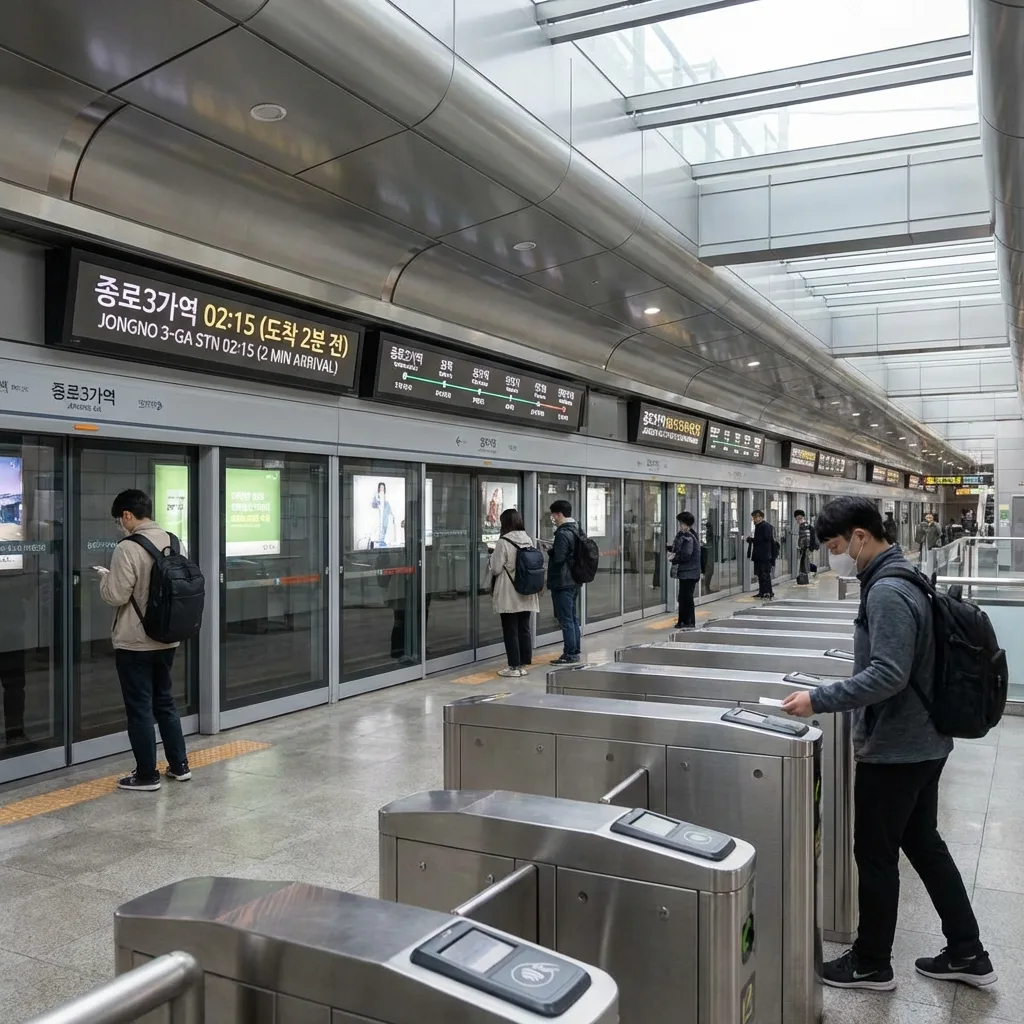
Seoul's public transportation system is often cited as one of the best in the world. It is clean, hyper-efficient, and covers every inch of the city.
but it is also a complex web of color-coded buses and silent rules. To save money and avoid getting lost, you need to understand the Hwanseung (Transfer) system and the logic behind the colors.
Stop wasting money on taxis. Here is how to navigate Seoul like a local.
1. Decoding the Bus Colors
Seoul's buses are not colored randomly. The color tells you exactly where the bus goes and how fast it moves.
💙 Blue Bus (Ganseon) -> "The Long Haul"
- Role: Connects major districts (e.g., Gangnam to Jongno) via main roads.
- Speed: Fast. They use the center dedicated bus lanes.
- Numbering: 3 digits (Start Zone + End Zone + Route ID).
💚 Green Bus (Jiseon) -> "The Connector"
- Role: Shorter routes that connect residential neighborhoods to the nearest subway station or Blue Bus stop.
- Vibe: They weave through smaller streets and twisty roads.
- Numbering: 4 digits.
- Village Bus (Maeul Bus): A smaller, lime-green mini-bus. These go deep into the hills and narrow alleys where big buses can't fit.
❤️ Red Bus (Gwangyeok) -> "The Express"
- Role: Connects Seoul to satellite cities (Bundang, Suwon, Incheon).
- Rule: Standing is illegal on Red Buses because they travel on highways. If the seats are full, the driver will not let you board.
- Price: More expensive than Blue/Green buses.
💛 Yellow Bus (Sunhwan) -> "The Loop"
- Role: Circles specific tourist or business districts.
- Famous Route: The Namsan Tower bus is yellow (and electric).
1.5 Reading a Bus Stop Sign
This is the skill that separates tourists from travelers. Seoul's bus stop display boards are packed with information — if you know how to read them.
Every major bus stop has a digital LED board mounted on a pole or shelter. At first glance, it looks like a wall of Korean numbers and characters. Here is how to decode it:
The Route Number Column: On the left side of the board, you will see the bus route numbers listed vertically. They are color-coded to match the bus type: blue for Ganseon, green for Jiseon, red for Gwangyeok. Even if the route name is in Korean, the color and number are enough to identify the bus you want.
The Arrival Countdown: Next to each route number, you will see a number followed by "분" (minutes) or "초" (seconds), or sometimes just the characters for "곧 도착" which means "arriving soon." This is a real-time countdown pulled from GPS transponders on every bus. It is extraordinarily accurate — far more reliable than the bus arrival apps you may be used to at home.
The Stop Count: Some boards also display "X 정거장 후" which means "X stops away." This gives you a physical sense of distance rather than just time, which is useful when the arrival countdown seems slow.
When the Board is Korean-Only: Most modern stops in tourist-heavy areas (Myeongdong, Insadong, Hongdae) have bilingual boards that cycle between Korean and English. But in residential neighborhoods, you may encounter Korean-only displays. In this situation, open Naver Map, search for your destination, select the bus route, and tap "Real-time." Naver will mirror the same GPS data from the official Seoul Transport system, giving you the countdown in English.
The QR Code: Look for a small QR code sticker on the stop pole itself. Scanning it takes you directly to the Seoul Bus real-time page for that exact stop — no need to type anything.
One practical tip: Seoul buses arrive and depart quickly. When your bus is two stops away ("2 정거장 후"), position yourself at the edge of the curb and have your transit card in hand. Drivers will not wait more than a few seconds.
2. The Transfer System (Hwanseung)
In Seoul, the bus and subway act as one unified network. You don't pay double if you switch modes.
- The Rule: You can transfer up to 4 times for FREE (paying only for the extra distance).
- The Condition: You must transfer within 30 minutes (extended to 60 minutes after 9 PM).
- The Golden Rule: You MUST TAP OUT when you exit.
- Entering: Tap your card at the front door.
- Exiting: Tap your card at the rear door.
- The Penalty: If you forget to tap out, the system assumes you went to the end of the line. You will be charged double the maximum fare on your next ride.
2.5 The Fare Structure: How Much Will You Actually Pay?
Knowing the color codes is useful. Knowing exactly what it will cost you is better. Seoul's fare system is distance-based, not zone-based, which means the further you travel, the more you pay — but the increases are modest and the base fare is remarkably low.
Base Fare (as of 2026):
- Card: approximately 1,500 KRW for adults on buses and subway
- Cash: approximately 1,700 KRW — around 200 KRW more, every single time
The message is clear: always use a transit card. Cash riders pay a convenience penalty on every single journey, and there is no legitimate reason for a tourist to pay it. T-Money cards are available at every convenience store (GS25, CU, 7-Eleven) for around 3,000 KRW, and you can top them up at subway station machines or convenience store counters.
The 10km Free Zone: For the first 10 kilometers of your journey, you pay only the base fare. No additional charge, no matter how many transfers you make within that distance, as long as you stay within the 30-minute transfer window. For context, 10 kilometers covers most cross-city tourist trips — Hongdae to Gyeongbokgung is roughly 6km, Myeongdong to Dongdaemun is about 4km.
Distance Surcharge: Beyond 10km, a surcharge of 100 KRW is added for every additional 5km traveled. This is a flat rate and accumulates slowly.
A Sample Calculation for a Tourist Day: Imagine your day: you start at your Hongdae guesthouse and take a Green bus to Hongdae Station (1km), transfer to Line 2 subway to Euljiro 1-ga (7km), then hop a Blue bus to Gyeongbokgung Palace (3.5km). Total distance: 11.5km.
- Base fare: 1,500 KRW
- Distance surcharge (1.5km over the 10km threshold, rounded to the next 5km bracket): 100 KRW
- Total: 1,600 KRW for a journey that would have cost 12,000-15,000 KRW in a taxi.
The Hwanseung system is, simply put, one of the most tourist-friendly fare structures on earth. Use it aggressively.
3. Subway Survival Guide
- Fast Transfer: Look for the numbers on the platform screen door (e.g., "5-3"). This means if you are in Car 5, Door 3, you will step out directly in front of the escalator for your transfer. Apps like KakaoMetro show this info.
- Rush Hour: Avoid Line 9 (Gold Line) Express trains between 7:30 AM - 9:00 AM. It is nicknamed the "Hell Train" because it is physically crushing.
- The Pink Seat: As mentioned in our social customs guide, the pink seats at the end of the car are for pregnant women only. Never sit there.
The 9 Lines at a Glance
Seoul's subway has 9 main numbered lines plus several additional rail lines. Tourists use maybe five of them regularly. Here is what you need to know about each:
Line 1 (Dark Blue) — The Grandfather: Seoul's oldest line, opened in 1974. It is slow, it is loud, and the trains look like they remember the 1990s fondly. But it connects Incheon Airport's city terminal area, passes through Seoul Station, and serves Dongdaemun. Functional, not fashionable.
Line 2 (Green Circle) — The Most Important Line You Will Ride: This is the circular line that loops the inner city and intersects with almost every other line. Hongdae, Sinchon, City Hall, Euljiro, Dongdaemun History & Culture Park, Kondae, Jamsil — all on Line 2. If you are going anywhere significant in Seoul, Line 2 probably touches it. Learn this line first.
Line 3 (Orange) — The Palaces Line: Runs through Gyeongbokgung, Anguk (for Bukchon Hanok Village), and Insadong-area stops. Essential for cultural sightseeing in the northern part of the city.
Line 4 (Blue) — The Museum Line: Serves Myeongdong, Dongdaemun, and Sadang. Connects to Line 2 at Sadang, which is a critical southern transfer hub.
Line 5 (Purple) — The Airport Express Alternative: Runs across the widest east-west span of the city. Useful for reaching Yeouido (financial district) and Gimpo Airport.
Line 6 (Brown) — The Hidden Gem: Serves Itaewon and the expat dining corridor. Underused by tourists, which means it is blessedly uncrowded.
Line 7 (Dark Olive) — The Outer Ring: Useful for reaching Konkuk University area (Kondae) from the south without changing lines.
Line 9 (Gold) — The Fast One: Express service that rockets between Gimpo Airport and Sinnonhyeon in Gangnam. It cuts travel time dramatically — and it is absolutely ruthless during rush hour. The "Hell Train" nickname is not an exaggeration. Avoid express trains before 9 AM and between 6-8 PM unless you enjoy being a human accordion.
Sinbundang Line (Red, Private) — The Luxury Option: Connects Gangnam's Sinnonhyeon station all the way down to Gwanggyosan in Gyeonggi Province. The trains are wide, air-conditioned to arctic levels, and the seats have armrests. It costs slightly more than the regular subway, but it serves the tech corridor in Pangyo and is a significantly more pleasant experience than any other line. Tourists rarely need it, but it is worth knowing for day trips south of Seoul.
Gyeongui-Jungang Line (Blue, Commuter) — The Day-Tripper Line: This is how you reach Hongdae from the airport (Gongdeok station), and how you escape Seoul for a day trip to Gapyeong (for the Nami Island ferry) or Yangpyeong. It operates like a commuter rail with larger gaps between trains — check the schedule before you rely on it for a late-night return.
Subway Etiquette That Koreans Don't Tell You
Seoul is a city with very high social expectations in public spaces. Nobody will scold you for getting it wrong, but they will notice. Here is the silent rulebook:
Phone Calls: Taking a phone call on the subway is considered rude. If your phone rings, the socially acceptable response is to whisper "I'm on the subway, I'll call you back" and hang up. You will see this happen constantly. Even Koreans who receive calls from their boss follow this protocol.
Eating on Trains: Technically not prohibited, but deeply frowned upon. The exception is if you are on a long-distance commuter line (Gyeongui-Jungang) where the journey takes 40+ minutes. On the main city lines, keep food in your bag. A bag of chips on a crowded Line 2 train will earn you cold stares from every passenger within range.
Priority Seating for the Elderly: The blue seats in the middle of each car are regular seats. The designated priority seats — usually at the ends of the car, marked with older-person iconography — are expected to remain empty unless the car is completely full. Koreans in their 20s and 30s will stand for an entire 40-minute journey rather than sit in a priority seat. Follow their lead.
The Door Culture: When the doors open, passengers exit before anyone boards. This is universally observed. If you step onto a Seoul subway car before the exiting passengers have cleared, you will cause a human traffic jam and experience a level of social disapproval that is entirely silent but entirely unmistakable.
Escalator Standing: Stand on the right side of escalators. The left side is for walking. This is true everywhere in Seoul — subway stations, shopping malls, department stores. It is enforced not by signs but by the sheer social pressure of 500 people in a hurry.
4. App Battle: Naver vs Kakao vs Google
- Google Maps: Good for finding places, but bad for walking/driving directions due to local mapping laws. Do not rely on it for estimated travel times.
- Naver Map: The gold standard. It shows real-time bus locations, how crowded a bus is (Empty/Normal/Crowded), and the best exit number. Has a full English interface.
- KakaoMetro: The best app specifically for subway navigation. It tells you exactly which car to board for the fastest transfer.
4.5 Bus Lane Rules and the Center Lane
One of the most distinctive features of Seoul's road system is the center bus lane — a dedicated lane running down the literal middle of major boulevards, separated from regular traffic by a solid yellow line and, on most roads, a physical barrier. It sounds counterintuitive at first. Once you understand it, you will see why Seoul's buses routinely beat taxis during rush hour.
How the Center Lane Works:
On wide arterial roads like Gangnam-daero, Jongno, and Teheran-ro, the two center lanes are reserved exclusively for buses. The bus stops for these lanes are on islands in the middle of the road, accessed by pedestrian crossings. You will walk to the center of a six-lane boulevard, wait on a platform, and board a bus from the median. It is perfectly safe and remarkably efficient.
The logic is elegant: regular traffic backs up at intersections and merges. Buses in the center lane bypass all of that. During peak hours, a Blue bus on Gangnam-daero can travel from one end of the boulevard to the other in a fraction of the time a taxi spends sitting in right-side traffic.
Bus-Only Hours:
The center lanes are enforced during two windows: 7:00 AM to 9:00 AM and 6:00 PM to 9:00 PM on weekdays. Outside these hours, and on weekends, regular vehicles are technically permitted to use the center lane — though most do not, out of habit and because Seoul's traffic management cameras are everywhere.
How to Use a Center-Lane Stop:
- Look for a pedestrian crossing that leads to an island platform in the road's center.
- Wait for the pedestrian signal, then cross to the island.
- Check the stop board for your bus number and the arrival countdown.
- Board from the island — the bus doors align with the platform edge.
Why This Matters for Tourists:
If you are standing at a roadside stop and your Blue bus route is not arriving, check whether the same route has a center-lane stop a few meters ahead. Many routes stop at both the curb and the center island at different points. Missing the center-lane stop is one of the most common navigation errors first-time visitors make.
Also: taxis cannot use the center lane during enforcement hours. If you are tempted to take a taxi across Gangnam during evening rush, your driver will sit in the same gridlock as everyone else while buses glide past in the center. The bus wins. It almost always wins.
5. Late Night? The "Owl Bus" (N-Bus)
Subways stop around midnight. But Seoul never sleeps.
- The "N" Bus: Night buses run from midnight to 4 AM.
- Identification: Look for an "N" before the number (e.g., N62).
- Crowds: They are vastly popular with students and party-goers on weekends, so expect a squeeze.
After midnight, your transit card still works on N-Buses. The Hwanseung transfer system also applies, so you are not locked out of the discount network just because it is 2 AM.
Finding the N-Bus Route Map:
The Seoul Metropolitan Government publishes the full night bus network on the official Seoul transport website (bus.go.kr), and Naver Map includes N-Bus routes in its directions feature. In Naver, simply enter your destination and set the time to after midnight — the app will automatically route you via night buses rather than the now-closed subway. KakaoMetro does not cover N-Buses, as it is subway-only.
Areas Well-Covered at Night:
Night bus coverage is concentrated on the routes that matter most after midnight. Hongdae, Sinchon, and the university corridor along Line 2 are exceptionally well-served — the N62, N13, and several other routes run frequently along these corridors because the demand is constant and predictable. Gangnam, Itaewon, and Apgujeong are also well-connected, with multiple N-Bus routes linking the entertainment districts to residential areas south of the Han River. Myeongdong and the Dongdaemun 24-hour shopping district have reliable coverage as well.
Areas Poorly Served at Night:
Suburban districts and newer outer neighborhoods are the weak spots. If you are staying in areas like Nowon, Dobong, or the far western reaches of Guro and Yangcheon, the N-Bus routes thin out significantly. Frequencies drop to one bus every 30-50 minutes, and some stops only appear on one route. In these areas, a late-night taxi becomes a genuine necessity rather than a luxury.
Tips for Getting Home Safely After a Late Night:
- Plan before you go out. Check the N-Bus route from your entertainment destination back to your accommodation before the evening starts. If the route is thin, identify the nearest taxi rank now rather than at 2 AM.
- Use KakaoTaxi. This is Korea's dominant ride-hailing app (similar to Uber in function, but local). It works reliably late at night, has English-language support, and allows in-app payment. Do not attempt to hail a street taxi in Hongdae at 2 AM on a Friday — the competition for cabs is fierce.
- The Bus Stop Display Still Works at Night. N-Bus stops have the same real-time arrival displays as daytime stops. The countdown is accurate. Trust it.
- Keep Your Transit Card Topped Up. Nothing is worse than arriving at a night bus stop at 1:30 AM and discovering your T-Money balance is 200 KRW. Top up at any convenience store — GS25 and CU are open 24 hours, and the top-up takes thirty seconds.
Seoul's transit system is one of the great gifts this city gives foreign visitors — clean, cheap, and nearly impossible to get lost in. Start with the complete guide to public transportation in South Korea if you want the nationwide picture. If you have not bought your card yet, use the T-Money guide. To choose between pass products, compare K-Pass, Climate Card, and T-Money. And if your Seoul stay ends with an intercity move, the Seoul to Busan transport comparison shows how to leave the capital efficiently.