Jeju Island Itinerary: The Ultimate Road Trip Guide
Jeju Island sits 100 kilometers off the southern tip of the Korean peninsula, and it feels like a different country entirely. The island is volcanic in every sense — built by eruptions over millions of years, the landscape is defined by black basalt columns, lava tube caves stretching for kilometers underground, and a dormant shield volcano that rises 1,947 meters above sea level at the center of everything. The beaches are real beaches: white sand in the west, black volcanic sand in the south, water clear enough to see the bottom in ten meters. When Koreans talk about taking a "real vacation," they usually mean Jeju.
This island is roughly three times the area of Seoul, and getting around without personal transport is genuinely frustrating — buses run on 40 to 60-minute intervals in rural areas, and many of Jeju's best attractions are not accessible by public transit at all. This guide is built around a 3-day self-drive itinerary that covers the island's essential geography: the eastern volcanic coast, the southern waterfall and cliff zone, and the western tea fields and sunset beaches. It also covers the logistics that trip up most first-time visitors, from the International Driving Permit requirements to the Hallasan reservation system.
Crucial Logistics: Renting a Car
Why You Must Drive
Jeju's bus system covers the major towns, but the distances between specific attractions and the infrequency of rural routes make bus-only travel a scheduling nightmare. A 15-minute drive by car becomes a 90-minute bus-and-walk operation. Renting a car changes the calculus entirely: you can be at Seongsan Ilchulbong before the tour groups arrive, drive the Ring Road at sunset without checking bus times, and stop spontaneously at a coastal pull-off because the view demanded it.
Jeju's roads are excellent, traffic outside of Jeju City is minimal, and the island is small enough that getting genuinely lost is difficult. For non-Korean drivers, this is one of the easiest driving experiences in Asia.
The International Driving Permit (IDP) — The Most Common Failure Point
Half of travelers who plan to drive in Jeju end up stranded at the rental counter because they have the wrong IDP or no IDP at all. Here is exactly what is required:
You must have a physical IDP booklet issued under the 1949 Geneva Convention.
The 1949 Convention IDP is a small booklet (not a card or a phone screen) issued by an authorized motoring organization in your home country. In the United States, this is AAA. In the United Kingdom, the AA or RAC. In Australia, the NRMA or equivalent state automobile club.
What is rejected by Korean rental companies:
- Digital IDPs or PDF printouts (not accepted anywhere in Korea)
- IDPs issued under the 1968 Vienna Convention — Korea is not a signatory to this convention. Germany, France, and several other European countries issue Vienna Convention IDPs. If you are from one of these countries, you must specifically request a 1949 Geneva Convention IDP from your automobile club, not the default one.
- Any expired IDP (they are typically valid for one year from issuance)
Getting the IDP before travel: Apply through your automobile club at least two weeks before departure. The process requires your valid national driving license and passport-style photos. It is inexpensive (typically $20 to $50 USD equivalent) and valid internationally.
Rental logistics: Multiple car rental companies operate at Jeju International Airport, with pick-up desks in the arrivals hall. Book in advance for peak season (summer, autumn foliage, and Chuseok/Seollal holidays). A compact car runs 60,000 to 90,000 KRW per day with basic insurance; fully comprehensive coverage adds 15,000 to 25,000 KRW per day and is worth it for peace of mind on unfamiliar roads.
Understanding Jeju's Geography
Jeju is an oval island approximately 73 kilometers east-to-west and 41 kilometers north-to-south. The main coastal road (Route 1132) loops around the entire perimeter, making orientation easy. The interior rises toward Hallasan, with smaller roads cutting inland to the mountain's trailheads.
The four quadrants have distinct characters:
North (Jeju City): The island's main city, airport, and ferry terminal. Traffic-heavy, urban, good for accommodation and logistics but not for scenery. Base here only if your ferry or early flight requires it.
East (Nature Coast): The volcanic eastern coast contains Seongsan Ilchulbong, the ferry to Udo Island, and some of the most dramatic lava tube coastline on the island. This is where to start the road trip.
South (Seogwipo): The island's second city sits on the warmer southern coast, surrounded by waterfalls, hexagonal basalt columns, and the best resort hotel infrastructure. Warmer microclimate than the north, excellent food scene.
West (Aewol and Hallim): Green tea fields, artisan cafes along the Jeju Olle coastal walking trail, the most dramatic sunset views, and a slower, more agricultural atmosphere than the east coast.
Day 1: The Eastern Volcanic Coast
Start the road trip heading east from Jeju City. This is the most photographically concentrated section of the island and benefits from early starts before tour groups arrive.
Seongsan Ilchulbong — Sunrise Peak (성산일출봉)
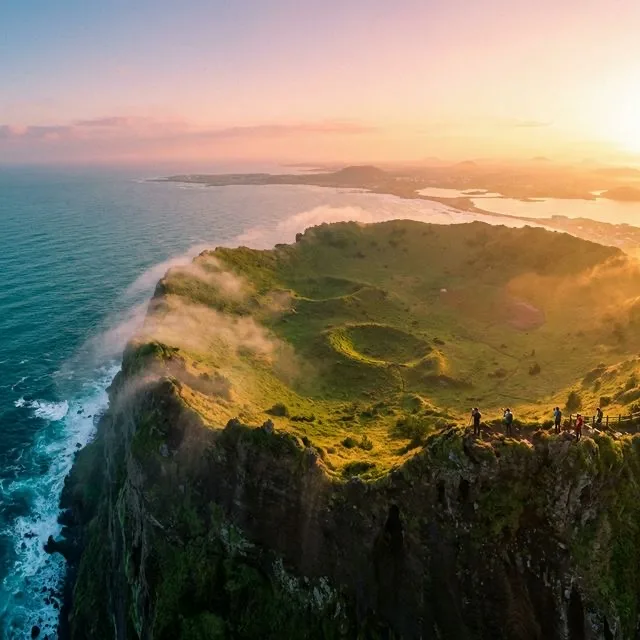
The defining image of Jeju: a massive green volcanic crater rising from the sea like a fortress, its rim toothed with 99 basalt columns formed by the cooling of ancient lava. Seongsan Ilchulbong is a UNESCO World Heritage Site and the most visited single attraction on the island for good reason — its silhouette is genuinely stunning, and the view from the crater rim across the surrounding sea justifies the 30-minute stair climb.
The hike: The trail to the crater rim is approximately 1.5 kilometers one-way, with a steep final section of stone stairs. Most reasonably fit visitors reach the top in 25 to 35 minutes. The crater interior cannot be entered — views from the rim are the destination.
Timing: Seongsan means "Sunrise Peak" and the stated ideal experience is sunrise. During clear conditions, the sunrise from the rim is extraordinary — the sea on three sides, the shadows withdrawing from the valleys below. Arriving at 6:00 a.m. during summer or 7:00 a.m. in autumn puts you ahead of the tour buses. Entry costs 2,000 KRW.
After the hike: The haenyeo diving performance at the base of the rock (haenyeo are Jeju's famous female free divers) typically runs mid-morning at 1:00 p.m. and 3:00 p.m. The haenyeo bring their catch of sea urchins, abalone, and various shellfish directly to the surface and sell them on the rocks — eating sea urchin roe (uni) scooped from a live urchin at the base of Seongsan is an experience specific to this location.
Udo Island (우도, Cow Island)
A 15-minute ferry from Seongsan Port takes you to Udo, a small volcanic island roughly 6 kilometers around. The ferries run every 30 minutes from 7:30 a.m. to 6:30 p.m. and cost approximately 7,700 KRW round-trip. You can bring your rental car on the ferry, but the island has its own rental options — most visitors leave the car on the mainland and rent electric scooters, bicycles, or the distinctive small three-wheeled electric carts that zip around the island's single main road.
What to see on Udo: The island's southern tip has a beach called Seobin Baeksa with white sand made of crushed coral — unusual for volcanic Jeju. The northeastern point offers views back across the water toward Seongsan. The central village has cafes, restaurants, and the island's signature product: peanut ice cream (udon is famous for its peanut cultivation, and the locally made peanut soft-serve is worth the ferry trip alone).
Allow 3 to 4 hours for Udo including ferry waits.
Evening: Seogwipo City
Drive south (approximately 45 minutes from Seongsan) to base in Seogwipo for night 1. The city sits on the southern coast and is warmer, quieter, and more resort-oriented than Jeju City. The harbor area has good seafood restaurants — Jeonbok Juk (abalone porridge) is a specifically Jeju specialty and makes an excellent dinner at one of the harbor restaurants (15,000 to 25,000 KRW for a bowl that is both delicious and deeply comforting).
Day 2: The Southern Coast
Jeongbang Waterfall (정방폭포)
Fifteen minutes east of Seogwipo, Jeongbang Waterfall is the only waterfall in Asia that falls directly into the ocean. The 23-meter drop sends water from a stream directly off a basalt cliff face into the sea below — there is no river delta or beach between the cliff and the open water. Standing at the base (reached via a short but steep stone stairway), with the spray in your face and the sea behind you, is one of the more dramatic physical experiences Jeju offers.
Entry costs 2,000 KRW. Visit in the morning before crowds build.
Cheonjiyeon Waterfall (천지연폭포)
A ten-minute drive west of Jeongbang, Cheonjiyeon is a different kind of waterfall experience — inland rather than coastal, surrounded by tropical trees including rare Canary Island date palms that grow nowhere else in Korea due to Seogwipo's exceptionally mild microclimate. The walk to the falls follows a forested river gorge. Entry costs 2,000 KRW.
Jusangjeolli Cliff (주상절리)
The drive west along the southern coast passes Jusangjeolli, where columnar basalt formations — hexagonal pillars of cooled lava — form a cliff face directly above the sea. The comparison to Ireland's Giant's Causeway is accurate but understates Jusangjeolli's scale: the columns here are larger and the setting more dramatic, with waves actively crashing against the base. The viewing platform above the cliff is free; the full coastal walk section costs 2,000 KRW.
Seogwipo Olle Market (올레 시장)
Evening dinner in Seogwipo's covered market is the recommended option for night two. The market operates daily and has an excellent food section with several categories worth attention:
Heuk-Dwaeji BBQ (Black Pork): Jeju's native black-haired pig produces meat that is fundamentally different from standard Korean pork — chewier, richer in fat marbling, more assertive in flavor. It is grilled over charcoal and typically eaten with mel-jeot (salted anchovy sauce), not the standard sesame oil and salt that accompanies mainland pork BBQ. Multiple restaurants in and around the market specialize in this; expect to pay 20,000 to 30,000 KRW per person for a full meal.
Fresh Sashimi (회): Seogwipo's fishing heritage means the sashimi here is fresh and competitively priced compared to Seoul. A platter of mixed local fish (modeumhoe) for two people runs 35,000 to 50,000 KRW and is typically significantly more interesting than Seoul raw fish options.
Day 3: The Western Coast
Osulloc Tea Museum (오설록 티 뮤지엄)
Korea's most extensive tea cultivation happens in western Jeju, where the volcanic soil and maritime climate produce green tea with distinct mineral characteristics. The Osulloc Tea Museum sits in the center of the company's tea fields — rolling green rows that stretch to the horizon, backed by Hallasan in the distance. The museum itself is free; the attached cafe sells green tea-based products of quality: the green tea roll cake and green tea soft-serve ice cream are the standards.
The fields are photogenic year-round but particularly beautiful in early June (when the new growth is vivid green) and in autumn when the surrounding hills change color around the uniform tea rows.
Bunjae Artpia (분재 아트리아)
Adjacent to the tea museum, the Bunjae Artpia bonsai garden contains hundreds of dwarf trees — some over 1,000 years old — in a garden setting that juxtaposes the miniature trees against Jeju's volcanic landscape. This is a quieter, more contemplative experience than the museum and recommended for those with an hour to spare.
Aewol Cafe Street (애월 해안도로)
The northern coast road between Aewol and Jeju City is lined with dramatic sea views and, increasingly, with high-concept cafes that have become the photographic heart of Jeju's Instagram identity. G-Dragon's former cafe (the Big Bang singer once operated a Monsant restaurant here) put the strip on the cultural map; now dozens of architect-designed coffee spaces occupy the coastal buildings, each competing for the most dramatic ocean view.
The Cafe Bora branch and % Arabica have Aewol outposts; the views from their window seating are legitimately spectacular. Budget an afternoon for slow cafe-hopping with sunset as the culmination.
Hyeopjae Beach (협재해수욕장)
The final stop before returning to Jeju City for departure: Hyeopjae Beach, where the water color — shallow, translucent turquoise over white sand — genuinely rivals Southeast Asian standards that most visitors consider unreachable in Korea. The beach faces the small island of Biyangdo, which provides a picturesque focal point for sunset photography. Water temperature is swimmable from June through September.
Special Topic: Hiking Hallasan
For those wanting to summit Korea's highest peak (1,947 meters), Hallasan requires advance planning that most casual visitors overlook.
Reservation mandatory: Since 2020, Hallasan's summit trails require an advance reservation through the national park system. The two summit trails — Seongpanak (9.6km one-way) and Gwaneumsa (8.7km one-way, more challenging) — both have reserved slot systems. Book at least 2 to 3 weeks in advance, as slots fill rapidly during peak season. The national park website (jeju.knps.or.kr) handles reservations.
The time constraint: Hikers must reach the summit checkpoint by 12:30 p.m. on Seongpanak and 12:00 p.m. on Gwaneumsa. This requires starting by 7:00 to 8:00 a.m. from the trailheads.
The non-reservation alternative: The Eorimok Trail on the western flank and the Yeongsil Trail in the southwest offer spectacular crater-adjacent scenery without requiring summit reservations. These trails reach the rim of Hallasan's crater at the Witseoreum shelter (1,700 meters) with full mountain views but without reaching the true summit. No reservation required; allow 3 to 4 hours round trip.
Practical Information
Getting to Jeju: Frequent flights from Seoul Gimpo Airport (50 minutes) and Seoul Incheon Airport (1 hour 10 minutes) connect to Jeju International Airport. This is one of the world's busiest domestic routes; flights run every 15 to 30 minutes during peak periods. Ferries from Mokpo, Wando, and Busan also serve Jeju for those wanting a nautical crossing, but flights are significantly faster.
Accommodation: Jeju City and Seogwipo both have wide hotel selections. For road trip logistics, two nights in Seogwipo (better positioned for the east and south attractions) and one night in Jeju City or Aewol (for the western coast and airport departure) works well for a 3-day itinerary. For curated picks including resort hotels and traditional pension houses, our guide to the best resorts and pension houses in Jeju covers options for every budget.
Weather: Jeju has its own distinct climate, generally 3 to 5 degrees warmer than Seoul. The southern coast (Seogwipo) is even milder. Typhoon season (July through September) can bring heavy rain and wind; check forecasts carefully. The island's nickname in Korea includes "Korea's most divorced city" — a reference to the frequency of disappointing rainy-day Jeju trips. If your dates are flexible, autumn offers the best weather reliability.
If you're wondering when exactly to plan this island road trip to avoid the humid monsoon season or bitter winter winds, our breakdown of the Best Time to Visit South Korea will help you choose the ideal month. For travelers pairing Jeju's natural wonders with mainland highlights, hopping a quick flight to the mainland allows you to seamlessly continue your coastal adventures in our Complete Guide to Busan. Alternatively, if you want a stark contrast to Jeju’s pristine geography, immerse yourself in the deep historical roots detailed in our Gyeongju Travel Guide.