Gyeongju Travel Guide: The Museum Without Walls

If Seoul represents the hyper-modern, fast-paced face of 21st-century South Korea, Gyeongju undeniably represents its ancient, enduring soul. For almost an entire millennium—from 57 BC to 935 AD—this relatively small city in the southeastern corner of the Korean peninsula stood proudly as the capital of the Silla Kingdom.
Today, Gyeongju is universally referred to by Koreans as "the museum without walls." This is not merely a poetic moniker; it is a literal description. You quite literally cannot turn a corner, dig a hole, or gaze out a window in the city center without seeing a millennia-old royal tomb, the ruins of a sprawling palace, or a delicately carved stone pagoda. The entire historical center, along with the surrounding mountains, forms the Gyeongju Historic Areas, a designated UNESCO World Heritage site.
However, Gyeongju is no longer just a sleepy town filled with old ruins visited only by middle school students on mandatory history field trips. In recent years, it has astonishingly transformed into one of the trendiest and most photogenic travel destinations for young Koreans, driven largely by the explosive cafe culture of Hwangnidan-gil.
If you are planning an itinerary to South Korea, dedicating at least two full days to Gyeongju is essential. Here is your comprehensive guide to stepping back in time while enjoying the modern aesthetic boom of Silla's ancient capital.
1. Getting Around: The Bicycle City
Unlike the mountainous terrain that characterizes Seoul and Busan, the central historical district of Gyeongju is incredibly flat and geographically compact. Because the city strictly limits the height of modern buildings to preserve the views of the ancient royal tombs, the skyline is remarkably low and open.
This combination of flat terrain and clustered historical sites makes Gyeongju the unequivocal best city in South Korea to explore on two wheels.
- Getting to Gyeongju: Most travelers take the KTX high-speed train from Seoul to Singyeongju Station. For a full breakdown of train options, see our guide on how to book KTX tickets in Korea.
- Renting a Bike: As soon as you step out of the Gyeongju Intercity Bus Terminal or the Express Bus Terminal, you will be greeted by dozens of rental shops. You can rent a standard city bike, a tandem bike for couples, or even a cute pink electric scooter. Rental prices are incredibly cheap, usually hovering around 5,000 to 10,000 KRW for a full day.
- The "Tasila" Service: For the ultra-budget traveler, Gyeongju operates a public bicycle-sharing system called "Tasila" (a play on words combining 'Ride' and 'Silla'). You can download the app and pick up or drop off bikes at numerous automated stations scattered throughout the tourist zones.
- The vibe: There is nothing quite like the feeling of pedaling down a quiet, tree-lined avenue in the crisp autumn air, with massive, grass-covered royal tombs rolling by on your left and mountains framing the distance.
2. Exploring the City Center (The Royal Belt)
The vast majority of Gyeongju's most iconic, Instagram-famous sites are located right in the center of town. You can comfortably spend an entire day leisurely biking between them.
Daereungwon Tomb Complex
When you first see photos of Daereungwon, it looks like a park filled with bizarrely surreal, giant green hillocks. These are, in fact, the burial mounds (tumuli) of kings, queens, and nobility from the Silla Dynasty. There are 23 massive tombs clustered within the walled park.
- Cheonmachong (The Heavenly Horse Tomb): This is the only tomb in the complex that is open to the public. Excavated in the 1970s, it yielded over 11,000 artifacts, including a spectacular pure gold royal crown. Walking into the cross-section of the tomb and seeing how heavily fortified the wooden burial chamber was beneath the mountain of stones and earth is truly awe-inspiring.
- The Famous Photo Zone: Deep inside the park, positioned precisely between two perfectly symmetrical giant tombs, stands a standalone magnolia tree. This is arguably the most famous photo spot in Gyeongju. During the spring blossoming season, expect to wait in a dedicated line just to snap a picture here.
Cheomseongdae Observatory
A very short bike ride from Daereungwon lies a slightly odd, bottle-shaped stone tower standing quietly in an open field. Built in the 7th century during the reign of Queen Seondeok, Cheomseongdae is officially recognized as the oldest surviving astronomical observatory in Asia, and possibly the world.
- The Architecture: The structure is fascinatingly mathematical. It is constructed from exactly 362 granite blocks, representing the 362 days in a lunar year. The square base represents the earth, while the curved top represents the heavens.
- Seasonal Beauty: While the observatory itself never changes, the surrounding fields are meticulously planted to reflect the seasons. Visit in spring for an explosion of yellow canola flowers, or in October to see the landscape blanketed in soft, dreamy Pink Muhly grass.
Donggung Palace and Wolji Pond (Anapji)
If you only take away one piece of advice from this guide, let it be this: Do not visit Donggung Palace during the day.
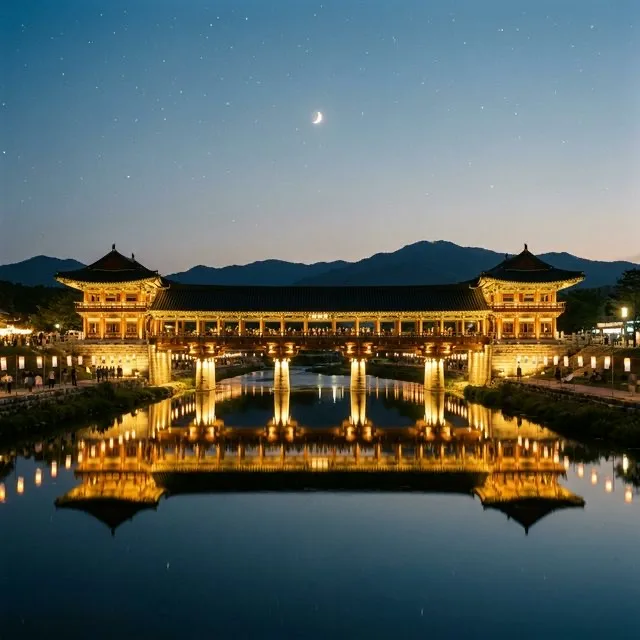
This site was the secondary palace complex of the Silla crown prince and the primary location for hosting grand banquets. At the center is Wolji Pond (formerly known as Anapji), a massive artificial lake specifically engineered so that its edges are hidden, giving the illusion of an endless ocean.
- The Night View: As the sun dips below the horizon, hundreds of golden floodlights switch on, illuminating the meticulously reconstructed wooden pavilions along the water's edge. The still surface of the pond acts as a perfect, glass-like mirror. The sight of the golden palace glowing in the dark and reflecting flawlessly on the water is widely considered one of the most stunning night views in all of South Korea.
3. The Mountain Zone (The UNESCO Heritage Masterpieces)
About a 45-minute bus ride southeast of the city center, high up on the slopes of Mount Tohamsan, lie Gyeongju’s crown jewels of Buddhist art and architecture. These two sites are jointly recognized as a UNESCO World Heritage property. To reach them without a car, take Bus 10 or 11 from the city center.
Bulguksa Temple
Bulguksa is the masterpiece of the golden age of Buddhist art in the Silla kingdom. Unlike mountain temples built for secluded meditation, Bulguksa was built to represent the Buddhist utopia (the Land of Buddha) on earth.
- The Grand Staircases: The facade of the temple features two magnificent, massive stone staircases—the Blue Cloud and White Cloud Bridges. While you can no longer walk up them (they are national treasures), they form an incredibly majestic entrance.
- The Twin Pagodas: In the main courtyard stand two highly contrasting stone pagodas. Seokgatap is minimalist, austere, and represents traditional Korean simplicity. Dabotap, featured on the Korean 10-won coin, is incredibly ornate, complex, and unlike any other pagoda in Asia. The juxtaposition of the two is a stroke of architectural genius.
Seokguram Grotto
From Bulguksa, you must take a winding shuttle bus (or hike a steep trail) further up towards the peak of the mountain to reach the Seokguram Grotto.
- The Marvel: Carved into the granite hillside in the 8th century, this artificial cave houses a monumental, unimaginably serene statue of a seated Buddha gazing out towards the East Sea to protect the nation from maritime invasions.
- Engineering Genius: The design of the domed ceiling, which fits perfectly without mortar, is an architectural marvel. For conservation reasons, the grotto is sealed behind a glass wall, meaning you can only view it from the antechamber, but the profound sense of peace and the sheer scale of the statue remain breathtaking.
4. Hwangnidan-gil: The Hipster Rebirth of the Old City
A decade ago, the neighborhood directly adjacent to the Daereungwon tombs was a quiet, slightly decaying residential area full of old, single-story traditional Korean houses (Hanoks). Then, gentrification fueled by social media aesthetics hit, and Hwangnidan-gil was born.
Today, this long avenue and its labyrinthine side alleys are the beating heart of modern Gyeongju's tourism scene. The combination of ancient tile roofs and hyper-modern interior design is intoxicating.
- Rooftop Cafes: You haven't truly experienced Gyeongju until you've sat on an outdoor terrace, sipping an artisanal matcha latte or Einspänner, looking out over a sea of grey Hanok rooftops with giant green royal tombs rising in the background.
- Self-Photo Studios: A massive trend in Korea is the automated self-photo studio (like Life Four Cuts). Hwangnidan-gil is packed with vintage-themed studios where you can don retro clothing and take black-and-white strips as souvenirs.
- Street Food Innovations:
- 10-Won Bread (Sip-won-ppang): The undisputed king of Gyeongju street food. It is a sweet, pancake-like dough poured into a mold shaped exactly like a massive Korean 10-won coin (which fittingly features the Dabotap pagoda). The inside is stuffed with an obscene amount of melted mozzarella cheese that stretches for miles when you pull it apart.
- Hwangnam Bread: For a more traditional souvenir, pick up a box of Hwangnam Bread—a delicate, thin pastry brimming with dense, sweet red bean paste that has been a local specialty since 1939.
5. The Perfect 2-Day Gyeongju Itinerary
To maximize your time and ensure you see the contrast between the city layout and the mountain temples, follow this highly optimized two-day flow:
Day 1: The City Loop & Nightscapes
- Morning (10:00 AM): Arrive at Singyeongju Station (KTX) or the Bus Terminal. Check into your accommodation (preferably a Hanok guesthouse near Hwangnidan-gil).
- Late Morning (11:00 AM): Rent your bicycle. Cycle straight to the Daereungwon Tomb Complex. Explore the Cheonmachong excavated tomb and line up for the magnolia tree photo.
- Lunch (1:00 PM): Head into Hwangnidan-gil. Grab lunch at a trendy fusion pasta or traditional bibimbap spot. Spend the afternoon café hopping and eating 10-Won Bread.
- Late Afternoon (4:30 PM): Cycle over to the Cheomseongdae Observatory during the golden hour to take photos in the surrounding flower fields.
- Evening (6:30 PM): Return your bike and have dinner.
- Night (8:00 PM): Walk to Donggung Palace and Wolji Pond for the spectacular night view of the illuminated pavilions.
Day 2: The Heritage Loop & National Treasures
- Morning (9:00 AM): Catch Bus 10 or 11 out to Mount Tohamsan.
- Mid-Morning (10:00 AM): Explore the grand courtyards and intricate architecture of Bulguksa Temple.
- Lunch (12:30 PM): Eat at one of the traditional mountain vegetable (Sanchae Bibimbap) restaurants clustered at the base of the temple.
- Early Afternoon (1:30 PM): Take the shuttle bus up the mountain to view the Seokguram Grotto.
- Late Afternoon (3:30 PM): Take the bus back to the city center and visit the Gyeongju National Museum. It is free to enter and houses the original solid gold crowns, jewelry, and artifacts excavated from the tombs you saw on Day 1.
- Evening: Catch your KTX train back to Seoul or onwards to Busan. If you're heading south, our Complete Guide to Busan covers everything from Haeundae Beach to the Jagalchi Fish Market.
Gyeongju Food Guide
Gyeongju has its own distinct culinary tradition worth seeking out alongside the historical sites.
Ssambap (쌈밥): Traditional Korean rice with a dozen types of seasonal greens and vegetables for wrapping — a style of eating associated with Gyeongju's agricultural heritage. Several restaurants near the Bulguksa temple entrance serve mountain vegetable ssambap (sanchae ssambap) that is among the best in Korea.
Hwangnam Bread (황남빵): The city's most famous food souvenir. A thin, delicate pastry with a dense red bean paste filling, made the same way since 1939. The original Hwangnam Bread bakery (near Daereungwon) is the definitive version; expect a queue. Sold in boxes of 10 or 20 for ₩8,000–₩16,000.
10-Won Bread (십원빵): A more recent Hwangnidan-gil street food invention — sweet dough molded into the shape of the 10-won coin (which features the Dabotap pagoda) and filled with molten mozzarella. Best eaten immediately; the cheese stretch moment is the entire point.
Gyeongju Beopju (경주법주): A traditional Korean rice wine (cheongju) specific to Gyeongju, brewed by a method that dates to the Silla dynasty. Available at traditional restaurants and the Gyeongju Folk Craft Village. Dry, delicate, and genuinely distinctive from mass-produced makgeolli.
Practical Information
Where to stay:
- Hanok guesthouses near Hwangnidan-gil: The most atmospheric option; sleeping in a traditional Korean wooden house within walking distance of the royal tombs. ₩60,000–₩120,000/night.
- Business hotels near Singyeongju Station: Practical for early KTX departures; 15-minute taxi from the city center. ₩70,000–₩100,000/night.
Getting there:
- From Seoul: KTX from Seoul Station to Singyeongju Station (~2 hours). Then take a local bus or taxi to the city center (20 minutes). Total travel time from central Seoul: ~2.5 hours.
- From Busan: KTX from Busan Station (~30 minutes to Singyeongju). Day trip from Busan is entirely feasible.
Admission fees:
- Daereungwon Tomb Complex: ₩3,000
- Donggung Palace & Wolji Pond: ₩3,000 (night admission: ₩5,000)
- Bulguksa Temple: ₩6,000
- Seokguram Grotto: ₩6,000 (combined Bulguksa + Seokguram: ₩10,000)
- Gyeongju National Museum: Free
Bicycle rental: ₩5,000–₩10,000/day from shops near the intercity bus terminal.
2026 booking note: Hanok guesthouses along Hwangnidan-gil fill up 4–6 weeks ahead during cherry blossom and autumn foliage seasons. Book early — accommodation options in Gyeongju's central zone are limited, and the Hanok experience is significantly more atmospheric than the business hotels near Singyeongju Station.
Frequently Asked Questions
Is Gyeongju worth a full day or two days? Two days. One day covers the city center highlights (Daereungwon, Cheomseongdae, Wolji Pond night view, Hwangnidan-gil) but leaves no time for the UNESCO temple sites on Mount Tohamsan. Bulguksa and Seokguram alone deserve a half-day. Travelers who try to cover both in one day consistently report they felt rushed and missed the meditative quality that makes Gyeongju special.
Can I visit Gyeongju as a day trip from Busan? Yes — Gyeongju is only 30 minutes from Busan by KTX, making it the ideal day trip. Leave Busan by 9 AM, arrive at Singyeongju by 9:30 AM, and you have 8–9 hours for city sightseeing. Focus on Day 1 of the itinerary above (city center + Wolji Pond night view) and return to Busan by 9–10 PM.
Can I visit Gyeongju as a day trip from Seoul? Technically possible but not recommended. The round trip alone is 4 hours of train travel. You'd arrive around 11 AM and need to leave by 4–5 PM to return by evening. You'll see the major sites but experience them rushed and without the magic of the Wolji Pond night view. An overnight stay transforms the experience.
Gyeongju rewards slow travel more than almost any destination in Korea. Every mound might be a king; every stone a thousand years old. To arrive in style, book your KTX tickets well in advance. Once there, extend your culinary curiosity with our guide to Korea's regional specialties, and pair the trip with a temple stay for a journey that will reshape how you see this country.