The Sound of Silence: Essential Etiquette for a Korean Temple Stay
A Temple Stay is not a vacation check-in; it is an entrance into a monastic life that has existed for over a thousand years. For 24 hours, you trade your smartphone for prayer beads and your stress for silence.
However, this tranquility comes with a strict set of rules. Visiting a working monastery requires a level of mindfulness and respect that goes beyond typical tourism. If you are worried about offending a monk or not knowing where to stand, don't worry.
Here is the essential etiquette guide to finding peace without breaking protocol.
How to Book a Temple Stay: The Official Program
Before you can observe a single moment of silence, you need a reservation. Korea operates one of the most organized cultural immersion programs in Asia through its official portal, templestay.com — a government-backed initiative run by the Jogye Order of Korean Buddhism. The website offers English-language booking for dozens of temples across the country, making it the definitive starting point for foreign visitors.
Program Types
There are two primary formats, and choosing the right one shapes your entire experience.
- Relaxation Program (Hyuyang): Think of this as a monastic Airbnb. You stay on temple grounds at your own pace, observe the daily schedule if you wish, and use the space for personal reflection. There are no mandatory activities. This is ideal for travelers who want the atmosphere of temple life without the structured commitment.
- Templestay Program (Ipsa): This is the full immersion. A guiding monk leads you through the complete monastic schedule: morning chanting, meditation, the 108 Bows ceremony, communal meals, and an evening tea ceremony. You will not be alone with your thoughts — you will be actively guided through them. This is the format most first-time visitors should choose, as it provides context that transforms a series of confusing rituals into a coherent spiritual journey.
What It Costs
Temple stays are remarkably affordable for the experience they offer. Prices generally range from 50,000 to 80,000 KRW per night (roughly $38–$60 USD), which includes accommodation, all meals, and program activities. This is not a luxury retreat — you are sleeping on a thin mat on a heated floor — but the value, measured in perspective rather than thread-count, is extraordinary.
Which Temple to Choose
Not all temples are equal in terms of English-language support. These three offer the most accessible experience for international visitors:
- Jogyesa Temple (Seoul): Located in the heart of Insadong, this is the headquarters of Korean Buddhism and the most logistically convenient option. You can arrive by subway. The English program is polished and well-staffed. If this is your first temple stay and you are arriving without a guide, start here.
- Haeinsa Temple (near Daegu): Set deep in the Gayasan mountains, Haeinsa is home to the Tripitaka Koreana — 81,000 carved wooden printing blocks that represent the entirety of Buddhist scripture, a UNESCO World Heritage treasure. The journey to get there is part of the experience: a winding mountain road through forests that smell of cedar and cold air. Choose Haeinsa if you want the intersection of history and natural grandeur.
- Tongdosa Temple (South Gyeongsang Province): Considered one of Korea's "Three Jewel Temples," Tongdosa is perhaps the most architecturally traditional. What makes it unusual: its main hall contains no Buddha statue. The altar faces an open window toward the mountains, on the premise that nature itself is the Buddha. This is the choice for travelers who want the most austere, classical experience.
Booking Timeline
For weekend stays and popular temples like Jogyesa, book at least 2–3 weeks in advance. Peak seasons — spring cherry blossom (late March to April) and autumn foliage (October to November) — require booking a month ahead. Weekday availability is generally more forgiving, and the quieter crowds on a Tuesday morning make the silence feel more genuine.
1. Entering the Sanctuary: Manners (Yejeol)
As soon as you cross the Iljumun (One Pillar Gate), you are leaving the secular world and entering sacred space.
Hapjang (The Greeting)
This is the universal gesture of respect. Place your palms together at chest height (fingers pointing up) and bow slightly at the waist.
- When to do it: Whenever you see a monk, entering or exiting a Buddha hall, or passing a pagoda. You do not need to shake hands or say "Hello." A silent Hapjang is enough.
Chasu (The Walk)
You shouldn't swing your arms while walking on temple grounds. Instead, adopt Chasu: Place your right hand over your left hand, crossing them lightly over your navel/lower belly. Walk quietly. Dragging your feet or running is considered disrespectful to the practitioners meditating nearby.
Mook-eon (Noble Silence)
Temples are zones of quiet. Keep your voice low. In many areas, you will see signs for "Mook-eon," implying that absolute silence should be observed to look inward.
The Four Gates: Understanding Temple Architecture
Most Korean Buddhist temples are organized around a sequential series of gates, each representing a stage in the traveler's spiritual progression. Walking through them with awareness — rather than treating them as mere archways between courtyards — transforms a tour into something closer to a pilgrimage.
1. Iljumun (One Pillar Gate): The first gate you pass through. It appears to stand on a single row of pillars when viewed from the front, symbolizing the unity of all things. The act of passing through it is meant to signal a letting-go of dualistic thinking — the division between self and world, sacred and profane. Many visitors walk through it quickly while looking at their phones. Don't. Pause. Look back at the world you are leaving behind.
2. Cheonwangmun (Gate of the Four Heavenly Kings): Beyond the first gate, you will encounter four enormous, ferocious-looking guardian figures, each holding a different object — a sword, a dragon, a lute, a pagoda. These are the Four Heavenly Kings, protectors of the Buddha's realm from the four cardinal directions. They are deliberately terrifying; their purpose is to ward off evil and to awaken a sense of solemnity in those entering. If their expressions unsettle you, you are having the correct reaction.
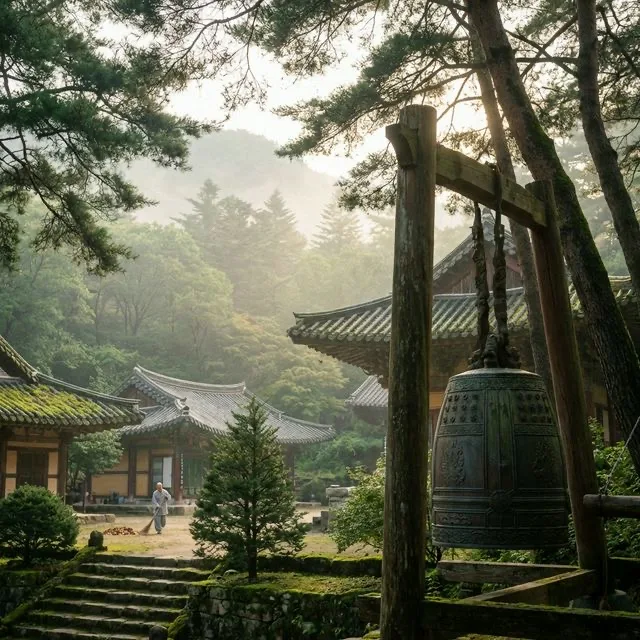
3. Beomnaru (Bell Pavilion): Before the main hall, most temples feature an open pavilion housing four sacred instruments that mark the rhythm of monastic life. The Brahma Bell (Beomjong), struck 28 times at dawn and 33 times at dusk, resonates for the beings of the sky. The Law Drum (Beopgo) calls to the animals of the earth. The Wooden Fish (Mokeo), a hollow carved fish struck rhythmically, speaks to the creatures of the water — fish never close their eyes, symbolizing unceasing vigilance. The Cloud Plate Gong (Unpan) summons the beings of the air. Together, the four instruments are a declaration that the monastery's practice extends compassion to all realms of existence.
4. Daeungjeon (The Main Buddha Hall): The heart of every Korean temple. Remove your shoes before entering. Bow upon entering. Inside, the central altar holds the primary Buddha image — most commonly Sakyamuni Buddha (the historical Buddha) — flanked by bodhisattvas and attendants. The smoke from the incense burners in front of the altar has been rising continuously for centuries in many of these halls. Spend at least five minutes here in silence. Let the weight of that continuity settle.
2. Clothing & Appearance
- The Uniform: Most Temple Stay programs provide a comfortable vest and baggy pants. Wear them. It creates a sense of equality—stripping away status and fashion.
- Socks (Mandatory): You will be taking your shoes off constantly to enter halls. Entering a Buddha hall barefoot is considered rude. Bring clean, thick socks.
- Modesty: If you are wearing your own clothes, ensure shoulders and knees are covered. No tank tops or leggings.
- Scent: Avoid strong perfumes or colognes. The only scent in the air should be incense and pine trees.
3. The Meal Ritual: Barugongyang
For many Westerners, the monastic meal is the biggest culture shock. It is eating as a spiritual practice.
- Silence: Meals are eaten in total silence. You focus entirely on the taste and texture of the food.
- Zero Waste: You must eat everything you take. A single grain of rice represents the sweat of 88 farmers. Take small portions; you can always go back for seconds.
- The Cleaning Ritual: At the end of the meal (in formal Barugongyang), you pour warm water into your rice bowl to rinse off the remaining crumbs/sauce. You use a slice of yellow radish (Danmuji) as a sponge to scrub the bowl. Then—and this is the hard part for some—you drink the rinse water. It ensures zero waste and leaves the bowl pristine.
Temple Food: The Philosophy of Veganism Before It Was Trendy
What arrives at your bowl during a temple stay is not simply vegetarian food. It is Sachal Eumsik — Korean Buddhist temple cuisine — one of the most sophisticated plant-based culinary traditions on the planet, refined over 1,700 years of monastic practice. UNESCO recognized it as an Intangible Cultural Heritage of Humanity in 2013, placing it alongside flamenco and Mongolian throat singing as a living expression of human civilization.
The Five Forbidden Vegetables (Ogak)
At the philosophical core of temple food is an unusual prohibition. Five vegetables are completely banned from monastic kitchens:
- Garlic (Manul)
- Onions (Yangpa)
- Green onions (Pa)
- Chives (Buchu)
- Leeks (Dallae)
These are the Ogak — the "Five Pungent Vegetables." The reasoning is precise: eaten raw, these vegetables are believed to stimulate anger and desire. Eaten cooked, they are said to arouse sexual energy. Either way, they interfere with the stillness of mind that monastic practice requires. For a monk attempting to meditate for six hours a day, even a small agitation of the nervous system is a meaningful obstacle.
This prohibition creates a fascinating culinary challenge: how do you build deeply flavorful food without the aromatics that anchor virtually every other cuisine in Asia? The answer, worked out over centuries, is a layered toolkit of fermented wild greens, dried mountain herbs, slow-reduced mushroom broths, and aged doenjang (soybean paste). Temple chefs — themselves considered practitioners of a spiritual discipline — use time and patience in place of garlic. A broth that a restaurant cook might build in 20 minutes with aromatics requires four hours of slow-simmering with dried shiitake, kelp, and roasted barley at a temple kitchen.
The result is food with a quieter, deeper flavor profile than standard Korean cuisine. Nothing shouts. Everything resonates.
The Seasonal and Foraged Dimension
Temple food is also intensely seasonal. Monks and kitchen staff forage the surrounding mountains for wild greens (namul) that shift with the calendar: shepherd's purse in early spring, bracken fern in late spring, bellflower root in summer, dried persimmons and lotus root in winter. Each season's harvest is preserved through fermentation or drying, building a larder that sustains the kitchen through leaner months. Eating a temple meal in November is a completely different experience from eating one in April. This connection to the land's actual rhythm is itself a teaching.
Where to Try Temple Food Outside a Temple Stay
You do not need to book an overnight program to experience this cuisine. In Seoul, Balwoo Gongyang — a two-Michelin-star restaurant operated by the Jogye Order near Jogyesa Temple — serves meticulously plated temple food in a formal dining setting. A multi-course lunch runs approximately 40,000–80,000 KRW. It is one of the most intellectually interesting meals you can eat in Korea: food that encodes a philosophy in every preparation decision.
4. The Physical Challenge: 108 Bows
You may be invited to perform 108 Bows (Baekpalbae).
- Why 108? In Buddhism, it is said humans are plagued by 108 delusions or anxieties. Each bow represents letting go of one delusion.
- The Form: This is a full prostration. Knees to the floor, hands to the floor, forehead touching the ground, and palms turned upward (to receive the Buddha's feet).
- The Experience: It takes about 15-20 minutes. It is a physical workout, but the repetitive motion induces a meditative trance. Don't feel forced to finish if you have knee injuries, but trying it is a powerful way to clear your mind.
Other Meditation Practices You May Experience
The 108 Bows are the most physically dramatic element of a temple stay, but they are not the only practice you will encounter. A well-structured program introduces several other contemplative disciplines. Knowing what to expect from each one removes the anxiety of unfamiliarity and allows you to actually participate rather than simply observe.
Seon (Zen) Seated Meditation: Jwa-seon
Jwa-seon is what most people mean when they say "meditation" — sitting in stillness and watching the breath. In Korean Seon (the root of Japanese Zen), the technique is deceptively simple: sit cross-legged on a cushion (bangseok), rest your hands in your lap with palms upward and thumbs lightly touching, keep your back straight without rigidity, and direct your gaze downward at a 45-degree angle. The instruction is to observe the breath as it enters and leaves the nostrils without controlling it.
A typical guided session in a temple stay runs 20 to 30 minutes. In that time, your mind will wander approximately 400 times. This is not failure; it is the practice. The discipline is the act of noticing that you have wandered and returning, again and again, without judgment. By the fifteenth return, something begins to shift. Experienced practitioners call it "settling." First-timers often describe it as the first moment of genuine quiet they have experienced in years.
Practical note: if sitting cross-legged is painful for your knees or hips, it is entirely acceptable to sit on the edge of the cushion with your legs folded to one side, or to request a small chair. Monks are pragmatic about the body's limitations. The posture serves the mind, not the other way around.
Dado: The Contemplative Tea Ceremony
At some point in your stay — often in the late afternoon, after the 108 Bows — a monk will invite you to sit for Dado, the Buddhist tea ceremony. This is not the elaborate formalism of Japanese chado; Korean temple tea is quieter, more intimate, and less codified. The monk brews green tea (nokcha) or roasted barley tea, pours it into small ceramic cups, and serves each guest individually.
The etiquette is simple but important: receive the cup with both hands. This gesture of two-handed receiving is a mark of respect throughout Korean culture, but in the context of the tea ceremony, it carries additional weight — you are receiving the monk's intention along with the tea. Lift the cup to your lips slowly. Do not slurp. Do not speak unless the monk speaks first. The ceremony is often conducted in a near-silence punctuated only by the sound of water and the occasional distant temple bell. Many guests report that this 15-minute tea ceremony is the single most calming moment of their entire trip to Korea.
Yebul: The 4 AM Morning Ritual
Nothing in a temple stay is as disorienting — or as memorable — as the morning ritual. At 3:30 to 4:00 AM, the silence of the sleeping temple is broken by the four sacred instruments in sequence.
It begins with the Brahma Bell: struck 28 times, slowly, each resonant note allowed to fully decay before the next is struck. The bell's tone is so low and so large that you feel it in your chest before you hear it with your ears. Then comes the Law Drum, beaten in an accelerating, rhythmic pattern that fills the entire valley. Then the Wooden Fish, its hollow knocking a rapid, hypnotic pulse. Finally, the Cloud Plate Gong, a thin metal sheet suspended in the pavilion, struck until it rings like a sheet of frozen sky.
By the time the instruments conclude, the monks have assembled in the main hall for Yebul — the morning chanting service. Guests are invited to attend. You will be handed a chanting book with phonetic romanization of the Korean text. Whether you attempt to follow along or simply sit and absorb is entirely your choice. The chanting itself — rhythmic, atonal by Western standards, hypnotically repetitive — is one of the most ancient sounds in Korean civilization. There is a reason monasteries have opened their doors to outsiders for this ritual: the experience of hearing it in the pre-dawn darkness, surrounded by mountain silence, is not something a brochure can adequately describe.
5. Practical Tips
- Separate Quarters: Men and women usually sleep in separate rooms, even married couples. Be prepared for this.
- The Schedule: Monastic life follows the sun. Dinner is often at 5:30 PM. Lights out at 9:00 PM. The morning drum (Yebul) wakes you up at 3:30 AM or 4:00 AM.
- Alcohol/Smoking: Strictly forbidden on temple grounds. do not sneak it in.
What to Bring (and What to Leave at Home)
Packing for a temple stay requires a different mindset than packing for a hotel. Less is genuinely more here.
Bring:
- Plain-colored clothing with no logos or loud patterns. Even if the program provides a uniform, you will change back to your own clothes during free time. Solid colors — grey, navy, white, earth tones — are appropriate. A graphic tee with a brand logo reads as jarring in a monastic setting.
- Earplugs. The 4 AM bell is not subtle, and the floor of a shared dormitory room transmits sound efficiently. If you are a light sleeper, earplugs allow you to stay rested without resenting the schedule.
- A small notebook. Journaling is one of the most natural activities during the unstructured free periods of a Relaxation Program. Many guests find that the quiet of temple grounds unlocks thoughts they have been too busy to have for months. A cheap notebook and a pen take up no space and may be the most valuable thing in your bag.
- Clean, plain socks — multiple pairs. You will remove your shoes at every hall entrance. Multiple times per day. Bring at least two fresh pairs.
Leave at home:
- Your laptop. The point is disconnection, not a change of scenery for remote work.
- Jewelry, especially anything that makes noise when you move.
- A phone with notifications enabled. Set it to silent — not vibrate. The buzz of a vibrating phone on a wooden floor during meditation is as intrusive as a ringtone.
Managing Expectations: Common Discomforts
A temple stay is one of the most genuinely rewarding travel experiences available in Korea, and it is also, in the most respectful possible sense, uncomfortable. First-time guests who know what to expect in advance are better positioned to lean into the discomfort rather than resist it.
The floor sleeping. Korean temple accommodation uses ondol — a traditional underfloor heating system that warms the floor from below using pipes or channels. You sleep on a thin mat directly on this heated floor, with a light blanket. The floor is warm but firm. For guests accustomed to mattresses, the first hour is often the hardest. By the second night — if you do a two-day program — most people sleep better than they have in months. The body adapts quickly, and the physical tiredness from a day of bowing, walking, and meditation does the rest.
The cold outdoor walk. In winter, the bathroom facilities in older temples may require a walk across an outdoor courtyard. At 4 AM in a Korean mountain monastery, the air is genuinely cold. Bring a warm layer that you can pull over your uniform quickly — a fleece or a down vest that packs small. The cold air at that hour is bracing in a way that wakes you up more thoroughly than any alarm clock.
The quiet itself. This is the discomfort that catches most guests by surprise. Extended silence — especially for travelers who live in cities and are accustomed to constant audio stimulation — can feel actively uncomfortable in the first few hours. The mind searches for its usual inputs and finds nothing. This agitation is well-documented in contemplative literature and is, in fact, the very thing you came to address. The prescription is simple: do not fight it. Sit with the discomfort. Take a slow walk. Journal. The unease typically dissolves within the first evening, replaced by something that is the opposite of boredom — a kind of alert, spacious stillness that is worth far more than the 50,000 KRW it cost to find it.
Leave your ego at the gate, and you might find something better waiting for you inside.
If you still need the broader booking flow, start with Temple Stay in Korea: How to Book, What to Expect & Best Programs. If you are comparing actual programs, the Templestay.com booking guide explains the platform step by step, and if you want a distinctive martial-arts-based program, see Golgulsa Temple Sunmudo Stay.