Chasing the Pink Wave: A 7-Day Cherry Blossom Itinerary from Jinhae to Seoul

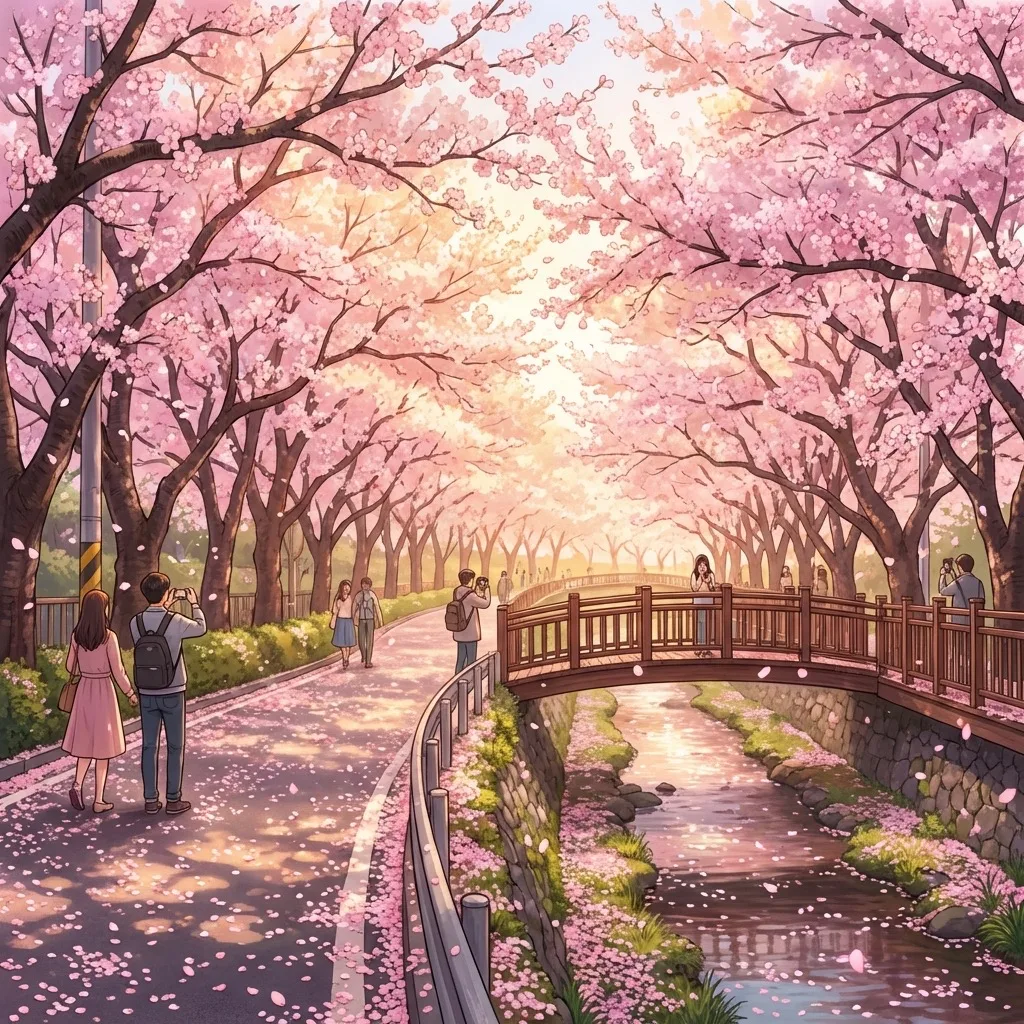
Spring in Korea is not a season; it is an event. For about ten days, the entire country turns a shade of pale pink. But the "Beotkkot" (Cherry Blossom) waits for no one. To see it at its peak, you must move with the bloom.
The "Cherry Blossom Front" sweeps from the warm South to the cooler North. If you arrive in late March, start in Busan. If you arrive in mid-April, start in Seoul.
Here is the ultimate 7-day plan to chase the flowers from the southern coast to the capital by following the "Pink Wave."
Understanding the Cherry Blossom Front: Why It Moves North
Korea's cherry blossom season is not random — it is a meteorological event governed by a single threshold. The dominant variety planted across the country is the Yoshino cherry (Prunus yedoensis), and it blooms when the average daily temperature crosses approximately 10°C for several consecutive days. Because Korea's southern coast sits closer to the warm currents of the Korea Strait, it warms up first. The front then marches northward at a rate of roughly 30–40 kilometers per day, eventually reaching Seoul and the interior mountains one to three weeks after Jeju.
The Korean Meteorological Administration (KMA) issues an official "first bloom" forecast each year, typically in early February. This forecast identifies the date a specific reference tree at each monitoring station is expected to open its first five flowers. "Peak bloom" — the state you actually want to photograph — arrives roughly one week after first bloom, when 70–80% of blossoms on a tree are open. That window of peak beauty lasts only 3–7 days under ideal conditions. Rain accelerates petal drop; strong wind strips the trees in hours. This is not a season where a flexible attitude is a virtue — it is a strategic necessity.
Global warming has compressed this uncertainty significantly. The 2024 Seoul peak bloom hit on March 22, the earliest date ever recorded in the capital, beating the previous record by four days. In practical terms, this means dates you read in old guidebooks are increasingly unreliable. Check the KMA website or the Korea Tourism Organization's real-time blossom tracker in the two weeks before departure. Build at least two days of buffer into your itinerary to account for the bloom arriving early or lingering longer depending on weather. The 3-day rule still applies: if you are within 72 hours of peak bloom at any location, drop everything and go.
2025 Forecast Snapshot (Estimates)
- Jeju Island: March 22
- Busan / Jinhae: March 23 - March 30
- Gyeongju: March 25 - April 2
- Seoul: April 1 - April 8 (Note: Dates shift yearly due to global warming, often arriving earlier than expected. Be flexible!)
Days 1-2: Busan & Jinhae (The Crown Jewel)
Base Camp: Busan (Stay near Sasang Station or Seomyeon for easy transport access).
Day 1: Busan's Coastal Blooms
Start your trip in Busan.
- Dalmaji Hill: A winding road overlooking Haeundae Beach, lined with old cherry trees. It's often called the "Montmartre of Korea."
- Oncheoncheon Stream: A riverbank path where locals picnic under a canopy of pink. It feels less touristy and more authentic.
- Hwangnyeongsan Mountain: If your legs are willing, do not skip this. The trailhead is accessible from central Busan, and the main ridge route takes roughly one hour at a comfortable pace. From the summit, you get a panoramic sweep of Busan's coastline, the harbor, and the dense rooftops of Gamcheon — all framed by cherry blossoms growing at different elevations along the slope. It is the single best elevated view of cherry blossoms in the city and is almost entirely absent from international tourist itineraries.
- Maengsan Park's Nak-Min-Tree: Hidden on the lower slopes of Maengsan Park is a cherry tree estimated to be over 100 years old, locally known as the Nak-Min-Tree. Unlike the slender Yoshino saplings planted along most urban streets, this tree has developed a wide, gnarled canopy that produces a cascade of blossoms far denser than anything you will see at the famous spots. Locals know it; tourists rarely find it. Ask at your guesthouse for the exact path.
Day 2: Jinhae Gunhangje Festival (Day Trip)
This is the big one. Take an intercity bus from Busan (Sasang Terminal) to Jinhae (approx. 45 mins). This small naval port hosts the largest cherry blossom festival in Korea.
- Yeojwacheon Stream ("Romance Bridge"): The quintessential photo spot where white wooden bridges cross a stream canopied by blossoms. Pro Tip: Go at night when it's illuminated.
- Gyeonghwa Station: An old railway track where trains stop under a tunnel of hanging blossoms. It is incredibly crowded, so arrive at 7:00 AM to get a photo without 5,000 other people.
Jinhae Logistics Deep Dive: The Gunhangje Festival draws over one million visitors across its ten-day run, which works out to 100,000 or more per day on peak weekends. The numbers are not an exaggeration — the streets around Yeojwacheon Stream can become genuinely impassable by midday on a Saturday. The most important tactical decision you can make is visiting on a Monday through Thursday. Foot traffic drops by roughly 60%, the festival food stalls are fully operational but not chaotic, and you can actually stop to photograph without being swept along by the crowd.
On the transport question: do not drive to Jinhae during festival period. Parking is a genuine nightmare — the lots fill by 8 AM, illegal parking results in towing, and the surrounding road network gridlocks for hours. The intercity bus from Busan's Sasang Terminal is the only sane option. Buses run frequently and drop you within walking distance of the main festival zone.
Eating in Jinhae is part of the experience. The town's identity as a naval port translates into a food culture built around pork — specifically, thick slices of grilled samgyeopsal served in the small restaurants that cluster around the festival perimeter. The annual festival food stalls along the main promenade sell hotteok (sweet pancakes), tteokbokki, and roasted chestnuts. But the local specialty worth seeking out is haemul pajeon (seafood scallion pancake) served at the market restaurants near the bus terminal. Portions are large, prices are fair, and it is exactly the kind of fuel you need for a full day on your feet.
Days 3-4: Gyeongju (The Ancient City in Bloom)
Transport: Take the KTX (30 mins) or Bus (1 hour) from Busan to Gyeongju.
Gyeongju is an "open-air museum," and in spring, it is magical. The contrast of ancient Silla dynasty burial mounds against the fragile pink flowers is unique to this city.
- Bomun Lake: Rent a bicycle. The entire 6km circumference of the lake is lined with cherry trees. When the wind blows, "flower rain" falls into the water.
- Daereungwon Stone Walls: The stone walls surrounding the royal tombs create a stunning, texture-rich backdrop for photography.
- Bulguksa Temple: Look for the specific "King Cherry Blossoms" here—they are double-layered, darker pink, and bloom slightly later than the common variety.
Cheomseongdae at Golden Hour
One shot that separates the Gyeongju veteran from the first-timer is the Cheomseongdae astronomical observatory framed by blossoms at golden hour. Built in the 7th century during the Silla dynasty, this cylindrical stone tower is one of the oldest existing observatories in Asia. In spring, the field surrounding it fills with low cherry trees, and the entire scene — ancient stone, pale pink petals, and fading warm light — is extraordinary.
The specific timing is critical. Arrive at approximately 5:00 PM and position yourself facing east, with the tower in the middle ground and the cherry trees at the left and right edges of the frame. As the sun drops behind you to the west, it casts warm orange light across the tower's rough stone surface. The blossoms glow. By 6:30 PM, the light is gone and the scene flattens. This is a 90-minute window and it does not negotiate.
Gyeongju Spring Food
Gyeongju has its own food identity, and you should engage with it. The most famous item is Gyeongju-ppang (경주빵), a small walnut-shaped pastry filled with sweet red bean paste and walnut. Every bakery in the city sells them warm, and they are exceptional with a cup of barley tea. Look for the shops clustered near Bulguksa and the Daereungwon entrance — the ones with the longest queues are consistently the best.
For a proper meal near Bulguksa Temple, the ssambap restaurants along the approach road offer an experience that is both delicious and theatrical. Ssambap is a Korean rice-and-wraps meal where you are served a large tray of seasonal vegetables, fermented pastes, and grilled meats, and you wrap each bite in a leaf of perilla or lettuce. The sets at Bulguksa ssambap restaurants often incorporate spring vegetables foraged from the surrounding mountains, making the late March and April version distinctly seasonal.
The Gyeongju Traditional Market (Jungang Sijang) near the city center is worth an hour of wandering. The produce stalls are stacked with early spring vegetables, the dried goods section smells of seaweed and grain, and the snack alley at the back serves handmade dumplings that cost almost nothing.
Hanok Guesthouse in the Historic District
Gyeongju's historic district contains a cluster of traditional Korean hanok guesthouses — courtyard homes built in the old style with curved tile roofs and ondol (heated floor) sleeping arrangements. Staying in one during cherry blossom season is a qualitatively different experience from a standard hotel. The courtyard often contains its own plum or cherry tree, which may be in bloom. Waking up, sliding open the wooden door, and stepping into a blossom-filled courtyard is the kind of memory that outlasts any photograph.
Book hanok guesthouses well in advance — the quality options have only 3–6 rooms and fill up for spring weeks by early February. Look for properties listed on Naver Stay or GoodStay (the Korean government's certified accommodation platform). Expect shared bathroom facilities in more traditional properties, heated floors (very pleasant on cool spring nights), and a simple breakfast of rice, soup, and pickled vegetables included in the rate. It is modest by international hotel standards and extraordinary in every other way.
Days 5-7: Seoul (The Grand Finale)
Transport: KTX from Singyeongju Station to Seoul Station (2 hours).
Day 5: Yeouido Spring Flower Festival
The road behind the National Assembly Building (Yunjung-ro) is blocked off to traffic, allowing pedestrians to walk through a 1.7km tunnel of old cherry trees.
- Warning: It is extremely crowded on weekends. Go on a weekday morning if possible.
What many visitors miss is the Hangang Park riverside path on the Yeouido side of the Han River. While the crowds funnel onto Yunjung-ro, a quieter stretch of older cherry trees runs parallel to the riverbank, south of the main road. This path connects to a series of small parks near the Yeouido Marina, where the trees are larger, the crowds are thinner, and the combination of water reflection and blossoms is often more photogenic than the famous tunnel.
For a genuinely unusual vantage point, look into the Hangang Ferry that operates from Yeouido Hangang Park. The Han River cruise departs from the Yeouido dock and passes under the cherry trees that overhang the riverbank. Viewing blossoms from the water, with the city skyline rising behind the soft pink fringe, is one of those experiences that does not translate into any postcard image you have ever seen — it is better. Check the ferry schedule at the Hangang Park information kiosk; blossom-season cruises often run extended hours.
Day 6: Changdeokgung Palace Secret Garden (Huwon)
This is the most important addition you can make to a Seoul cherry blossom itinerary, and it is the one most tourists skip because it requires planning. Changdeokgung Palace's Secret Garden (Huwon, 후원) is a 78-acre royal garden built in the 17th century that was, for most of its history, off-limits to anyone outside the royal family. Today it is open to visitors, but access is strictly controlled: entry requires a separate ticket beyond the palace admission, tours are capped at roughly 100 visitors per session, and sessions must be booked in advance online.
During cherry blossom season, the Huwon contains something you cannot find at any of the crowded public parks — ancient trees that have been growing undisturbed for centuries. The garden's pear trees, cherry trees, and zelkova groves predate the modern city entirely. Walking through a 500-year-old royal garden while the petals fall around a pavilion built for a Joseon king is an experience of a completely different order from the Yeouido festival.
Book your Huwon session on the Cultural Heritage Administration website as early as possible — ideally two to three weeks before your visit. Morning sessions (typically 10:00 AM) have slightly better light; afternoon sessions (around 2:00 PM) have slightly smaller crowds. The guided tour lasts approximately 90 minutes. Do not miss it.
After Changdeokgung, walk to Seokchon Lake in Jamsil. Located next to Lotte World, the walking path loops around the lake with the futuristic Lotte World Tower rising above the soft pink clouds. It's the perfect mix of modern Seoul and nature.
Day 7: Secret Spots (Escape the Crowds)
If the crowds at Yeouido are too much, head to these quieter gems:
- Seoul National Cemetery: Sounds morbid, but it is famous for its rare "Weeping Cherry Blossoms" that hang down like willow branches.
- Anyang Stream: Just outside the main city center, a long, peaceful walking path loved by locals.
- Kyung Hee University: The Gothic-style campus architecture framed by blossoms looks like a scene from Harry Potter.
Photography Tips for the Entire Trip
Cherry blossom photography is both easier and harder than it looks. The blossoms are beautiful, but the combination of overcast skies (common in spring Korea), white petals, and auto-exposure settings conspires to produce flat, washed-out images. A few techniques apply across every location on this itinerary.
Golden Hour is Non-Negotiable: The window between 5:30 AM and 7:00 AM is, without question, the most productive two hours of the entire trip. The light is warm and directional, the crowds have not arrived, and the silence of early morning in a blossom-filled park or temple complex is something you carry with you long after the trip. Commit to waking up early at least twice on this journey. You will not regret it.
The "Flower Rain" Shot (Baenggot Binu): When petals fall in the wind, the Japanese call it hanafubuki — flower blizzard. In Korea it is called baenggot binu, flower rain. To capture it, find a position with a dark background (a shadowed wall, dark water, a crowd in the distance) and wait for a gust. Use a shutter speed of at least 1/500s to freeze individual petals mid-air. The best locations for natural wind on this itinerary are Bomun Lake (open water creates wind channels) and Yeouido's riverside path.
Dealing with White Skies: Korea's spring sky is frequently overcast, and overcast white sky turns cherry blossom photography into a blown-out nightmare if you expose for the blossoms. Two solutions: expose slightly for the sky and recover the shadows in post-processing, or shoot during blue-sky windows (usually morning before cloud cover builds). Alternatively, embrace the overcast — shoot close-up, low angles looking up through the blossom canopy, where the sky becomes a textured white backdrop rather than a competing element.
Gyeonghwa Station Angle: The best photograph at Gyeonghwa Station is not taken from the platform. Walk to the pedestrian bridge that crosses the tracks, roughly 30 meters north of the station building. From this elevated position, shoot straight down the track line. The tunnel of overhanging blossoms recedes into the distance, and any train stopped in the frame becomes a compositional anchor. Arrive before 7:30 AM to get this shot without other photographers in the frame.
Practical Survival Tips
- Book KTX Early: During festival season, trains to Gyeongju and Busan sell out weeks in advance. Book exactly 30 days prior on the KORAIL website.
- Dress in Layers: Spring weather is fickle. It can be a warm 18°C in the afternoon and drop to a freezing 5°C at night.
- Check the Dust: Spring is also "Yellow Dust" season. Check the AQI (Air Quality Index) and wear a mask if the pollution is high.
5-Day Version: If You Can't Do the Full 7
Not everyone has a full week. If you are working with five days, the following compressed routing hits the highest-priority spots without sacrificing the essential experience.
- Day 1: Fly into Gimhae International Airport (Busan). Check in near Sasang Station. Afternoon at Dalmaji Hill and Oncheoncheon Stream. Dinner in Seomyeon.
- Day 2: Full day in Jinhae (Mon–Thu strongly preferred). Bus from Sasang Terminal, arrive before 9 AM. Gyeonghwa Station in the morning, Yeojwacheon Stream at midday, night illumination before the last bus back to Busan.
- Day 3: Morning KTX to Gyeongju. Bicycle around Bomun Lake in the afternoon. Cheomseongdae at golden hour (5 PM). Dinner at a ssambap restaurant. Stay in a hanok guesthouse.
- Day 4: Morning KTX from Singyeongju to Seoul Station. Check in and head directly to Seokchon Lake for late-afternoon light. Dinner in Jamsil or Insadong.
- Day 5: Early morning at Yeouido (arrive by 7 AM for the riverside path). Mid-morning at Kyung Hee University or Seoul National Cemetery. Afternoon departure from Gimpo or Incheon.
This routing sacrifices the Huwon Secret Garden and some of the Gyeongju depth, but it preserves the crown jewels: Jinhae, Bomun Lake, and Yeouido. If you can extend by even one day, add Changdeokgung's Secret Garden on Day 4 before Seokchon Lake.
Cherry Blossom Photography Checklist
Before you leave Korea, aim to have these eight shots in your archive. They represent the full range of the blossom experience, from iconic to intimate.
- The Tunnel Shot (Gyeonghwa Station): From the pedestrian bridge looking down the tracks, with the blossom canopy converging to a vanishing point. Best before 7:30 AM.
- The Reflection Shot (Bomun Lake): Blossoms mirrored in still water. Best in early morning before wind disturbs the surface. A bicycle in the foreground adds scale and story.
- The Royal Mound Closeup (Gyeongju Daereungwon): Low angle, stone wall texture filling the lower third, blossom branch filling the upper third, burial mound silhouette in the middle distance. Timeless composition.
- The Silhouette Shot (Yeouido at Night): Stand beneath the lit Yunjung-ro tunnel and expose for the illuminated blossoms. Your own silhouette or a companion's silhouette in the foreground anchors the image.
- The Petal Rain Mid-Air Shot (Bomun Lake or Yeouido Riverside): Dark background, fast shutter (1/500s minimum), wait for the gust. The frozen petals look like snow.
- The Café Window Shot: Sit inside any café along the blossom routes and frame a branch of blossoms through the glass, with the street and other pedestrians blurred in the background. This is the shot that communicates the feeling of being inside the season.
- The Aerial/Hilltop Shot over Busan (Hwangnyeongsan): The panoramic sweep of Busan's coastline with the harbor and blossoms in the foreground. This image communicates scale — the sheer density of cherry trees across a major Korean city.
- The Hanbok Portrait: Rent a hanbok (traditional Korean dress) from any of the rental shops near Gyeongju's historic district or Seoul's Gyeongbokgung Palace and photograph yourself or a companion among the blossoms. It is the one shot that every traveler regrets not taking, and it costs about 15,000 KRW for a two-hour rental.
Cherry blossom season is fleeting — it peaks for just one to two weeks — so planning precise timing is everything. Before the trip, map your route with our 10-day South Korea itinerary to layer cherry blossom stops into a broader journey. If you're renting a car to reach rural blossom spots, our Korea car rental and driving guide covers everything from IDPs to section cameras. And to pack right for the unpredictable spring weather, check our Korea packing list by season.