Japanese Train Etiquette: Quiet Cars, Priority Seats & Phone Rules

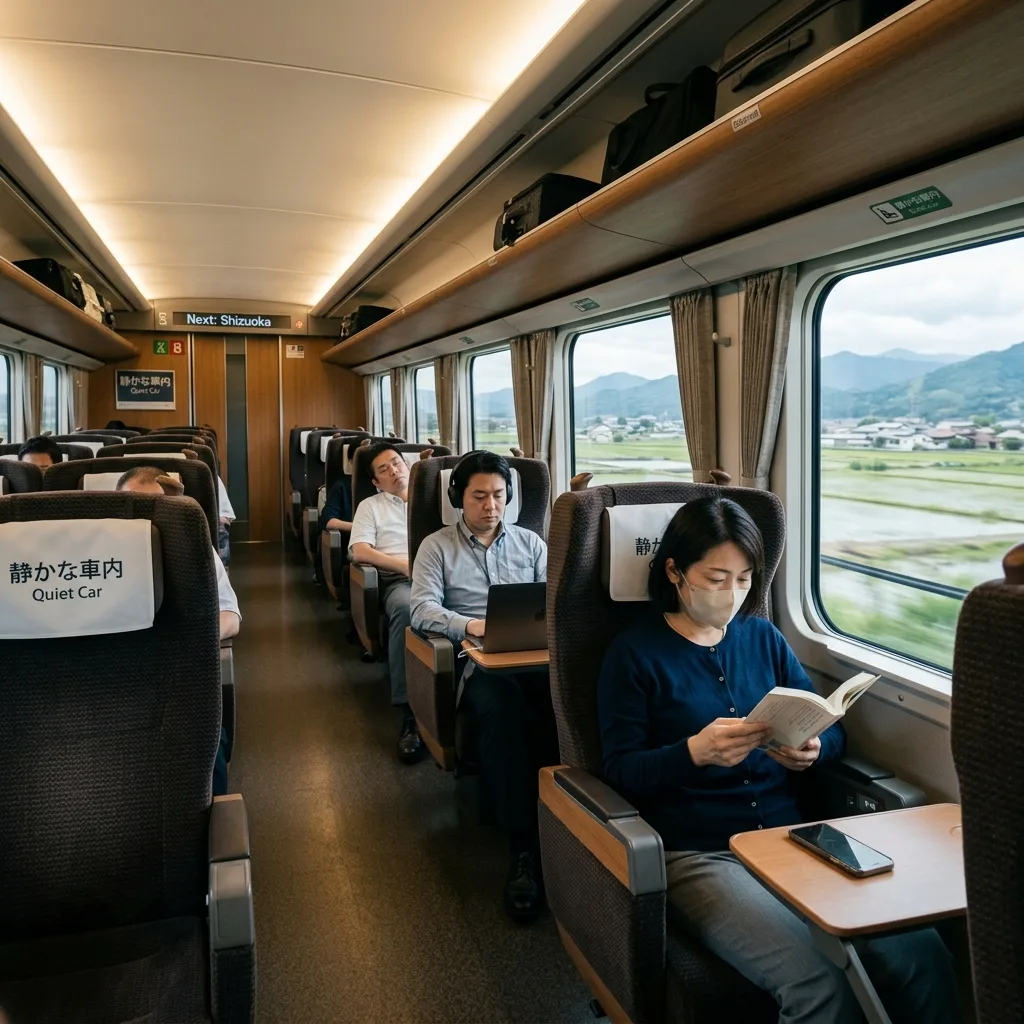
Japanese train etiquette is one of those travel topics that feels simple until you are actually standing on a crowded platform, balancing luggage, checking your phone, and trying to figure out whether you should talk, eat, sit, or move. The good news is that the real rules are not mysterious. Once you understand the logic behind quiet cars, priority seats, and phone behavior, Japan’s rail system becomes much easier to use with confidence.
Introduction
Japanese train etiquette matters because trains are not just transport in Japan. They are shared public space, daily commute infrastructure, and a place where small habits add up quickly. A traveler who understands the basics will move more smoothly, avoid awkward moments, and generally feel less like a disruption and more like a normal passenger.
This guide is designed for the practical decisions that come up on real trips. It connects the etiquette rules to the rest of your Japan planning, including Japan Travel Planning: Visa, IC Card, Rail Pass & Essential Logistics Guide, Getting Around Tokyo: Trains, IC Cards & Navigation Apps, and Japan Cash vs Card: Where IC Cards, Credit Cards & Yen Are Accepted so the transportation part of your trip fits into the rest of the itinerary instead of feeling like a separate puzzle.
Primary Topic Section
Japanese train etiquette is really about reducing friction in a dense shared system. On most rides, that means keeping your voice low, making your phone behavior invisible, leaving priority seats available for the people who need them most, and reading the room before you do anything that creates noise, movement, or delay. If you remember that one sentence, you will already avoid the most common mistakes.
The first thing to understand is that Japanese rail etiquette is not one single rulebook. The expectations can vary by operator, service type, and car type. A commuter line in central Tokyo, a limited express service in Kansai, and a Shinkansen ride between cities may all have different practical expectations even if the underlying principle is the same: do not make the trip harder for everyone else. That is why you should always look for the posted signs inside the station or train before assuming a rule from another trip applies here.
The second thing to understand is that many etiquette rules are really about timing. A phone call is more acceptable in one car than another. A seat may be available, but still not appropriate for you if the priority row is full of people who need it more. A bag can be harmless if it stays on your lap, but awkward if it occupies another person’s space during rush hour. The difference between being polite and being annoying is often just awareness.
The most useful habit is to board with a low-profile mindset. Walk into the station already thinking about where your body, bag, voice, and phone will go. If you do that, the rest of the etiquette becomes easy to execute automatically. This is also why travelers who already understand city transit from Tokyo Neighborhoods Guide: From Shinjuku to Shimokitazawa or Ultimate Tokyo Travel Guide 2026: Everything First-Timers Need to Know tend to settle in faster once they start riding.
Quiet cars, quiet behavior, and why the distinction matters
Many visitors use the phrase “quiet car” loosely, but in Japan the exact meaning depends on the service. Some trains or long-distance services have specially designated quiet or calm cars with stronger expectations around silence, while other trains simply expect generally polite behavior. In practice, the safest rule is to treat every car as if somebody nearby is studying, working, sleeping, or trying not to be disturbed.
If you are in a designated quiet area, do not assume the rule is only about avoiding loud conversations. It is also about device sound, phone calls, video audio, speakerphone use, and any behavior that becomes visually or acoustically distracting. Even short interruptions stand out more in a packed rail car than they would in a cafe because the sound has nowhere to go.
On the other hand, not every service treats mobile use the same way. JR Central’s S Work car, for example, is specifically designed for work and explicitly allows mobile device use and even calls with consideration for nearby passengers. That does not mean every train is a work car. It means the rule is service-specific, and the sign in your car matters more than a general assumption you brought from another line.
Tokyo Metro’s published guidance gives a good summary of the everyday standard: set your phone to silent mode, avoid talking on it during the ride, and give extra attention near priority seats during busy times. The same official guidance also reminds passengers to place larger luggage overhead or keep it with them, which shows how broad “etiquette” really is. It is not only about manners in the abstract. It is about how you physically use shared space.
For travelers, the practical takeaway is simple. Quiet is not only a cultural preference. It is part of how the system stays efficient, comfortable, and predictable for millions of daily riders.
Priority seats and who they are for
Priority seats are one of the easiest Japanese train rules to understand, but they are also one of the easiest to ignore accidentally if you are tired, distracted, or not watching the signage. Tokyo Metro says priority seats are meant for elderly passengers, passengers with disabilities, passengers with infants, and expectant mothers. That basic principle is common across many Japanese rail operators.
The rule is not just “if an older person appears, stand up immediately and make a scene.” The better approach is to keep those seats available when you are not sure you need them, and to move without hesitation if someone visibly benefits from the seat more than you do. If you are carrying a heavy backpack, have a minor injury, or feel tired from sightseeing, that does not automatically make a priority seat yours. The seat exists for people with greater need, not just people with a long day behind them.
There is also a quieter layer to this rule. Even when a priority seat is empty, some riders prefer not to sit there unless the car is empty or they are certain they are not preventing someone else from using it. On crowded trains, that visible restraint is part of what keeps the atmosphere calm. For travelers, this is less about performing humility and more about making the easiest possible choice for everyone else.
If you are unsure, stand near the priority area instead of sitting there. That way, you can react quickly if the need arises, and you do not have to awkwardly move across a crowded car later. The same pattern appears in other Japan travel contexts too: if you are planning your route well, like in Japan 7-Day Itinerary: Tokyo-Kyoto-Osaka Golden Route Planner, the whole trip tends to feel smoother because you make fewer rushed decisions in the moment.
Phone rules on Japanese trains
Phone etiquette on Japanese trains is a mix of silence, discretion, and service-specific exceptions. The standard traveler-safe move is to put your phone on silent and avoid making or taking calls inside the car. If you need to answer something urgently, step off at the station or wait until you are in a car where the signage clearly allows a different standard.
The reason this matters is not just politeness. Trains are one of the few public environments where everyone is already in close physical contact with strangers and cannot easily create distance. A loud call, notification sound, or video clip becomes everyone’s problem immediately. That is why Japanese rail etiquette treats phone use as a shared-space issue, not just a personal preference.
There are some exceptions. Business-oriented cars, like the S Work car on JR Central’s services, can allow work calls and device use under specific expectations. That is a reminder to read the car designation rather than relying on a blanket rule you learned from a blog post, including this one. Service classes, line operators, and the type of train all influence what is acceptable.
If you need to take a call, the cleanest habit is to step to the platform between stops or wait for a station transfer. If the call cannot wait, keep it short and quiet, and then move on. Travelers who already use transit responsibly in places like Tokyo usually find this easier after reading a practical navigation guide such as Getting Around Tokyo: Trains, IC Cards & Navigation Apps, because navigation confidence and etiquette confidence tend to grow together.
Secondary Topic Section
The deeper layer of Japanese train etiquette is that the rules change depending on what kind of rider mix the train has. A commuter train packed with office workers at 8:15 a.m. is not the same environment as a half-empty midday express, and neither is identical to a long-distance Shinkansen. What feels normal in one place can be out of place in another.
Morning and evening rush hours are the strictest in practice, even when the written rule has not changed. Noise stands out more, seats are more contested, and people are usually tired or focused on getting somewhere on time. This is why the standard travel advice about behavior on Japanese rail is often less about memorizing a hard rule and more about learning when people become less tolerant of extra disruption.
The average traveler should also understand that Japanese trains are designed around flow. That includes how people queue on the platform, how they let passengers off before boarding, and how they move down the aisle after entering the car. If you stand still in the doorway or block the entrance while checking your map, you are violating the system even if you are not saying a word. Simple body positioning is part of etiquette.
Another subtle point is that the local expectation can shift with geography. In Tokyo, fast commuter rhythm is normal and people move quickly. In smaller cities or tourist corridors, passengers may be more forgiving of confused visitors, but the same baseline expectations still apply. The safe assumption is that silence, order, and unobtrusiveness are welcome everywhere, while noise and blocking behavior are welcomed nowhere.
That is also why train etiquette is closely tied to broader travel competence. Once you know how to read stations, use IC cards, and understand transfer flow, you stop looking like a person wrestling with the system. You start looking like someone who belongs in it. That is part of why articles like Japan Cash vs Card: Where IC Cards, Credit Cards & Yen Are Accepted matter even when the article is not directly about trains: payment, access, and mobility all overlap.
Eating, drinking, and the unspoken limits
Eating and drinking on Japanese trains is another area where the rule is more contextual than absolute. On many commuter rides, full meals are frowned upon because of smells, crumbs, packaging noise, and the general feeling that the car is not a dining room. On longer intercity services, especially reserved-seat trains or Shinkansen trips, snacks and drinks are more normal because the car is built for longer sitting time and people expect a different rhythm.
The traveler-friendly rule is to keep food light, quiet, and low-friction. If you need to eat, choose something that does not smell strong, does not require a lot of open packaging, and does not make the row feel like a picnic. Convenience-store items are popular for exactly this reason: they are fast, portable, and usually easy to handle without making a mess. That is one reason our Japanese Convenience Store Food Guide: Lawson vs 7-Eleven vs FamilyMart is useful even in a rail context.
Drinks are easier, but still worth handling thoughtfully. A bottle of water or tea is fine on many services, but a large, fragrant beverage that spills easily is not ideal when the train is crowded. If you are on a long ride, buy something you can close quickly and store without fuss. The goal is to avoid turning a personal convenience into a nearby passenger’s irritation.
Luggage, backpacks, and personal space
Luggage is one of the most underrated parts of train etiquette in Japan because many visitors do not realize how much space a backpack or rolling suitcase can occupy in a dense car. Tokyo Metro’s guidance is straightforward: large luggage should go on the overhead rack or stay with you. That principle applies even when the train does not feel especially full at the station platform.
If you are carrying a backpack, the polite habit is to wear it in front of you when the train is crowded, or at least hold it low and out of the way. A bag on your back can bump into seated passengers, people entering the aisle, or someone standing behind you without you noticing. That is why Japanese commuters often move backpacks to the front during rush hour. It is not a fashion statement. It is a space-management decision.
Rolling luggage deserves extra attention. The wheels themselves are not the main problem; the problem is where the bag sits, how much aisle space it blocks, and whether it becomes a hazard when the train moves. On a quiet off-peak ride, a suitcase might be easy to manage. On a crowded platform transfer, the same suitcase can become a nuisance very quickly.
If you are planning a multi-city trip, think about luggage before you ride. A traveler who chooses a smaller bag or uses luggage forwarding is usually far more comfortable on Japanese trains than someone trying to drag a large hard-shell case through the system. This is one of those details that becomes obvious only after you have experienced a transfer in rush hour, which is why it belongs in any real planning guide.
Line-by-line differences travelers should expect
Not all Japanese trains behave the same way. Local metros, commuter rail, private railways, JR services, limited express trains, and Shinkansen services each have their own rhythm. The etiquette you use should adapt to the service, not the other way around.
On a subway or commuter line, the emphasis is usually on speed, silence, and efficient boarding. People want the doors clear, the aisles unobstructed, and the ride kept as low-drama as possible. On intercity trains, there is usually more room for a reserved seat, a snack, a short chat, or quiet work, but that does not eliminate the need for restraint.
This is where travelers sometimes get confused. They hear that one train allowed a phone call or a drink, then assume that means all Japanese trains are relaxed. They are not. The right question is always, “What does this particular car expect?” If the answer is not immediately obvious, follow the most conservative choice until the signage tells you otherwise.
You will also notice that some car types are built around specific behavior. JR Central’s S Work car is a good example of a service that acknowledges work use, while ordinary commuter cars are built around quiet commuting. The distinction is useful because it shows that Japanese rail etiquette is not anti-phone or anti-work. It is simply pro-context. In the right space, a device is fine. In the wrong one, it becomes noise.
Practical Guide
There is no admission fee for Japanese train etiquette, but there is still a practical learning curve. The easiest way to handle it is to prepare before you board and then use the system as it is marked, not as you hope it might work. If you do that, you will avoid most of the awkward moments travelers run into during their first few rides.
The first step is to check the platform signs and car markings before boarding. Many mistakes happen because a traveler assumes every car is interchangeable. They are not. If you see signs about quiet behavior, priority seating, luggage placement, or car-specific rules, treat those signs as the authority for that ride.
The second step is to lower your volume before you enter the train, not after you get stared at. Put your phone on silent, finish your last loud conversation on the platform, and decide where your bag will live. If you are traveling with a companion, agree in advance that the train is a low-voice zone. It is much easier to maintain etiquette if everyone in your party is on the same page.
The third step is to position yourself like a considerate rider. Stand to the side while waiting, let passengers exit before you board, and move inward once inside so the doorway stays clear. This is especially important in busy stations because door congestion slows everyone down and creates avoidable tension.
The fourth step is to choose seats with care. If priority seats are the only open seats, do not automatically take them. If ordinary seats are available, use those first. If you must sit in a priority area because the train is crowded, be prepared to move without hesitation. That flexibility is part of the etiquette.
The fifth step is to manage your belongings actively. Hold your backpack in front of you if needed, place your suitcase where it will not trip anyone, and do not leave bags spread across neighboring seats. A small amount of physical discipline here goes a long way. It keeps the car calm and makes you look far more confident than someone who is constantly readjusting their stuff.
The sixth step is to think in terms of ride duration. Short commuter rides reward minimalism. Long-distance rides allow a little more personal comfort, but still benefit from low noise and tidy handling. If you are on a long route and want to eat, work, or take a call, choose the right car or wait for a more appropriate moment. Do not force a short-ride etiquette style onto a long trip, or the reverse.
For route planning, travel apps matter more than most first-timers expect. If you can confidently see where you are, what you need to transfer to, and how long the ride lasts, you are less likely to wander around with a phone in your face or block a doorway while figuring things out. That is why pairing etiquette knowledge with route knowledge is so effective.
If you are still building your trip, use the transportation articles already on the site as a scaffold. Japan Travel Planning: Visa, IC Card, Rail Pass & Essential Logistics Guide gives you the big picture, Getting Around Tokyo: Trains, IC Cards & Navigation Apps helps with the urban network, and Japan Cash vs Card: Where IC Cards, Credit Cards & Yen Are Accepted fills in the payment side so you are not trying to solve everything from inside a moving car.
Tips & Common Mistakes
The biggest mistake travelers make is assuming Japanese train etiquette is mostly about being very quiet. Silence is important, but it is only one part of the system. The deeper rule is about reducing the impact you have on the shared environment. You can violate etiquette without speaking at all if your bag blocks the aisle, your suitcase swings into someone’s knees, or your phone screen and audio dominate the space.
Another common mistake is sitting in priority seats because they are empty and then forgetting that empty does not mean available for anyone without consequence. If you are a healthy adult and there are ordinary seats open, take the ordinary seat. If the train gets crowded and someone needs the priority seat, move immediately and without hesitation.
Travelers also often underestimate how visible phone habits are. A phone call that feels short and harmless in your home city can feel loud and intrusive in Japan because the train car is already so quiet. Even a speaker notification or video clip can stand out immediately. The solution is simple: mute first, think second, speak last.
Luggage is another repeated problem, especially for travelers who arrive with airport-sized bags and then try to use packed commuter trains. If you have a large suitcase, try to avoid rush hour, use wider intercity trains when possible, and keep the bag from occupying space that belongs to others. Japan is one of the easiest countries to travel in once you learn the transit rhythm, but it becomes much harder if you fight the system with oversized baggage.
Here are the habits that usually make the biggest difference:
- Let passengers off before boarding so you do not create a bottleneck at the door.
- Keep your voice low, even if the train seems noisy at the platform.
- Put your phone on silent and avoid calls unless the car clearly allows them.
- Choose ordinary seats before priority seats, and give priority seats up quickly when needed.
- Hold backpacks in front during crowded periods and keep rolling luggage controlled.
- Read the signage in each car, because service-specific exceptions are real.
The best travelers do not try to memorize etiquette as a list of moral obligations. They build a few automatic habits and then repeat them everywhere. That is the easiest way to stay comfortable, respectful, and unbothered while moving through Japan’s rail network.
FAQ
Can I talk on the phone on Japanese trains?
Usually, no inside ordinary train cars. The safer choice is to set your phone to silent and avoid talking until you reach the platform, transfer area, or a service that clearly allows calls. Some business-oriented cars may be different, but you should always follow the posted rules for that specific train.
What should I do if the only empty seats are priority seats?
If you are able-bodied and ordinary seats are available elsewhere, use those instead. If the train is crowded and priority seats are the only option, sit only if you truly need to and be ready to move immediately if someone who needs the seat boards.
Is eating on the train okay?
It depends on the service and the length of the ride. Light, tidy snacks are more acceptable on longer intercity trains than on short commuter rides. In general, keep food quiet, low-smell, and easy to handle so you do not bother nearby passengers.
Do I need to worry about my backpack?
Yes. In crowded cars, a backpack on your back can bump into other people and take up more space than you realize. Hold it in front of you or keep it tucked neatly out of the way when the train is busy.
Are quiet cars the same on every train?
No. Some services have designated quiet or business-friendly cars, and the rules can differ by operator and line. Always check the signage in the car you boarded instead of assuming the same standard applies everywhere.
Conclusion
The easiest way to think about Japanese train etiquette is this: make yourself small in the best possible way. Keep your noise down, control your luggage, respect priority seats, and follow the instructions for the exact car you are in. That is enough to handle most situations without stress.
If you are building a bigger Japan trip, the most useful next steps are to review Japan Travel Planning: Visa, IC Card, Rail Pass & Essential Logistics Guide, Getting Around Tokyo: Trains, IC Cards & Navigation Apps, and Tokyo Neighborhoods Guide: From Shinjuku to Shimokitazawa. Together, those guides turn train etiquette from a standalone rule set into part of a usable travel system.
Once you understand the rhythm, Japanese trains become one of the most pleasant parts of the trip. They are clean, efficient, and predictable, and they reward the traveler who pays attention to the little things. That is why etiquette matters: not because it is complicated, but because it makes the whole network work better for everyone.