Temple of Heaven Park: Morning Tai Chi and the Circular Walk

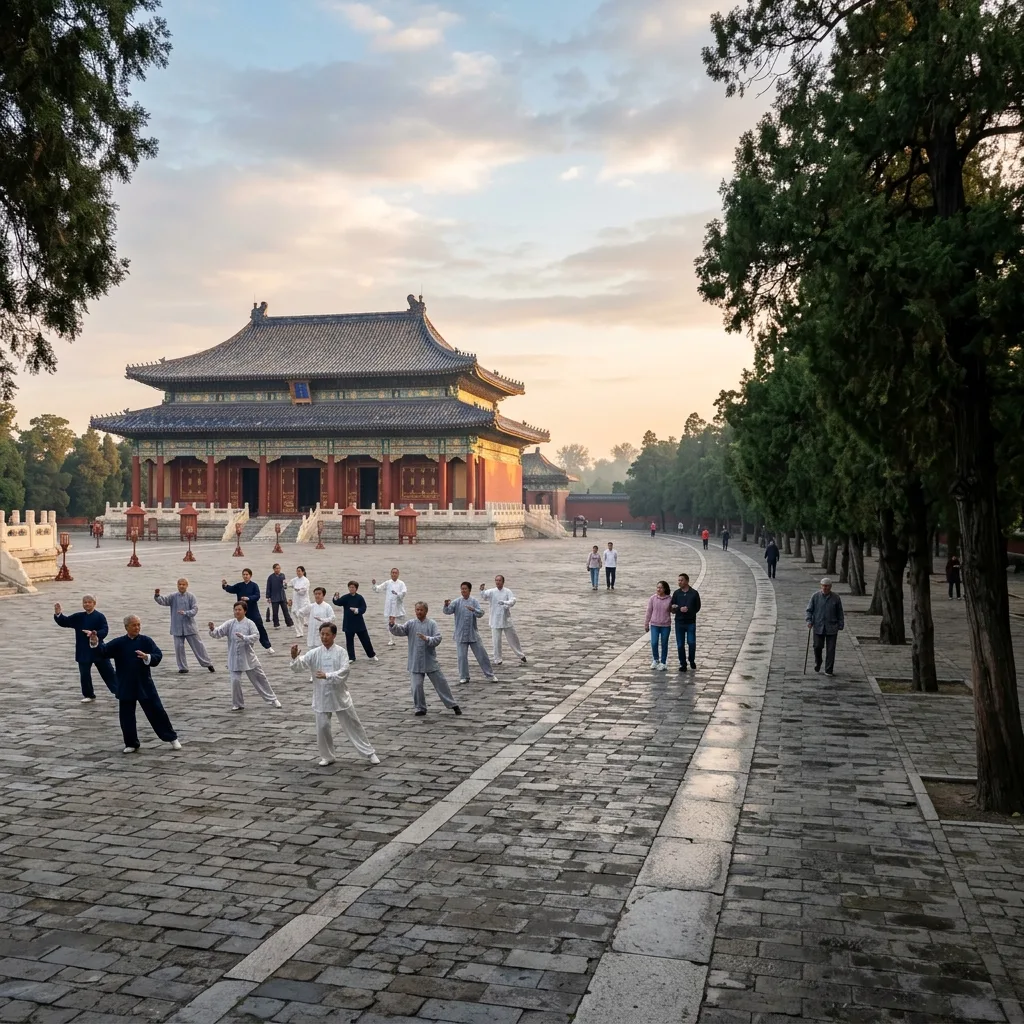
Most visitors to Beijing's Temple of Heaven spend about ninety minutes here, tick the Hall of Prayer off their checklist, and leave before the park truly wakes up. That's the wrong approach. If you arrive when the south gate opens at 6 AM, you walk into something far more interesting than a UNESCO-listed monument: a living neighborhood park where Beijing's retirees practice tai chi in near-silence under a canopy of 500-year-old cypress trees, ballroom dancers glide across the wide stone paths, opera singers rehearse against the echo of ancient walls, and water calligraphers brush enormous characters onto the paving stones with sponge-tipped poles. This guide covers how to structure a morning so you catch both experiences — the authentic local ritual and the architectural grandeur of one of China's most sacred imperial sites.
Why Temple of Heaven Park Is Unlike Any Other Site in Beijing
Temple of Heaven Park is not a roped-off museum. It is a 273-hectare urban park that Beijingers use every single morning, and the ancient structures sit at the center of that daily life rather than apart from it. The imperial complex — built between 1406 and 1420 under the Yongle Emperor and expanded by the Jiajing Emperor in the 1530s — served as the site where the Son of Heaven performed Heaven Worship rituals once a year, praying for good harvests. Today the park is classified as a UNESCO World Heritage Site, but its most distinctive quality is that it is genuinely inhabited.
Arrive before 8 AM and you will have the cypress groves almost entirely to yourself and the locals. After 8:30 AM the organized tour groups arrive, the audio guides switch on, and the atmosphere shifts. The practical implication: structure your visit in two acts. First act, pre-8 AM — local life, tai chi, almost no crowds, golden morning light filtering through ancient trees. Second act, 8 AM onward — the imperial buildings open, and you walk the circular route through the complex before the main wave arrives.
The Morning Scene: Tai Chi, Dance, and the Sound of the Erhu
The south gate (Tiantan Nan Men) is the best entry point for a morning visit because it drops you directly into the park's most active social zone. The wide promenade that runs north from this gate toward the Hall of Prayer for Good Harvests is where you will find the highest concentration of activity, but the real magic happens in the side groves.
By 6:30 AM on any weekday, the main cypress grove west of the central axis has clusters of people spread throughout it, each group running its own routine independently of the others. One corner will have eight or ten people practicing Yang-style tai chi in slow synchronized movements, their breath visible in the cool morning air. Another patch of open ground nearby hosts a group doing fan dancing with red fans that catch the light between the trees. At the path edges, pairs practice ballroom dancing — waltz, foxtrot, Latin — to music playing from a small portable speaker set down on the tiles.
This is not performance. Nobody is doing it for tourists. The participants are almost entirely over 60, and they have been coming to this park for years, sometimes decades. The atmosphere is calm, focused, and genuinely welcoming. If you stand at the edge of a tai chi group and watch respectfully, an instructor will often wave you in and gesture that you should follow along. The pace is slow enough that you can mirror the movements without training. This is one of the rare moments in Beijing where a traveler can participate in local life without any mediation.
By around 7:30 AM, a secondary wave of park-goers arrives — people who have been for a walk along the outer perimeter and are now circling back through. This is also when the water calligraphy practitioners typically appear. They use sponge brushes the size of a large paintbrush, dipped in plain water, to write characters on the dry paving stones. The characters evaporate within minutes in the morning air. The practice is part meditation, part physical exercise — the brush strokes require arm and shoulder movement across a wide arc. Watch for a few minutes and you begin to understand why people find it absorbing.
What to Expect at an Organized Tai Chi Tour
If you want a guided introduction rather than an informal observation, several operators run structured morning tai chi sessions at Temple of Heaven Park that include a traditional Beijing breakfast. Tours typically pick up from central hotels around 6 AM, arrive at the south gate by 6:30 AM, and run a 45-minute tai chi session with a local instructor before the buildings open. BiteEscape and Viator both list options with English-speaking instructors; prices range from approximately 55 to 90 USD per person depending on group size. These tours work well for solo travelers who want a more structured entry point into the experience.
The Circular Walk: A Route Through Sacred Geography
Temple of Heaven's layout is not incidental — it encodes cosmological meaning into the physical arrangement of structures, paths, and open space. Understanding the basic logic makes the circular walk significantly more interesting than simply moving from building to building.
The park is built on a north-south axis. The Hall of Prayer for Good Harvests (Qinian Dian) sits in the northern section on a raised triple-tiered marble platform. The Circular Mound Altar (Yuanqiu Tan) sits in the southern section on a similar but lower platform. Between them runs the Danbi Bridge, a 360-meter elevated walkway that rises slightly from south to north so that the emperor, walking from the altar toward the Hall of Prayer, was symbolically ascending toward Heaven. The structures in the north are circular; the enclosing walls of the southern section are semicircular on the north side and straight on the south — because in Chinese cosmology, Heaven is round and Earth is square.
A well-paced circular walk takes about two hours at a comfortable pace. Here is a suggested sequence:
Start at the South Gate (Tiantan Nan Men). Enter and head into the cypress grove for the morning activity scene before 8 AM. Spend 30 to 45 minutes here.
Walk north along the western covered walkway (Long Corridor). This 400-meter covered corridor was used by the emperor's procession to shield the sacred offerings from view. It connects the sacrificial kitchen and storerooms to the main altar complex. Walking it now, with Beijing's sky visible through the latticed sides, gives a sense of the ceremonial scale.
Enter the Circular Mound Altar (Yuanqiu Tan). This three-tiered marble platform is where the emperor knelt and prayed at the winter solstice. The top tier has an acoustic peculiarity: if you stand on the central marble stone and speak normally, your voice reflects back from the surrounding circular balustrade with a slight amplification. The effect is subtle but noticeable when the platform is not crowded. Each tier of the altar has a specific number of stone slabs arranged in multiples of nine — nine being the supreme yang number associated with Heaven. Count them if you enjoy that sort of detail.
Visit the Echo Wall. The circular wall enclosing the Imperial Vault of Heaven is the site's most famous acoustic phenomenon. A whisper directed at the wall on one side can, under the right conditions, be heard at the opposite side more than 60 meters away. In practice the effect requires a quiet crowd and the right position. Early morning gives you the best chance of experiencing it.
Walk the Danbi Bridge north. The elevated walkway north toward the Hall of Prayer for Good Harvests offers one of the site's best photographic angles: looking north along the straight causeway with the blue-tiled circular hall rising at the end. The hall is among the most immediately recognizable structures in China — a triple-eaved circular building on a white marble platform, its blue glazed tiles representing Heaven, its wooden construction achieved without a single nail in the interior support structure.
Explore the Hall of Prayer interior. The interior columns are arranged in concentric rings representing the four seasons, twelve months, and twelve two-hour periods of the traditional day. The central four columns (the Dragon Well Columns) represent the four seasons. The twelve inner columns represent the months. The twelve outer columns represent the traditional time units. The ceiling's painted interior is one of the most elaborate examples of Chinese decorative craftsmanship still intact.
Return to the south gate via the eastern path. The eastern side of the park is quieter than the main axis and passes through more open cypress grove. This is often where you will see individuals practicing sword forms or qigong away from the main morning crowd.
If you are combining Temple of Heaven with the Forbidden City in the same day, budget Temple of Heaven for the early morning slot (6–9 AM) and the Forbidden City for mid-morning when it opens. The two sites are about 4 kilometers apart; a taxi or DiDi takes 15 minutes.
Inside the Complex: What to See and What to Skip
See without skipping:
- Hall of Prayer for Good Harvests (Qinian Dian) — the building itself and the interior columns
- Circular Mound Altar (Yuanqiu Tan) — acoustics and stone geometry
- Imperial Vault of Heaven and Echo Wall — the circular enclosure and its painted interior
- The Long Corridor (Changlang) — often overlooked but worth walking
Skip if time is short:
- The Divine Music Administration on the western side of the park — a small museum covering the ritual music of Heaven worship, detailed but niche
- The Sacrificial Kitchen and Slaughterhouse — accessible with the through-ticket but very sparingly interpreted
The combo through-ticket is the right choice for most visitors. It gives access to all three main structures plus the Hall of Prayer. The park admission-only ticket at 15 CNY does not include the interior buildings.
Practical Guide: Tickets, Hours, and Getting There
Admission and Ticket Types
High season (April 1 – October 31):
- Park admission only: 15 CNY
- Through ticket (park + all three main sites): 34 CNY
Low season (November 1 – March 31):
- Park admission only: 10 CNY
- Through ticket: 28 CNY
Children under 18 and seniors over 60 receive free admission. Visitors aged 18–25 qualify for a half-price student discount with a valid ID.
Tickets must be booked in advance online with real-name registration, 1 to 7 days ahead. Book via the WeChat Official Account "Visiting Beijing Parks" (北京公园游览) or "Temple of Heaven" (天坛公园). Foreign visitors without a Chinese ID can use passport registration. Walk-up tickets at the gate are not reliably available during peak season.
Opening Hours
Park gates (high season): 6:00 AM – 10:00 PM; last admission 9:00 PM Main buildings: 8:00 AM – 5:00 PM (last entry 4:30 PM)
In low season, park hours shift slightly earlier for closure; check the official WeChat account for exact dates.
Getting There
By subway: Line 5 to Tiantan Dongmen Station (Temple of Heaven East Gate). This exit drops you at the east gate, a 5-minute walk to the main complex. Alternatively, Line 8 to Tiantan Nanmen Station for the south gate — the better option for a morning tai chi visit.
By taxi or DiDi: From Tiananmen Square or Wangfujing, approximately 15–20 minutes and 30–40 CNY. Ask for 天坛南门 (Tiantan Nanmen) for the south gate entry.
Walking: From the Forbidden City it is a 40-minute walk south through Qianmen and along the temple's outer perimeter — manageable in good weather and gives you a sense of the imperial city's spatial logic.
Guided Tour Options
If you want a structured Tai Chi + Temple of Heaven experience, Viator lists a 3-hour private morning tour with a tai chi lesson, English guide, and roundtrip hotel transfer for approximately 70–90 USD per person. BiteEscape's Tai Chi and Breakfast Tour combines a traditional Beijing breakfast with the tai chi session before the buildings open. Both are bookable online and include park entry fees.
For a standard historical tour of the complex without the tai chi component, licensed guides are available at the east gate at prevailing hourly rates, or book in advance through China Discovery or TravelChinaGuide.
Tips and Common Mistakes
Arrive at 6 AM, not 8 AM. The tai chi and dance scene winds down by 8:30 when organized tour groups start arriving. If you arrive at 8, you see the tail end of the morning activity and hit the buildings at peak crowd time. The best version of this park requires an early start.
Enter from the south gate, not the east gate. The east gate is the subway exit and drops most visitors directly into the complex near the Hall of Prayer. The south gate gives you the full spatial experience of approaching the complex from the south (the cosmologically correct direction, how the emperor would have arrived) and places you in the main morning activity zone.
Buy the through-ticket, not the park admission. The main buildings — Hall of Prayer, Circular Mound Altar, Echo Wall — each require a separate ticket on top of park admission unless you have the combo through-ticket. The price difference is modest and the through-ticket removes friction at each gate.
Book online before you go. The real-name booking system is now standard for Beijing's major parks, and walk-in availability has been limited since 2020. The WeChat booking works with a passport number for foreign visitors. If you cannot navigate the WeChat system, your hotel concierge can often assist, or book through a licensed tour operator.
Wear layers. The pre-dawn park can be significantly cooler than the daytime temperature, particularly in spring and autumn. The locals doing tai chi are dressed in lightweight athletic gear they know from experience; first-time visitors underestimate the early morning chill. Bring a layer you can remove by 8 AM.
Be a respectful observer. The tai chi and dance groups are not performers. Do not photograph faces at close range without acknowledgment. If you want to join a group, stand at the edge and mirror the movements — most groups will wave you in after a minute or two if they are comfortable with observers. Do not interrupt flowing group practice by trying to take selfies in the middle of the formation.
Combine with the Beijing Food Guide for breakfast. The area immediately south of the Temple of Heaven, around Yongdingmen Street and the surrounding hutong, has several traditional Beijing breakfast spots serving jianbing, douzhir (fermented mung bean milk — an acquired taste), and sesame flatbreads. The Beijing Food Guide covers the full range of what to eat in the capital, and breakfast near Temple of Heaven is one of the most authentically local meal experiences in the city.
Frequently Asked Questions
Do I need to book Temple of Heaven tickets in advance? Yes. Real-name reservation is required and tickets must be booked 1–7 days ahead online. Walk-up availability at the gate is limited during peak season (spring and autumn). Book via WeChat or through a licensed tour operator if you cannot navigate the WeChat system.
What time should I arrive to see tai chi? Aim for 6:00–6:30 AM for the fullest experience. By 7:30 AM the scene is still active but thinning. By 8:30 AM it is largely over. If you cannot make a very early start, 7:00 AM is an acceptable compromise.
Can I join the tai chi practice as a foreigner? Informally, yes — stand at the edge of a group, mirror the movements, and the instructors usually invite you in after a few minutes. For a more structured lesson with an English-speaking instructor, book a guided morning tour in advance.
Is the Echo Wall effect real? It is real but requires a quiet crowd and correct positioning. Early morning visits give you the best chance. In peak tourist season with a full crowd around the wall, the effect can be difficult to reproduce. The acoustic physics rely on the circular geometry of the enclosing wall — the same principle as the Whispering Gallery at St Paul's Cathedral in London.
How long does the full visit take? The morning tai chi observation (6–7:30 AM) plus a thorough walk through all the main buildings and the Danbi Bridge takes about 3–3.5 hours total. If you are short on time, a focused 2-hour visit covering the Hall of Prayer, Circular Mound Altar, and Echo Wall without the early morning component is fully satisfying.
Is Temple of Heaven worth visiting if I have only one day in Beijing? Yes, but plan carefully. In a single day, the most efficient pairing is Temple of Heaven for the early morning (6–9 AM) and the Forbidden City for mid-morning through early afternoon. The Ultimate Beijing Travel Guide covers how to structure a full Beijing itinerary with these sites.
Conclusion
Temple of Heaven Park rewards visitors who treat it as two experiences in one: the living park in the early morning, and the imperial sacred complex that opens at 8 AM. The tai chi and dance scene under the ancient cypress trees is one of the most genuinely moving encounters Beijing offers — not because it is exotic, but because it is so quietly, habitually human. The elders who come here every morning are not performing culture; they are living their lives in a remarkable space.
The architecture that follows — the Hall of Prayer's self-supporting wooden dome, the Circular Mound Altar's geometry, the whisper-carrying Echo Wall — is exceptional by any standard. But the experience lands differently when you have already spent an hour watching people move through it as a neighborhood park.
Get there at 6 AM. Walk in from the south gate. Follow the morning activity for an hour. Then walk the circular route through the complex before the tour groups arrive. That is the visit that stays with you.
If you are still building your Beijing itinerary, the Beijing Hutong Experience makes an excellent afternoon pairing with a Temple of Heaven morning — it takes you into the intimate alley life of old Beijing that complements the imperial scale of the park.