Korean Street Food Snacks Ranked: From Hotteok to Bungeoppang

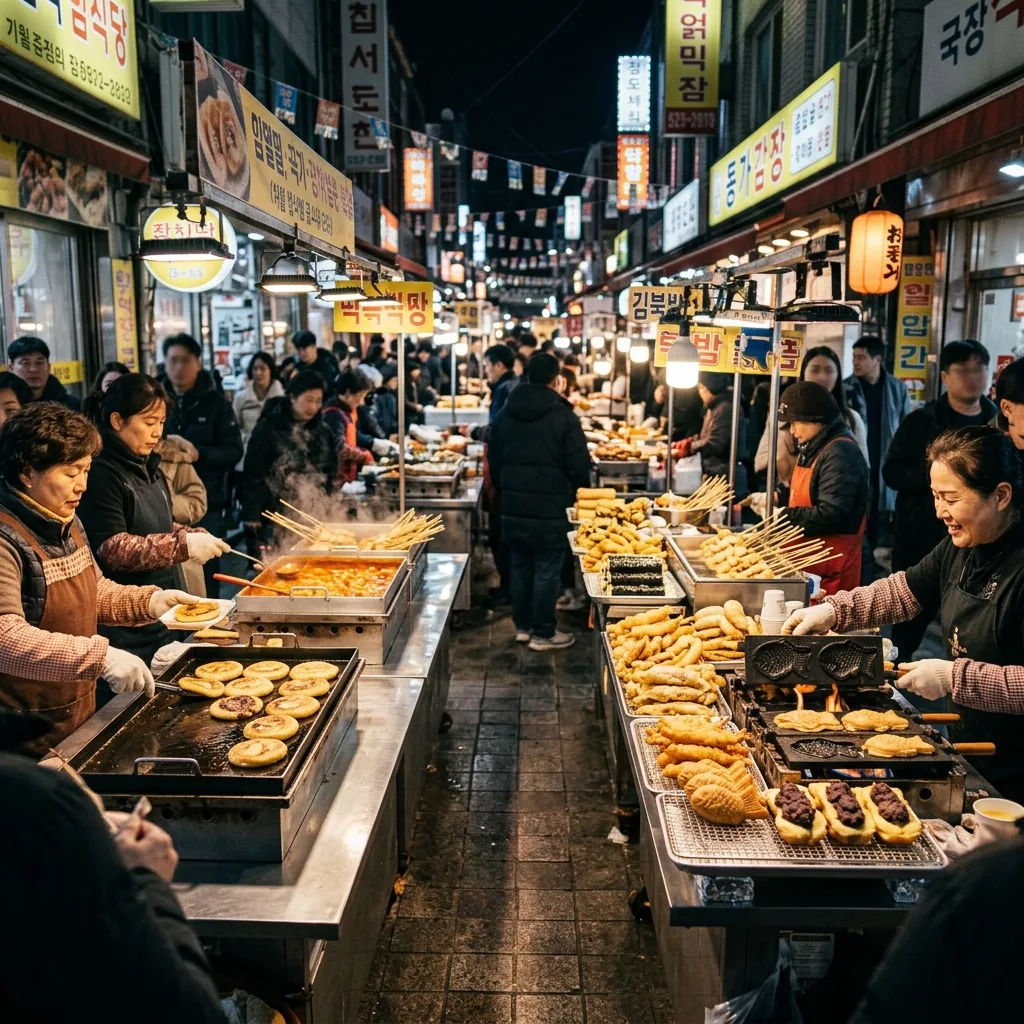
You've just landed at Incheon, taken the AREX into Seoul, dumped your bags, and stepped outside hungry. Within two blocks you'll pass a vendor crisping sesame-flecked hotteok on a flat iron, another pressing red-bean paste into fish-shaped bungeoppang molds, and a third ladling crimson tteokbokki sauce over chewy rice cakes. The problem isn't finding Korean street food — it's knowing which stall to stop at first, what each snack actually tastes like, and how much you should be paying. This guide ranks the essential Korean street snacks from most iconic to most underrated, with honest notes on taste, texture, and value so you spend your won on the ones you'll actually love.
Why Korean Street Food Deserves Its Own Tier
Korean street food — collectively called bunsik (분식) — isn't a sideshow to restaurant dining. It's a centuries-old food culture baked into daily life. Office workers grab odeng skewers on winter lunch breaks. Students wolf down tteokbokki between classes. Families queue for bungeoppang when the first cold snap hits in November. The snacks are cheap, fast, and calibrated to scratch very specific cravings: sweet, spicy, savory, chewy, crispy.
What makes Korean street food worth seeking out beyond novelty is the sheer variety compressed into a small price range. A full street food crawl hitting six or seven items — the equivalent of a complete meal in flavor terms — costs ₩15,000–₩25,000 ($11–$18 USD) in 2026. That's exceptional value by any global city standard. For a deeper look at how to build a full food day around these snacks, The Ultimate Korean Street Food Guide: Tteokbokki to Tornado Potato covers the broader landscape including pojangmacha stall culture and night market strategies.
The Ranking: 10 Korean Street Snacks, Worst to Best
This isn't a "best of Seoul restaurants" list. Every item here is available from street carts, market stalls, or pojangmacha tents for under ₩5,000 per serving. Ranking criteria: taste complexity, value for money, cultural significance, and how well the snack holds up after a few minutes of walking.
10. Gyeranppang (계란빵) — Egg Bread
Price: ₩2,000–₩3,000 per piece Season: Year-round, more common in winter
Gyeranppang is a small oblong bread loaf with a whole cracked egg baked into the center. The concept is straightforward: slightly sweet bread dough, savory egg, done. It's warm and filling, and the egg gives it a protein boost that most street snacks lack. What keeps it at the bottom of this ranking is the sameness of it. Every vendor makes essentially the same product with minimal variation. The bread-to-egg ratio can feel off when the loaf is thick — you're eating a lot of bread to get to the egg. That said, if you're tired and need something substantial for under ₩3,000, gyeranppang is reliable comfort food. Look for it near subway entrances in autumn and winter.
Best eaten: Immediately from the vendor, while the egg yolk is still slightly soft.
9. Soondae (순대) — Blood Sausage
Price: ₩3,000–₩5,000 per portion Season: Year-round
Soondae is not for the faint-hearted or the squeamish. It's a Korean blood sausage made from pig intestine casing stuffed with glass noodles, rice, and pork blood. The texture is dense and slightly gelatinous, the flavor earthy and savory with a faint iron note. It's almost always served sliced with salt and perilla leaf, and frequently alongside tteokbokki or sundae soup.
Why rank it ninth? Because soondae is polarizing. First-timers are often put off by the texture and smell before they've had a chance to taste it. Veterans who grew up eating it love it deeply — it's childhood food for most Koreans. If you're an adventurous eater, try it; if you have food texture sensitivities, start elsewhere on this list. Gwangjang Market is one of the best places to try soondae from a vendor who will walk you through it — the Gwangjang Market Food Guide: Seoul's Oldest Traditional Market has a full breakdown of what to order there.
Best eaten: Dipped in coarse salt and sesame oil, with a side of tteokbokki broth to cut the richness.
8. Ttangkongbbang (땅콩빵) — Peanut-Shaped Bread
Price: ₩3,000–₩4,000 for 5 pieces Season: Year-round, peak in autumn and winter
Ttangkongbbang are bite-sized pastries shaped like peanuts and filled with sweet peanut cream. They're made in molds on a griddle, similar to bungeoppang, and sold in small bags of five or six. The taste is mild — sweet, slightly nutty, with a soft doughy shell. They're not exciting, but they're the kind of snack you keep eating because each piece is just small enough to justify another. The novelty factor (who can resist peanut-shaped food?) bumps them above gyeranppang. Find them at street markets around Insadong and Hongdae.
Best eaten: Warm, in a group, as a filler between more intense snacks.
7. Odeng / Eomuk (오뎅/어묵) — Fish Cake Skewers
Price: ₩1,000–₩1,500 per skewer Season: Year-round, essential in winter
Odeng gets underrated by tourists because it looks unassuming — flat beige fish cake sheets folded onto skewers, sitting in a lukewarm cloudy broth. Don't be deceived. The broth is the whole point. Made from dried anchovies and radish, it's clean, mildly savory, and deeply warming. Most vendors let you drink it for free with your skewers. On a cold Seoul night, standing at a pojangmacha tent with an odeng skewer and a cup of broth is one of the most satisfying cheap eating experiences the city offers.
The fish cake itself has a springy, slightly chewy texture that takes on the broth's flavor. Varieties include flat sheets, tubular rolls, and triangles — triangles tend to have the best texture-to-surface-area ratio. At ₩1,000–₩1,500 per skewer, it's among the cheapest items on this list and genuinely good.
Best eaten: Standing at the vendor's cart in cold weather, broth included.
6. Corn Dog / Gamja Hotdog (감자핫도그) — Korean Corn Dog
Price: ₩3,000–₩5,000 Season: Year-round
The Korean corn dog is not the American corn dog. Here, the coating is made from a rice flour batter (lighter and crispier than cornmeal), and variations include the gamja hotdog — a dog rolled in cubed potatoes before frying so that chunks of potato stick to the outside and crisp up in the oil. Some versions substitute the sausage for mozzarella cheese, which stretches dramatically when pulled apart. Others use half sausage, half cheese. Sugar is often sprinkled on the outside, creating a sweet-savory contrast that sounds strange and works completely.
Myeongdong is ground zero for Korean corn dogs, with multiple competing vendors, and the Myeongdong Street Food: What to Eat and Where to Find It guide covers the specific stalls worth queuing for. Expect a short wait at peak hours.
Best eaten: The cheese version, pulled slowly apart for maximum stretch effect.
5. Tteokbokki (떡볶이) — Spicy Rice Cakes
Price: ₩2,000–₩4,000 per cup, ₩3,000–₩6,000 for a full portion Season: Year-round
Tteokbokki is arguably the most iconic Korean street food — chewy cylindrical rice cakes in a fiery red-orange sauce made from gochujang (fermented chili paste), gochugaru (chili flakes), soy sauce, and sugar. The sauce is sticky and sweet with a slow-building heat, and the rice cakes absorb it over time to create something between a snack and a comfort meal.
It sits fifth rather than first because the experience is highly vendor-dependent. Bad tteokbokki — overcooked rice cakes, thin bland sauce — is genuinely disappointing. Great tteokbokki involves sauce that's been simmering long enough to thicken and develop umami depth, with rice cakes that still have a slight resistance when bitten. Seek out stalls that have been open for years (look for worn carts and loyal lunchtime crowds) rather than brand-new tourist-facing vendors.
The Sindang neighborhood in central Seoul has an entire alley dedicated to tteokbokki with vendors who've been perfecting the sauce for decades — a full breakdown is in the Sindang-dong Tteokbokki Alley guide linked in the next section.
Spice note: Standard tteokbokki is moderately spicy — Level 2 or 3 out of 5. Some vendors offer rabokki (라볶이), a milder version with ramen noodles added.
4. Gimbap (김밥) — Seaweed Rice Rolls
Price: ₩1,500–₩3,000 per roll Season: Year-round
Technically gimbap is as much a fast food item as a street snack, but it earns its spot on this list because of how it functions in the street food crawl — as the neutral anchor between spicy, sweet, and fried items. Gimbap is seaweed (gim) wrapped around vinegared rice and fillings: typically pickled radish, carrot, spinach, egg, and crab stick or tuna. It's mild, balanced, and filling without heaviness.
The key thing to know: gimbap is not sushi. The rice isn't seasoned with sharp vinegar, the rolls are cut thicker, and the filling philosophy leans toward vegetables and cooked proteins rather than raw fish. A tuna mayo gimbap or a cheese gimbap from a 김밥천국 (Gimbap Cheonguk) chain restaurant is a perfect mid-crawl refueling stop. From a street market stall, freshly rolled gimbap still warm is something else entirely.
Best eaten: Fresh, within an hour of being rolled. Avoid pre-packaged convenience store gimbap if you have options.
3. Hotteok (호떡) — Sweet Stuffed Pancakes
Price: ₩1,000–₩2,000 standard, ₩3,000–₩5,000 for premium versions Season: Peak in autumn and winter, available year-round
Hotteok is a fried pancake made from a yeasted wheat dough, pressed flat on an oiled griddle, and filled with a mixture of brown sugar, cinnamon, and chopped peanuts or sunflower seeds. As it cooks, the sugar filling melts into a syrup that pools inside the pancake. When you bite into a hot hotteok, that syrup runs — so be careful or it'll burn your chin.
The classic version is simple and near-perfect: crispy exterior from the oil, chewy interior from the yeasted dough, and that rush of warm cinnamon-sugar in the center. Variations include green tea hotteok, red bean hotteok, and a savory cheese-and-vegetable version. Gwangjang Market is famous for its hotteok vendors, some of whom have been working the same griddle for thirty years.
At ₩1,000–₩2,000 for the standard version, hotteok is one of the best value-per-bite street foods in Korea. It ranks third rather than higher only because it's best in cold weather — on a July afternoon in Seoul, fried syrup-filled dough is less appealing.
Best eaten: Hot from the griddle in November or December, paired with coffee from a nearby convenience store.
2. Bungeoppang (붕어빵) — Fish-Shaped Red Bean Pastry
Price: ₩1,000–₩2,000 for 2–3 pieces Season: Autumn through early spring (roughly October–March)
Bungeoppang is the most nostalgic food in South Korea. Ask any Korean about childhood and bungeoppang appears — bought on the walk home from school, stuffed into jacket pockets in winter. The pastry is a waffle-iron-cooked bread shell in the shape of a carp (붕어, bungeo), filled with sweetened red bean (azuki) paste that's thick and dense with a earthy sweetness.
The red bean filling is the dividing line for tourists: some love it immediately, others find it unfamiliar. If you've eaten Japanese taiyaki (which bungeoppang directly inspired), you already know what to expect. If you haven't, start with one piece before committing to a bag. The newer custard cream (커스터드) filling is a softer introduction for people new to red bean desserts.
Bungeoppang has strict seasonality — vendors disappear in spring and summer. Seeing a bungeoppang cart steam rising from a side street is a reliable sign that real winter cold has arrived in Seoul. This seasonality is part of what makes it special: it's not always available, which means when it is, it gets the appreciation it deserves.
Best eaten: Hot, immediately, standing next to the cart. The shell softens as it cools.
1. Tteokbokki + Soondae + Twigim Combo (분식 세트)
Price: ₩6,000–₩10,000 for the combination set Season: Year-round
The top slot doesn't go to a single snack but to the combination that defines Korean street food eating: tteokbokki, soondae (blood sausage), and twigim (battered and fried vegetables and fish cake) eaten together at a pojangmacha tent. This is bunsik at its fullest expression — multiple textures and flavors in one sitting, sharing a table with strangers, reheating your hands on a paper cup of fish cake broth.
The combination works because each element contrasts with the others. Spicy tteokbokki is offset by the neutral starchiness of soondae. Crispy twigim (often including battered sweet potato, squid, and pepper) provides texture variety. Vendors often let you dip the twigim directly into the tteokbokki sauce, which improves both.
This is the street food experience that's impossible to replicate at home or in a restaurant — it requires the specific context of a small folding table, cold air, and the chaos of a busy market. If you visit Seoul and skip this, you've missed something central.
Practical Guide: Where, When, and What to Pay in 2026
Best Markets and Neighborhoods for Street Food
Gwangjang Market (광장시장) The best single destination for traditional street food in Seoul. Open daily, busiest at lunch. Hotteok, soondae, bindaetteok (mung bean pancakes), and gimbap are all available from permanent stalls. No tourist markup — prices are the same as everywhere else in the city.
Myeongdong (명동) Ground zero for the Korean corn dog trend and international-facing snacks. Busiest in evenings. Expect a slight tourist premium (₩500–₩1,000 more per item than Gwangjang), but the concentration of vendors makes it easy to try multiple things quickly.
Hongdae (홍대) Youth-focused area with high snack innovation. More experimental variations (flavored hotteok, unusual corn dog fillings, trendy desserts) alongside classics.
Insadong (인사동) Traditional crafts neighborhood with a pedestrian street (Ssamziegil) lined with snack stalls. Slightly touristy but still with genuine vendors. Good for ttangkongbbang and honey hotteok.
Sinchon / Edae (신촌/이대) University district — food is cheap and abundant. Less photographed than Hongdae but equivalent quality and lower pressure to buy.
2026 Price Reference
| Snack | Price Range (KRW) | USD Equivalent |
|---|---|---|
| Odeng (1 skewer) | ₩1,000–₩1,500 | $0.70–$1.10 |
| Bungeoppang (2–3 pcs) | ₩1,000–₩2,000 | $0.70–$1.45 |
| Hotteok (1 piece) | ₩1,000–₩2,000 | $0.70–$1.45 |
| Gyeranppang | ₩2,000–₩3,000 | $1.45–$2.20 |
| Tteokbokki (cup) | ₩2,000–₩4,000 | $1.45–$2.90 |
| Gimbap (1 roll) | ₩1,500–₩3,000 | $1.10–$2.20 |
| Korean Corn Dog | ₩3,000–₩5,000 | $2.20–$3.60 |
| Full combo set | ₩6,000–₩10,000 | $4.35–$7.25 |
Prices as of 2026. Seoul vendors have seen modest increases since 2023 but remain significantly cheaper than equivalent street food in comparable Asian cities.
Getting There
All major street food areas are accessible by subway. The Seoul Metro app and Naver Maps both provide English-language navigation. Get a T-money card at any convenience store or airport kiosk — single rides cost ₩1,400–₩1,800 depending on distance.
- Gwangjang Market: Line 1, Jongno 5-ga Station (Exit 8)
- Myeongdong: Line 4, Myeongdong Station (Exit 6 or 8)
- Hongdae: Line 2 / AREX, Hongik University Station (Exit 9)
- Insadong: Line 3, Anguk Station (Exit 6)
Tips and Common Mistakes
Eat immediately. Korean street food is designed for on-the-spot consumption. Bungeoppang softens within ten minutes. Hotteok's sugar syrup congeals as it cools. Tteokbokki's rice cakes keep absorbing sauce and become mushy. There are no takeout containers at most pojangmacha stalls — that's by design.
Pay with cash. Most street vendors are cash-only, though this is slowly changing in higher-traffic tourist areas like Myeongdong. Carry ₩10,000–₩20,000 in small bills for a street food crawl.
Avoid peak tourist hours at Myeongdong. The 6–9 PM window on weekends means 20-minute queues for popular vendors. Go at 4–5 PM or on a weekday morning when vendors are just setting up and freshness is highest.
Don't skip the broth. At odeng stalls, the broth is free and refillable. It's often the most genuinely warming part of the experience and costs nothing extra.
Seasonality is real. Bungeoppang and hotteok are technically available year-round from some vendors but are meaningfully better in cold weather when the contrast between outside temperature and warm pastry is sharpest. If you're visiting in winter, prioritize these.
Spice management. If you have low heat tolerance, stick to odeng, gimbap, gyeranppang, hotteok, and bungeoppang — none of these are spicy. Tteokbokki, soondae dipped in sauce, and anything labeled 매운 (maeun, spicy) will have real heat. Convenience store banana milk (바나나우유) is the local antidote.
FAQ
Is Korean street food safe to eat? Yes. Food safety standards in Korea are high, vendors in established markets have regular inspections, and cooking-to-order at high heat eliminates most contamination risk. Stick to vendors with visible cooking (not pre-made platters sitting uncovered) and you'll be fine.
What is the most popular Korean street food? Tteokbokki consistently ranks as the most popular Korean street food by volume sold and cultural recognition. It's available everywhere, eaten by all age groups, and forms the base of the classic bunsik combination plate.
Can I find Korean street food outside Seoul? Yes. Busan has strong street food culture centered around BIFF Square and Gukje Market (where prices have risen slightly in recent years but remain affordable). Jeonju has its own regional street food scene centered on the Hanok Village. Gyeongju's night market near Wolseong Park is worth visiting for regional specialties.
When is bungeoppang season? Bungeoppang vendors typically appear in late October as temperatures drop and pack up by late March or early April. The peak season is December through February. If you're visiting in summer, don't expect to find it.
Are there vegetarian-friendly options? Several: gimbap (ask for vegetable-only, 야채 김밥), hotteok, bungeoppang, gyeranppang, and plain tteokbokki (check if the broth is anchovy-based — it often is). Odeng, soondae, and corn dogs are not vegetarian. At Gwangjang Market, bindaetteok (mung bean pancakes) is a solid vegetarian-friendly option.
How do I order without speaking Korean? Pointing works at every stall. Vendors in tourist areas are accustomed to non-Korean speakers. Hold up fingers for quantity. Have ₩5,000–₩10,000 notes ready and the vendor will make change. No Korean required for any item on this list.
Conclusion
Korean street food rewards curiosity and punishes hesitation. The best snacks — bungeoppang, hotteok, the full tteokbokki combo — are cheap enough that ordering something you don't like costs you ₩2,000 and thirty seconds. The worst case is mild disappointment. The best case is that you find yourself queuing for a third hotteok because the first two disappeared too fast.
Start with hotteok or bungeoppang to ease in (neither is spicy, both are universally accessible), then work toward the tteokbokki and soondae combination at a pojangmacha tent when you're ready for the full experience. If you're building a full food day in Seoul, the A Foodie's Guide to Seoul: Top 15 Must-Try Street Foods covers sit-down and restaurant options beyond the street level. For the market experience specifically, spend an afternoon at Gwangjang — it's the most concentrated version of traditional Korean food culture accessible to a first-time visitor.
Eat while it's hot. That's the only rule.