The Ultimate 14-Day South Korea Grand Tour (Seoul to Jeju)
If you have two weeks in South Korea, you don't have to choose between the city and the countryside. You can have both.
This 14-day itinerary is designed to give you the perfect balance. You'll start in the hyper-modern capital, dive into the ancient history of the Silla Kingdom, eat your way through the coastal markets of Busan, and end by relaxing on the volcanic island of Jeju.
Follow this "Golden Route" clockwise around the peninsula.
How to Plan Your 14 Days: The Essential Framework
Before you book anything, it helps to understand exactly what this route is — and who it is built for.
This itinerary is designed for first-time visitors to South Korea who want the complete picture: world-class city life, living ancient history, dramatic coastlines, and volcanic island landscapes. The pace is moderate, not punishing. You'll move cities roughly every two to three days, which gives you enough time to settle in, eat well, and feel the distinct personality of each place — without the exhaustion of constant hotel-hopping. If you are the kind of traveler who needs to see everything in a country in one go but still wants evenings free to wander and eat, this route was written for you.
The "Clockwise Loop" Logic
The route runs Seoul → Andong → Gyeongju → Busan → Jeju, moving south and east down the peninsula before jumping to the island. This is the most efficient sequence for three reasons. First, it follows the natural KTX and intercity bus network — each hop is a short, comfortable journey with no backtracking. Second, it creates a logical emotional arc: you start at maximum urban intensity in Seoul, slowly decompress through the ancient rural landscapes of Andong and Gyeongju, hit the coastal energy of Busan, and finish on the unhurried natural rhythms of Jeju. Third, ending in Jeju is logistically smart — Jeju has direct international flights to several Asian hubs, so you can fly home without returning to Seoul if your routing allows.
If You Fly Into Busan or Jeju First
Many travelers from Southeast Asia and Australia find cheaper fares into Busan's Gimhae Airport or Jeju International Airport. If that is you, simply reverse the route: start in Jeju, work up through Busan, Gyeongju, and Andong, and finish your two weeks in Seoul for your international departure. The itinerary works equally well in both directions.
A Realistic Cost Overview
South Korea rewards budget travelers but is not as cheap as Southeast Asia. Here is a practical breakdown for mid-range travel:
- Budget traveler: $60–100/day (hostel dorm or basic guesthouse, street food and local restaurants, public transport only)
- Mid-range traveler: $100–150/day (private room in a guesthouse or 3-star hotel, sit-down meals, occasional taxi)
- Comfortable/luxury: $150–200+/day (boutique hotel or Hanok guesthouse, restaurant dinners, Jeju car rental factored in)
The two biggest line items that will eat your budget are accommodation in Seoul (which commands higher prices than anywhere else on this route) and the Jeju car rental, which is non-negotiable since the island's public transport does not serve most of its best sights. Budget at least $50–80/day for a compact car in Jeju, or more in peak summer and public holiday seasons when demand spikes.
Days 1-4: Seoul (The Heart)
Seoul is a city where 600-year-old palaces sit next to futuristic design plazas. Spend your first few days soaking in the contrast.
-
Day 1: Arrival & Myeongdong.
- Take the AREX to Seoul Station. The Airport Railroad Express (AREX) runs directly from Incheon International Airport to Seoul Station in approximately 43 minutes. Buy a T-Money card at the airport — it works on every subway, bus, and even some convenience stores throughout your entire trip.
- Neighborhood Choice: Your first night's location sets the tone for your Seoul experience. Hongdae is the neighborhood of young energy — street performers, late-night bars, independent clothing shops, and some of the best budget guesthouses in the city. Myeongdong gives you shopping convenience and the highest concentration of street food stalls, but it is unambiguously touristy. Insadong is the quietest of the three — traditional tea houses, antique shops, and a calmer pace that is ideal if you prefer culture over crowds. All three are well-connected on the metro, so any of them works as a base for Day 2.
- Dinner: Skip the tourist restaurants displaying picture menus. Instead, find a local 감자탕 (gamjatang) restaurant — this is a rich, fiery pork neck and potato soup that Koreans eat as a late-night meal. Almost every neighborhood has at least two or three of them. It costs around 10,000–15,000 KRW per person, it is deeply warming after a long flight, and it is exactly the kind of meal that tells you immediately that you have arrived somewhere real.
-
Day 2: Royal History.
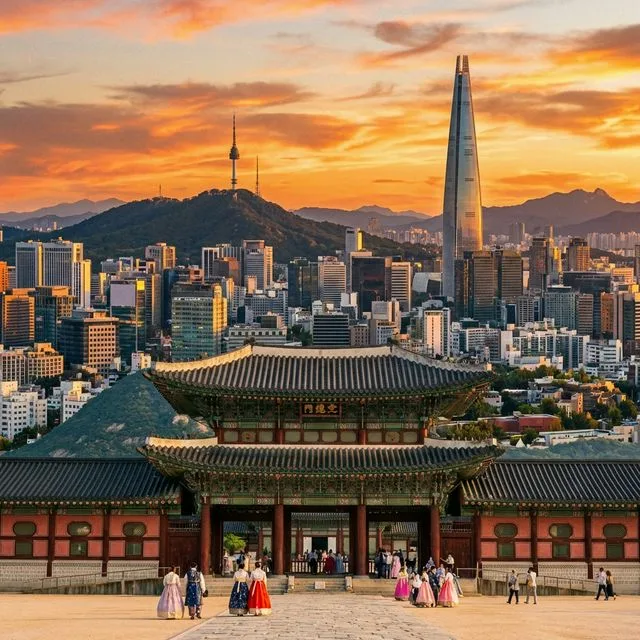
- Morning: Rent a Hanbok and enter Gyeongbokgung Palace for free. Watch the Changing of the Guard ceremony at 10 AM.
- Hidden Gem: While Gyeongbokgung gets the crowds, its neighbor Changdeokgung Palace holds the most beautiful garden in Korea — the Huwon Secret Garden (후원). This 78-acre rear garden was the private retreat of the Joseon royal family for 500 years. Access is strictly limited to 100 visitors per guided session, and tickets must be booked online well in advance (changdeokgung.go.kr). English-language tours run at 11:30 AM and 2:30 PM. The lotus ponds, pavilions, and ancient persimmon trees are worth planning your entire Day 2 around.
- Afternoon: Wander through the preserved alleyways of Bukchon Hanok Village. Respect the residents (keep your voice down!).
- Evening: Walk the Cheonggyecheon Stream — a 5.8 km urban waterway that runs through the center of Seoul. It was paved over in the 1950s and beautifully restored in 2005. The elevated walkway on either side is lit at night and becomes a procession of couples, families, and joggers. It's one of Seoul's most pleasant after-dinner walks, completely free, and ends near Gwanghwamun if you want to loop back to your accommodation.
- Read More: Seoul Nightlife Guide (For evening plans).
-
Day 3: The DMZ.
- Book a half-day tour to the Demilitarized Zone. Peer into North Korea from the Dora Observatory and walk through the 3rd Infiltration Tunnel.
-
Day 4: Modern Seoul.
- Morning — Seongsu-dong: Before you make it to Gangnam, spend the morning in Seongsu-dong, Seoul's answer to Brooklyn. This former industrial district on the north bank of the Han River has transformed into the city's most interesting creative neighborhood. Former factories now house artisan coffee roasters, upcycled fashion concept stores, and restaurants where the interior design is as considered as the food. The contrast with what comes next is the whole point.
- Afternoon — Gangnam: Visit the Starfield Library in Gangnam (the one with the giant bookshelves). The juxtaposition of Seongsu's raw, reclaimed aesthetic against Gangnam's polished luxury gives you a genuine cross-section of what contemporary Seoul actually is — two cities living inside one. Walk along the Han River Park and order delivery chicken for a picnic.
Days 5-6: Andong (The Soul)
Take the KTX-Eum high-speed train from Cheongnyangni Station (approx. 2 hours) to Andong. This is the spiritual capital of Korea.
-
Day 5: Hahoe Folk Village.
- This is a UNESCO World Heritage site where people still live in traditional thatched-roof houses (Choga).
- Must-See: Catch the Hahoe Mask Dance Drama performance at 2 PM. It's a satirical play that mocks the aristocracy, and it's hilarious (even if you don't speak Korean).
- Food: Try Andong Jjimdak (Braised Soy Chicken) — it was invented here! The original restaurant district for Jjimdak is near the Andong bus terminal, where you'll find half a dozen competing versions of the dish within 100 meters of each other.
- Andong Soju: After dinner, seek out the local 막걸리 (makgeolli) taverns and pojangmacha (street tent bars) to try Andong Soju — the original, unfiltered rice soju that bears no resemblance to the sweet commercial bottles you may know from Korean restaurants abroad. Andong Soju runs at 45% ABV, considerably stronger and more complex than its commercial cousins. It tastes of grain and smoke and tradition. Drink it slowly, with food.
-
Day 6: Temples and Scholars.
- Morning — Bongjeongsa Temple: Most visitors skip this one, which means you may have it almost entirely to yourself. Bongjeongsa is home to one of the oldest surviving wooden structures in Korea, the Geungnakjeon Hall, dating to the Goryeo period (918–1392). It sits in a narrow mountain valley about 20 km from the city center and is reachable by local bus. The building is extraordinarily spare and beautiful — seven centuries of wood and prayer.
- Afternoon — Dosan Seowon: Visit this Confucian academy nestled in the mountains. It's quiet, scholarly, and incredibly beautiful.
- Accommodation Note: If your schedule allows, book one night inside Hahoe Village itself at a Hanok guesthouse. Several families in the village rent out rooms in their 600-year-old thatched houses. You sleep on a heated ondol floor, wake to roosters and mist over the Nakdong River, and eat a home-cooked breakfast of rice, soup, and banchan. Book directly through the Hahoe Village tourism office website or through Naver — these guesthouses typically run 60,000–80,000 KRW per night and are not widely listed on international booking platforms.
Days 7-9: Gyeongju (The History)
Take an intercity bus from Andong to Gyeongju (1.5 hours). This city was the capital of the Silla Kingdom for 1,000 years.
Gyeongju is not a living museum — it is a real city that simply happens to have royal tombs in its parks and thousand-year-old stone lanterns at its intersections. UNESCO calls the entire city a "museum without walls," and once you arrive, you'll understand why immediately.
-
Day 7: The Museum Without Walls.
- Rent a bicycle from one of the many shops near the city center (around 5,000–8,000 KRW for a full day). The terrain is completely flat, and the distances between sites are manageable in a gentle 3–4 hour loop.
- The Cycling Route: Start at Tumuli Park, where you can enter the interior of the reconstructed Cheonmachong royal tomb and see the artifacts buried with Silla royalty. Continue north on the bike path to Cheomseongdae — the oldest surviving astronomical observatory in Asia, built in 647 CE, an elegant stone cylinder that looks almost modern. From there, ride east to Anapji Pond (also called Donggung Palace and Wolji Pond) to see the daytime version before you return at night, then finish at the Gyeongju National Museum, which houses the Emille Bell — one of the largest and most beautifully cast bronze bells in Asia. The whole loop is approximately 8–10 km on flat, well-marked paths.
-
Day 8: Bulguksa Temple.
- Take city bus 11 from the Gyeongju intercity bus terminal up the mountain to Bulguksa Temple. Opening hours are 7 AM–6 PM (5 PM in winter), and the entrance fee is 6,000 KRW. Bulguksa contains eight separate National Treasures of Korea within a single complex, including the twin stone pagodas Dabotap and Seokgatap, the Cheongun-gyo (Blue Cloud Bridge), and the gilt-bronze seated Buddha inside Geungnakjeon Hall. Arrive before 9 AM to experience it in relative quiet before the tour groups arrive.
- From Bulguksa, take the shuttle bus (runs every 30 minutes) to Seokguram Grotto, 15 minutes up the mountain. The grotto houses a 3.5-meter granite Buddha that is considered the artistic pinnacle of Silla-period Korea. The statue sits in a circular stone chamber engineered with extraordinary precision — the morning light enters through the entrance at an angle calculated to illuminate the Buddha's face at sunrise. Visit late morning when the light inside is best.
- Read More: Temple Stay Etiquette (If you want to stay overnight).
-
Day 9: Night Views.
- Spend the morning exploring the Gyeongju Historic Areas walking trail near Wolji Pond — a relaxed loop through the old palace district that takes about 90 minutes.
- Evening at Wolji Pond: Arrive at Donggung Palace and Wolji Pond approximately 30 minutes before sunset to watch the light change over the water. Admission is 3,000 KRW. As darkness falls, the pavilions and reconstructed palace buildings are illuminated from below, and their reflection in the still pond creates one of the most genuinely magical views in all of Korea — a photograph that no filter can improve on. Stay for at least an hour. There are small food stalls outside the gate selling hotteok and roasted corn for the walk back.
Days 10-12: Busan (The Energy)
Take the KTX from Singyeongju Station to Busan Station (30 mins).
Busan hits differently from Seoul. It's louder, saltier, more chaotic, and more alive. The sea is everywhere — in the smell of the air, in the food on every table, in the fishing boats visible from the hillside villages. Korea's second city has a personality entirely its own.
-
Day 10: Markets & Culture.
- Morning — Jagalchi & Gukje Markets: Start at Jagalchi Fish Market, where the "Jagalchi Ajurmma" (fiery market ladies) sell octopus and hagfish from tanks at the water's edge. From Jagalchi, walk ten minutes inland to Gukje Market — a sprawling maze of covered stalls born from the Korean War era, when refugees settled here and began trading whatever they had. Today it sells everything from used military jackets to dried seafood to fresh produce. It is a sensory overload in the best possible way.
- Afternoon — BIFF Square & Gamcheon: Walk to BIFF Square — the home of the Busan International Film Festival and Korea's answer to the Hollywood Walk of Fame, with handprints of Korean cinema legends pressed into the pavement. End the afternoon at Gamcheon Culture Village, the "Santorini of Korea." Colorful houses built into the hillside. Stop for coffee at one of the cafes perched on the upper terraces — the views over the port are worth the climb.
-
Day 11: The Coast.
- Morning — Taejongdae: Take a bus from Nampo-dong to Taejongdae, the dramatic cliff park at Busan's southernmost tip. The walking trail loops around the headland above the Korea Strait — on clear days you can see the Japanese island of Tsushima in the distance. The cliffs drop 20–30 meters into the sea in vertical columns of layered rock. The park takes its name from the Silla king Taejong Muyeol, who is said to have practiced archery here. Allow two hours for the full trail.
- Afternoon: Take the Sky Capsule train at Haeundae Blueline Park — brightly colored gondola cars that ride elevated rails along the coast, giving you spectacular views of the sea below.
- Visit Haedong Yonggungsa, a rare temple built on the cliffs overlooking the ocean.
-
Day 12: Beach Day.
- Morning: Head to Gwangalli Beach for the morning. For lunch, try milmyeon — Busan's signature cold wheat noodle dish, served in an icy beef broth with a vinegary kick. Several well-regarded milmyeon shops are clustered in the streets behind Gwangalli Beach and cost under 10,000 KRW per bowl. It is the local dish that Busan people are most proud of, and rightfully so.
- Evening: Stay at Gwangalli into the evening on a Saturday night to catch the Gwangalli drone show at 8 PM. A fleet of hundreds of drones lifts off from the beach and forms coordinated shapes — Korean characters, fireworks, landscapes — above the Gwangan Bridge, which is lit throughout in color. It runs for approximately 15–20 minutes and draws large crowds, so secure your viewing spot on the sand by 7:30 PM.
- Read More: Summer Beach Escapes
Days 13-14: Jeju Island (The Nature)
Fly from Busan (Gimhae Airport) to Jeju. Rent a car immediately.
Do not attempt Jeju without a rental car. The island's best sights — lava tubes, cliffs, hidden beaches, waterfalls — are scattered across a 1,850 square kilometer landscape that local buses reach only partially and infrequently. Pick up your car at the airport arrivals hall and head east along the coastal road.
-
Day 13: Sunrise & Lava & Cliffs.
- Early Morning — Seongsan Ilchulbong: If you are in Jeju, you owe it to yourself to climb Seongsan Ilchulbong (Sunrise Peak) before the crowds arrive. The hike takes about 30 minutes up a stepped path and delivers you to the rim of an ancient volcanic crater with panoramic views of the eastern coast. Aim to reach the summit before 8 AM.
- Morning — Manjanggul Lava Tube: A 10-minute drive from Seongsan brings you to Manjanggul, one of the longest and best-preserved lava tubes in the world. The cave stretches over 13 km, and 1 km of it is open to the public. The interior is cool, dark, and genuinely otherworldly — a cathedral of basalt shaped entirely by flowing lava. Bring a light jacket.
- Afternoon — Seopjikoji: Drive south to Seopjikoji, the volcanic headland that juts into the sea at the island's southeastern corner. The cliffs here are some of the most dramatic on Jeju — black lava rock against turquoise water, with fields of canola flowers in spring and silver grasses in autumn. This headland has been the filming location for numerous K-dramas and films, and you'll understand the appeal immediately. Below the headland, the small beach at Sinyang Seopjikoji offers calmer water and is far less visited than Jeju's famous beaches on the northern coast.
- Evening: Drive across to Seogwipo on the southern coast. Visit Jeongbang Waterfall, one of the few waterfalls in Asia that falls directly into the sea.
- Read More: Jeju Island Itinerary (For detailed driving routes).
-
Day 14: Western Jeju & Departure.
- Morning — Hallim Park: Drive to the island's western coast for Hallim Park, which combines a lava cave system (Hyeopjae Cave and Ssangyong Cave), botanical gardens, a bonsai garden, and a reconstructed traditional village in a single large complex. It is more interesting than it sounds — the lava cave section alone is worth the entrance fee.
- Hyeopjae Beach: A short walk from Hallim Park, Hyeopjae Beach is widely considered the most beautiful beach on Jeju — white sand, shallow turquoise water clear enough to see the bottom at chest depth, and an islet (Biyangdo) visible offshore. If the weather cooperates, take your final swim here before heading back to the airport.
- Lunch — Jeju Black Pork: Before you fly, do not leave Jeju without eating 흑돼지구이 (heukdwaeji-gui) — grilled Jeju black pork. The breed is native to the island and has a richer, more marbled flavor than mainland Korean pork. The best restaurants for it are concentrated in the Heukdwaeji Street area of Jeju City (돈사돈 or 자매국수 area). Grill it tableside over charcoal, wrap it in perilla leaves with ssamjang, and eat it with kimchi. It is the perfect final meal.
- Dongmun Market: Buy boxes of Hallabong chocolate at Dongmun Market.
- Fly back to Seoul (Gimpo Airport) for your international connection.
Practical Tips for the Grand Tour
- Transport: Download the KORAIL Talk app for trains and T-Money GO for buses.
- Connectivity: Get a SIM card with unlimited data. You will need Naver Map constantly. (SIM Card vs Wifi Guide)
- Money: Carry cash for street food and markets in Andong/Gyeongju. Credit cards work everywhere else.
Accommodation Strategy by City
Where you stay matters on a route this long. Here are the recommended neighborhoods and realistic price ranges per night:
- Seoul: Hongdae or Myeongdong guesthouses, $40–60/night for a private room. Insadong boutique guesthouses run slightly higher. Avoid hotel chains near Gangnam unless you have a specific reason to be there — it adds 45 minutes of commute to everything on this itinerary.
- Andong: A Hanok guesthouse inside or near Hahoe Village, $60–80/night. This is worth the premium — sleeping in the village itself rather than commuting from Andong city center transforms the experience.
- Gyeongju: A Hanok or modern guesthouse near Wolji Pond, $40–60/night. The pond is within walking distance of most of the city's key sites, making it the single most practical base in Gyeongju.
- Busan: Near Seomyeon or Gwangalli Beach, $50–80/night. Seomyeon gives you the best access to the subway network; Gwangalli puts you at the beach and the best restaurant cluster.
- Jeju: A pension (민박, minbak) in Seogwipo for the southern circuit, $70–100/night. Seogwipo-based accommodation puts you within 15–20 minutes of most of the Day 13 sights, saving significant driving time.
The Golden Rule of Korean Booking
International booking platforms are convenient, but Korean travelers do not primarily use them — and this matters because the best restaurants, guesthouses, and experiences are booked through Korean platforms first.
Learn to use Naver Maps for everything: it is the most accurate navigation tool for Korea (Google Maps lags significantly), and it also functions as a restaurant review platform and booking engine. Popular restaurants across this itinerary require reservations through Naver — look for the "예약" (yeoyak / reservation) button on each listing. For KTX trains, always book through KORAIL (letskorail.com) or the Korail Talk app — advance booking is essential for the popular Seoul-to-Busan corridor, especially on weekends and public holidays. For Jeju car rental, book your vehicle at least two weeks in advance in peak season (July, August, Chuseok, and Seollal holiday periods) — the island's rental fleet sells out completely, and waiting until arrival will leave you stranded.
This route covers the neon lights, the quiet temples, the busy markets, and the crashing waves. It is the full Korean experience. To maximize your in-country travel between each stop, our car rental and driving guide gives you the freedom to reach corners that trains can't. For the best market experiences en route, pair each city with our guide to traditional Korean markets. And for those who want to build a shorter version of this trip, the 10-day first-timer's itinerary distills the highlights into a tighter plan.