Seoul Lotus Lantern Festival (Yeondeunghoe) Highlights

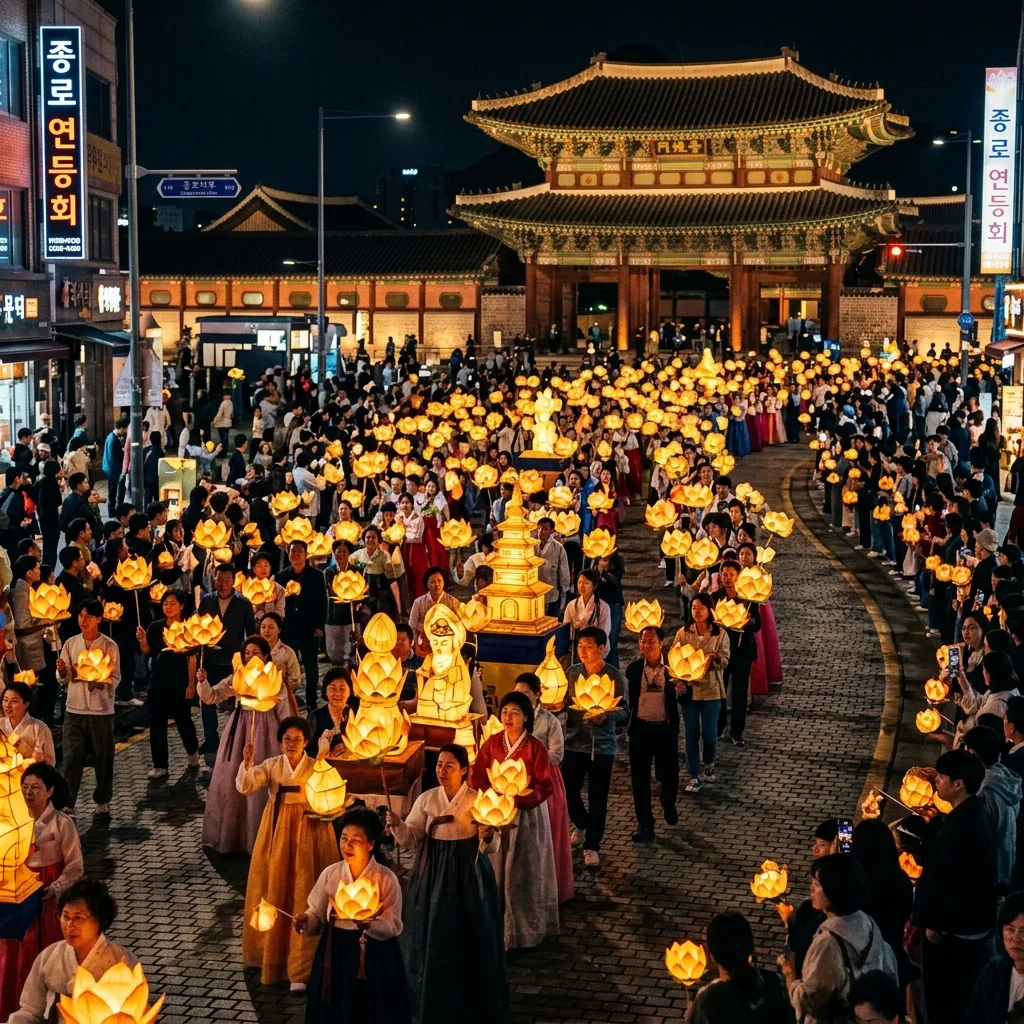
Every spring, a river of golden light flows through the heart of Seoul. Tens of thousands of lanterns — hand-crafted lotus blooms in white, red, and saffron — move in silence down Jongno Street while drumbeats echo off centuries-old temple walls. The Yeondeunghoe Lotus Lantern Festival is not a tourist spectacle tacked onto a city calendar; it is one of Korea's most spiritually resonant traditions, practiced without interruption for over a millennium and now inscribed on UNESCO's Representative List of the Intangible Cultural Heritage of Humanity. If you attend only one festival in Seoul, make it this one.
The festival unfolds around Buddha's Birthday (부처님 오신 날), the eighth day of the fourth lunar month, and centers on the neighborhood surrounding Jogyesa Temple in Jongno-gu. What separates Yeondeunghoe from every other lantern event in the world is its unbroken lineage: the same rite performed in the Goryeo Dynasty (918–1392) is still enacted today, with the same lotus motif and the same spirit of offering light as a symbol of wisdom. In 2020, UNESCO formally recognized this continuity by granting the festival Intangible Cultural Heritage status — the highest endorsement any living tradition can receive.
The 2026 Schedule and Key Events
The 2026 Yeondeunghoe Lotus Lantern Festival runs from May 8 to May 25, with the Grand Lantern Parade on Saturday, May 16 (7:00–9:30 PM). All main events — the parade, exhibitions, and cultural performances — are free to attend. Arrive by 5:30 PM to secure a prime viewing spot along Jongno Street.
The 2026 festival spans nearly three weeks of events, with activities radiating outward from Jogyesa Temple across the wider Jongno district. The centerpiece — the Grand Lantern Parade — falls on Saturday, May 16, but savvy visitors plan to arrive a day early and stay through Sunday to catch the full range of cultural programming. The festival officially opens with a Lighting Ceremony at Gwanghwamun Square on April 22, a full month before the main events — a lower-crowd, high-atmosphere preview that most visitors miss entirely.
Full 2026 Calendar:
| Date | Event | Time |
|---|---|---|
| April 22 | Lighting Ceremony – Gwanghwamun Square | 7:00 PM |
| May 8 – May 25 | Traditional Lantern Exhibition (Jogyesa, Bongeunsa, Cheonggyecheon Stream) | All day |
| May 16 (Sat) | Eoulim Madang – Buddhist Cheer Rally (Dongguk University Stadium) | 4:30 PM – 6:00 PM |
| May 16 (Sat) | Grand Lantern Parade | 7:00 PM – 9:30 PM |
| May 16 (Sat) | Daedong Hanmadang – Post-Parade Celebration | 9:30 PM – 11:00 PM |
| May 17 (Sun) | Traditional Culture Madang | 11:00 AM – 7:00 PM |
| May 17 (Sun) | Performance Madang | 11:00 AM – 7:00 PM |
| May 17 (Sun) | Yeondeungnori – Closing Celebration | 7:00 PM – 9:00 PM |
| May 24 (Sun) | Buddha's Birthday – Commemorative Dharma Service at Jogyesa | 10:00 AM |
The Lantern Exhibition is often overlooked by first-timers who focus on the parade. Do not make that mistake. The outdoor exhibition in the plaza around Jogyesa Temple fills the entire three-week period with enormous sculptural lanterns — some two or three stories tall — depicting Buddhas, Bodhisattvas, dragons, and celestial animals. Entry to the exhibition area is free.
The Eoulim Madang on Saturday afternoon is a choreographed cheer rally held by Buddhist organizations from across Korea. In 2026, the rally relocates to Dongguk University Grand Stadium (near Jangchungdan Park), giving the event a more formal enclosed venue. Monks, nuns, lay practitioners, and schoolchildren perform in coordinated formations before the march begins. It remains the ceremonial ignition of the evening — the moment the festival shifts from exhibition to procession.
The Parade Route: Dongdaemun to Jogyesa
The Grand Lantern Parade is the emotional and visual peak of Yeondeunghoe. At 7:00 PM on Saturday, May 16, the procession departs from Heunginjimun Gate (Dongdaemun) and travels westward along Jongno Street — Seoul's oldest royal boulevard — for approximately 3.5 kilometers before arriving at Jogyesa Temple.
Subway stations along the route (west to east):
- Jonggak Station (Line 1)
- Jongno 3-ga Station (Lines 1, 3, 5)
- Jongno 5-ga Station (Line 1)
- Dongdaemun Station (Lines 1, 4)
The parade takes roughly two hours to pass any fixed point. Participants number in the tens of thousands, carrying traditional hanji paper lanterns shaped like lotus flowers, fish, and animals from the Korean zodiac. Each lantern is lit by a small electric bulb, giving the procession a warm amber glow that no photograph fully captures.
Best Viewing Spots
Jongno 3-ga is the single best vantage point for most visitors. The street is wide here, the crowds are manageable on the side streets branching off Jongno, and you are positioned roughly halfway along the route — meaning you see the parade in full momentum rather than at its frantic start or winding finish. Arrive by 5:30 PM to secure a front-row position on the barrier.
For something more elevated, the footbridge near Jongno 5-ga (the one crossing above the main boulevard) offers a bird's-eye view of the lantern river flowing beneath you. It fills quickly — plan to claim your spot no later than 5:00 PM.
Jonggak Station exit deposits you directly in front of Jogyesa Temple, where the parade terminates. This spot has maximum energy but minimum visibility during the procession itself; the real reward here is watching thousands of participants flood into the temple courtyard at the conclusion of the march.
The Daedong Hanmadang
After the parade ends near Jogyesa, the energy does not dissipate — it transforms. The Daedong Hanmadang (대동 한마당), literally "great togetherness gathering," is the uninhibited street party that follows from 9:00 PM to 11:00 PM. Traditional folk musicians perform nonstop. Participants in hanbok form impromptu circles for ganggangsullae (a circular folk dance). Vendors sell tteok (rice cakes), hotteok (sweet pancakes), and soju from pop-up stalls lining Ujeongguk-ro. Non-Buddhists and tourists are explicitly welcomed to join the dancing — no knowledge of the steps required.
Cultural Experiences and Workshops
Yeondeunghoe is not only a spectacle to observe from a distance. Jogyesa Temple and its surrounding organizations actively invite visitors — including non-Buddhists and foreigners — to participate in hands-on cultural programs throughout the festival period.
Lantern-Making at Jogyesa Temple
The most popular activity is the lantern-making workshop (연등 만들기) held daily inside the Jogyesa Temple complex during the festival. Skilled volunteers guide participants through the traditional process of bending wire frames, layering hanji paper, and attaching the paper petals to create a finished lotus lantern. The workshop takes roughly 45–60 minutes. Participants keep their lanterns.
Registration is recommended in advance through the official Yeondeunghoe website (www.llf.or.kr). Walk-in slots are available on weekday mornings when demand is lower, but Saturday slots often sell out before 10:00 AM. The 2026 fee is approximately ₩5,000–₩10,000 depending on lantern size, consistent with recent years.
Before visiting the temple for workshops, it helps to understand the customs expected of guests — from how to bow to how to navigate the prayer halls. Our guide to temple stay etiquette in Korea covers the essential protocols in detail.
Global Supporter Program
The organizing committee runs a Global Supporter Program specifically for international visitors. Accepted supporters receive a commemorative hanbok rental, a guided orientation to Buddhist culture, VIP access to selected stages of the parade, and a dedicated support coordinator who speaks English, Chinese, or Japanese. Applications typically open 6–8 weeks before the festival via the official website.
Even without the formal program, international guests will find the festival welcoming. Multilingual signage covers the main route, and temple staff at Jogyesa are accustomed to answering questions from non-Korean speakers.
Traditional Performances
On Sunday, April 27, the Traditional Culture Madang and Performance Madang run concurrently from 11:00 AM to 6:00 PM at venues near Jogyesa and in Tapgol Park. Programming typically includes:
- Samulnori: The driving percussion ensemble of four traditional instruments (kkwaenggwari, jing, janggu, buk). Performances run at 30-minute intervals throughout the afternoon.
- Buddhist music and dance: Monks perform Beomnyeobul (ceremonial chant) and masked dances derived from temple ritual traditions.
- Pungmul: Community folk drumming that dates to farmers' harvest rites and is now performed in the street with infectious, participatory energy.
- Food stalls: Templefood (사찰 음식) demonstrations where chefs prepare and distribute vegetarian dishes prepared without the five pungent vegetables (garlic, green onion, chives, leeks, and wild garlic) prohibited in Buddhist monastic cooking.
Photography Guide for the Lantern Parade
The Lotus Lantern Parade is one of Seoul's most photographed events — and also one of the most technically challenging to shoot well. The combination of slow-moving subjects, point-source lights, and total darkness creates a scene that quickly overwhelms phone cameras and punishes lazy DSLR settings.
For a broader reference on shooting Seoul after dark, our guide to night photography in Seoul covers vantage points and settings that translate directly to festival work.
Camera Settings for the Parade
The fundamental challenge: you are shooting light sources moving through darkness. Your camera's metering will try to expose for the black sky and blow out every lantern. Override it.
Recommended starting settings for mirrorless/DSLR:
- Mode: Manual (M)
- ISO: 1600–3200 (start at 1600; push to 3200 if shutter speed drops below 1/60)
- Aperture: f/2.8 if you have it; f/4 is workable
- Shutter speed: 1/100–1/200 for frozen lanterns; drop to 1/15–1/30 intentionally for light trails
- White balance: 3200K–4000K (tungsten or custom) to preserve the warm amber tone rather than letting auto WB shift everything to grey-blue
For smartphones: switch to Night mode or Pro mode. Lock your exposure on the brightest lantern in frame, not the sky. Enable a 2-second timer or use a remote shutter to eliminate camera shake.
Framing the "Sea of Lights" Shot
The iconic image — an unbroken river of lanterns stretching to the horizon — requires elevation and a long focal length.
Best positions:
- The pedestrian overpass near Jongno 5-ga, 5:00 PM arrival minimum
- Any building terrace or rooftop café with a south-facing view onto Jongno (several cafés along the strip open late on parade night specifically for this)
- The slight rise in the road near Jongno 3-ga, which gives a natural compression effect when shooting east toward Dongdaemun
A 70–200mm lens or equivalent zoom is ideal for compressing the parade into a dense field of light. Wider lenses (24–35mm) are better for capturing the street-level intimacy of individual participants and their lanterns up close.
Timing: The parade is densest and most spectacular in its middle third — roughly 7:45 PM to 8:30 PM at the Jongno 3-ga point. The opening section (floats and official dignitaries) moves slowly and is heavily lit by stage lighting. The closing section thins out. Aim to shoot the middle.
Hidden Gems and Insider Tips for 2026
The Lighting Ceremony at Gwanghwamun Square (April 22)
Most visitors don't realize the festival's opening ritual takes place a full month before the parade. The Lighting Ceremony at Gwanghwamun Square on April 22 draws a fraction of the main event crowds but carries equal ceremonial weight. Giant sculptural lanterns are installed along the palace boulevard and illuminated for the first time — offering some of the best low-crowd photography of the entire festival period. If your travel window includes late April, this is a hidden gem worth planning around.
Bongeunsa Temple in Gangnam: The Overflow Exhibition
The official lantern exhibition now extends beyond Jogyesa to Bongeunsa Temple in Gangnam, a satellite venue that displays many of the same large-scale sculptural lanterns in a markedly less crowded setting. If the density of central Jongno on parade weekend feels overwhelming — and it will — Bongeunsa offers the full visual experience at roughly a third of the crowd density. It is also more photogenic after 8:00 PM, when the temple's own architecture provides a traditional rooftop backdrop for the illuminated displays.
Cheonggyecheon Stream After Dark
The exhibition along Cheonggyecheon Stream — the restored urban waterway running parallel to Jongno — is perhaps the most underrated venue in the entire festival. Lanterns reflected in still water, flanked by illuminated stone channels, produce images that routinely outperform anything shot at the main parade. Walk the stream east from Cheonggye Plaza (near Gwanghwamun) toward the Jongno 3-ga crossing after dark on any evening during the May 8–25 exhibition window. The stream is accessible until 11:00 PM and remains far less crowded than Jogyesa on any given evening.
Skip the Food Stalls, Go to Gwangjang Market
The pop-up food stalls along the parade route are convenient but overpriced for what they offer. A better move: walk fifteen minutes east to Gwangjang Market after the Daedong Hanmadang winds down. The covered market stays open until midnight on festival nights and anchors its menu on bindaetteok (mung-bean pancakes) cooked fresh on cast-iron griddles, along with mayak gimbap (small sesame-soy rice rolls) at ₩3,000 per plate — among the best value-for-money bites in all of Seoul.
Practical Logistics for Visitors
Getting There
The festival zone runs along Jongno Street between Dongdaemun and Jogyesa Temple. All four subway lines that serve this corridor are useful, and the Korea subway system makes navigation straightforward.
For a full breakdown of how to use the Seoul Metro — including how to buy T-money cards, interpret line colors, and use transfer discounts — see our guide to navigating Seoul's subway and bus system.
Recommended stations by activity:
| Activity | Station | Line(s) |
|---|---|---|
| Watch parade start | Dongdaemun | 1, 4 |
| Mid-route viewing | Jongno 3-ga | 1, 3, 5 |
| Arrive at Jogyesa | Jonggak | 1 |
| Sunday cultural events | Anguk | 3 |
Note: Expect significant crowd surges at Jongno 3-ga and Jonggak stations between 6:30 PM and 8:00 PM on Saturday. If using the subway to travel to your viewing spot, aim to arrive before 6:00 PM. Exit routes after the parade close around 10:00 PM — the station concourses are staffed by crowd management personnel.
Taxis are not recommended during or immediately after the parade. The road closures along Jongno make routing unpredictable and drivers often decline rides into the festival zone.
What to Bring
The parade runs outdoors in late April, when Seoul evenings can drop to 8–12°C even when afternoons are warm. A layer — a light down jacket or fleece — is not optional if you plan to stay for the Daedong Hanmadang. Standing on a concrete barrier for two hours in a thin shirt gets cold fast.
Checklist:
- T-money card or credit card for transit
- Layer for the evening chill
- Power bank (phone usage is heavy; battery drain is real)
- Cash for food stalls (many are cash-only)
- Comfortable, flat shoes (3+ km of standing and walking)
- Plastic bag if rain is forecast (April showers are common)
Admission and Fees
The Lantern Parade, exhibition, and most cultural performances are free to attend. The lantern-making workshop has a small materials fee (approximately ₩5,000–₩10,000). The Global Supporter Program is also free but requires advance application.
Accessibility
Jogyesa Temple and the main viewing areas along Jongno Street are paved and accessible for wheelchair users. Designated accessible viewing zones are set up along the parade route; look for orange barrier tape and uniformed volunteers who can direct you to these areas. Accessible restrooms are available near Tapgol Park and at the Jogyesa Temple entrance.
Where to Eat Before the Parade
The Insadong and Bukchon neighborhoods — both within a 10-minute walk of the main festival zone — offer a concentration of traditional Korean restaurants and teahouses that are ideal for a pre-parade dinner. If you want to eat temple food specifically, the Jogyesa Temple cafeteria opens for lunch on festival days and serves simple Buddhist vegetarian meals.
After the parade, Gwangjang Market (a 15-minute walk east along Jongno) stays open late and is one of Seoul's great street-food experiences, anchored by bindaetteok (mung-bean pancakes) and mayak gimbap (small sesame-soy rice rolls).
Conclusion: A Path of Light Worth Walking
The Yeondeunghoe Lotus Lantern Festival is, at its core, a meditation made visible. The act of lighting a lantern, releasing it into the procession, and watching it merge with ten thousand others carries a meaning that transcends Buddhism and speaks to something universal — the human impulse to mark time, to offer beauty, and to walk together through the dark.
For visitors to Seoul in late April, this festival offers something that no palace tour or street-food crawl can replicate: the experience of a city pausing its ordinary business to enact a rite it has performed for a thousand years. The crowds are real. The cold is real. The wait for a good viewing spot is real. So is the moment when the first lanterns round the bend from Dongdaemun and the street ignites into gold.
Plan your Seoul itinerary around this date. The rest of the city will still be there when the lanterns go out.
For broader context on what else to see and do while you are in the capital, start with The Ultimate Seoul Travel Guide to build your full itinerary around the festival.