Busan International Film Festival (BIFF): A Visitor's Guide
Every October, something remarkable happens in Busan. The port city — already South Korea's most cinematic backdrop, with its layered hillside villages, jade harbour, and neon-lit beaches — transforms into the continent's biggest celebration of film. The Busan International Film Festival, known worldwide as BIFF, draws more than 200,000 visitors each year, premieres hundreds of films from across Asia and beyond, and turns the streets of Haeundae and Nampo-dong into an outdoor film culture you can feel just by walking around. If you've ever wanted to mix serious cinema with one of Korea's most vibrant cities, this is your window.
This guide is built for the visitor who wants to actually get in — to the screenings, to the stage greetings, to the buzz. Because BIFF isn't the kind of festival where you can just show up and expect things to work out. The ticket race is real, the venues are spread across the city, and the logistics take planning. Work through this guide before you book your flights and you'll arrive in Busan with a plan.
Planning Your Visit: Dates and Timing
The Busan International Film Festival runs for ten days every autumn. Knowing the exact window matters because flights and accommodation near the main venues book up weeks in advance — sometimes months.
BIFF 2025 dates: September 17–26, 2025. This year's edition is the 30th anniversary of the festival, a milestone that brought the schedule forward by two weeks compared to the usual early October slot. The shift was deliberate — organisers moved the dates to avoid overlapping with the Chuseok public holiday. The Asian Contents & Film Market (ACFM), the industry trade component that runs alongside the public festival, takes place September 20–23.
BIFF 2026 dates: October 6–15, 2026. The festival returns to its traditional early October window. If you're planning a Korea trip around cultural events, this slot pairs well with early autumn colour across the south of the peninsula.
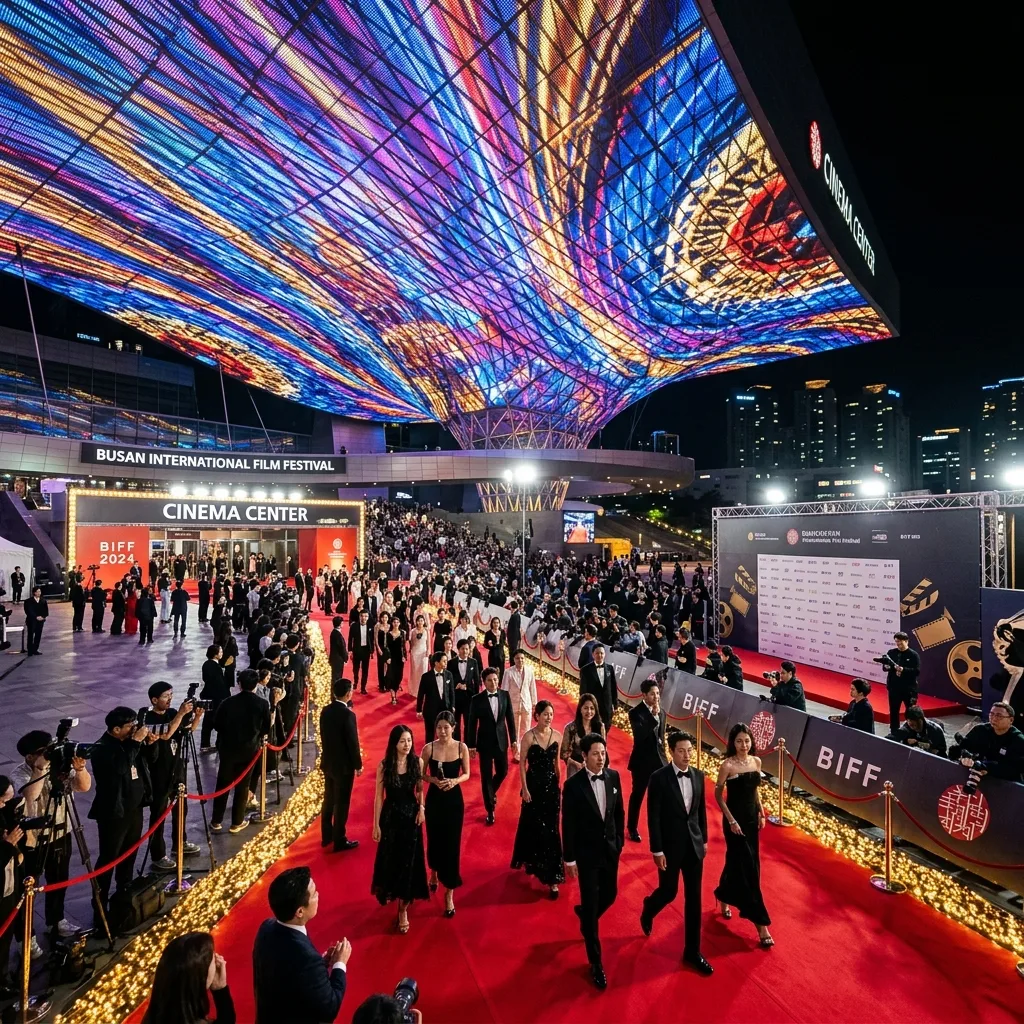
A note on weather. Late September and early October in Busan sit on the tail end of typhoon season. The city bakes through summer and the transition to autumn can be dramatic — warm days, cool evenings, and the occasional tropical rainstorm rolling in from the Korea Strait overnight. Pack layers. A compact umbrella is non-negotiable. The Busan Cinema Center's iconic "Big Roof" — the world's largest cantilever LED canopy — provides shelter for the outdoor opening and closing ceremonies, but many of the outdoor stage greetings at Haeundae Beach happen in the open air. Plan accordingly.
Main Venues: Where the Magic Happens
BIFF is spread across several distinct neighbourhoods. Understanding the geography before you arrive makes the difference between spending your festival at screenings and spending it on the subway wondering where you are.
Busan Cinema Center (Centum City)
This is the nerve centre of the modern BIFF. The Busan Cinema Center sits in the heart of Centum City, the commercial district that developed rapidly after the festival moved its primary hub here in 2011. The building is striking: a deconstructivist structure whose "Big Roof" — a curved LED canopy spanning 163 metres — hovers over the outdoor Cine Mountain stage. This is where the opening and closing ceremonies happen, where the red carpet rolls out, and where thousands of people gather to watch live feeds of the ceremony even without tickets.
Inside, there are two indoor cinemas (Haneulyeon and Sori Theatre) that screen competition and special programme films throughout the festival. Getting a ticket to anything at the Cinema Center is a status symbol among BIFF regulars — these seats fill within minutes of the booking window opening.
Centum City Multiplex Cinemas
The bulk of BIFF screenings happen in the commercial multiplexes a short walk from the Cinema Center: CGV Centum City and Lotte Cinema Centum City. These are the workhorses of the festival — between them, they contribute the majority of the screening slots. Films from the main competition, the wide angle, Korean cinema today, and the world cinema programmes all rotate through these venues across the festival's ten days. The atmosphere is less glamorous than the Cinema Center but these are often where you'll catch the most interesting international premieres.
BIFF Square (Nampo-dong)
Before Centum City, Nampo-dong was BIFF. The original home of the festival is in the older, denser southern part of Busan — a neighbourhood of covered markets, street food lanes, and theatres that have been running since the 1950s. BIFF Square itself is a pedestrian plaza on Nampo-daero where the handprints of celebrated directors and actors are embedded in the pavement, a tradition that stretches back to the festival's early years.
Today, Nampo-dong hosts "Community BIFF" — a free outdoor screening programme that runs throughout the festival. These screenings are open to anyone, no ticket required, and tend to draw a local crowd watching classic Korean films or retrospective programming under the open sky. The area is also home to several of Busan's oldest independent cinemas, some of which participate in festival programming. And the street food is excellent: this is the neighbourhood for hotteok, ssiat hotteok (the sesame-seed filled Nampo-dong variation), and cheap seafood.
Haeundae Beach and the BIFF Village
Haeundae is both the most popular beach in Korea and one of BIFF's main event spaces. The BIFF Village — a temporary festival zone that appears along the beach promenade — hosts outdoor stage greetings where cast and directors of films screening that day appear briefly before an open crowd. These events are free to attend. They're your best chance to see Korean cinema stars without a ticket.
The atmosphere along Haeundae during BIFF is something distinct. The combination of beach crowds, film crews, camera equipment, fans, and industry people creates an energy that doesn't exist anywhere else in Korea. Walking from the beach to Haeundae station in the evening, past outdoor screens and street vendors, is an experience worth having even if you don't see a single film.
The Ticketing Survival Guide
Getting tickets to BIFF screenings is genuinely competitive. The festival receives far more demand than supply, particularly for opening and closing ceremonies, any screening with a major Korean actor attached, and the midnight passion section. A methodical approach to ticketing is not optional — it's the difference between seeing films and watching the festival from outside.
Tickets for BIFF 2025 were priced as follows: general screenings at 9,000–10,000 KRW ($7 USD) and opening and closing ceremony tickets at 30,000 KRW ($22 USD). These prices have been consistent across recent years and are not expected to change significantly for 2026. Discounts apply for seniors (65 and over) and people with disabilities.
Online Booking for Foreigners
The official ticketing portal is ticket.biff.kr, which has an English-language interface. You do not need a Korean phone number or a Korean national ID to register — foreigners create an account and receive their tickets by email rather than via KakaoTalk (which Korean nationals use). Payment is accepted by credit and debit card as well as mobile payment options.
The timeline matters. For BIFF 2025, ceremony tickets went on sale first (September 20 at 2:00 PM KST), followed by general screenings (September 24 at 2:00 PM KST). The festival typically announces the ticketing schedule about two weeks before sales open. Create your account and save your payment details before the sales window opens — every second counts.
A limit of two tickets per person per screening applies across all categories.
The Programme Code Strategy
Before the ticketing window opens, BIFF releases the full programme guide as a PDF. Each screening has a three- or four-digit programme code. Experienced festivalgoers download the PDF, identify every film they want to see, note the programme codes, and open the ticketing site already knowing exactly which screenings to search for. Don't wait until the site opens to start browsing — you'll lose precious minutes.
Same-Day Box Office
A portion of tickets — typically 8 to 20 percent of total seats — is held back for same-day on-site sales. The box office at each venue opens in the morning, and a queue forms early. If you're staying near Centum City, showing up at the Cinema Center box office by 7:00 AM is not unusual during peak days of the festival. For less high-profile screenings, same-day tickets are generally available without the crack-of-dawn commitment.
Cancellation Hunting
BIFF allows cancellations up to 30 minutes before a screening, with a 1,000 KRW fee for cancellations made during the festival period. This means the 24–48 hour window before any screening is worth checking on ticket.biff.kr — returned tickets go back into the pool and can be purchased again online. For sold-out screenings, set a reminder and check back the evening before and again the morning of the screening.
Maximising Your Experience: Programmes and Insider Tips
Guest Visits (GVs) — The Best Part of BIFF
A "GV" (Guest Visit) is a post-screening Q&A session with the director and sometimes the cast. These are marked in the programme and they are the soul of a film festival — the part that can't be replicated by streaming. The Q&A format at BIFF is structured: a moderator translates between Korean and English (or the language of the filmmaker), and audience questions are typically taken through a written submission system.
When you're selecting screenings, prioritise ones with GVs for films you're genuinely curious about. The conversation that follows a film — especially a challenging or unusual one — often changes how you process it.
Subtitles
For screenings of non-English-language films, English subtitles are standard at BIFF. Korean films screening in the international sections are subtitled in English. Documentaries and experimental films sometimes have Korean-only subtitles — this is noted in the programme listing, so check before booking.
Free Outdoor Stage Greetings
Stage greetings are brief public appearances by the cast and director of a film, held either at the Cinema Center's outdoor Cine Mountain stage or at the BIFF Village on Haeundae. They happen before screenings, usually 20–30 minutes of fan interaction and photo opportunities. No ticket is required. If you want to catch a glimpse of a specific Korean actor or director without the ticketing lottery, stage greeetings are your best option.
The schedule is published daily on the BIFF app and website. Check in the morning, identify any stage greetings of interest, and arrive 30 minutes early to get a good position.
A Three-Day BIFF Itinerary
Three days is the sweet spot for a first-time BIFF visitor — long enough to see a handful of films, experience the different venues, and explore Busan between screenings.
Day 1: Arrive at Haeundae. Walk the BIFF Village in the afternoon, catch an evening stage greeting, and attend a late-afternoon screening at CGV Centum City. End the night at the Haeundae Night Market.
Day 2: Morning at BIFF Square in Nampo-dong for the Community BIFF atmosphere and street food. Afternoon screening at the Cinema Center. Evening GV session at one of the Centum City multiplexes.
Day 3: Same-day box office run in the morning at the Cinema Center. Film or two in the afternoon. Walk Gwangalli Bridge at sunset, which is one of the best free views in the city, and a short subway ride from Centum City.
Logistics: Getting Around and Staying in Busan
Where to Stay
Haeundae and Centum City are the most convenient bases for the festival. You'll be walking distance from the Cinema Center, the Centum City multiplexes, and the BIFF Village beach events. The tradeoff is price — hotels and guesthouses in this area cost significantly more during festival dates than at other times of year. Book at least six to eight weeks ahead.
Gwanganli is the alternative worth considering. The neighbourhood sits one subway stop west of Haeundae, has a strong café and restaurant scene, and offers views of the Gwangan Bridge from the beach. Prices are lower and the commute to Centum City takes under 10 minutes on Line 2.
Nampo-dong is the budget option. You'll be immersed in old Busan atmosphere and close to BIFF Square and its historic cinemas, but the main festival venues at Centum City require about 30 minutes on the subway. Manageable if you're doing it right, but tiring across multiple days.
You can find detailed neighbourhood breakdowns, price ranges by season, and hotel recommendations in our guide to Where to Stay in Busan: Best Neighborhoods for Beach, Food, and Sightseeing.
Getting Around
Subway Line 2 is the artery of BIFF. It connects Haeundae, Centum City (BIFF's Cinema Center exit), and Gwanganli in a straight east-west run. The journey from Haeundae station to Centum City station takes about five minutes. Line 1 connects the Nampo-dong area (Nampo station) to the rest of the network.
BIFF operates shuttle buses between major venues during the festival — the routes and schedules are published on the official app. These are useful during mid-day when the subway isn't crowded and you want to move between Nampo-dong and Centum City without changing lines.
Taxis during BIFF are a trap. Traffic in Haeundae and Centum City during festival hours can be severe, particularly in the evenings after large screenings let out. A taxi ride that takes 8 minutes outside the festival can take 45 minutes during it. Stick to the subway for anything within Busan.
For getting to Busan from Seoul, the KTX from Seoul Station to Busan Station takes about 2 hours and 40 minutes. The Seoul to Busan route has multiple daily departures and booking through Korail in advance is strongly recommended during festival dates — trains fill up. For a full breakdown of getting to Busan from across Korea, see our guide on Seoul to Busan: The Ultimate Transport Battle (KTX vs. SRT vs. Bus vs. Flight).
Essential Apps
- Naver Maps — the most accurate mapping app for Korea, better than Google Maps for transit routing and walking directions in dense urban areas
- Kakao Taxi — the primary ride-hailing app; create an account before you arrive, as verification can take time
- BIFF Official App — the festival's own app shows the programme, stage greeting schedules, and seat availability in real time; updated daily during the festival
Food and Nightlife: Busan Beyond the Screen
Haeundae Night Market
The Haeundae Night Market operates seasonally and ramps up during BIFF. It runs along the beach promenade east of the main swimming area — stalls selling grilled skewers, seafood pancakes, corn dogs, and local craft beer. After a late evening screening, the night market is the natural landing spot. It's busy until well past midnight during festival weeks.
BIFF Square Street Food
Nampo-dong is one of the best street food destinations in all of Korea, and BIFF Square sits at the heart of it. The area around the handprint plaza is lined with vendors selling ssiat hotteok — a Busan-specific variation of the Korean pancake filled with seeds and brown sugar syrup — as well as raw seafood from the adjacent Jagalchi Market, tteokbokki, and fish cake skewers. Even if you're staying in Haeundae, making a half-day trip to Nampo-dong for the food alone is worthwhile.
After-Hours Networking
The festival runs its own parties and industry events, most of which are invitation-only and tied to accreditation. But the bars around Haeundae and the rooftop venues near Centum City attract a mixed crowd of filmmakers, critics, and festival regulars in the evenings. If you're interested in the industry side of BIFF — making connections, joining conversations — being present in these spaces is part of the festival experience. The BIFF Village area on the beach is often the most open and accessible late-night gathering point.
Practical Tips for International Visitors
Money and Connectivity
Korea is a card-friendly country but street food and some older market stalls are cash-only. Withdraw Korean Won (KRW) from airport ATMs on arrival — exchange rates are competitive and the machines are reliable.
For transport, get a T-money card at any convenience store (GS25, CU, 7-Eleven) near the airport or at Busan Station. Load it with cash and tap in and out of every subway and bus ride. It also works at convenience stores and some cafés.
For mobile data, an airport SIM card from KT, SK Telecom, or LG U+ gives you fast LTE for the duration of your stay. Data-only tourist SIMs are available in 5, 7, and 10-day configurations starting at around 10,000–20,000 KRW. Alternatively, a pocket Wi-Fi rental from the airport works if you're travelling with multiple devices.
What to Wear
This one requires more thought than you'd expect. During the day, BIFF is a walking festival — you'll cover 10,000+ steps moving between venues, waiting in queues, and wandering between screenings. Comfortable walking shoes are mandatory.
For evening screenings and especially for anything at the Cinema Center (where the opening and closing ceremonies attract a fashion-conscious crowd), smart casual to semi-formal is appropriate. You won't be turned away for wearing jeans, but a surprising proportion of the crowd dresses up for the major events — particularly for red carpet ceremonies.
Late September evenings can drop to 15°C or lower. A light jacket or layering option is essential.
The "Culture BIFF" Experience
One thing first-time visitors miss: BIFF is as much about the city as it is about the films. The festival functions as a de facto celebration of Busan itself — local cinemas that have been running for decades, independent galleries hosting film-adjacent exhibitions, neighbourhood cultural events that run alongside the official programme.
If you find yourself with a gap between screenings, use it to explore Busan's neighbourhoods rather than queuing for standby tickets. Gamcheon Culture Village, the UN Memorial Cemetery, and the Huinnyeoul Culture Village each offer a different layer of the city's character. For a comprehensive introduction to everything the city offers beyond the festival, the guide to Exploring Busan: A Complete Guide to South Korea's Coastal Gem covers the city's neighbourhoods, beaches, and day trips in full.
Conclusion
The Busan International Film Festival has earned its title as the "Cannes of Asia" honestly — not through marketing, but through three decades of programming that has launched careers, introduced international audiences to Korean cinema before it went global, and built an atmosphere that serious film lovers travel across the world to experience. Busan in October, during BIFF, is one of those travel experiences that doesn't have a direct equivalent anywhere else in East Asia.
But the festival rewards preparation. The single most important thing you can take from this guide is the ticketing advice: create your account at ticket.biff.kr before the sales window opens, download the programme PDF and note your codes in advance, and have your payment details ready. The best screenings — the ones with GVs, the ones at the Cinema Center, the midnight passion slots — go in minutes. The visitors who get in are the ones who planned.
Everything else — where to stay, how to get around, what to eat — falls into place once you have your screenings locked. Busan will take care of the rest.
If this is your first trip to South Korea, you'll want a broader framework for the country. Our The Ultimate 10-Day South Korea Itinerary for First-Timers maps out the full circuit, with Busan as a natural stopping point. And for navigating Korea's transport network beyond BIFF, The Ultimate Guide to Public Transportation in Korea (2025 Edition) covers T-money, subway systems, and intercity trains in detail.