The Bund Walk: Best Times, Photo Spots & Across-River Pudong Views

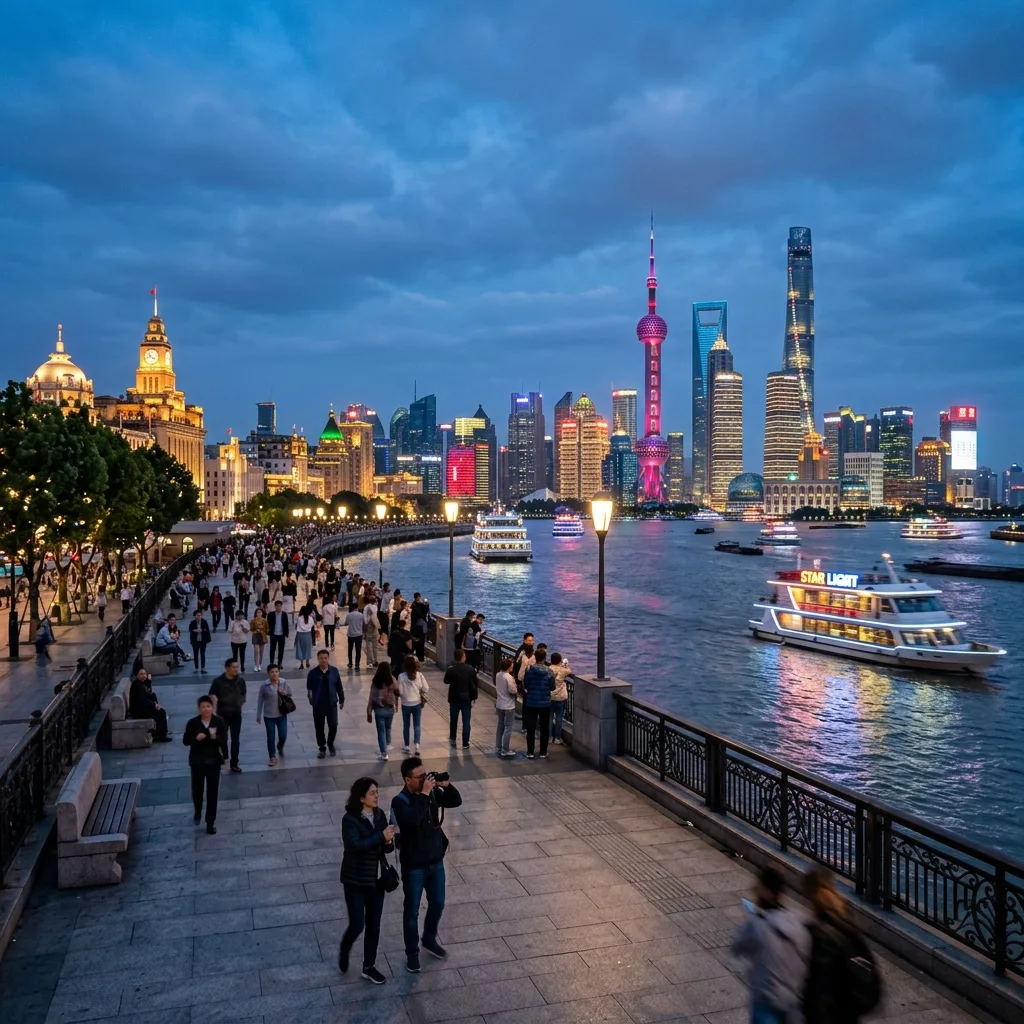
Nobody warns you about the crowds on the Bund at noon. You show up expecting a leisurely walk along a historic waterfront, and instead find yourself wedged between tour groups, selfie sticks, and vendors hawking Pudong-branded magnets. The Bund rewards timing — get it right, and you'll have postcard-perfect views of the Shanghai skyline reflected in the Huangpu River; get it wrong, and you'll spend your visit elbowing for a railing spot. This guide tells you exactly when to arrive, where to stand, and how to photograph the across-river Pudong views that make the Bund one of the most photographed urban waterfronts on earth.
What Is the Bund and Why It Matters
The Bund (外滩, Wàitān) is a 1.5-kilometer waterfront promenade that runs along the western bank of the Huangpu River in central Shanghai. On one side stands a parade of 52 neoclassical, Art Deco, and Gothic buildings built between the 1860s and 1930s, when Shanghai was the financial capital of Asia and foreign concession banks competed to outdo each other with ever-grander facades. On the other side, across the brown water, rises Pudong — a skyline assembled almost entirely after 1990 that now includes the Oriental Pearl Tower, the Jin Mao Tower, the Shanghai World Financial Center (the "bottle opener"), and the Shanghai Tower, currently the tallest building in China.
That contrast — a century-old European banking district facing a 21st-century futurist skyline — is what draws millions of visitors a year. Walking the Bund is free. The promenade is open around the clock, though the light show on the Pudong towers runs until 11:00 PM on most nights. There is no admission fee to walk the waterfront itself; fees you may see cited elsewhere (¥50–¥70) refer to the Bund Sightseeing Tunnel, a kitschy underground crossing to Pudong that most travelers skip.
Best Times to Walk the Bund
The single biggest variable in a Bund visit is timing. The difference between a sunrise walk and a midday walk is not subtle — it is the difference between a quiet, golden-lit promenade and a standing-room-only tourist corridor.
Early Morning (6:30–9:00 AM) — Best for Photographers
This is the consensus pick among photographers and serious travelers. Foot traffic is thin, the colonial buildings catch warm directional light from the east, and the Pudong towers reflect softly in the river before tour boat wakes churn the surface. Joggers and elderly locals doing tai chi give the scene a genuinely local feel. By 9:00 AM, coach tours begin arriving.
Golden Hour Before Sunset (5:30–7:00 PM) — Best for Atmosphere
The Bund faces west and the Pudong skyline faces east, which means sunset light rakes across the colonial facades at a flattering angle while leaving the skyscrapers in shadow — the reverse of sunrise. The river turns amber. The crowds are heavy, but the energy is high and the light is unmatched for architectural photography of the western-bank buildings.
Blue Hour and Night (7:30–10:30 PM) — Best for the Light Show
Once the sky drops to a deep blue, the Pudong towers illuminate and the real spectacle begins. The Oriental Pearl Tower glows pink and purple; the Shanghai Tower wraps in changing LED sequences. The buildings reflect in the river with a clarity that can feel almost fake. Crowds are at their thickest from 8:00 to 9:30 PM on weekends — if you are visiting on a Friday or Saturday night, arrive early to claim a railing spot before the promenade fills.
Midday (10:00 AM–4:00 PM) — Avoid if Possible
Flat, harsh light, maximum tour-group density, and no advantage unless you have no other window. If midday is your only option, walk to the northern end of the promenade near Waibaidu Bridge, where crowds thin quickly.
Seasonal Notes
Shanghai's peak travel season runs May through October, with summer (July–August) bringing both the largest crowds and the most haze. Spring (March–May) offers mild temperatures and occasional fog that wraps the Pudong towers dramatically. Autumn (September–November) is the most reliably clear for photography. Winter mornings can bring crisp, crystal visibility rare at other times of year.
The Bund Photo Spots: Where to Stand for Each Shot
The Bund promenade runs roughly north to south, numbered from south at Yan'an Road (near the Bund Tourist Tunnel) to north at Waibaidu Bridge. Knowing which numbered section corresponds to which view saves time.
Chen Yi Square (Bund #9–#12 area) — The Classic Angle
The bronze statue of Chen Yi, Shanghai's first mayor after 1949, sits in a square roughly midway along the promenade. This is ground zero for the most reproduced Bund shot: colonial facade on the left edge of frame, river center, full Pudong skyline right. It's busy, but for good reason — the sightline is genuinely excellent. For the cleanest composition, position yourself at the railing directly in front of the statue and shoot slightly north of center to include both the Oriental Pearl Tower and the Shanghai Tower in the same frame.
Waibaidu Bridge (Northernmost Point) — Rare Angle, Fewer Crowds
Waibaidu Bridge, a 1907 steel truss bridge at the northern end of the Bund, is one of the city's most underrated viewpoints. Standing on the bridge gives you a three-directional view: south along the Bund promenade, east across the river to Pudong, and north into the Suzhou Creek area. From here you can frame the Pudong skyline with the bridge's latticed ironwork in the foreground — a completely different composition from the typical promenade shot. Crowds here are a fraction of the Chen Yi Square density.
North Bund Green Land (East Bank, Across Suzhou Creek) — Reverse Angle
Walk north across Waibaidu Bridge and continue into the North Bund Green Land park. From this park, you get an unusual shot: the full Bund facade from the river side, with Pudong in the background. It is the reverse of the typical tourist photo, and it is dramatically underused. The park also contains the Silver Egg, a reflective spherical sculpture that has become a popular standalone subject.
The Stage Observatory (Pudong Side)
If you want the best elevated view of the Bund itself — looking west at the colonial buildings from across the river — The Stage Observatory, built atop a former helipad in Pudong, offers completely open panoramic views. It is the definitive answer to "where do I photograph the Bund from the other side?" Note that this requires crossing to Pudong via metro or ferry; see the getting-there section below.
Cool Docks (Southern Bund)
Less known to first-time visitors, Cool Docks sits at the southern edge of the Bund and offers an angled riverfront view of the Pudong skyline without the crowds of the main promenade. The geometry is different — sharper, more compressed — and the surrounding repurposed warehouses give strong context for street-level composition.
Understanding the Pudong Skyline: Landmarks to Know
The across-river view is more satisfying once you can identify what you are looking at.
Oriental Pearl Tower (东方明珠, 468m) — The iconic pink-and-grey spherical TV tower, opened 1994. Despite being one of the oldest towers in the skyline, it remains the most recognizable because of its distinctive shape. The lower sphere houses an observation deck and a glass-floor section; the upper sphere offers 360-degree views.
Jin Mao Tower (金茂大厦, 421m) — The pagoda-shaped tower opened in 1999, clad in stainless steel with a stepped profile that references traditional Chinese architecture. The Grand Hyatt Shanghai occupies floors 53–87; the observation deck is on floor 88.
Shanghai World Financial Center (上海环球金融中心, 492m) — Colloquially called "the bottle opener" because of the trapezoidal aperture at the top (originally designed as a circle but changed to avoid diplomatic sensitivities). Opened 2008. The observation deck at the aperture level gives a looking-down view of the Oriental Pearl Tower.
Shanghai Tower (上海中心大厦, 632m) — China's tallest building, opened 2015. The spiraling form is designed to reduce wind loads; the twist is most visible from the Bund at sunset when shadows play across the facets. The observation deck at 546m is the second-highest in the world.
From the Bund promenade, the optimal framing includes all four towers in a single shot — achievable with a wide-angle or normal lens from the Chen Yi Square area. A telephoto compresses them together for a more dramatic layered effect.
How to Get to the Bund
By Metro (Recommended)
- Line 2, East Nanjing Road Station (南京东路): Exit 7 puts you at the heart of Nanjing Road, a five-minute walk east to the promenade. This is the most convenient option from Jing'an, the French Concession, or Hongqiao.
- Line 10, Yuyuan Garden Station (豫园): Exit 3 for the southern Bund area near the Bund Tourist Tunnel.
By Ferry to Pudong
A short ferry from the Bund to Pudong runs from near the Jinling Road pier. The crossing takes about five minutes and costs ¥2. It is a dramatically cheap way to experience the river and see both skylines from the water. Hours are approximately 7:00 AM to 10:00 PM.
By Taxi or Rideshare
Ask your hotel to write "外滩" (Wàitān) for the driver, or use Didi (China's Uber equivalent). Drop-off on the riverside is restricted for vehicles — expect to be let out on Zhongshan Road and walk east to the promenade.
Walking from Nearby Neighborhoods
The Bund is walkable from East Nanjing Road (5 minutes east), Xintiandi (20 minutes north), and the Old City / Yu Garden area (15 minutes north along Zhonghua Road). If you are making a full day of central Shanghai, chaining the Bund with a visit to the French Concession or Yu Garden is easy. The Shanghai travel guide covering the Bund, French Concession, and hidden gems has route suggestions for doing exactly this.
The Bund Walk Route: A Suggested Itinerary
Total distance: 1.5 km one way, roughly 20–25 minutes at a strolling pace With photography stops: 1.5–3 hours depending on time of day
Starting Point: Waibaidu Bridge (North)
Begin at the northern end. The bridge itself is a photo subject; the view south from its center gives you the full sweep of the Bund promenade stretching toward downtown. Walk onto the bridge, pause for the northward Suzhou Creek view, then head south.
Northern Promenade (North Bund to #20)
The northern stretch of the promenade is quieter, especially in the morning. The buildings here include the Russo-Asiatic Bank, the Yokohama Specie Bank, and the Former Union Building — all with elaborate cornices and facades worth examining up close. The river is wide here and the Pudong towers are fully visible but at a slightly more oblique angle.
Chen Yi Square (#9–#12 area)
This is your midpoint and the classic photo stop. Spend time here for your primary Pudong skyline shots. Face east, hold the railing, and experiment with both wide compositions (all four towers) and tight telephoto shots of individual buildings.
Southern Promenade (#1–#6 area)
The southern end is dominated by the HSBC Building (#12), the Customs House (#13, with its famous clock tower), and the Peace Hotel (#19). These are arguably the most photogenic individual buildings on the western bank. The Customs House clock still chimes on the hour — an atmospheric detail. From here you can continue south to the Bund Tourist Tunnel area or cut west into the Old City direction.
Optional Extension: Pudong Side via Ferry
From the Jinling Road ferry pier (near the southern Bund), cross to Pudong for ¥2 and walk north along the Pudong riverside park. This gives you the reverse angle on the Bund's colonial facade, a view most visitors never see. The Stage Observatory and the base of the Oriental Pearl Tower are both within a 10-minute walk.
Photography Tips for the Bund
Gear Considerations
A wide-angle lens (16–24mm equivalent on full frame) is ideal for capturing the full Pudong skyline from the promenade railing. A standard 35mm or 50mm works well for isolating individual towers or the colonial facades. A telephoto (70–200mm) lets you compress the four Pudong towers into a dramatic stacked composition from across the river.
For night photography, bring a tripod. The Bund railing is about 1.1m high and can serve as a stabilizing surface in a pinch, but a proper tripod gives you control over long-exposure shutter speeds for silky river reflections.
Composing the Classic Shot
The most common Bund photo failure is shooting with the sky occupying too much of the frame. Lower your perspective and include the river in the lower third — the reflection of the Pudong lights is often more dramatic than the towers themselves. The water tends to be calmest in the early morning before boat traffic starts.
Avoiding Blown-Out Highlights
At night, the Pudong towers are significantly brighter than the sky and river. Expose for the highlights if you want to preserve the tower detail, then recover shadows in post. Alternatively, shoot during the blue hour when the sky luminance is roughly balanced with the artificial lights — this is the 20–30 minute window after sunset where everything is in equilibrium.
Composition with the Colonial Buildings
For the reverse shot — photographing the western bank from Pudong or the river — include the full Bund facade at a slight angle rather than head-on. The rows of columns and pediments create depth when shot at 15–30 degrees off axis.
Practical Information
Admission: Free. The Bund promenade is a public space with no entry fee. The Bund Sightseeing Tunnel (a separate underground attraction connecting to Pudong) costs ¥55–¥70; it is a novelty, not a necessity.
Hours: The promenade is accessible 24 hours. The Pudong light show runs until approximately 11:00 PM. The morning hours (6:00–8:30 AM) have official promenade maintenance, but pedestrian access is maintained.
Best months: October–November (clear skies, mild temperatures) and March–April (occasional mist, blooming riverside trees). Avoid the National Golden Week holidays (October 1–7) unless you specifically want to experience peak-China crowd density.
Facilities: Public restrooms are located near Chen Yi Square and at both ends of the promenade. Cafes and restaurants line the western side of Zhongshan Road; prices are tourist-premium but the al fresco spots facing the river are pleasant.
Safety: The Bund promenade is one of Shanghai's most heavily policed tourist areas. Pickpocketing is the primary concern during peak hours; keep bags zipped and phones secured, especially in the dense crowd around Chen Yi Square after dark.
Common Mistakes to Avoid
Arriving at noon on a weekend. The combination of peak midday light and maximum crowd density makes for the worst photographic and experiential conditions simultaneously. Any other time slot is better.
Taking only the standard Chen Yi Square shot. The Waibaidu Bridge view, the North Bund Green Land reverse angle, and the Pudong-side ferry crossing offer completely different perspectives that the majority of visitors never see.
Skipping the colonial facades in favor of only the Pudong view. The western-bank buildings are individually remarkable. Walking slowly and looking up at the #1–#20 buildings reveals architectural detail that rewards attention: rusticated stonework, maritime-themed ornament, green copper domes, neoclassical capitals.
Not planning for the blue hour window. The 20-minute window after sunset is objectively the best light condition on the Bund. Missing it by 30 minutes — arriving when it is already fully dark — is one of the most common regrets photographers mention.
Using the Bund Sightseeing Tunnel as your main crossing. The tunnel is dated and slow. The ¥2 ferry is more direct, more atmospheric, and drops you on the Pudong side closer to the riverside park than the tunnel exit does.
FAQ
Is the Bund free to visit?
Yes. The waterfront promenade is a public space with no admission fee at any time of day. Some elevated viewing platforms on the Pudong side (the observatory in the Shanghai Tower, for example) charge fees, but the promenade itself is free.
How long should I spend at the Bund?
For a casual visit, 45–60 minutes is enough to walk the full promenade and take photos. For photographers targeting the blue hour or sunrise, plan 2–3 hours to catch the transition and work different spots.
What is the best way to cross to Pudong?
The ¥2 public ferry from the Jinling Road pier is the fastest and most atmospheric option. Metro Line 2 also connects directly to Lujiazui Station in Pudong in about 5 minutes from East Nanjing Road.
Can you see the Bund light show for free?
Yes. The Pudong light show is visible from anywhere along the promenade at no cost. The towers light up at sunset and the full show typically runs until 11:00 PM.
Is the Bund worth visiting without going to Pudong?
The Bund promenade alone is worth the visit. However, crossing to Pudong — even briefly via ferry — gives you the reverse view of the colonial buildings and a completely different perspective on the skyline. If time allows, do both.
Final Thoughts
The Bund is one of those places that photographs better than expected and crowds worse than expected. The key to a good visit is treating it as a timing exercise: sunrise or blue hour gets you the experience that justifies the trip; midday gives you a crowded walk between some impressive buildings. For photographers specifically, the Waibaidu Bridge angle and the Pudong-side reverse shot are worth the extra 20 minutes of walking that most visitors skip.
If you are building a broader Shanghai itinerary, the Shanghai travel guide covering the French Concession and the Bund lays out how to chain the waterfront with a half-day in the city's most interesting residential neighborhood. For travelers adding Beijing before or after Shanghai, the ultimate Beijing travel guide covers the major landmarks, transport, and logistics for China's capital. The Bund is a compelling start — and the across-river view of Pudong, at the right hour, is one of the genuinely great urban spectacles in Asia.