Shanghai Travel Guide: The Bund, French Concession & Hidden Gems

Shanghai hits differently from every other city in China. Within a single afternoon you can stand on a waterfront promenade ringed by century-old colonial banking towers, duck into a coffee shop inside a 1930s French villa, and then find yourself completely lost in a labyrinth of lane houses where grandmothers hang laundry from bamboo poles above the alley. No city compresses so many eras and aesthetics into such a walkable, livable grid — and yet most first-time visitors leave having only scratched the surface.
This guide covers the three layers of Shanghai that reward slowing down: The Bund and its storied waterfront, the shaded streets of the former French Concession, and the genuinely off-the-map corners that the Instagram crowds have not yet colonized. Whether you have three days or a week, the goal is the same — to leave with a real sense of the city rather than a checklist of famous facades.
The Bund: More Than a Photo Backdrop
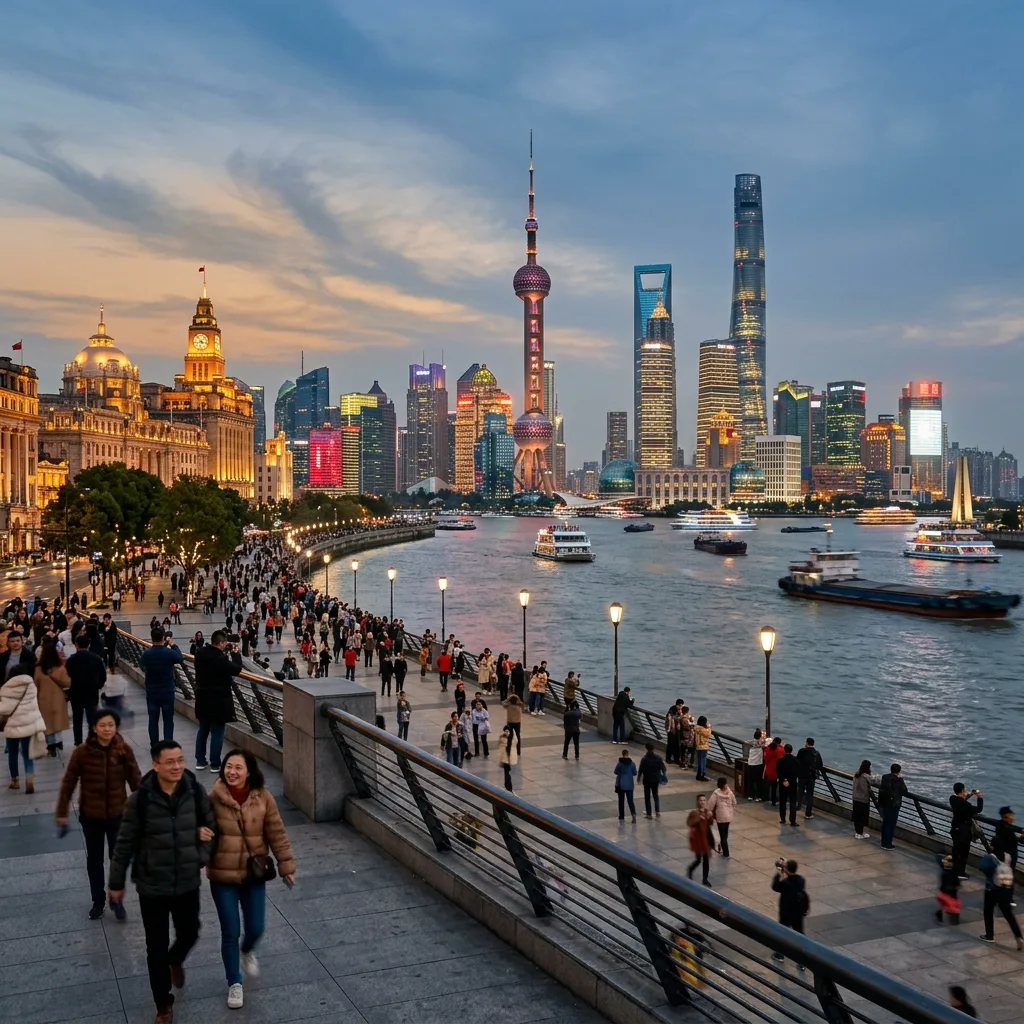
The Bund (外滩, Wàitān) is the first thing every guidebook shows you, and for good reason. The mile-long waterfront promenade runs along the western bank of the Huangpu River and faces Pudong's futuristic skyline — the two halves of Shanghai staring each other down across the water like a before-and-after advertisement for the past century of Chinese development.
The Bund is free to enter and open 24 hours a day. There is no gate, no ticket booth, and no queue — just a wide riverside walkway that anyone can stroll at any hour. That openness is part of its character. At dawn, you will find elderly residents doing tai chi in the mist. At midday, tour groups fan out along the railing for photographs. After dark, both the colonial buildings and the Pudong towers light up in competing spectacles, and the promenade fills with couples, families, and solo walkers sharing cold beer from convenience stores.
The buildings behind the promenade — often called the "architectural museum of the world" — span Gothic Revival, Renaissance, Baroque, Art Deco, and Beaux-Arts styles, all constructed between roughly 1860 and 1940 when Shanghai was one of the most cosmopolitan cities on the planet. The former Hong Kong and Shanghai Banking Corporation building (now a branch of Pudong Development Bank) is worth pausing at for the ceiling mosaics in the main hall, which tourists can typically access during banking hours. The Peace Hotel on the north end has been restored to its 1930s Art Deco glory; even if you are not staying there, the lobby bar hosts a jazz band most evenings.
Practical notes: The Bund is most atmospheric at dusk and for the first two hours after dark, when both sides of the river are fully lit. Arrive by 5:30 p.m. to claim a good railing spot before the weekend crowd peaks. The waterfront can feel very crowded on Saturday nights in summer — if you want the same view with fewer people, walk north of Suzhou Creek toward Sichuan Road North, where the promenade thins out considerably.
Getting there is straightforward: take Metro Line 2 or Line 10 to East Nanjing Road station and walk roughly 10 minutes east. Alternatively, a Huangpu River ferry from Dongchang Road Pier in Pudong costs ¥2 and lands you directly on the Bund-side wharf, which is a more scenic approach.
The Former French Concession: Shanghai's Most Livable Neighborhood
If The Bund is Shanghai's public face, the Former French Concession (法租界, Fǎ zūjiè) is its private soul. The neighborhood covers the central-western part of the city — roughly bounded by Huaihai Middle Road to the north, Fuxing Road, and the old Rue Lafayette corridor — and it remains the most pleasant place in the city to simply wander without a plan.
The concession was controlled by France from 1849 to 1946, and the physical imprint of that era is still legible on every block. Plane trees line the avenues (most famously Wulumuqi Road and Anfu Road), creating a canopy of shade that makes summer walking bearable. The architecture mixes French-style row houses with shikumen (stone-gate houses), the distinctly Shanghainese hybrid of Western townhouse and Chinese courtyard building that became the dominant urban housing type of the early 20th century.
There is no admission charge to explore the French Concession. It is a functioning residential and commercial neighborhood, not a preserved attraction. You walk the streets, step into cafes, browse bookshops, and eat at restaurants exactly as you would in any urban district. That normality is what makes it feel real rather than staged.
The clearest entry point is Xintiandi, a restored shikumen complex off Taicang Road where the stone-gate architecture has been hollowed out and filled with restaurants, bars, and the occasional high-end retailer. Xintiandi draws crowds and is expensive by Shanghai standards, but it gives you a legible version of what shikumen interiors look like before you find them in rawer form elsewhere. From there, walk west along Fuxing Road, turn south onto Sinan Road, and keep going. Sinan Road is lined with French villas that now house consulates, private clubs, a boutique hotel (the Puxuan), and the former Sun Yat-sen residence, which is open to visitors for a small fee (typically ¥20 in recent years — verify at the gate on arrival as prices can adjust).
Continue south and west toward Fuxing Park — a small but genuinely lovely public garden where locals gather for morning ballroom dancing, badminton, and afternoon chess. The park does not charge admission. Around Yongkang Road, you hit the neighborhood's café and bar strip, a narrow street packed with independent coffee shops operating out of converted ground-floor residences. This block gets its own kind of crowd in the evenings when the outdoor seating fills up.
The further west you walk from Xintiandi — toward Wukang Road, Anfu Road, and Julu Road — the less touristic and more genuinely neighborhood-like the French Concession becomes. The Wukang Mansion (also called the Normandie Building), a 1924 Art Deco wedge-shaped apartment block where Wukang Road meets Hunan Road, is probably the most photographed single building in the district and makes a good anchor for an afternoon walk. The queue for photos on the pedestrian island in front can be long on weekends; mornings are calmer.
Hidden Shanghai: The Neighborhoods Most Visitors Skip
The French Concession and The Bund together form a two-mile corridor that most visitors cover in a day and call it Shanghai. That is a shame, because the city's most interesting corners are just slightly further away.
Tianzifang: The Right Kind of Tourist Trap
Tianzifang, tucked into the alleyways around Taikang Road in Huangpu District, has been popular enough long enough that it barely qualifies as a hidden gem anymore. But it is worth including because it does something genuinely well: it preserved a functioning residential alley system while allowing small shops, galleries, and studios to occupy ground-floor spaces. Unlike Xintiandi, where residents were displaced for commercial renovation, Tianzifang residents still live above the boutiques. You can hear families cooking dinner while browsing handmade jewelry one floor below.
The lanes are narrow and require putting your phone down to navigate. That constraint is the point. The art and craft shops vary wildly in quality — plenty of generic tourist merchandise alongside genuinely distinctive work by local designers. Spend an hour letting yourself get lost in the secondary lanes that branch off the main corridors. Metro Line 9 to Dapuqiao Station is the most direct approach.
The Shanghai Jewish Refugees Museum
Between 1933 and 1941, roughly 20,000 European Jews fled Nazi persecution to Shanghai — one of the only ports in the world that would accept them without a visa. The Hongkou District neighborhood where they lived, worked, and built community is now marked by the Shanghai Jewish Refugees Museum, housed in the restored Ohel Moshe Synagogue on Changyang Road.
The museum (admission approximately ¥50) documents the lives of the refugees through photographs, personal testimony, and preserved artifacts with a level of specificity and care that is genuinely moving. The surrounding Zhoushan Road area retains some of the original street-level commercial buildings from that era. This is one of the most historically layered sites in the city, and it receives a fraction of the visitors that The Bund does. Metro Line 12 to Tilanqiao Station is the closest stop.
Jing'an and Xuhui for Local Life
Two of Shanghai's most livable districts — Jing'an to the north of the French Concession and Xuhui to the south — reward visitors who spend time in their residential pockets rather than just their commercial corridors. Jing'an Temple (¥50 admission) is an active Buddhist temple of surprising architectural ambition lodged between luxury shopping malls; the contrast is characteristically Shanghainese. The streets north of the temple, around Kangding Road and Yuyuan Road, have a concentration of pre-war lane houses that have not been converted for commercial use and retain their original residential character.
In Xuhui, Tianyaoqiao Road and the blocks around Longhua Temple (a working Buddhist monastery with a pagoda, a ¥20 entrance fee) are far removed from the tourist circuits of central Shanghai. The Longhua area also has a peach blossom festival in early spring that draws locals from across the city but is largely unknown to international visitors.
Century Park for Scale
Pudong has a reputation as a sterile financial district, and much of it is. But Century Park in the Pudong New Area is one of the largest urban parks in mainland China, and on a weekday it is mostly empty. The scale — nearly 200 hectares — makes it feel genuinely expansive in a way that the smaller parks of central Shanghai cannot. Bring a picnic, rent a bike at the west gate, and spend two hours riding the perimeter path while the Lujiazui towers are visible in the distance. Metro Line 2 to Century Park Station drops you at the main entrance.
Practical Guide: Getting Around, Eating, and Timing Your Visit
Transport
Shanghai's metro system is extensive, cheap (¥3–7 for most trips), and in English throughout. The card-based payment via Alipay or the Shanghai Metro app is faster than buying individual tickets. Ride-hailing through DiDi (the dominant Chinese equivalent of Uber) is effective for cross-town trips and airport transfers; set your destination in Chinese characters when possible, as some drivers struggle with Pinyin.
The Bund, French Concession, Tianzifang, and Xintiandi are close enough to each other to connect on foot or by a short taxi ride. Hongkou (Jewish Museum) and Century Park in Pudong require the metro.
Food
Shanghai cuisine (本帮菜, Běnbāng cài) is sweeter and richer than most northern Chinese cooking. The hallmarks are red-braised pork belly (红烧肉), braised pork with crystal shrimp rice cakes, smoked fish (熏鱼), and lion's head meatballs (狮子头). For breakfast, hunt down a stall selling sheng jian bao — pan-fried soup dumplings with a crispy bottom — which are distinct from the steamed xiaolongbao that Shanghai is famous for. Both are worth eating as often as possible.
Street food corridors near Jiashan Road Market, the night market strips around Yunnan South Road, and the neighborhood stalls in Xuhui's residential blocks offer more authentic eating than the tourist-facing restaurants of Xintiandi. Budget ¥30–60 per person for a proper meal at a local restaurant; the French Concession café strip runs ¥30–50 for coffee and pastries.
For context on how Shanghai's food culture compares to other major Chinese cities, our Beijing Food Guide: Peking Duck, Jianbing & Night Market Snacks covers the northern capital's very different culinary tradition — useful reading if you are combining both cities on one trip.
Best Time to Visit
Spring (March to May) and autumn (September to November) are the most comfortable seasons. Summer is hot and humid with temperatures regularly above 35°C and frequent rainstorms; winter is cold and grey but workable if you layer. The National Golden Week holidays (early October and early May) bring enormous domestic tourist crowds — The Bund in particular becomes extremely congested. Plan around those windows if possible.
Visa
Citizens of many countries can now access China visa-free for up to 15 days (the list has expanded significantly in 2024–2026; check your country's current status before booking). Shanghai is also part of the 144-hour transit visa-free policy, which lets visitors from eligible countries enter for up to 6 days without a pre-arranged Chinese visa. Verify your eligibility via the official consulate website for your country, as policy changes have been ongoing.
Tips Most Guides Miss
Download maps offline before you arrive. Google Maps is blocked in China. Apple Maps works reasonably well in Shanghai. Amap (高德地图) is what locals use and has an English-language mode. Download your area of interest before you board the plane.
WeChat Pay and Alipay are essential. Many small restaurants, market stalls, and smaller shops operate largely cashless, and foreign credit cards are not universally accepted. Both apps now allow foreign passport holders to link international credit cards directly — set this up before you arrive or on the day you land while connected to reliable Wi-Fi.
The lane houses are private residences. It is worth repeating: the shikumen lane houses in the French Concession and Hongkou are where people live. Wandering into an alley to look around is generally fine; walking into a courtyard uninvited or photographing residents without asking is not.
Pudong is further than it looks on the map. The Lujiazui towers look close from The Bund, but walking across the pedestrian tunnel or taking the (novelty-worth-it-once) sightseeing tunnel under the river still leaves you a 20-minute walk from the base of the Oriental Pearl Tower. Budget more time than you think for anything in Pudong.
Negotiate or research prices for museum shops and souvenir markets. At Yu Garden Bazaar, which surrounds the classical Yuyuan Garden (admission ¥40), vendor pricing is typically negotiable. At any other fixed-price shop or restaurant, negotiating is unusual and will earn confused looks.
FAQ
Is Shanghai safe for solo travelers? Yes. Shanghai has very low violent crime rates and is among the safest major cities in Asia for tourists, including solo women travelers. Standard urban precautions apply — be aware of your belongings in crowded areas like The Bund on weekend nights and in metro stations during rush hour.
Do I need to speak Mandarin to get around Shanghai? Not in the main tourist areas. English signage is widespread in the metro, at major attractions, and in many restaurants. Outside the French Concession and central districts, fewer service workers speak English, and having a translation app (Google Translate with the camera function works well if you have a VPN) is useful.
How many days do I need in Shanghai? Three full days cover The Bund, the French Concession, Tianzifang, and one or two neighborhoods beyond. Five days allows you to move at a comfortable pace and get into Pudong, Jing'an, and Hongkou without feeling rushed. A week is enough to develop genuine familiarity with the city's rhythms.
Can I day-trip from Shanghai to other cities? Yes. High-speed rail connects Shanghai to Suzhou (30 minutes, a classical garden city worth a full day), Hangzhou (1 hour, famous for West Lake), and Nanjing (1.5 hours, the former Ming Dynasty capital). Shanghai Hongqiao Station is the main departure point for high-speed services; buy tickets in advance through the 12306 app or website.
How does Shanghai compare to Beijing for first-time visitors to China? They are genuinely different cities. Beijing is the political and historical capital — its major sites (Forbidden City, Great Wall, hutong districts) are monumental and ancient. Shanghai is the commercial and cultural capital — its appeal is more cosmopolitan, contemporary, and architectural. If you are choosing between them, both reward a visit; if you are planning one trip, your interest in history versus urban energy will determine the priority. For a deeper look at what the northern capital offers, the Ultimate Beijing Travel Guide: Great Wall, Forbidden City & More covers the essentials. And if the idea of exploring Beijing's traditional alleyway neighborhoods appeals to you, our guide on the Beijing Hutong Experience: How to Explore the Old Alleyways is a useful companion — Shanghai's lane houses and Beijing's hutongs share a similar spirit, even if the architecture and culture are distinct.
Conclusion
Shanghai rewards travelers who resist the urge to treat it as a backdrop. The Bund is visually spectacular but also a functional public space where ordinary life happens around the edges of the postcard view. The French Concession is genuinely lovely, but its best version is found by walking past the obvious stops into the residential streets where the plane trees meet overhead and the pace drops. And the neighborhoods beyond — Tianzifang's creative alleyways, the Hongkou Jewish quarter, the quiet expanse of Century Park — represent a city that has more layers than most visitors take the time to find.
Plan for more time than you think you need. Eat the sheng jian bao. Get comfortably lost somewhere without a map. That is when Shanghai starts to make sense.