Kansai Region Travel Guide: Osaka, Kyoto & Nara in One Trip

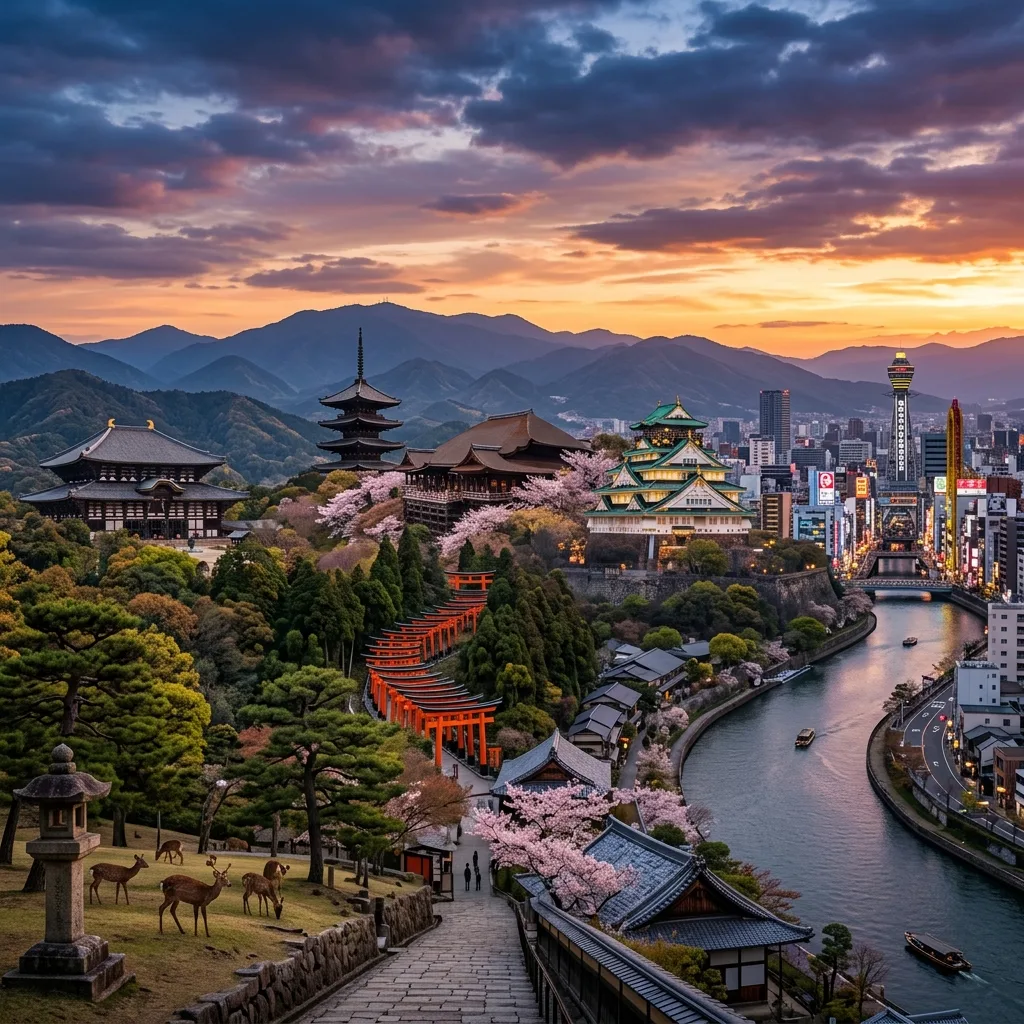
Most first-time Japan visitors spend all their days in Tokyo — and miss the country's beating cultural heart entirely. Kansai, the region encompassing Osaka, Kyoto, and Nara, is where Japan's history was written: ancient temples, deer-filled parks, neon-lit street food alleys, and bamboo forests that look lifted from a woodblock print. If you have five to seven days and a JR Pass, you can see all three cities without backtracking, spending a fortune, or sleeping in a different hotel every night.
Why the Kansai Region Deserves a Dedicated Trip
The Kansai region sits in central Honshu and clusters three of Japan's most storied cities within easy train distance of each other. Osaka takes about 15 minutes from Kyoto by shinkansen, and Nara is under an hour from either city. This geographic proximity makes Kansai uniquely efficient: a single base in Osaka lets you day-trip everywhere, or you can split nights between cities for a slower, deeper experience. No other region in Japan offers this density of world-class sights.
Unlike Tokyo, which dazzles with scale and modernity, Kansai rewards travelers looking for cultural texture. Kyoto alone contains 17 UNESCO World Heritage Sites. Osaka has been Japan's commercial and culinary capital for centuries. Nara was the country's first permanent capital and still feels genuinely ancient — the deer that roam Nara Park have lived there as a protected species since the 8th century. The contrast between the three cities within a single trip is itself part of the appeal.
How Many Days Do You Need for Kansai?
Minimum viable trip: 5 days. This gives you two full days in Kyoto, one and a half in Osaka, and a half-day in Nara. You will not see everything, but you will see the essential highlights without feeling rushed.
Recommended: 7 days. The extra two days let you slow down — linger over a kaiseki dinner, hike the full Fushimi Inari trail instead of turning back at the first landing, or rent a bicycle in Arashiyama for the morning.
Sample 5-Day Kansai Itinerary
| Day | Base | Focus |
|---|---|---|
| Day 1 | Osaka | Arrive, Dotonbori, Kuromon Market |
| Day 2 | Osaka | Osaka Castle, Shinsekai, Tennoji |
| Day 3 | Kyoto | Fushimi Inari, Nishiki Market, Gion at dusk |
| Day 4 | Kyoto | Kinkaku-ji, Arashiyama Bamboo Grove, Nishiki |
| Day 5 | Nara (day trip) | Nara Park, Todai-ji, depart from Osaka |
If you are also spending time in Tokyo, Osaka makes a logical transit hub — the Tokaido Shinkansen connects the two cities in about 2 hours 30 minutes. For a broader sense of how to structure a multi-city Japan itinerary, the Ultimate Tokyo Travel Guide 2026: Everything First-Timers Need to Know lays out the Tokyo side in similar depth.
Osaka — The Kitchen of Japan
Osaka has a reputation that precedes it: this is the city where people live to eat (kuidaore), where the street food is legendary, and where locals are noticeably louder and friendlier than elsewhere in Japan. Budget travelers will also appreciate that Osaka is cheaper than Tokyo in almost every category — hostels, izakayas, street snacks, and transport.
Dotonbori
Dotonbori is Osaka's neon-lit canal district and the closest thing Japan has to Times Square — except the signs advertise restaurants rather than Broadway shows, and the crowds are there to eat. The famous Glico Running Man billboard is the go-to photo spot. Arrive at dusk when the canal reflects the signs, and spend the evening walking east toward Namba, ducking into takoyaki (octopus ball) stalls, kushikatsu (fried skewers) counters, and ramen shops along the way.
Must-eat in Dotonbori:
- Takoyaki — crispy outside, molten inside, topped with bonito flakes and mayo
- Kushikatsu at Daruma — Osaka's signature fried skewers; never double-dip the sauce
- Okonomiyaki — Osaka-style savory pancakes with cabbage, egg, and your choice of protein
Osaka Castle
Osaka Castle sits on a moated hilltop in the center of the city, surrounded by a large public park. The reconstructed main tower houses an eight-floor museum charting the castle's history from Toyotomi Hideyoshi's construction in 1583 through its various destructions and rebuilds.
Admission: ¥600 for the castle tower; ¥200 for Nishinomaru Garden (cherry blossom season is exceptional here) Hours: 9:00 AM – 5:00 PM daily (last entry 4:30 PM) Access: Tanimachi 4-chome Station (Tanimachi Line) or Osakajokoen Station (JR Loop Line)
The grounds themselves are free and worth a slow walk even without paying for the tower. Cherry blossom season (late March to mid-April) draws enormous crowds but is genuinely beautiful.
Kuromon Ichiba Market
Kuromon Market — nicknamed "Osaka's Kitchen" — is a covered market stretching nearly 600 meters, packed with fishmongers, butchers, produce sellers, and ready-to-eat stalls. It opens early (most stalls by 9:00 AM) and closes around 6:00 PM. Come hungry. Crab legs, wagyu on skewers, fresh sea urchin, and thick cuts of tuna are all available for street-level prices. Go on a weekday morning before the tour groups arrive.
Kyoto — A City Frozen in Time
Kyoto served as Japan's imperial capital for over a thousand years (794–1869) and was deliberately spared during World War II, which is why it remains the country's most intact historical city. It has more temples and shrines than any traveler can realistically visit in a week, so the key is choosing deliberately rather than trying to check off every famous landmark.
Fushimi Inari Taisha
The thousands of vermilion torii gates winding up Mount Inari are Kyoto's single most photographed sight. The trail to the top and back takes two to three hours — most visitors turn around at the first major landing (about 30 minutes in) and miss the quieter, forested upper sections entirely. Starting before 7:00 AM almost guarantees you the lower gates to yourself; by 9:00 AM the crowds are heavy.
Admission: Free Hours: Open 24 hours Access: Inari Station (JR Nara Line, 5 minutes from Kyoto Station)
Kinkaku-ji (The Golden Pavilion)
Kinkaku-ji is a Zen Buddhist temple whose top two floors are completely covered in gold leaf, reflected in the surrounding pond. It is simultaneously one of Japan's most visited sites and one of its most legitimately stunning — the photos do not lie, though they also do not capture the scale. The garden circuit takes about 30–45 minutes.
Admission: ¥500 adults, ¥300 primary and middle school students Hours: 9:00 AM – 5:00 PM daily Access: Bus 101 or 205 from Kyoto Station (about 40 minutes); Kinkakuji-michi stop
Book tickets in advance during peak season (March–May, October–November) as timed entry slots sell out. The official site sells tickets directly.
Arashiyama Bamboo Grove
The Arashiyama district on Kyoto's western outskirts clusters several major attractions in walkable distance: the bamboo grove, Tenryu-ji temple garden (¥500), the Togetsukyo bridge over the Oi River, and the quieter Jojakko-ji temple on the hillside. The bamboo grove itself is free and takes about 15 minutes to walk through at an unhurried pace.
Arrive before 8:00 AM to avoid the worst of the crowds. Rent a bicycle from one of the shops near Arashiyama Station (about ¥1,000 for half a day) and cover the district on two wheels — the roads along the river are flat and scenic.
Gion — Kyoto's Geisha District
Gion is Kyoto's preserved entertainment district, where machiya townhouses line narrow lanes and maiko (apprentice geisha) still practice their craft. The most photogenic streets are Hanamikoji (south of Shijo) and Shirakawa Minami-dori (the canal street north of Shijo). Walk here at dusk rather than midday — the lanterns come on, the foot traffic thins slightly, and the atmosphere is as close as a tourist gets to understanding why Kyoto felt different from everywhere else in Japan.
Do not photograph or chase geiko and maiko on the street — it is considered deeply disrespectful and the city has posted signage to this effect.
Nishiki Market
Nishiki Market is a narrow, five-block covered arcade running parallel to Shijo Avenue, packed with food vendors, pickle shops, tofu specialists, and kitchen supply stores. It is an excellent lunch stop between Gion and Kinkaku-ji and a good place to buy Japanese kitchen knives as a souvenir. Hours are roughly 10:00 AM – 6:00 PM, with some stalls closing earlier.
Nara — Half a Day Among Ancient Deer
Nara was Japan's first permanent imperial capital (710–784 AD) and its oldest surviving monuments are matched by no other Japanese city. The approximately 1,200 sika deer that live freely in Nara Park are descended from animals considered divine messengers of the Kasuga Grand Shrine — they have been a protected national treasure since 1957 and have become thoroughly accustomed to humans.
Nara Park and the Deer
The deer roam freely across Nara Park and the temple grounds, and they have learned to bow when they see a tourist holding deer crackers (shika senbei). The crackers are sold by vendors throughout the park for ¥800 per bundle. Be aware: the deer are not shy. They will headbutt, nip sleeves, and crowd aggressively if you hold food too long. Hold the crackers out low and feed quickly, or tuck them away.
The park is free to enter. The deer are most active and photogenic in the early morning when the light is low and the crowds have not yet arrived.
Todai-ji Temple
Todai-ji houses the Great Buddha Hall (Daibutsuden), which the Guinness World Records has recognized as the world's largest wooden building. Inside is a 15-meter bronze statue of Vairocana Buddha, cast in 752 AD. It remains one of the most genuinely awe-inspiring structures in Japan — the scale only registers when you are standing inside.
Admission: ¥600 adults, ¥300 children Hours: 7:30 AM – 5:30 PM (April–October), 8:00 AM – 5:00 PM (November–March)
Getting to Nara
From Osaka: Kintetsu Nara Line from Osaka-Namba to Kintetsu-Nara Station (about 40 minutes, ¥680). JR passes can be used on the JR Yamato-ji Line to JR Nara Station, which is a 20-minute walk from the main park area.
From Kyoto: Kintetsu Kyoto Line direct to Kintetsu-Nara Station (about 45 minutes, ¥760). This is the faster and more direct option.
Getting Around Kansai
IC Cards
Pick up an ICOCA card from any JR machine at Osaka, Kyoto, or Kansai Airport stations. ICOCA works on all JR trains, most private rail lines (Kintetsu, Hankyu, Keihan), and subway systems across Kansai. It also works in convenience stores and vending machines. Load it with ¥3,000–¥5,000 for a day's transit.
If you already have a Suica from Tokyo, it functions identically in Kansai — no need to buy a second card.
JR Pass
The nationwide JR Pass covers Shinkansen between Tokyo and Osaka, JR local trains in Kansai, and the Haruka airport express from Kansai Airport. For trips that combine Tokyo and Kansai, the 7-day JR Pass (approximately ¥50,000 as of 2026) pays for itself just on the Tokyo–Osaka Shinkansen round trip. It does not cover Kintetsu trains (relevant for Nara and some Kyoto routes) or Osaka Metro.
Osaka as a Base
Using Osaka as your overnight base and day-tripping to Kyoto and Nara is both practical and cost-effective. Hotels and hostels in Osaka are generally cheaper than equivalent options in Kyoto, and the train connections are fast. The JR Kyoto-Osaka run on the Shinkansen takes 15 minutes; on the slower Shin-Kaisoku it takes about 28 minutes at a fraction of the Shinkansen fare.
Osaka Amazing Pass
For days spent entirely within Osaka, the Osaka Amazing Pass (¥2,800 for 1 day, ¥3,600 for 2 days) covers unlimited rides on Osaka Metro and city buses plus free admission to 40+ attractions including Osaka Castle. If you plan to visit more than two paid attractions in a day, the pass covers itself easily.
Practical Guide: Admission Prices & Hours at a Glance
| Attraction | Admission | Hours |
|---|---|---|
| Fushimi Inari Taisha | Free | 24 hours |
| Kinkaku-ji | ¥500 adults | 9:00 AM – 5:00 PM |
| Arashiyama Bamboo Grove | Free | Always open |
| Tenryu-ji Garden | ¥500 | 8:30 AM – 5:30 PM |
| Osaka Castle Tower | ¥600 | 9:00 AM – 5:00 PM |
| Todai-ji Temple | ¥600 adults | 7:30 AM – 5:30 PM |
| Nara deer crackers | ¥800 per bundle | Park vendors (daytime) |
| Nara National Treasure Hall | ¥700 adults | 9:00 AM – 5:00 PM |
All prices as of 2026. Exchange rates fluctuate; budget roughly ¥3,000–¥5,000 in paid admissions for a full Kyoto day, and ¥1,500–¥2,000 for a Nara half-day.
Tips & Common Mistakes
Book Kyoto experiences in advance. The most popular temples — Kinkaku-ji, Ryoan-ji, and Fushimi Inari — do not require advance booking, but popular restaurants, tea ceremony experiences, and some seasonal events (moss garden at Saiho-ji, Togetsukyo nighttime illumination) require reservations weeks or months ahead.
Do not skip the upper trail at Fushimi Inari. The first 15 minutes of torii gates get all the Instagram attention. Walk past the Yotsutsuji intersection (the first panoramic viewpoint) and into the upper mountain — the crowds thin dramatically, the gates continue for another hour, and the forest atmosphere is completely different from the tourist rush below.
Watch your volume in Kyoto. Kyoto has implemented noise ordinances and etiquette signage in Gion and other historic districts. Talking loudly on the phone, playing music, or congregating in narrow lanes draws real friction from locals and enforcement staff.
Bring cash for smaller towns and markets. While convenience stores, JR ticket machines, and most major restaurants accept credit cards, many market stalls, small shrines, and traditional restaurants in Kyoto and Nara are still cash-only. Keep ¥5,000–¥10,000 in notes on hand.
Avoid Arashiyama on weekends. The bamboo grove is genuinely enjoyable on a weekday morning. On weekend afternoons it becomes a slow-moving queue of shoulder-to-shoulder tourists who can barely move, let alone appreciate the bamboo. If your schedule forces a weekend visit, arrive by 7:30 AM.
Layer for temple visits. Many Kyoto temples require removing shoes to enter the main hall, and the wooden floors can be cold even in autumn. Slip-on shoes and a thin wool sock layer make the experience significantly more comfortable.
FAQ
Is 5 days enough for Kansai? Five days covers the major highlights: two days in Kyoto (Fushimi Inari and Arashiyama on separate days), a half-day in Nara, and a day and a half in Osaka. You will not feel cheated, but you will also leave with a list of things to return for — which is probably the honest outcome for any first trip to Kansai.
What is the best time of year to visit Kansai? Spring (late March to mid-April) for cherry blossoms and autumn (mid-October to mid-November) for foliage are the most spectacular seasons, but also the most crowded and expensive. Mid-May through June offers comfortable temperatures with fewer crowds; avoid the rainy season peak in late June. Winter (December–February) is cold but quieter, and the temples in snow are genuinely beautiful.
Is Nara worth a full day or just a half-day? For most travelers, a half-day (four to five hours) covers the deer park, Todai-ji, and the Kasuga Grand Shrine comfortably. Spending a full day allows you to explore Naramachi (the old merchant district south of the park), hike up to Kasugayama Primeval Forest, and visit quieter shrines away from the tourist core. If you are based in Osaka, a half-day out and back is the practical choice.
How do I get from Tokyo to Osaka? The Tokaido Shinkansen (Hikari or Nozomi) connects Tokyo Station to Shin-Osaka Station in approximately 2 hours 15 minutes to 2 hours 45 minutes. A reserved-seat Nozomi ticket costs around ¥14,500 one way. The 7-day JR Pass covers Hikari and Sakura services but not the faster Nozomi. For tips on getting the most out of Tokyo before heading to Kansai, the Best Day Trips from Tokyo: Nikko, Kamakura, Hakone & More guide is a useful companion.
Can I use a JR Pass for everything in Kansai? The JR Pass covers JR lines in Kansai (including the Shinkansen between Osaka and Kyoto), but not Osaka Metro, Kintetsu trains (the fastest route to Nara and some Kyoto points), or Hankyu/Keihan private railways. Budget travelers should supplement the JR Pass with an ICOCA card for non-JR connections.
Should I stay in Osaka or Kyoto? Osaka if you are budget-conscious or love nightlife and food. Kyoto if you want to wake up already inside the atmosphere — mornings in Kyoto before the tour buses arrive are singularly quiet for a major tourist destination. Many travelers do two nights in Kyoto at the start of the trip, then shift to Osaka for the remaining nights to save money and simplify the airport departure.
Conclusion
Kansai works because the cities complement each other rather than compete. Osaka gives you permission to eat recklessly and stay out late. Kyoto slows everything down and makes you feel the weight of a thousand years of history. Nara offers something neither city can — genuine wildness in the middle of an ancient park, where you share the grass with animals that have been sacred for longer than most nations have existed.
The logistics are straightforward: base yourself in Osaka, buy an ICOCA card, and let the trains do the work. If you are also spending time in Tokyo and want to think through the full Japan trip budget, Tokyo on a Budget: Cheap Food, Free Attractions & Affordable Stays breaks down the cost management side in comparable detail.
Start with Fushimi Inari at sunrise. End with kushikatsu in Dotonbori. Everything in between is Kansai.