Sushi Etiquette in Japan: Omakase, Kaitenzushi & How to Order Right

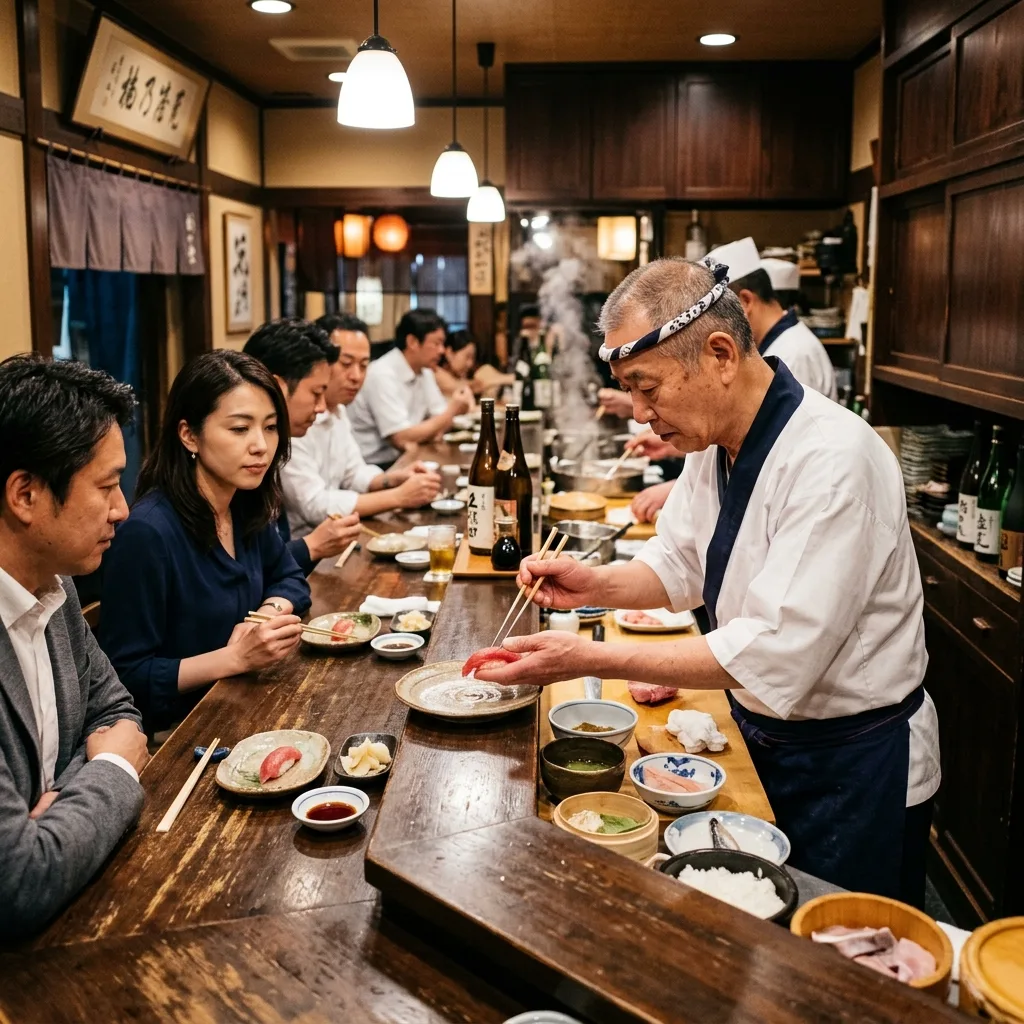
There is no food experience in Japan quite as easy to get wrong as sushi. Not because sushi is complicated — it isn't — but because the rules change completely depending on where you sit down. The casual conveyor belt spot near Shinjuku Station operates on an entirely different social contract than the eight-seat omakase counter in Ginza. Confuse the two, and you'll either embarrass yourself in front of a chef who has spent twenty years perfecting each piece, or miss half the fun of a ¥500 lunch that was designed to be loud, fast, and stress-free.
This guide breaks down sushi etiquette in Japan by venue type, starting with the fundamentals that apply everywhere, then going deep on kaitenzushi (conveyor belt sushi) and omakase counter dining. Whether you are planning a quick lunch stop or your first high-end Japanese dining experience, you will leave knowing exactly what to do, what to avoid, and how to get the most out of every plate.
For a broader look at Japan's food landscape, see our Japanese Food Guide: Ramen, Sushi, Yakitori & What to Eat and Where.
The Sushi Basics Every Traveler Must Know
The fundamentals of sushi etiquette apply whether you are at a standing sushi bar in Tsukiji or a Michelin-starred counter in Roppongi. These are the rules that define respectful eating in Japan, and getting them right takes almost no effort once you know them.
Use the fish side, not the rice side, for soy sauce. Nigiri sushi (the piece with a topping pressed onto rice) should be picked up and dipped fish-side down into soy sauce. Dipping the rice side absorbs too much liquid, causes the rice ball to fall apart, and floods the piece with salt that overpowers the fish. This is one of the most common mistakes tourists make and one of the easiest to fix.
Do not mix wasabi into your soy sauce. At any restaurant beyond the lowest tier, the chef has already placed a precise amount of wasabi between the rice and the fish. Mixing wasabi into soy sauce is considered rude because it signals to the chef that you plan to override their seasoning decision. If you genuinely want more wasabi, ask politely — "wasabi wo motto onegaishimasu" — and it will be applied directly to the piece.
Eat sushi in one bite. Each piece of nigiri is sized to be consumed whole. Biting a piece in half and setting the rest back on the plate is considered bad form at any level of restaurant. If a piece seems too large, use your chopsticks to eat it cleanly in one motion. At more casual spots, this rule is relaxed, but forming the habit serves you well everywhere.
Hands are acceptable, chopsticks are optional. Traditional sushi eating — even at high-end restaurants — allows you to pick up nigiri with your fingers. The rice is often lightly pressed and can crumble under chopstick pressure. Using your hands is not rude; it is, in fact, historically the correct method. That said, sashimi (raw fish without rice) should always be eaten with chopsticks.
Ginger is a palate cleanser, not a condiment. The pink pickled ginger (gari) served alongside your sushi is meant to be eaten between different pieces to reset your palate, similar to sorbet at a Western tasting menu. Do not pile it on top of a piece of sushi or mix it with soy sauce. Eat one small slice between pieces when you want to clear the previous flavor.
Never pass food chopstick-to-chopstick. In Japanese culture, passing food between two pairs of chopsticks mimics the way cremated bones are handled at funerals. It is taboo in any dining context. Set shared pieces on a plate instead.
Kaitenzushi: The Conveyor Belt Rules
Kaitenzushi — literally "rotating sushi" — is Japan's most democratic dining format. Plates of sushi circle the restaurant on a conveyor belt, priced by plate color (typically ¥110–¥660 per plate in 2026), and customers help themselves. Major chains include Sushiro, Kura Sushi, Hamazushi, and Uobei. These restaurants are fast, affordable, affordable, and genuinely fun — but they have their own specific code of conduct.
Touch a plate, take a plate. The single most important rule at kaitenzushi: if you pick up a plate from the belt, you have committed to taking it. Hesitating, putting it back, or touching multiple plates is not acceptable. The belt carries food past dozens of other customers, and a plate that has been handled is considered contaminated. Reach only when you are certain you want what is on the plate.
Do not return plates to the belt. Even if you realize you grabbed the wrong thing or you are already full, do not put a plate back onto the conveyor. Leave it at your table and let the staff collect it during your meal or at checkout.
Do not take plates intended for other customers. Modern kaitenzushi chains now allow you to order specific items via tablet, and those pieces arrive on a dedicated lane or with a marker indicating they belong to a specific table. These are not available for general grab. Only take from the general circulation belt, and only take items that are clearly unclaimed.
Stack your empty plates. As you finish each piece, stack the empty plates at the side of your table. At the end of your meal, a staff member counts the plates to calculate your bill. Do not try to hide or discard plates — the system is designed around honest counting, and some newer restaurants use technology that tallies plates automatically as they are dropped into a slot at the table.
Use tongs for shared condiments. If ginger, wasabi, or other condiments are available in shared containers, use the provided mini tongs or spoon. Never use your personal chopsticks to take from a communal container — this is a hygiene violation that applies across Japanese dining, not just at sushi restaurants.
Order via tablet for freshness. At all major chains, you can order specific rolls and nigiri through a tablet at your table. These arrive directly to your seat via a dedicated fast lane and are always fresher than items that have circulated for several minutes. Make it a habit to use the tablet for anything premium — wagyu, sea urchin, salmon roe — and grab simpler standbys like tuna or egg from the belt.
Avoid strong fragrances. Many kaitenzushi restaurants explicitly ask that guests avoid wearing heavy perfume or cologne. Fresh fish is extremely sensitive to ambient smells, and strong fragrances disrupt the experience for everyone in the restaurant. This is not universally enforced, but it reflects a genuine cultural expectation.
Omakase: The Counter Experience
Omakase — meaning "I'll leave it to you" — is Japan's premium sushi format. You sit at a counter of typically six to twelve seats, and the chef curates an entire meal for you based on the season's best fish, your dietary restrictions, and their own judgment. There is no menu. You eat what the chef decides, in the order the chef decides.
Price ranges for omakase in 2026. Budget around ¥10,000–¥20,000 per person for a quality mid-range omakase lunch or dinner. High-end restaurants in Tokyo — especially those with Michelin stars — typically charge ¥30,000–¥83,500 per person. Affordable options exist from around ¥4,800 for a lunch course. Most omakase restaurants include tax and service charge in the listed price, so what you see is what you pay.
Book weeks or months in advance. Serious omakase counters in Tokyo do not accept walk-ins. Reservations at top restaurants like Sushi Saito or Harutaka are famously impossible to obtain without a personal introduction. For international visitors, the most reliable booking platforms are Tableall and OMAKASE, both of which specialize in connecting foreign tourists with reservations at Japan's top sushi restaurants. Alternatively, concierge services at major hotels in Tokyo can often secure bookings at restaurants not listed on any public platform.
Arrive exactly on time. Omakase counters operate on tight scheduling. Arriving late compresses not only your own meal but potentially the seatings of guests after you. If you must cancel, do so at least 24–48 hours in advance. No-shows at high-end restaurants are taken extremely seriously; some chefs will charge the full course price for unreserved cancellations.
Do not use your phone at the counter. The etiquette around photography varies. At some counters it is welcomed; at others, the chef will politely decline. When in doubt, ask before you photograph. Regardless of the photo policy, keeping your phone face down on the counter and not taking calls during the meal is considered basic courtesy.
Eat each piece immediately after it is served. The chef times preparation precisely, including the temperature of the rice and the texture of the fish. Allowing a piece to sit for several minutes while you photograph it or finish a conversation defeats the craft. Pick up each piece and eat it within one to two minutes of it being placed in front of you.
Do not ask for substitutions or modifications during the meal. If you have allergies or serious dietary restrictions, communicate them clearly when booking and again when you arrive. But omakase is not the format for ordering à la carte or requesting changes once the meal has begun. The structure is the experience. Requesting a different fish because you are not in the mood for mackerel is the equivalent of asking a chef to re-write their menu on the spot.
Engage, but do not dominate. Some of the best omakase experiences include genuine conversation between the chef and the guests. The chef may explain the origin of a particular fish, the technique behind a cut, or the specific seasoning decision for that piece. Listening and asking brief, genuine questions is welcome. Holding court with loud group conversation or talking over the chef is not.
Sake and drinks. Most omakase restaurants offer sake, beer, wine, and whisky pairings. Sake is the traditional pairing with sushi, and the staff can guide you to a bottle that complements the chef's selections. It is polite to pour for others at the counter before pouring for yourself.
Practical Guide: Where to Go and What to Expect
Kaitenzushi Chains (Budget)
The four major kaitenzushi chains all operate similarly and are excellent entry points for first-time visitors:
- Sushiro — the largest chain in Japan by revenue; known for consistent quality and seasonal specials. Plates start at ¥110.
- Kura Sushi — family-friendly atmosphere, strong technology integration (plate drop slots that trigger small prizes for children), and a solid selection of non-sushi items.
- Hamazushi — budget-friendly, with most plates priced at ¥110–¥165. Good option when traveling on a tight budget.
- Uobei — ultra-fast format where orders are delivered directly to your seat via a high-speed rail system rather than a slow belt. You order everything by tablet; nothing circles the restaurant.
All four accept IC cards (Suica, Pasmo) for payment, and most now have English tablet interfaces. Expect queues on weekends and during peak hours; Sushiro and Kura Sushi offer app-based waitlist registration.
Mid-Range Sushi Restaurants
Between kaitenzushi and full omakase lies a wide range of traditional sushi restaurants where a chef makes your pieces to order but within a more relaxed, à la carte or set-menu format. Look for small neighborhood sushi-ya outside tourist districts, particularly in residential areas of Tokyo like Koenji, Sangenjaya, or Kagurazawa. A satisfying set lunch at this level typically costs ¥1,500–¥3,500.
Booking Omakase as a Tourist
The easiest platforms for international visitors to book omakase in 2026:
- Tableall (tableall.com) — curated list of top-rated and Michelin-starred restaurants with English booking interface
- OMAKASE (omakase.in) — Japan's original reservation management service for high-end dining, now with English support
- byFood (byfood.com) — strong selection of affordable omakase options in Tokyo, with English-language food experiences and cooking classes as well
Hotel concierge services remain the gold standard for restaurants that are not listed on any platform. If you are staying at an international hotel in Tokyo, reach out to the concierge at least two to three weeks before your desired dining date.
For context on planning your full Japan itinerary around dining and sightseeing, see our Japan 7-Day Itinerary: Tokyo-Kyoto-Osaka Golden Route Planner.
Tips and Common Mistakes
Mistake: Saying "no wasabi" reflexively. Many Western tourists ask for no wasabi out of habit, even when they enjoy it. At a serious omakase restaurant, asking for no wasabi removes part of the chef's carefully calibrated seasoning. Try it as the chef prepared it first; you can always ask to adjust.
Mistake: Ignoring the rice. Japanese sushi rice (shari) is seasoned with rice vinegar, salt, and sugar in proportions the chef has spent years perfecting. The rice is not just a vehicle for fish — it is half the dish. Paying attention to its texture and temperature tells you a great deal about the quality of the restaurant.
Mistake: Ordering everything at once at a traditional counter. At a sit-down sushi-ya, especially one without a fixed menu, it is common to order two or three pieces at a time and then ask for more. This gives the chef time to prepare each piece properly and lets you adjust based on what you have already eaten.
Mistake: Using the wet towel (oshibori) to wipe your face. The oshibori handed to you at the start of a meal is for cleaning your hands only. Using it to wipe your face or neck is considered rude in Japanese dining culture.
Tip: Ask what is in season. Saying "ima wa nani ga oishii desu ka?" ("what is delicious right now?") to a sushi chef or server opens a natural conversation and often leads to the best piece of the day. Seasonal fish in Japan — firefly squid in spring, young yellowtail in winter, Pacific saury in autumn — are always superior to what appears on a fixed printed menu.
Tip: Try the egg (tamago) as a quality gauge. Traditional sushi chefs end the omakase meal with a piece of tamago — sweetened, layered egg. The complexity of the tamago reflects the overall skill of the kitchen. Some chefs spend years perfecting their tamago recipe.
Tip: Don't leave a tip. Tipping is not part of Japanese dining culture and can cause confusion or even offense. The service charge, where applicable, is already included in the bill. Simply saying "gochisosama deshita" — "thank you for the meal" — when you leave is the correct expression of appreciation.
FAQ
Can I eat sushi with my hands in Japan? Yes, and at traditional high-end omakase restaurants, eating with your hands is historically the correct method. The rice is pressed lightly and can fall apart under chopstick pressure. Hands are always acceptable for nigiri; use chopsticks for sashimi.
What does "omakase" mean and what should I expect? Omakase translates roughly to "I leave it to you." You sit at a counter, tell the chef about any dietary restrictions, and eat whatever they prepare — typically 10 to 20 pieces of nigiri chosen by the chef based on the season's best fish. There is no menu and no substitutions mid-meal.
How much does omakase cost in Japan? In 2026, mid-range omakase runs ¥10,000–¥20,000 per person. High-end Michelin-level counters cost ¥30,000–¥83,500. Budget omakase lunch options are available from around ¥4,800. Booking platforms like Tableall and OMAKASE list current prices for each restaurant.
Is it rude to photograph sushi in Japan? It depends on the restaurant. At kaitenzushi chains, photographing your food is standard practice. At omakase counters, always ask the chef before photographing. Some chefs welcome it; others prefer you focus on eating while the piece is at its best temperature and texture.
What is the difference between kaitenzushi and regular sushi restaurants? Kaitenzushi is a conveyor belt format where plates of pre-made sushi circle the restaurant and customers take what they want. A traditional sushi restaurant (sushi-ya) has a chef making each piece to order, either à la carte or as a set course. Kaitenzushi is cheap and casual; sushi-ya ranges from affordable neighborhood spots to high-end omakase counters.
How do I book a sushi restaurant in Japan as a tourist? For omakase, use Tableall, OMAKASE (omakase.in), or byFood. For mid-range sit-down restaurants, Google Maps works well — look for places with photos of a counter and Japanese-language reviews. Hotel concierge is the most reliable option for top-tier reservations.
Conclusion
Sushi etiquette in Japan is not about following rules for their own sake. It is about respecting the craft — the years a chef has spent perfecting rice temperature, knife angles, and the balance between vinegar and fish. Whether you are grabbing a ¥110 plate off a belt in Shibuya or paying ¥30,000 for a seat at a Ginza counter, the underlying principle is the same: eat what is in front of you, when it is in front of you, and pay attention.
The practical takeaways are simple. Dip the fish side in soy sauce, not the rice side. Don't mix wasabi into your soy sauce. At kaitenzushi, only touch what you intend to take. At omakase, arrive on time, eat each piece immediately, and let the chef lead. Everywhere, ginger is a palate cleanser — not a topping.
Japan's sushi culture rewards curiosity. Try the seasonal specials, ask what the chef recommends, and eat in one bite. You will almost certainly have the best sushi of your life. And you will be welcome back.
For more on navigating Tokyo's dining scene and planning your Japan trip, read our Ultimate Tokyo Travel Guide 2026: Everything First-Timers Need to Know.