Dim Sum Guide for Travelers: What to Order and How to Order It

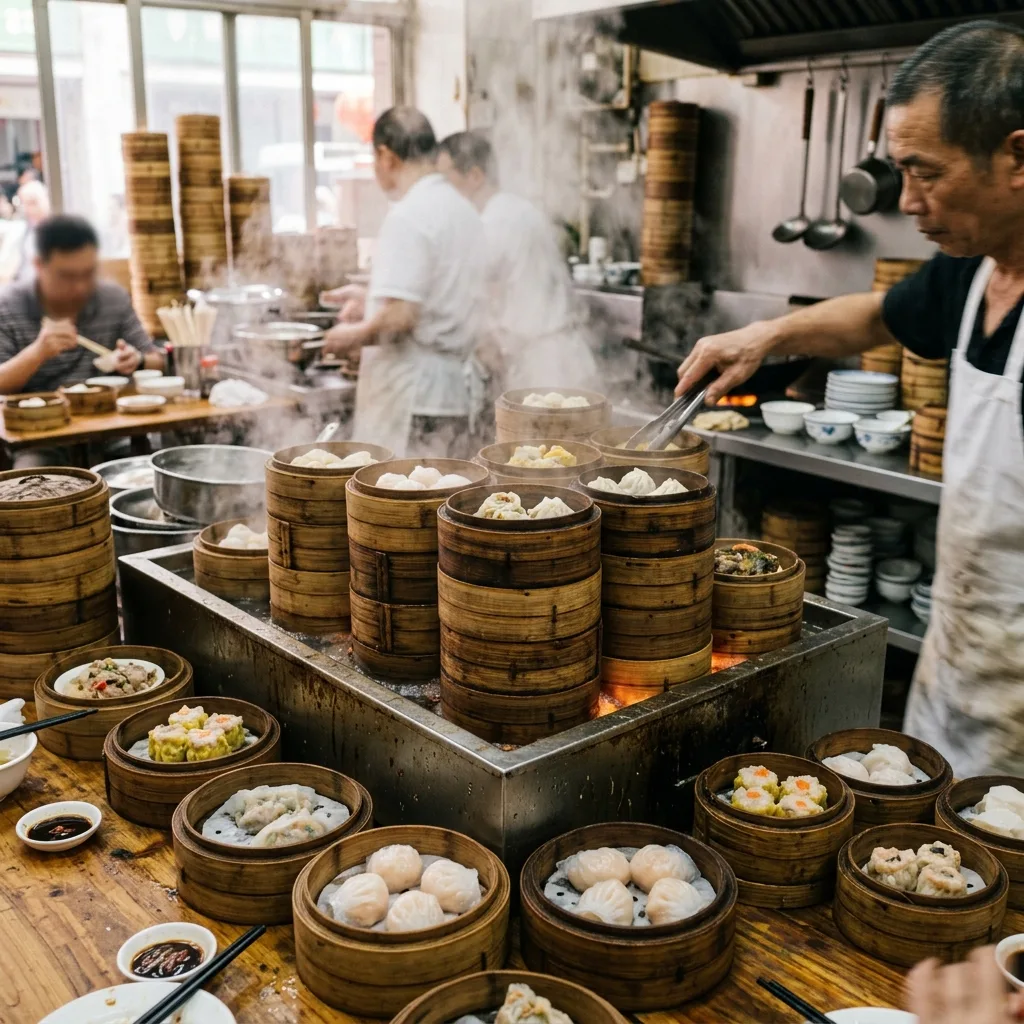
The first time you walk into a busy dim sum restaurant, it can feel like organized chaos. Carts wheel past at speed, servers call out dish names in Cantonese, and a table of ten is already elbowing past you toward the only available four-top. You sit down, someone places a pot of tea in front of you without asking, and then — nothing. No menu. No server. Just the expectation that you know what you're doing.
You don't. Not yet. But you will after reading this.
Dim sum is one of the most joyful eating experiences in Chinese food culture — small, shareable bites eaten over conversation, tea, and unhurried time. It is served during brunch hours at dedicated restaurants across Hong Kong, Guangzhou, and major mainland Chinese cities, and it follows its own logic: a rotating cast of dishes, tea as the anchor, and a style of dining that rewards the curious and penalizes the overcautious. This guide walks you through everything you need to know before your first sitting — what to order, how the system works, what not to do, and how to budget for it.
What Is Dim Sum, Exactly?
Dim sum (點心, diǎn xīn in Mandarin, dim sam in Cantonese) literally translates to "touch the heart" — a fitting name for food built around small, careful pleasures. It originated as a light snack served alongside tea in the teahouses (yum cha) of the Guangdong province. Over centuries it evolved into a full meal format with dozens of dishes, though the pairing with tea remains central. "Yum cha" — meaning "drink tea" — is the Cantonese term people use interchangeably with dim sum, because the two are inseparable.
The meal is social by design. You order many small plates and share everything at the table. There is no individual entrée culture here: you taste, you share, you order more of what you liked. The typical dim sum sitting runs from morning until early afternoon, usually between 7am and 3pm, with peak hours between 10am and 1pm. Arrive after 11am on a weekend without a reservation and you will be waiting.
The Essential Dishes Every Traveler Should Order
If you remember nothing else from this guide, learn these five dishes. They appear on virtually every dim sum menu, they represent the range of textures and fillings you will encounter, and they are universally beloved.
Har Gow (蝦餃) — Shrimp Dumplings
Har gow is the benchmark dish. Seasoned dim sum chefs are often judged by the quality of their har gow alone. The wrapper should be thin, translucent, and slightly elastic — not gummy, not torn. Inside are whole or roughly chopped shrimp, seasoned simply with salt, white pepper, and a touch of sesame oil. A skilled wrapper will have at least seven pleats folded along one side.
Order it first. If the har gow is well made, everything else will be too.
Siu Mai (燒賣) — Open-Top Pork and Shrimp Dumplings
Siu mai is the other classic. These are open-topped dumplings — the wrapper is gathered around a filling of ground pork and shrimp, leaving the top exposed, often garnished with a single fish roe bead or a small piece of carrot. The filling should be juicy and slightly springy, never dense or dry. Siu mai and har gow are usually ordered together.
Char Siu Bao (叉燒包) — BBQ Pork Buns
There are two versions: baked (焗) and steamed (蒸). The baked version has a slightly sweet, shiny crust and a caramelized pork filling. The steamed version has a soft, pillowy white dough and splits open at the top during steaming. Both are excellent. If you can only pick one, the baked bun has more contrast of texture and flavor. Order a basket of each if you can.
Cheung Fun (腸粉) — Rice Noodle Rolls
Cheung fun are silky rolls of steamed rice noodle wrapped around various fillings — most commonly shrimp, beef, or char siu pork. They are served with a thin, slightly sweet soy sauce drizzled over the top. The texture is extremely soft and slippery; handle them with chopsticks gently. This is one of the most texturally distinct dishes in the dim sum canon and a reliable crowd-pleaser.
Lo Mai Gai (糯米雞) — Sticky Rice in Lotus Leaf
A whole portion of glutinous rice, seasoned with soy sauce and filled with chicken, Chinese sausage, and shiitake mushrooms, all wrapped in a lotus leaf and steamed. The lotus leaf imparts a faint herbal aroma to the rice. Lo mai gai is filling and often appears late in the meal to anchor everything else. It pairs especially well with a second pot of tea.
Additional Dishes Worth Ordering
Once you have the essentials, explore from this list:
- Turnip cake (蘿蔔糕, lo bak go): Pan-fried slices of radish cake, crispy on the outside, soft inside. An acquired texture, but addictive once you're used to it.
- Taro dumplings (芋角, wu gok): Deep-fried dumplings with a lacy, crackled taro crust and pork filling. One of the more impressive-looking dishes.
- Egg tarts (蛋撻, dan tat): Flaky pastry shells filled with a smooth, barely-sweet egg custard. Order these for the end of the meal.
- Custard buns (奶黃包, nai wong bao): Steamed buns with a salted egg yolk custard filling. The white dough makes them look plain; do not skip them.
- Turnip dumplings (粉果, fun gor): A Chiu Chow-style dumpling with a slightly chewier wrapper and a filling of turnip, pork, and peanuts.
How the Ordering System Works
Traditional Trolley Service
In classic dim sum restaurants — especially in Hong Kong — dishes arrive via trolley. Servers wheel carts loaded with bamboo steamers and plates through the dining room. When a cart comes near your table, you flag it down and pick what you want. The server stamps your paper order card with each basket you take.
This system rewards confidence. If you hesitate, the cart moves on. If you want something specific, you can ask your server to have it sent out when it is ready. Don't be afraid to lean out of your seat a little.
Menu-Based Ordering
Many modern dim sum restaurants — particularly in mainland China, and increasingly in Hong Kong — use paper tick-sheet menus or tablet ordering systems. You mark what you want, quantities, and hand the sheet to your server. This is less theatrical but easier for first-timers, since you can take your time reading.
In Hong Kong, many Cantonese restaurants combine both systems: a fixed menu for the standard items and trolleys for the rotating specials.
How Much to Order
A good rule is three to four dishes per person to start, then order additional dishes as you go. Order light before heavy: start with steamed items (har gow, siu mai, cheung fun) and move toward fried and baked items (taro dumplings, BBQ buns) later. Finish with something starchy (lo mai gai) or sweet (egg tarts, mango pudding).
It is entirely normal to order in waves over the course of an hour or more. Do not order everything at once.
Tea Culture and Table Etiquette
Tea is not optional at dim sum — it is the point. Ordering tea is the first thing you do when you sit down. In Cantonese, "yum cha" literally means "drink tea," and this framing matters: you are there to drink tea and eat snacks, not simply to have lunch.
Common Tea Varieties
- Pu-erh (普洱): Dark, earthy, aged tea. Cuts through the fat of pork-heavy dishes. The default choice at most traditional restaurants.
- Jasmine (茉莉花茶): Light and floral. Good for those who find pu-erh too strong.
- Chrysanthemum (菊花茶): Pale and slightly sweet, often ordered blended with pu-erh.
- Oolong (烏龍茶): Medium body, semi-oxidized. Versatile and widely available.
At most restaurants, ordering tea comes with a small per-person cover charge or is included in a minimum spend. In older teahouses, this charge also covers the use of the table itself.
Pouring Tea
The etiquette is simple: pour for others before you pour for yourself. If someone reaches across to pour tea for you, tap two fingers (index and middle) on the table near your cup. This gesture — finger-kowtow — is a quiet Cantonese way of saying thank you, originating from a story about an emperor traveling incognito who poured tea for his servants, who could not bow openly without revealing his identity.
If your teapot runs empty, leave the lid propped open slightly (tilted, not fully removed). This signals to the server that you need more hot water — a refill is typically complimentary.
Practical Guide: Prices, Hours, and Where to Go
Prices
In Hong Kong, dim sum costs vary significantly by venue:
- Budget / traditional teahouses: HK$100 per person (approximately USD $13), including tea. Individual dishes run HK$25–50 each.
- Mid-range Cantonese restaurants: HK$250–400 per person for a full sitting.
- Upscale hotel dining or Michelin-starred venues: HK$600–700+ per person.
In mainland China, prices are generally lower. In cities like Guangzhou, Shenzhen, and Shanghai, a solid dim sum lunch at a local Cantonese restaurant typically costs RMB 80–150 per person (USD $11–21). Guangzhou — the cultural home of dim sum — has some of the finest traditional teahouses in existence at extremely approachable prices.
Hours
Dim sum is a breakfast and lunch format. Most restaurants serve from 7am or 8am until 3pm, with some extending to 4pm on weekends. Evening dim sum exists but is rarer and typically served in abbreviated form. The peak window is 9am–12pm on weekdays, 10am–1pm on weekends.
Arrive at opening time on weekdays if you want to walk in without a wait. Weekend mornings at popular restaurants require either a reservation or patience.
Reservations
For Hong Kong's busiest traditional restaurants (Lin Heung Tea House, Maxim's Palace, Tim Ho Wan), weekend reservations are strongly recommended and often open a week in advance. For mid-range restaurants, calling the day before is usually sufficient. Budget teahouses typically operate first-come, first-served.
In mainland China, reservations are increasingly standard at popular spots. WeChat is often the primary booking channel; having a working WeChat account matters. If you need help navigating China's digital ecosystem before your trip, the China Travel Planning guide covers WeChat Pay setup, SIM cards, and VPN considerations in detail.
Where to Find Dim Sum
Hong Kong is the canonical destination. Causeway Bay, Yau Ma Tei, and Sham Shui Po have dense concentrations of traditional teahouses. Central and Admiralty have more upscale options.
Guangzhou is the origin city of Cantonese cuisine and arguably the best place for dim sum in mainland China. The city's teahouse culture runs deep — breakfast dim sum at a local restaurant is a daily ritual for many residents.
Shanghai has a strong dim sum scene centered on Cantonese restaurants in the Huangpu and Jing'an districts. If you are visiting Shanghai, the Shanghai Travel Guide includes neighborhood breakdowns and dining recommendations to help orient your stay.
Beijing has excellent Cantonese restaurant options near the Sanlitun and Dongcheng areas. Dim sum culture is less embedded in daily Beijing life than in Guangzhou, but quality restaurants are easy to find. The Beijing Food Guide covers the broader culinary landscape of the capital.
Tips and Common Mistakes
Do Not Over-Order at the Start
First-timers almost always order too much too early. The dishes look small. They are small. But they also accumulate quickly, and by the time the fourth cart rolls by you are already full of har gow and have nowhere to put the turnip cake. Start conservatively, assess your pace, then order more.
Pace the Ordering
Dim sum is not fast food and should not be treated as one. A proper sitting takes 60–90 minutes. Let dishes arrive in waves, eat slowly, drink tea between courses, and order the next round only when the previous one is nearly finished.
Share Everything
There is no "your dish" at a dim sum table. Everything goes in the center, and everyone serves themselves from shared plates. Using serving chopsticks or the flat end of your personal chopsticks when taking from a shared dish is polite but not rigidly enforced at casual settings — follow the table's lead.
Avoid These Etiquette Errors
- Do not stick chopsticks vertically into food. This resembles funeral incense offerings and is considered deeply inauspicious.
- Do not point your chopsticks at people while gesturing or talking.
- Do not ask for a takeaway container. Doggy bags are not culturally standard at dim sum and will mark you as a tourist in the most obvious way.
- Do not pour your own tea first. Pour for the others at your table, then fill your own cup last.
Inform Dietary Restrictions Early
Most dim sum dishes contain pork or shellfish. If you have dietary restrictions, tell your server before ordering rather than trying to navigate the menu alone. Some restaurants have a modest selection of vegetable or tofu-based dishes, but pure vegetarian dim sum requires seeking out specifically vegetarian Cantonese restaurants, which exist but are not the default.
Understanding the Bill
In Hong Kong, your paper order card is used to calculate the bill. Each basket or plate that arrives at your table is stamped with its price tier. Keep this card safe — losing it is not catastrophic (servers can usually reconstruct the order) but it adds friction. In mainland China, the bill is usually calculated by the server based on a running tab.
Frequently Asked Questions
Can I go to dim sum alone? Yes, though it is best enjoyed with a group. Alone, you can still order a manageable selection — har gow, cheung fun, and egg tarts make for a satisfying solo meal. Ask to be seated at a communal table if available, which some traditional teahouses offer.
Is dim sum the same thing as yum cha? The terms are used interchangeably but they emphasize different things. "Yum cha" means "drink tea" and refers to the overall practice of gathering at a teahouse for tea and small bites. "Dim sum" refers specifically to the food. In practice, saying either phrase means the same thing to your hosts.
Do I need to speak Cantonese to order dim sum? No. At most restaurants popular with tourists — and at nearly all mid-range and upscale establishments — servers speak at least functional English. Pointing at pictures on a menu or tapping on a tablet is perfectly workable. At old-school trolley-service teahouses, a confident wave and a nod will get you far.
What should I drink besides tea? Tea is the correct answer and the culturally expected one. Soft drinks exist at most restaurants but ordering them in place of tea at a traditional teahouse is mildly out of place. Warm soy milk is sometimes available as a non-tea alternative that fits the setting.
Is dim sum served at dinner? Occasionally. Some Cantonese restaurants in Hong Kong and Shanghai run abbreviated evening dim sum menus, typically offering 10–20 dishes rather than the full daytime range. This is the exception rather than the rule. The daytime format is the full experience.
Conclusion
Dim sum rewards people who show up ready to explore. The system is intuitive once you understand that the goal is not to finish a fixed meal — it is to keep tasting, keep pouring tea, and keep the conversation going. Start with har gow and siu mai to calibrate the kitchen's quality, work through the steamed dishes, push into fried territory with taro dumplings and turnip cake, and finish with egg tarts and a last cup of pu-erh.
The rules of etiquette — pour for others, tap to say thank you, leave the lid tilted for more water — take thirty seconds to learn and earn you immediate goodwill from your hosts and fellow diners. The rest is just appetite.
If dim sum is your entry point into Cantonese food culture, treat it as a gateway. The cuisine runs deep — roast duck, clay pot rice, wonton noodle soup, and dozens of other dishes await beyond the steamer basket. Come hungry, bring people you like to sit with, and let the carts come to you.