Sichuan Hotpot Guide: Heat Levels, Ingredients & Best Chains

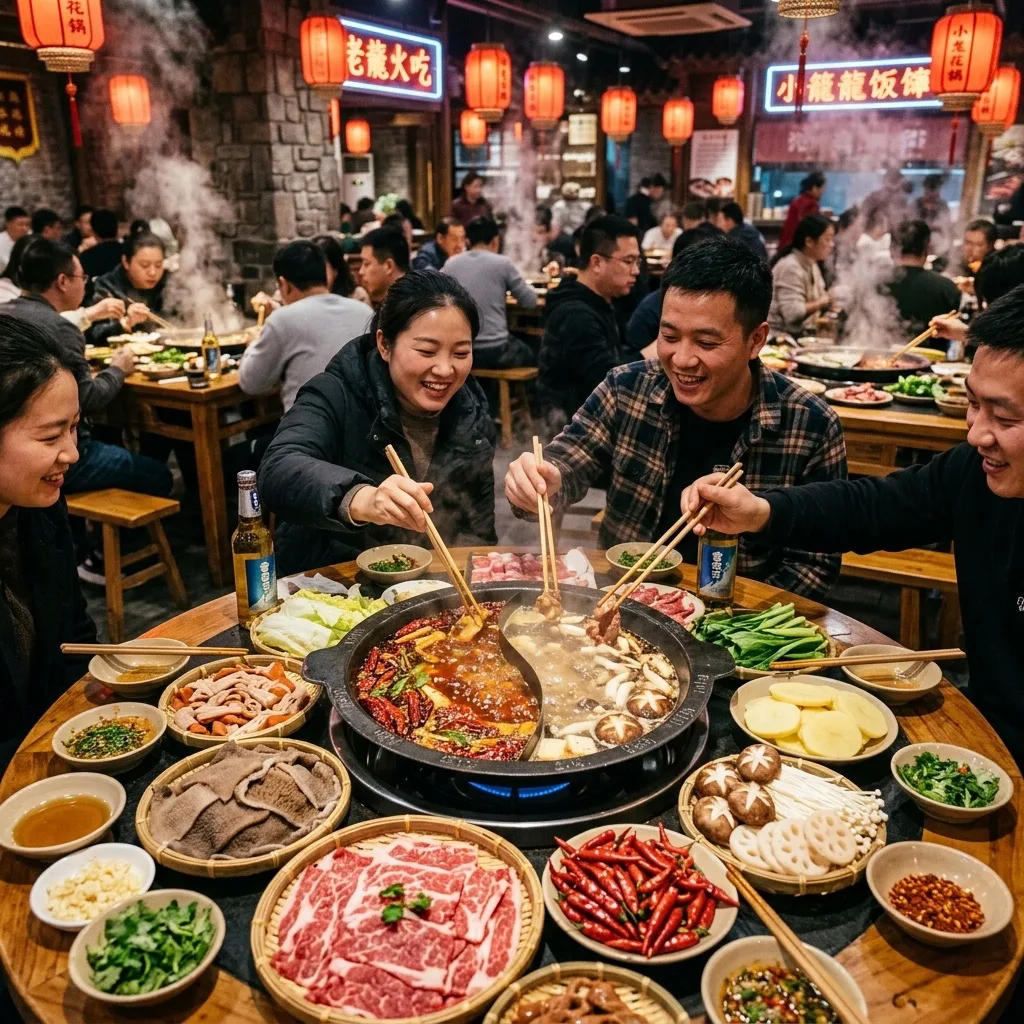
The first time I sat down at a Sichuan hotpot restaurant, I did everything wrong. I picked the full-spice broth without a backup, grabbed the fattiest pork belly slices on impulse, and dunked them straight into the bubbling red oil without a dipping sauce. Two bites in, my lips had gone numb, my eyes were streaming, and I was roughly sixty seconds from begging for a glass of milk. I came back the next night.
Sichuan hotpot is one of the most thrilling eating experiences in China — and one of the most confusing for first-timers. The menu is enormous, the heat is serious, and the unwritten rules of ordering and dipping can feel impenetrable when you're seated at a table with strangers and a boiling cauldron of chili oil between you. This guide covers everything you need to enjoy it properly: what mala actually means, how to read heat levels, which ingredients are worth ordering, how to navigate the best chain restaurants, and what to do when things get too spicy to handle.
What Is Sichuan Hotpot and Why Is It Different
Sichuan hotpot (四川火锅, Sìchuān huǒguō) is a communal cooking experience built around a simmering pot of intensely spiced broth placed at the center of the table. Diners choose raw ingredients from a menu or a self-serve station and cook them directly in the pot. The meal is social, unhurried, and usually loud.
What separates Sichuan hotpot from other Chinese regional varieties — like the light, clear-broth styles popular in Guangdong or the lamb-centric Inner Mongolian version — is the broth. Sichuan hotpot is built on mala (麻辣), a flavor combination that means numbing (má) and spicy (là). The broth is made with beef tallow rendered down with dried chilies, Sichuan peppercorns, Pixian doubanjiang (fermented chili bean paste), ginger, garlic, and a long list of aromatics. It is deeply savory, ferociously spicy, and uniquely tongue-numbing in a way that no other cuisine replicates.
The numbing sensation comes specifically from hydroxy-alpha-sanshool, the active compound in Sichuan peppercorns. It interferes with your nerve receptors and creates a tingling, almost electric buzz on your lips and tongue. This is not heat in the capsaicin sense — it's a completely different experience, and it's what makes Sichuan cuisine addictive rather than simply punishing.
If you want a broader look at how Sichuan flavors fit into China's regional food culture, our guide to Chinese regional food: dim sum, Sichuan spice, and Beijing duck is a good starting point.
Understanding Mala Heat Levels
Most Sichuan hotpot restaurants offer a spectrum of spice levels, and choosing correctly is the single most important decision you'll make before the food arrives. The terminology varies by chain and city, but the broad framework looks like this:
Mild (微辣 / wēi là) Almost no detectable heat. The broth is aromatic with spices but not spicy in any meaningful way. This level is designed for children and people with very low spice tolerance. If you've never had Sichuan food before, this is where to start — it lets you taste the complexity of the spice blend without the pain.
Medium (中辣 / zhōng là) Noticeable heat with a building burn after several bites. You'll feel warmth in your chest and a mild tingling on your lips. This is the right call for people who enjoy spicy food but don't eat it daily. Most international visitors find this satisfying without being overwhelming.
Spicy (大辣 / dà là) Proper heat. Your lips will go numb within a few minutes, your face will flush, and you'll be reaching for your sesame oil dipping sauce between every few bites. This is what Chengdu locals would consider a normal evening meal.
Extra Spicy / Extreme (特辣 / tè là) Reserved for people who genuinely eat spicy food every day. Full-strength mala hotpot broth can register between 50,000 and 100,000 Scoville Heat Units — roughly equivalent to a habanero pepper, sustained over an entire meal. If you're not sure, do not order this.
The Split Pot Solution
Almost every hotpot restaurant offers a divided pot (鸳鸯锅 / yuānyāng guō, literally "mandarin duck pot") — a pot split down the middle, one side with mala broth and one side with a mild clear or milky bone broth. This is the move. It lets you cook spicy ingredients on one side and milder, more delicate ingredients on the other. When the heat builds up too aggressively, you can cool down with a dumpling cooked in the clear broth. Order the split pot every time until you know your tolerance.
The Dipping Sauce: Your Best Defense
Before you start cooking, you'll visit the dipping sauce station — and this is where first-timers often underestimate what's available. The standard base is sesame oil (麻油 / má yóu), and it's not optional. A bowl of sesame oil mixed with minced garlic and fresh cilantro does two things: it coats the just-cooked food to reduce the immediate impact of the chili oil, and it adds a nutty, fragrant counterpoint to the mala broth.
Common add-ins include:
- Minced garlic — always
- Fresh cilantro — adds freshness that cuts the oil
- Sesame paste — richer and creamier, good for coating meat
- Oyster sauce — adds sweetness and depth
- Chopped scallion — for a sharper bite
- Chili crisp or fermented black beans — for those who want more complexity, not less spice
Avoid the extra chili oil at the sauce station if you're already on a medium or higher broth. The sauce is meant to be a buffer, not an amplifier.
Essential Ingredients: What to Order
The menu at a Sichuan hotpot restaurant can run to three pages. Here's how to think about it.
Meats
Thinly sliced beef (牛肉 / niúròu) is the canonical choice. The beef is shaved paper-thin so it cooks in the boiling broth in under ten seconds. Fatty cuts like ribeye work best — the fat renders in the broth and the meat stays tender. Wagyu and premium beef selections are available at higher-end chains.
Lamb (羊肉 / yángròu) is another classic, especially popular in winter. It has a stronger flavor than beef and holds up well against the spiced broth.
Pork belly (五花肉 / wǔhuāròu) is rich and satisfying. It needs slightly longer in the pot than beef — about 30 to 45 seconds.
Duck blood tofu (鸭血 / yā xuè) is a Chengdu staple. It looks intimidating but tastes like a very soft, silky tofu with an earthy, mild flavor. It absorbs the broth beautifully.
Tofu and Soy Products
Tofu skin rolls (豆皮 / dòupí) and firm tofu (老豆腐 / lǎo dòufu) are essential. They cook quickly and act as mild buffers between intensely flavored bites. Firm tofu holds its shape in the broth; silken tofu will fall apart and is better suited for the mild side of a split pot.
Vegetables
Lotus root (莲藕 / lián'ǒu) is sliced into rounds and cooks to a pleasant, slightly crunchy texture. It's starchy and filling. Potato slices (土豆 / tǔdòu) take longer — about two to three minutes — and are best left in the broth to soak through. Enoki mushrooms (金针菇 / jīnzhēngū) are delicate and only need a few seconds.
Napa cabbage (白菜 / báicài) is the classic vegetable choice. It wilts quickly and soaks up flavor without overpowering.
Noodles and Starch
Most menus include glass noodles (粉丝 / fěnsī), rice noodles (米线 / mǐxiàn), and sometimes hand-pulled noodles. Add noodles toward the end of the meal — they soak up the broth and become intensely flavored, and they're good for slowing down when you're full but not quite ready to stop.
Seafood
Prawns, crab sticks, fish tofu, and scallops are common. Seafood cooks very quickly in the boiling broth and pairs better with the mild side of a split pot — the delicate flavor gets lost in the mala.
How to Actually Cook the Food
The technique is simple once you understand the timing:
- Set up your dipping bowl first. Go to the sauce station and build your bowl before the food arrives.
- Wait for a full boil. Never drop raw meat into broth that isn't actively boiling.
- Use chopsticks or the provided ladle. Don't add entire plates at once — the broth temperature will drop and your meat will gray instead of cook properly.
- Thin beef and lamb: 10–15 seconds. Hold the slice in the broth with chopsticks or dip it through like shabu-shabu.
- Vegetables: 1–3 minutes depending on density. Root vegetables take longer; leafy greens go in seconds.
- Tofu: 2–3 minutes. Let it heat through completely.
- Noodles: 3–5 minutes.
- Taste the broth. As the meal goes on, evaporation concentrates the spice. The broth gets hotter over time. Add the accompanying clear broth (usually provided in a small pitcher) to maintain balance.
Best Sichuan Hotpot Chains in China
Haidilao (海底捞)
Haidilao is the most internationally recognized hotpot chain in China, with locations in over 30 countries. It was founded in Jianyang, Sichuan, in 1994, and has grown into one of the largest restaurant chains in the world. The brand is as known for its service as its food — waiting customers receive free snacks, drinks, manicures, shoe shines, and sometimes a noodle-pulling performance at the table.
The food is solid. The mala broth is well-made and consistent, the ingredient quality is reliable, and the menu is broad enough to satisfy everyone at the table including non-spice eaters. Prices are mid-to-high: expect to spend ¥150–250 per person (approximately $20–35 USD) at a typical Chinese location. The split pot is always available.
Waits at popular Haidilao locations in Chengdu, Chongqing, and Beijing can exceed two hours on weekends. The chain's app lets you queue remotely so you can arrive when a table is almost ready.
Xiabu Xiabu (呷哺呷哺)
Xiabu Xiabu is the largest individual-style hotpot chain in China. The concept is bar-seating with individual pots — each diner gets their own small pot instead of sharing a communal one. This makes it ideal for solo diners, lunch crowds, and anyone who wants full control over their broth and ingredients without negotiating heat levels with the whole table.
Pricing is significantly lower than Haidilao, making it a daily-meal option for many urban workers in China. A full meal typically runs ¥60–100 per person (around $8–14 USD). The menu is streamlined but covers all the essentials. The broth options at Xiabu Xiabu lean toward lighter, less intensely spiced variations compared to a traditional Chengdu-style full mala.
Xiaolong Kan (小龙坎)
Xiaolong Kan is the choice for people who want the authentic Chengdu hotpot experience with none of the tourist-brand softening. Founded in Chengdu, it uses traditional beef tallow broth and positions itself as a heritage brand rather than a service-forward chain. The menu is more focused on traditional ingredients — duck blood, tripe, beef throat, pork brain — that other chains have softened or removed to appeal to broader audiences.
Prices sit between Xiabu Xiabu and Haidilao. Spice levels are taken seriously: if you order medium at Xiaolong Kan, it will be hotter than medium at Haidilao.
Da Long Yi (大龙燚)
Another Chengdu-origin chain, Da Long Yi is popular for its golden-broth option alongside the standard mala. The golden broth is made with butter, chicken stock, and a proprietary blend of spices — it's rich, warming, and spicy in a different way from the mala. Da Long Yi has expanded rapidly in recent years and now has locations across China's major cities. It's a good option for groups that include people who can't handle extreme heat, since the two-broth setup (golden and mala) covers different tolerance levels well.
Navigating the Restaurant Without Speaking Chinese
Most chain hotpot restaurants now have tablets or QR code menus with English translations at tourist-frequented locations. Haidilao in particular has invested heavily in multilingual service in its flagship locations in Shanghai, Beijing, and Chengdu.
If you're at a smaller local restaurant without English support, these are the most useful Mandarin phrases:
- 鸳鸯锅 (yuānyāng guō) — split pot (half spicy, half mild)
- 中辣 (zhōng là) — medium spice
- 不要太辣 (bù yào tài là) — not too spicy
- 芝麻酱 (zhīma jiàng) — sesame paste (for dipping)
- 多少钱 (duōshǎo qián) — how much does this cost
Payment at most hotpot chains in China is expected via WeChat Pay or Alipay. This can be a barrier for foreign visitors — our guide to setting up WeChat Pay as a tourist in 2026 walks through the process step by step, including how to link an international card. Many chain restaurants now also accept foreign credit cards directly at the cashier.
Tips and Common Mistakes
Don't start with the highest heat level. Even people with strong spice tolerance will find that Sichuan mala is different from other types of spicy food. The combination of capsaicin and the numbing effect from Sichuan peppercorn is cumulative — what feels manageable in the first ten minutes becomes genuinely overwhelming by the end of the meal.
Build your dipping sauce before you start cooking. The sesame oil dipping bowl is not optional garnish. It's a functional tool for making each bite palatable and for protecting your stomach lining from a full session of straight chili oil.
Drink milk, not water. Water doesn't neutralize capsaicin — it spreads it around. Cold milk, yogurt drinks, or the milky bone broth on the clear side of a split pot are more effective for cooling down. Most hotpot restaurants sell cold milk and yogurt beverages specifically for this reason.
Don't overload the pot. Adding too many ingredients at once drops the temperature of the broth and leads to uneven cooking. Cook in small batches.
Use different chopsticks for raw and cooked food. Many restaurants provide a second set of chopsticks specifically for handling raw meat. If they don't, use the ladle for raw items and reserve your eating chopsticks for cooked food.
Pace yourself. Hotpot is a long meal. In Chengdu, a table of four might spend two to three hours eating. The social dimension is the point. Don't rush through the ordering trying to finish quickly.
Avoid alcohol if your tolerance for spice is low. Alcohol dilates blood vessels and intensifies the perception of heat. Beer with hotpot is traditional, but if you're already at your limit with medium broth, alcohol will accelerate the problem.
Sichuan Hotpot vs. Chongqing Hotpot
Travelers frequently encounter "Chongqing hotpot" (重庆火锅) listed separately from "Sichuan hotpot," and the distinction is worth understanding. Chongqing is a municipality that borders Sichuan province, and the two styles evolved together and share most of their DNA. The core difference is in the broth: Chongqing hotpot traditionally uses a higher ratio of beef tallow and dried chilies, producing a broth that is even richer and more aggressively spiced than the standard Sichuan version. Many food scholars treat Chongqing hotpot as the ancestral form from which the Chengdu style evolved — lighter, slightly more fragrant, and more willing to incorporate non-traditional ingredients.
In practice, the two terms are often used interchangeably. When you see "Chongqing hotpot" on a menu in Shanghai or Beijing, it signals a traditional, high-heat preparation — useful as a signal, even if the restaurant itself is not from Chongqing.
Where to Eat Sichuan Hotpot Outside China
Major Sichuan hotpot chains have expanded internationally. Haidilao has locations in the United States, United Kingdom, Australia, Japan, South Korea, and across Southeast Asia. Xiaolong Kan and Da Long Yi have also opened overseas branches in select cities.
For the most authentic experience, Chengdu and Chongqing remain the standard. If you're building a broader China itinerary, our practical guide to planning your China trip — visas, WeChat Pay, and high-speed rail covers the logistics end-to-end, including how to get a tourist visa and how to move between cities. Chengdu is roughly two hours from Chongqing by high-speed rail — a straightforward combination.
For food lovers who want to explore beyond hotpot, the Shanghai food scene guide covering xiaolongbao, shengjianbao, and local restaurant picks is a useful complement to the Sichuan chapters of your trip.
FAQ
Is Sichuan hotpot safe for people with low spice tolerance?
Yes, if you choose correctly. Order the split pot (鸳鸯锅), pick mild (微辣) or medium (中辣) broth for the spicy side, and use the sesame oil dipping sauce generously. You'll be able to enjoy the meal without distress. The problem only arrives when first-timers order full spice without a backup plan.
How much does Sichuan hotpot cost in China?
Budget roughly ¥100–150 per person ($14–21 USD) at Xiabu Xiabu and mid-range local restaurants. Haidilao and Xiaolong Kan typically run ¥150–250 per person ($21–35 USD). High-end or specialty chains in first-tier cities can go higher, especially with premium ingredient selections like wagyu or live seafood.
What's the difference between mala and regular spicy?
Regular spicy food causes a burning sensation from capsaicin. Mala adds a numbing, buzzing sensation from Sichuan peppercorn's hydroxy-alpha-sanshool compound. The numbing effect is what makes mala distinctive — it doesn't reduce the heat, it changes the texture of how you experience it. Many people find mala more addictive than straightforwardly spicy food.
Can vegetarians eat Sichuan hotpot?
The mala broth itself is typically made with beef tallow, making it unsuitable for vegetarians. Many restaurants now offer a mushroom broth or a clear vegetable broth option on request — worth asking about before you're seated. The ingredient options are naturally generous for vegetarians: lotus root, potato, tofu, mushrooms, and leafy greens are all excellent.
Do I need to make a reservation?
At popular chains like Haidilao, especially on Friday and Saturday evenings, waits of 60–120 minutes are common. Use the chain's app to queue remotely. Smaller local restaurants typically do not take reservations and operate on a walk-in basis.
Is it safe to eat raw meat cooked in hotpot?
Yes, as long as the broth is at a full rolling boil and you're cooking your food long enough. The boiling temperatures in the pot — typically above 95°C (203°F) — are sufficient to kill pathogens in thin-sliced meat within a few seconds. Don't use the same chopsticks for raw and cooked food, and don't undercook thick cuts.
Conclusion
Sichuan hotpot is one of China's great culinary experiences and worth planning your evening around. The key is going in with a strategy: choose the split pot, start at medium heat, build your dipping sauce before anything else, and don't rush. The best hotpot meals are slow ones.
Haidilao is the safe, reliable, widely available option — good for first-timers and groups with mixed preferences. For the most authentic expression of the style, Xiaolong Kan or a local Chengdu restaurant will give you a closer view of what the tradition actually is. Either way, you'll probably end up going back the next night.
If you're planning a broader China food trip, start with the regional overview and work outward from there. Sichuan hotpot is one chapter in a very long book.