Chinese Night Market Guide: Wangfujing, Xi'an & Chengdu Snack Streets

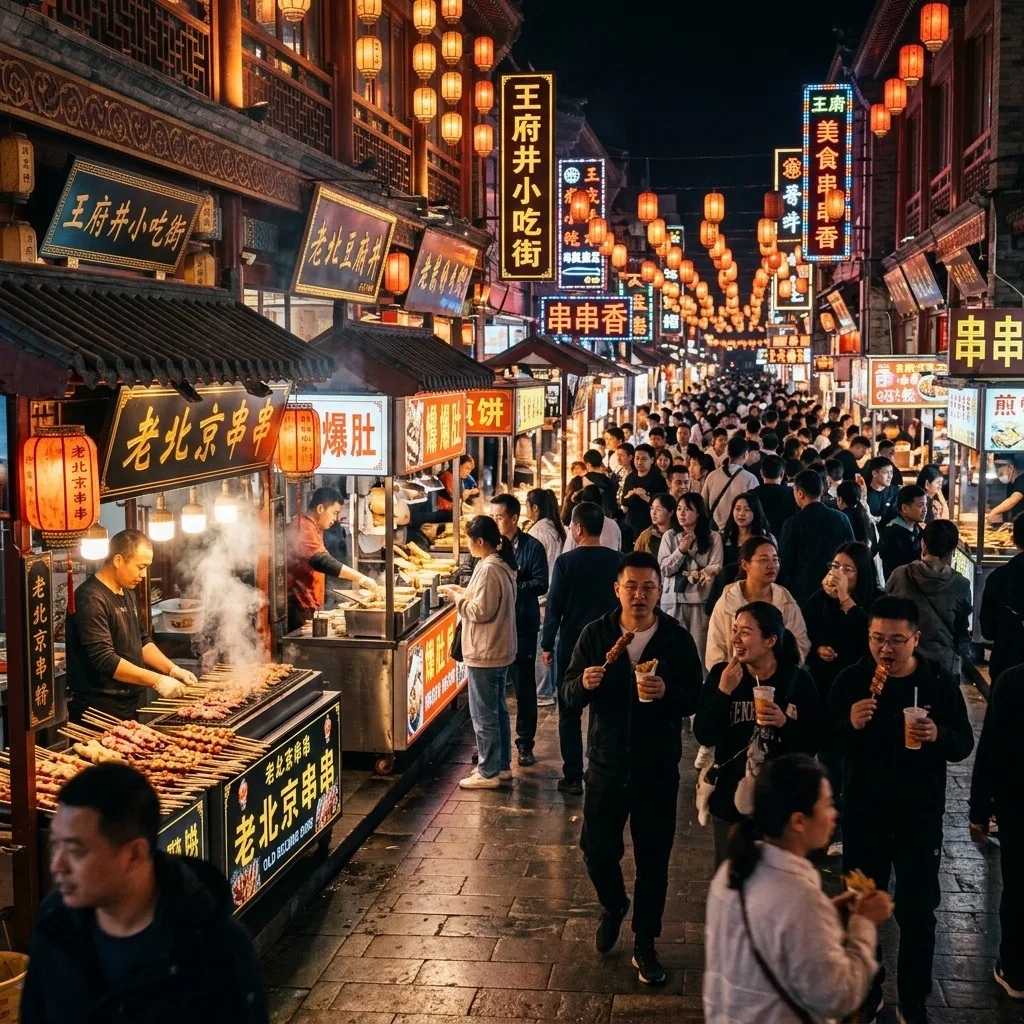
If you only have room for one food crawl in China, the wrong choice can waste a night. Wangfujing can feel polished and tourist-heavy, Xi'an's Muslim Quarter can overwhelm you with history and snack variety, and Chengdu's Jinli can seduce you with lantern light and Sichuan aromas before you have time to plan your route home. This guide helps you choose the right stop for your budget, appetite, and energy level, with practical 2026 notes on hours, transport, and what each street is really best at. For a wider Beijing plan, pair this with Ultimate Beijing Travel Guide: Great Wall, Forbidden City & More, then use China SIM Card Guide 2026: eSIM, Local Cards & Roaming Options and Currency in China: Where to Exchange, Use Cards & Avoid Scams so you are not solving connectivity and payment problems while you are hungry.
The Three Night Market Styles: Beijing, Xi'an, and Chengdu
The simplest way to think about Wangfujing, Xi'an's Muslim Quarter, and Chengdu's Jinli is that they solve three different travel problems. Wangfujing is the easiest night food stop for first-timers in Beijing because it sits inside a major shopping corridor, has very simple transport access, and lets you sample street snacks without needing a full evening plan. Xi'an's Muslim Quarter is the most culturally layered of the three; it is less a single market than a dense food district where you can weave between historic lanes, halal specialties, mosques, and late-evening vendors. Chengdu's Jinli is the most atmospheric option, especially after sunset, because the street feels designed for strolling, photography, tea breaks, and casual snack hunting rather than pure eating speed.
That difference matters more than many travelers realize. Some people want an efficient one-hour snack stop. Others want a place to wander for three hours, take photos, sit down, and people-watch. The best market is not the one with the most famous name; it is the one that matches the rhythm of your trip. If you are arriving tired after a day of sightseeing, you may want the easiest, most central option. If you are building a food-focused evening around one district, the more immersive choices usually win.
Wangfujing: The easiest first-night option in Beijing
Wangfujing is the most recognizable stop on this list because it combines a pedestrian shopping street with a snack alley that has long been marketed to visitors. It is not the most authentic food crawl in Beijing, and it is not the cheapest, but it is often the lowest-friction introduction to Chinese night food culture. If you are staying near central Beijing, want to walk straight out of a metro station, and prefer a place where everything is clearly signposted, Wangfujing is hard to beat.
The practical advantage is location. Wangfujing sits close to the Forbidden City and Tiananmen area, so it fits naturally into a classic first-time Beijing itinerary. That makes it useful for travelers who want a dinner-plus-walk evening after a day of palaces, museums, or hutong wandering. The area also benefits from broad pedestrian space, which means you can move slowly, compare stalls, and avoid the feeling of being trapped in a single narrow alley.
The tradeoff is that Wangfujing can feel heavily curated for tourists. Some of the more attention-grabbing stalls lean into novelty rather than flavor, and the best eating strategy is usually to treat the area as a sampling stop rather than a destination for a serious dinner. If you want truly memorable Beijing food, use Wangfujing as a gateway, then head elsewhere for the deeper local experience.
For travelers building a bigger Beijing trip, Wangfujing pairs well with a day that includes the Forbidden City, Jingshan, or the hutongs. A guide like Ultimate Beijing Travel Guide: Great Wall, Forbidden City & More gives you the broader urban context, while Wangfujing gives you the easy evening finish.
Xi'an Muslim Quarter: The strongest food-and-history combination
Xi'an's Muslim Quarter is the place on this list that feels most like a living neighborhood. Yes, it is a major tourist draw, but it also carries a much stronger sense of place than a standard shopping-night market. The mix of Hui Muslim heritage, historic lanes, and Shaanxi snacks gives the area a depth that makes it more than just a place to eat. You are walking through a district where food, religion, commerce, and local identity overlap.
That overlap is what makes the quarter so satisfying for first-time visitors. You can snack on roujiamo, liangpi, skewers, dumplings, and sweets, then detour toward the Great Mosque or nearby lanes to see how daily life sits beside the tourist flow. Even if you are not planning a long cultural visit, the food here feels more rooted than the novelty-heavy stalls at some other famous market streets.
The district is also easier to treat as a long, flexible evening. You can arrive before dinner, graze for an hour or two, sit down for a proper meal, and keep walking after dark. Because the area is large and layered rather than a single line of stalls, it supports a slower pace. That makes it particularly good for travelers who like to sample many dishes in small portions instead of committing to one restaurant.
If you are already using China SIM Card Guide 2026: eSIM, Local Cards & Roaming Options, Xi'an is also the sort of district where having maps, translation, and ride-hailing ready can save time. If you are still sorting out money handling, Currency in China: Where to Exchange, Use Cards & Avoid Scams matters here more than on a typical hotel-district dinner because smaller snack purchases add up quickly.
Chengdu Jinli: The best atmosphere and snack-street walk
Jinli is the most visually polished of the three and arguably the best place to go when you want your food crawl to feel like an evening out rather than an errand. Lanterns, courtyards, Sichuan opera energy, tea houses, and restored architecture give the street a cinematic quality that gets especially strong after sunset. If Xi'an feels like a district you move through, Jinli feels like a place you linger in.
The food is a big part of the appeal, but not the only reason people go. Jinli is one of the best places to combine snacks with sightseeing because you can eat, browse handicrafts, watch performances, and sit down for tea in the same small area. That makes it ideal for couples, photographers, and travelers who want to slow down rather than maximize stall count.
It is also the best option if your larger Chengdu plan already leans into Sichuan flavor. You are unlikely to come to Chengdu for subtle food, and Jinli embraces that identity. The street is full of the kind of small bites and heavy aromas that make sense in a city famous for chili, peppercorn, and slow social meals. It is not the most local-feeling food street in Chengdu, but it is one of the easiest to enjoy without a long learning curve.
For travelers comparing food regions, Jinli fits neatly into a broader Sichuan plan, just as a Beijing night stop fits within a capital itinerary. If you are already reading about regional food differences, this is the Chengdu evening version of that same idea: culture plus snacks plus atmosphere, with the balance tipped toward atmosphere.
What to Eat at Each Street
Each of these districts has its own eating logic. If you try to order the same way everywhere, you will miss what makes them different. Wangfujing is about easy, recognizable street snacks. Xi'an is about hearty, savory local staples with strong Muslim and Shaanxi influences. Chengdu is about spice, texture, and the pleasure of eating while you move slowly through a decorative historic lane.
Wangfujing snack strategy: Go for recognizable bites
The best approach at Wangfujing is to prioritize snacks that are easy to compare and easy to finish in a few bites. Think jianbing, tanghulu, lamb skewers, dumplings, sticky rice treats, and local desserts. If you see highly theatrical stalls with unusual insects or photo-bait snacks, treat them as optional entertainment rather than the core of the experience. They are often the most expensive, least representative items in the area.
This does not mean Wangfujing is bad. It means the street is strongest when you lower your expectations from "hidden local secret" to "easy introduction to Beijing snack culture." That framing makes the visit more enjoyable and prevents disappointment. A lot of travelers go in expecting a hyper-local market and leave frustrated. Travelers who go in expecting a fun, accessible sampler usually have a much better time.
If you only want one practical rule, use this: order one or two obvious snacks, share them, and keep walking. Wangfujing works best as a stroll with bites, not as a long sit-down feast. That keeps your budget under control and leaves room for a proper dinner elsewhere if needed.
Xi'an snack strategy: Build a mini meal from several small dishes
Xi'an's Muslim Quarter rewards curiosity. Instead of chasing a single signature item, it is usually smarter to assemble a small spread. Start with roujiamo if you want something familiar and filling, then add liangpi or cold noodles for texture, a skewer or two for quick heat, and a sweet or roasted snack to finish. If you are hungry after a day of sightseeing, the district makes it easy to build a real meal out of a few stops.
The Muslim Quarter is also where it helps to pay attention to the rhythm of the crowd. Later evening hours can be lively, but they can also become slower and more congested near the most famous arches and main lanes. The better strategy is often to wander a little away from the first obvious entrance, compare prices, and look for stalls that are busy with local customers rather than only camera-holding tourists.
Because the district is larger than a single street, you can find pockets that feel different from one another. Some lanes are food-first, while others lean toward souvenir traffic or mosque-adjacent footfall. That variety is useful if you prefer to eat at a measured pace. You can snack, walk a bit, and then choose a proper seat or a more traditional restaurant if you want to slow down.
Chengdu snack strategy: Match the heat level to your tolerance
Chengdu is where travelers should be honest about their spice tolerance. Sichuan food can be brilliantly complex, but the flavor profile is not designed to be gentle. When you are snacking in Jinli, a good strategy is to mix one spice-forward item with one milder item so your palate does not get overwhelmed. That way you can enjoy the mala heat without flattening everything else you taste.
Popular choices often include bo bo chicken, rice-based snacks, sesame or sugar-focused treats, dumplings, and items that show off Sichuan seasoning without forcing you to commit to a full hotpot-level meal. Jinli is also a good place to try tea or a seated break between snacks. In Chengdu, the slow pause is part of the experience; the city does not reward people who rush through the evening.
The street also offers one advantage many food-focused travelers value: it is visually satisfying even when you are not actively eating. That means your budget can stay modest while your evening still feels rich. A tea stop, a few snacks, and a slow walk under lantern light can be more memorable than a larger meal elsewhere.
Which street is best for first-timers?
If you are brand new to China travel, Wangfujing is the simplest first stop because it asks the least of you logistically. Xi'an's Muslim Quarter is the best all-around food-and-culture stop. Chengdu's Jinli is the best if your priority is atmosphere, photos, and a relaxed night walk. There is no universal winner because each one optimizes for a different kind of evening.
If I had to reduce the choice even further, I would frame it this way:
- Choose Wangfujing if you want convenience and minimal planning.
- Choose Xi'an if you want the strongest food identity and cultural texture.
- Choose Chengdu if you want the most photogenic and leisurely night street.
That is the practical comparison most guides skip. They tell you all three are famous, but fame is not the same as fit. Your best choice depends on whether you care more about speed, depth, or atmosphere.
Practical Guide
This is the part that matters once you have chosen a city. Food streets are fun until you arrive hungry, the metro exit is confusing, or you assume a place is open later than it really is. The notes below focus on what is stable enough to plan around in 2026 and where you should still leave room for on-the-ground variation.
Hours, admission, and typical costs
Wangfujing is public space, so there is no entrance fee. The pedestrian area is effectively open all day, while the surrounding shops usually run roughly from 10:00 AM to around 10:00 PM. Some snack-street stalls operate on similar daytime-to-evening hours, and a few vendors may stay open later, but the safe assumption is to go in the evening rather than trying to stretch it too late. Budget-wise, the touristy snack items tend to cost more than neighborhood street food, so a small tasting budget is sensible.
Xi'an's Muslim Quarter is also free to enter and accessible all day. Most shops open around 8:00 AM and close around 10:00 PM, with the busiest food atmosphere arriving in the late afternoon and evening. Because it is a district rather than a single controlled attraction, the exact rhythm can vary by lane, weather, and holidays. The important takeaway is that you do not need to buy a ticket, but you do need to plan enough time to wander.
Jinli in Chengdu is likewise free to enter. The street is generally accessible all day, and shops usually run from about 9:00 AM to 10:00 PM, with the evening being the most attractive time to visit. If you want the lanterns and the most photogenic mood, do not come too early. If you want smaller crowds, arrive before the peak dinner window and stay through sunset.
There are no official booking links for walking the streets themselves. You simply show up. If you want to combine a paid attraction with your food crawl, book that separately. In Beijing, that may mean pairing the evening with a museum or a formal restaurant booking. In Xi'an, it could mean the Great Mosque or a guided heritage walk. In Chengdu, it may mean a performance or a seat-based tea experience. The street entry itself does not require reservations.
How to get there without wasting time
Wangfujing is easiest via Beijing Subway Line 1 to Wangfujing Station or Line 5 to Dengshikou, depending on where you want to enter. That flexibility is useful because you can choose the side that best fits your hotel or your earlier sightseeing stop. If you are already on the east side of central Beijing, Wangfujing is straightforward enough that it can become a spontaneous dinner plan rather than a prebooked outing.
Xi'an's Muslim Quarter is usually approached from the Bell Tower area, which is why it feels so central. Metro access is simple, and the quarter sits close enough to Xi'an's most recognizable landmarks that you can combine it with a wider city-center walk. The key is to use a map app and not assume the first market lane you see is the only entrance. The district branches more than first-time visitors expect.
Jinli is best reached by Chengdu Metro Line 3 to Gaoshengqiao Station, then a short walk. That route is easy to remember and keeps you from overcomplicating the evening. Chengdu is a city where Didi and metro both work well, but the subway is usually the least stressful option if your main goal is a simple arrival and a leisurely walk back out after dark.
One useful planning habit for all three cities is to arrive before your hunger peaks. If you reach a night market starving and disoriented, you will make poor choices. Eat a small snack or late lunch earlier in the day, then arrive ready to compare stalls and move without panic. The best street-food evenings happen when you are hungry enough to care, but not so hungry that you buy the first thing you see.
What to do if you only have one evening
If your trip gives you a single night for a food street, make the choice based on what your day already looked like. After a classic Beijing sightseeing day, Wangfujing is the easiest capstone. After a full Xi'an heritage day, the Muslim Quarter is the most satisfying because it feels like a continuation of the city's old commercial core. After a slower Chengdu day or a museum-heavy afternoon, Jinli is the best transition into evening because you can wander, sit, and snack without needing a strict plan.
If you are trying to choose between food and photography, Jinli usually wins. If you are trying to choose between food and cultural context, Xi'an usually wins. If you are trying to choose between food and simplicity, Wangfujing usually wins. That is the shortest honest answer.
Booking links and official notes
For the three streets covered here, the booking answer is simple: no ticket, no reservation, no official booking link for the street itself. That is good news because it keeps the decision low-risk. The only reason you need to think about bookings is if you are combining the visit with nearby paid attractions, guided tours, or a dinner reservation at a sit-down restaurant.
That simplicity is part of why these places remain useful for travelers. You can decide late, pivot based on weather, and still have a good evening. If the day runs long, you do not need to worry about missing a fixed entry window. If your train arrives late, you can still go after check-in. And if you change your mind, these streets are straightforward enough to drop from the plan without losing prepaid money.
Tips & Common Mistakes
The difference between a good food-street night and a mediocre one is usually not the food itself. It is planning, expectations, and pacing. Most mistakes are predictable, which means they are easy to avoid once you know what to look for.
1. Do not assume the most famous stall is the best one
At all three locations, the most photographed stall is not automatically the one you should buy from. Famous stalls often sit in the most tourist-heavy spots, where prices are higher and the food is more repetitive. Look for stalls with clear pricing, quick turnover, and customers who seem to know what they are ordering. That tends to be a better sign than the longest line of visitors holding cameras.
2. Do not try to turn Wangfujing into a whole evening's dinner
Wangfujing is best as a sampler, not as a marathon. If you approach it expecting to build a multi-course feast from scratch, you may feel let down. It is more efficient to enjoy a handful of snacks there, then leave room for a proper dinner elsewhere or a second stop in another part of Beijing.
3. Do not underestimate how fast Xi'an can become crowded
Xi'an's Muslim Quarter has enough lanes and variety to feel spacious, but the busiest entrances can pack up quickly. If you arrive at the exact peak when everyone else does, your first impression may be more crowd than cuisine. Going a bit earlier, walking a little deeper into the district, and staying flexible usually makes the experience better.
4. Do not rush Jinli if you want the atmosphere
Jinli rewards patience. If you arrive, grab one snack, and leave, you will miss the point. The strongest version of Jinli is the version where you slow down for the lanterns, the architecture, and the little pauses between bites. Give yourself time to sit or stand and watch the street breathe. That is where the value is.
5. Bring the right payment setup
China in 2026 is still a place where payment friction can ruin a casual plan. Even when vendors accept mobile payments, that does not guarantee they want to deal with a foreign card workaround at the exact moment you are trying to order food. Make sure your phone connectivity is sorted before dinner, and keep a secondary payment option ready. If you have not already planned that piece, go back to the practical setup guides on China SIM Card Guide 2026: eSIM, Local Cards & Roaming Options and Currency in China: Where to Exchange, Use Cards & Avoid Scams.
6. Watch the difference between street food and souvenir food
This matters especially at Wangfujing and, to a lesser degree, at the tourist-heavy parts of the other two districts. Some stalls are optimized for photo appeal and impulse purchases rather than flavor. If a stall seems designed mainly to entertain foreign visitors, treat it as a novelty stop and move on. The more satisfying snacks are usually the ones that look ordinary, move fast, and sell repeatable food instead of spectacle.
7. Plan your exit before you start eating
Food streets are always easier to enter than to leave. Crowds, tired feet, and late-night transport can make the last mile feel annoying if you do not know the exit route. Pick the metro station or ride-hailing pickup spot you want before you start eating. That way your brain is not trying to solve navigation after a plate of spicy snacks and a long walk.
8. Use the right expectations for each city
Wangfujing should feel convenient. Xi'an should feel historic and filling. Chengdu should feel beautiful and slow. If you assign the wrong expectation to the wrong street, you will misread the experience. A lot of online complaints come from expecting one city to do the job of another. The smarter move is to let each place be good at its own thing.
FAQ
Is Wangfujing still worth visiting in 2026?
Yes, if you treat it as an easy Beijing evening rather than a once-in-a-lifetime food pilgrimage. It is free, central, and simple to navigate. What it does not always deliver is deep local authenticity. For first-time travelers or anyone short on time, that tradeoff is still reasonable.
Is Xi'an's Muslim Quarter the best night market in China?
It is one of the best if your definition of best includes food variety, cultural setting, and walkability. If you care only about raw local authenticity, some neighborhood food streets in each city can outperform it. But as a traveler-friendly district, Xi'an is very hard to beat.
Is Jinli more of a tourist street than a real food street?
It is both. Jinli is tourist-friendly, but that does not make it useless. In fact, its polished atmosphere is exactly why many travelers enjoy it. The key is to use it for what it does well: an atmospheric night walk with snacks, tea, and cultural texture.
How much money should I budget for one night?
A modest solo budget can stay quite low if you eat lightly, but a more realistic range depends on how many snacks and drinks you want. Wangfujing can be a little pricier for novelty snacks. Xi'an often gives you the best value for filling food. Jinli sits somewhere in the middle, with value rising if you mix snacks with a tea break rather than ordering multiple impulse items.
Which street is best for families?
Wangfujing is usually the easiest for families because the navigation is simple and the surroundings are straightforward. Xi'an is best if your family likes food and history together. Jinli is best if you want a slower evening with more visual appeal and fewer decisions.
Can I visit all three on one China trip?
Absolutely, and for many travelers that is the ideal approach. Beijing gives you the capital's easy introduction, Xi'an gives you the deepest food-and-history pairing, and Chengdu gives you the most atmospheric finale. Together they create a strong cross-section of northern, central, and Sichuan food culture.
Conclusion
If you want the short answer, it is this: Wangfujing is the easiest, Xi'an is the most complete, and Chengdu is the most beautiful. Wangfujing wins on convenience, Xi'an wins on cultural depth and food variety, and Jinli wins on atmosphere and relaxed night-walk energy. None of them is a perfect substitute for the others, which is exactly why comparing them helps.
For travelers who like to plan by mood, use Wangfujing when you need a simple first-night solution, Xi'an when you want the fullest food experience, and Chengdu when you want an evening that feels more like a memory than a checklist. If you are heading to China soon, sort out your connectivity and money setup before you leave, then choose the market that fits the kind of night you actually want to have.
If you are building a larger trip, keep the city context in mind. Beijing night food works best inside a Beijing sightseeing plan, Xi'an's Muslim Quarter works best as part of a heritage-heavy day, and Chengdu's Jinli works best when you are ready to slow down. Pick the street that matches your itinerary, then let the food do the rest.