Sound Healing and Meditation Centers in Korea Open to Foreigners
The most useful thing to know about sound healing and meditation in Korea is that you do not need to find a perfect, deeply spiritual retreat to have a good experience. Most foreign visitors do better by choosing a simple, bookable session with clear English information, a fixed price, and a place that already expects first-timers. In Korea, that often means an urban sound bath studio, a temple mindfulness program, or a temple stay that welcomes non-Korean guests and explains the schedule in advance.
What Sound Healing and Meditation Look Like in Korea
The easiest way to join a sound healing or meditation session in Korea is to choose a venue that already sells tickets in English, then book early and bring only what the listing asks for. Temple stays, urban sound-bath studios, and temple mindfulness walks all welcome foreigners.
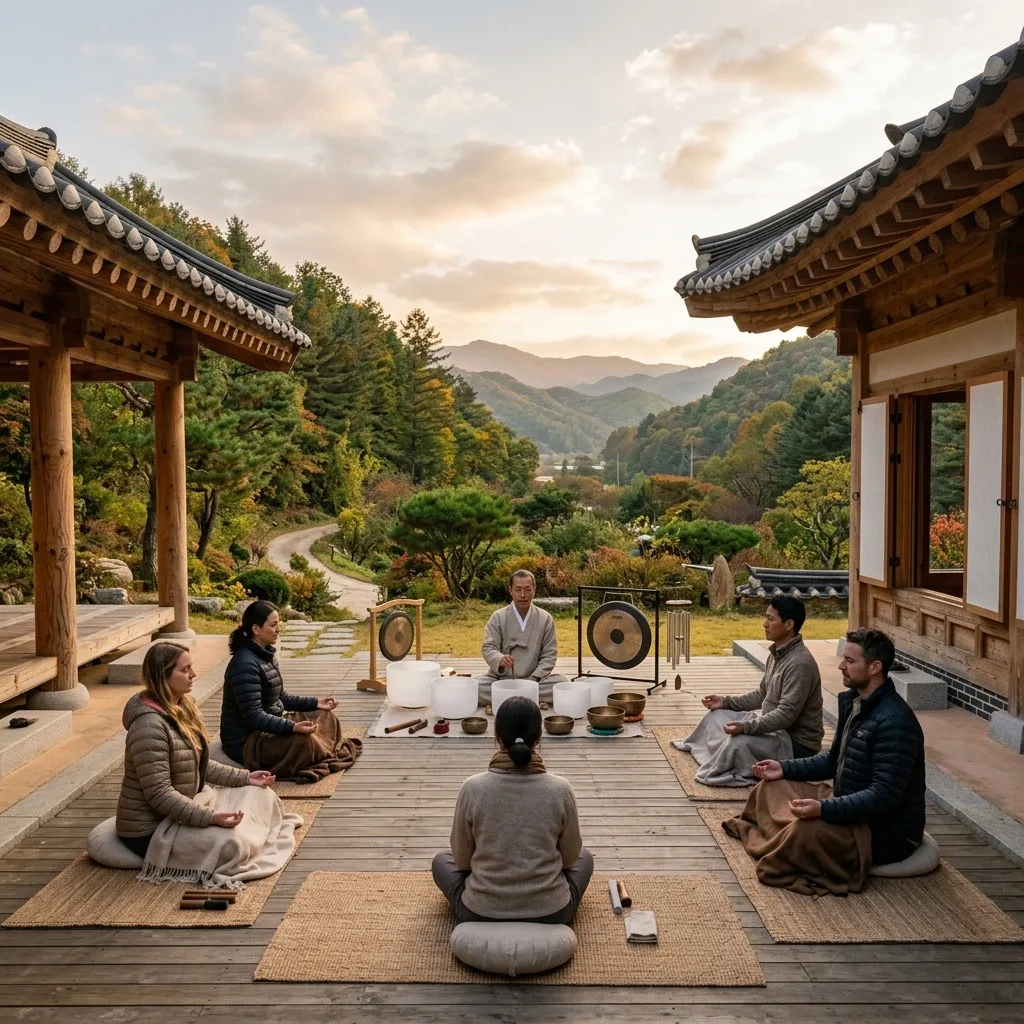
In practice, “sound healing” in Korea usually refers to a session built around singing bowls, gongs, chimes, or guided breathwork. Some sessions are quiet and restorative. Others feel closer to a wellness class with light movement, tea, or a short walk. Meditation programs can be even broader: silent sitting, walking meditation, Buddhist temple etiquette, and, in some cases, a cultural program that ends with tea or a communal meal.
That variety matters because travelers often use the phrase “meditation center” to mean a dedicated retreat building. In Korea, the experience may instead take place in a yoga studio, a Buddhist temple, a small wellness space in a neighborhood commercial building, or a one-off class hosted by a local teacher. The good news is that foreigners are rarely treated as outliers. The wellness scene in Seoul, Gyeonggi, and temple-town destinations is used to international guests, so many listings include English summaries, digital booking, and clear price points.
If you want the cultural version, start with a temple stay. If you want the gentlest first experience, book a sound bath in the city. If you want a middle ground, pick a short mindfulness experience at a temple that includes movement, a walk, and a bowl session. For background on the overnight format and temple etiquette, see Temple Stay Programs in Korea: A Guide to Finding Inner Peace. If you are comparing location and transport before you commit, Best Areas to Stay in Seoul: A Neighborhood-by-Neighborhood Guide for Travelers will help you decide whether to stay near the city center or closer to the districts where wellness classes are concentrated.
One reason this niche works so well for travelers is that Korea combines efficient transit with a strong program culture. You do not usually wander in and hope for the best. You reserve, arrive on time, remove your shoes when asked, and follow the sequence. That makes the experience less intimidating than it sounds, especially if your main goal is rest rather than spiritual mastery.
Foreign-Friendly Places to Look
Not every peaceful experience in Korea is labeled “meditation center,” so it helps to think in categories instead of brand names. The foreigner-friendly options usually fall into three buckets: temple programs, urban sound bath studios, and guided mindfulness experiences that mix Korean culture with relaxation.
1. Temple stays and temple mindfulness programs
Temple stays are the most culturally distinctive option. They are usually hosted by Buddhist temples and designed for both Korean and international participants. The format can range from a few hours to an overnight stay, and the activities often include silent sitting, chanting, tea service, a temple meal, a guided walk, or a short sound meditation session with bowls or a gong.
For foreigners, temple stays are attractive because they are structured. You know where to go, when to arrive, and what the program includes. You do not need to improvise or worry that you are missing the “right” spiritual vocabulary. Most programs are built to be accessible to first-timers, and many can be booked online through official temple-stay platforms or major travel activity sites.
A temple stay also solves a common problem: many travelers want a restorative experience in Korea, but they do not want it to feel like a private therapy appointment or a niche local club. A temple program gives you the atmosphere of Korean Buddhism without demanding fluency or long-term commitment. If you want to compare the different ways people book these programs, Temple Stay Programs in Korea: How to Book and What to Expect is the closest companion read, although some booking systems are faster to use than others depending on the temple.
2. Urban sound bath studios
If you are staying in Seoul, an urban sound bath is often the easiest first choice. These classes are usually shorter, easier to access by subway, and less demanding physically than a temple program. The setting is typically a yoga studio, a wellness room, or a small dedicated meditation space. You arrive with a mat or use one that is provided, lie down, and let the instruments do most of the work.
Urban sound baths are especially useful for travelers with limited time. You can fit a one-hour session into a day of sightseeing without committing to an overnight stay. That makes them a smart choice if your trip already includes shopping, museum visits, or food tours and you want a quiet reset between active days.
This format is also where foreigners are least likely to feel out of place. Many of these classes are explicitly listed online, accept card payment or simple reservation methods, and use enough English for a visitor to understand the basics. That said, the best ones still expect punctuality and respect for the room. If the class says to arrive 30 minutes early, do it. If it asks you to silence your phone before entering, treat that as part of the experience rather than a formality.
3. Guided mindfulness experiences around temples
The third category sits between a retreat and an excursion. These are experiences that combine a temple walk, a sound bath, and a short meditation sequence into one bookable activity. They are useful if you want a wellness activity that still feels like sightseeing.
This is a particularly strong option in Seoul and nearby temple districts because you can get the “Korea” part of the experience without sacrificing convenience. You still need to travel to the site, but the structure is usually lighter than a temple stay. If you are the sort of traveler who wants something unique but not too intense, this category is worth prioritizing.
The broader travel lesson is simple: if you want the quietest possible setting, go outside the city. If you want the easiest logistics, stay in Seoul. If you want the most balanced first-time experience, choose a temple-based program that has a timetable and English booking details already posted.
Practical Guide: Hours, Prices, and Booking
The current market for sound healing in Korea is relatively straightforward: short classes are inexpensive by international wellness standards, while more structured temple or mindfulness programs cost more because they bundle guidance, location, and often tea or other extras.
Here are the clearest current examples I found while verifying the article:
| Program | Price | Duration / Timing | Booking Notes |
|---|---|---|---|
| Goyowalkyoga Sound Bath in Seoul | ₩50,000 | 2:00 PM to 3:20 PM on the listing I found | Reservations can be made up to 2 hours before class; entry opens 30 minutes before |
| Meditation Season sound bath session | ₩85,000 | 1 hour | Booking is handled through Instagram DM; the space is near Guro Digital Complex Station |
| Bongeunsa Temple mindfulness experience | $61.12 | 3 hours | Booked through a travel platform rather than directly at the temple |
Those numbers are useful because they show the range. A basic sound bath in the city may sit around the 50,000 won mark, while a more curated or longer experience can climb into the 80,000 won range. Temple-based programs and guided cultural packages may be priced in dollars on international booking platforms, which can be convenient for foreigners who want to avoid local payment friction.
The Goyowalkyoga listing is a good example of how practical these classes can be. The schedule is fixed, the price is public, and the venue gives simple logistics: you can reserve very close to the class time, but you still need to respect entry timing. That is ideal if your Korea trip is moving quickly and you only realize on the day before that you want one quiet evening in the middle of the trip.
The Meditation Season listing shows another common pattern in Korea: small wellness spaces may rely on social-media booking instead of a large ticketing engine. That is not a red flag by itself. It usually means the organizer is small and personal. It does, however, mean you should screenshot the details, confirm the address, and leave extra time for messaging back and forth if you do not read Korean fluently.
For temple-style experiences, the booking experience can be even more polished. Temple stays are often centralized through dedicated platforms, which is better for foreign travelers because you can browse multiple temples, compare region and program type, and avoid the awkwardness of emailing a temple directly if you are not sure which language the staff uses. When in doubt, start from the official temple-stay ecosystem and then compare whether you want a city temple, a mountain temple, or a quiet provincial option.
What to expect from the schedule
Most first-time visitors are surprised by how much structure these programs have. A sound bath often begins with a short explanation of the instruments, followed by breath awareness or a lying-down meditation. A temple session may add a walk, tea, or a talk about the site. Some programs will include an arrival window rather than a strict start time, but if a class says to show up 20 to 30 minutes early, do not treat that as optional.
The actual hours matter because Korea is a country where you can lose time quickly if you underestimate transit. A session that begins at 2:00 PM in Seocho-gu or Guro may still require a subway transfer, a short walk, and a quick search for the correct building entrance. If you are planning a day that also includes shopping, sightseeing, or dinner, keep the wellness session in the middle of the day or early evening rather than trying to squeeze it into a tight travel gap.
Booking links and how to choose
If you want the least friction, choose a listing with direct online booking and clear English notes. If you are comfortable with social media, some smaller Korean spaces use Instagram DM as their reservation channel. If you want cultural depth, use an official temple-stay booking site first and treat the wellness activity as the centerpiece of your day.
Travel platforms can be helpful for comparison, but they are not always the best source for the final truth about a program. Whenever you see a class on a platform, double-check the date, duration, and what is included. A 3-hour package may sound similar to another 3-hour package, but one may include transport, tea, or a temple donation while another is just the class itself.
As a practical rule, book earlier when the experience is temple-based and book later when the experience is an urban sound bath with a clearly posted reservation cutoff. In the city, many classes are organized for residents who make decisions last minute. In temple settings, the calendar can fill up faster because the number of spaces is smaller and the cultural experience is more distinctive.
How to Get There and Plan the Day
Getting to a meditation or sound healing session in Korea is usually not difficult, but the quality of the experience depends on how well you plan around transit and neighborhood context. A calm class can turn into a rushed one if you arrive hungry, confused about the building entrance, or too late to settle in before the session starts.
The easiest transit tool is still the T-Money card. If you are moving between subway, bus, and sometimes taxi, it saves time and reduces friction. For a deeper practical overview, Mastering the T-Money Card: Your Key to Korea's Transit (and More) covers the basics, and it is worth reading before you build an itinerary around classes in Seocho, Guro, or other districts that are not on your main sightseeing route.
If you are new to Seoul, pick a lodging area that keeps your meditation day simple. Central neighborhoods reduce the chance that you will spend more energy on transit than on the session itself. That is why many visitors combine a wellness class with a stay in a convenient base such as Myeongdong, Hongdae, Itaewon, or a business district with quick subway access. If you are still choosing where to sleep, Best Areas to Stay in Seoul: A Neighborhood-by-Neighborhood Guide for Travelers can help you balance nightlife, food, and transport.
Seoul strategy
If your session is in Seoul, the best strategy is usually to treat the class like a scheduled appointment, not a spontaneous detour. Check the exact building address, the nearest subway exit, and whether the venue is in a tower, residential block, or studio building. The last 200 meters are often the most confusing part because Korean buildings can have multiple entrances, basement levels, or rear access points.
Arrive with a little margin. That gives you time to take off shoes if needed, ask where to put your belongings, and mentally switch from sightseeing mode to stillness mode. Many foreigners underestimate how much mental energy it takes to reset between a noisy street and a quiet room. Give yourself that transition.
Temple strategy
For temple programs, the logistics can be more involved because the setting is often on a hillside, at the edge of a city, or in a rural location. In that case, your ideal day is simple: leave earlier than you think you need, eat lightly before arrival, and bring only the items listed by the organizer. If the schedule includes a walk, wear proper shoes rather than sandals that will slow you down or make you feel insecure on uneven ground.
Temple programs also tend to reward a full-day mindset. Even a short session can be more satisfying if you do not rush off immediately afterward. Some travelers try to pair a temple visit with a second major attraction on the same day, but that can dilute the calm atmosphere. If the meditation experience matters to you, let it be the anchor and build the rest of the day around it.
What to wear and bring
Most sound bath classes are comfortable with regular stretch clothing. You do not need specialized gear unless the listing says otherwise. A light layer is helpful because indoor rooms can feel cool once everyone lies down and stays still for an hour. For temple programs, modest clothing is a safer default: sleeves that do not feel revealing, pants or leggings that are easy to sit in, and shoes that are easy to remove.
Bring a water bottle, but do not overpack. You are going to a stillness-based activity, not a hiking expedition. The more you can keep your bag simple, the easier it is to settle. If the venue provides mats, cushions, blankets, or tea, let them do the work. If it does not, be ready to follow the organizer’s guidance without making a scene about missing amenities.
Tips & Common Mistakes
The biggest mistake foreigners make is assuming a sound healing or meditation session will behave like a typical wellness class in their home country. Korea’s best sessions are often more organized, more compact, and more culturally specific than people expect. The format is not meant to be improvised on the spot. It is meant to be followed.
Another common mistake is choosing a program based only on the words “sound healing” or “meditation” without checking what kind of environment it is. Some travelers want a silent room and are surprised by a class that includes movement or a social component. Others want an immersive cultural experience and are disappointed when they book a plain studio class. Read the description carefully enough to know whether you are buying rest, instruction, or a blend of both.
Do not assume English support just because the program is foreigner-friendly. Many of the best experiences are accessible to foreigners because the booking page is clear, not because the on-site conversation will be effortless. That is why it helps to save the address, screenshot the key instructions, and prepare a short translation if you need to confirm the entrance or timing.
Do not overthink perfection. If a listing seems solid, has a recent schedule, and clearly explains how to join, it is usually enough. People sometimes delay booking because they are searching for the “most authentic” or “most sacred” experience, but the actual quality often comes from the teacher, the acoustics, and your own willingness to be still. A modest class that starts on time and ends calmly can be more restorative than a glamorous package with too much marketing.
If you are sensitive to sound, choose your class carefully. Sound bath instruments can be deep and resonant, and while most sessions are gentle, they are still intentionally immersive. If you know you dislike loud low-frequency vibration, start with a shorter class or one that describes itself as meditation with sound rather than a full sound bath.
One more practical point: if you plan to write about the experience or share it with friends, choose a venue that explicitly allows photos before or after the session. In many meditation spaces, the most respectful choice is to keep your phone away during the actual practice and only take a picture of the room, the exterior, or the tea service after the program finishes.
The etiquette side matters too. If you are coming from a spa or wellness culture where casual conversation is normal, bring that volume down. Even a friendly class can feel more centered when participants are quiet before start time. If the venue asks you to remove shoes, store your belongings, or silence devices, treat those steps as part of the ritual, not as inconveniences.
For broader cultural context, it also helps to understand how Korean wellness overlaps with public-bath etiquette, temple manners, and group-based experiences. If you need a refresher on basic social expectations, Korean Spa Etiquette: Do’s and Don’ts for International Visitors is useful even if you are not visiting a jjimjilbang. The habits of quiet, cleanliness, and respect carry over into many relaxation spaces.
Finally, remember that some of the most foreigner-friendly programs are not the ones with the biggest ad budget. Small studios and temple operators often do the best job because they have already simplified the experience for guests. If a class gives you a clear price, a clear schedule, and a clear meeting point, that is usually a good sign.
FAQ
Do I need to speak Korean to join?
Usually no. The most foreigner-friendly programs provide enough English for booking, arrival, and the basic flow of the session. Temple stays and travel-platform listings often have the clearest English pages. Smaller studio-run sound baths may use simpler English or rely on direct messages, but the actual practice itself requires very little language.
Is sound healing the same as meditation?
Not exactly. Meditation is the broader umbrella. Sound healing is usually a meditation-adjacent practice that uses instruments such as bowls, gongs, or chimes to help people relax and focus. Some programs add breathwork or body awareness, while others are almost entirely passive. In Korea, the two terms are often used together because many experiences combine both.
How much should I budget?
A basic urban class may be around ₩50,000. More curated or longer programs can be around ₩85,000, and some temple or guided cultural packages are priced in dollars on international booking platforms. If you are booking a temple stay, budget a bit more because you may be paying for a fuller cultural program rather than a one-hour class.
Are these programs beginner-friendly?
Yes, most of them are designed for beginners. You are not expected to already know Buddhist terms, advanced meditation technique, or the symbolism of every instrument. The teacher usually explains enough for you to settle in, and the rest is about following the pace of the room. If anything, beginners often benefit more because they arrive without fixed expectations.
What should I avoid doing?
Avoid arriving late, interrupting the quiet, using your phone during the session, or assuming that casual spa behavior will transfer directly to a meditation room. Do not pack your day so tightly that you are rushed when you arrive. And do not skip reading the program description, because sound bath, temple walk, and overnight temple stay can all look similar in search results even though they are very different experiences.
Conclusion
Sound healing and meditation centers in Korea are open to foreigners in a practical sense, not just a theoretical one. If you want a simple restorative class, Seoul has bookable sound baths with clear prices and short lead times. If you want deeper cultural context, temple stays and temple-based mindfulness programs give you a more immersive experience. Either way, the best approach is to choose a program with a clear schedule, a transparent booking method, and a setting that matches your tolerance for structure.
If you are planning a wellness day in Korea, start by deciding whether you want city convenience or temple atmosphere. Then check the booking page, save the address, and build the rest of your day around the session instead of treating it as an afterthought. For many travelers, that is the point where a standard Korea itinerary turns into something more memorable.