Conveyor Belt Sushi (Kaitenzushi) Guide: Best Chains and Tips

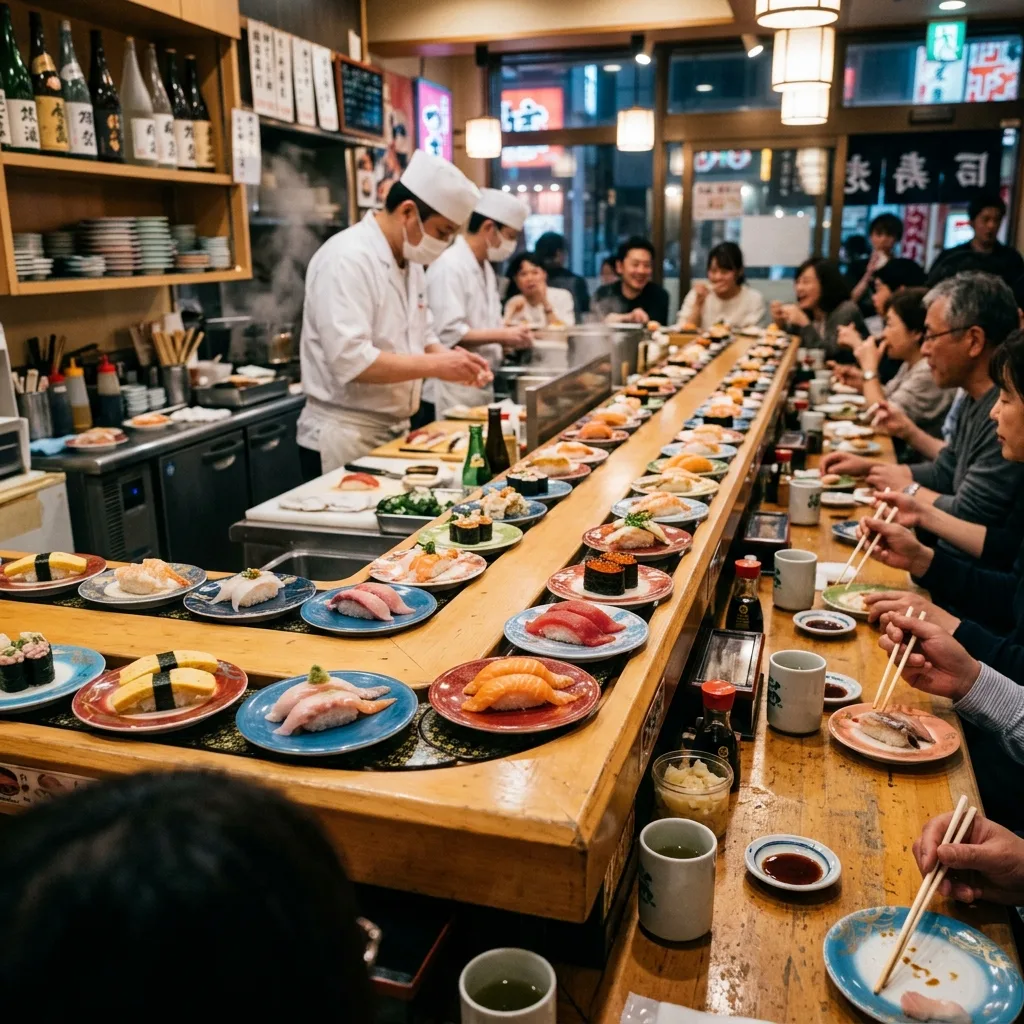
For many travelers visiting Japan, eating at a conveyor belt sushi restaurant isn't just a meal—it's an essential cultural experience. Imagine a brightly lit, high-energy dining room where plates of fresh nigiri, hot bowls of ramen, and even slices of cheesecake glide past your table on an automated belt. It is fast, incredibly affordable, and remarkably fun. However, if you have never been to one, the digital kiosks, automated delivery lanes, and unwritten rules of kaitenzushi (回転寿司) can feel a bit overwhelming.
What is Kaitenzushi? (The Conveyor Belt Sushi Experience)
Conveyor belt sushi (kaitenzushi) is a uniquely Japanese dining concept where plates of sushi circulate through the restaurant on a winding conveyor belt, allowing diners to simply grab whatever catches their eye. Introduced in the 1950s in Osaka, the concept has evolved dramatically into high-tech, highly efficient dining ecosystems.
Quick Summary: In 2026, most major kaitenzushi chains in Japan charge around ¥110 to ¥130 for a standard plate of two sushi pieces. Diners use multilingual touch-screen tablets to order specific items, which are then rapidly delivered directly to their table via a high-speed express lane.
Today, while the classic "grab from the moving belt" experience still exists in some local shops, the major national chains have modernized. Driven by efficiency and hygiene, most have transitioned to a dual-belt system or fully digital ordering systems where your food zips directly to your table.
Step-by-Step Guide: How to Eat at a Conveyor Belt Sushi Restaurant
Walking into a major kaitenzushi chain like Sushiro or Kura Sushi is a highly standardized process. You rarely interact with a human server until it is time to pay, making it one of the most introvert-friendly and language-barrier-free dining experiences in Japan.
Step 1: Getting a Table (The Check-in Kiosk)
When you walk through the doors, you will be greeted by a digital touch-screen kiosk.
- Tap the screen and select your language (English is almost always available).
- Enter the number of people in your party.
- Choose your seating preference: Counter (カウンター) or Table/Booth (テーブル). Insider Tip: If you are traveling solo or as a duo and want to eat quickly, selecting "Counter" will usually get you seated much faster than waiting for a booth.
- The machine will print a ticket with a number. Keep an eye on the waiting room screens; when your number is called, the screen will direct you to your specific table or seat number.
Step 2: Preparing Your Station
Once seated, you are in charge of your own table setup.
- Green Tea: Every table has a small container of green tea powder (matcha or konacha) and a hot water dispenser. Put one or two small spoonfuls of powder into a teacup, press the cup against the hot water spigot, and stir.
- Condiments: You will find soy sauce (shoyu), pickled ginger (gari), and sometimes wasabi packets on the table or circulating on the belt. Note that most kaitenzushi chains no longer put wasabi directly inside the sushi by default (to cater to children and international palates), so you will need to add it yourself.
- Chopsticks and Wet Wipes: These are usually stored in a hidden compartment embedded into the table itself, or in a box right above the condiment tray.
Step 3: Ordering via Tablet
Every table is equipped with a digital tablet mounted on a swiveling arm.
- Switch the tablet to English.
- Browse through the categories: Nigiri, Gunkan (battleship rolls), Sides, Noodles, and Desserts.
- Tap the items you want and hit the "Order" button.
- A few minutes later, the tablet will play a chime or an animation to warn you that your food is arriving. Your order will zip down the upper "express lane" and stop precisely at your table. Take the plate off the tray, and press the flashing button (if there is one) to send the tray back to the kitchen.
Step 4: Paying the Bill
When you are completely stuffed, locate the "Checkout" or "Call Staff" (会計 / Kaikei) button on your tablet.
- Depending on the chain, a staff member may come to your table to quickly scan and count your plates, or the tablet might automatically calculate your total based on your digital orders.
- Take your seating clipboard or barcode slip to the front counter. Most modern chains use self-checkout registers where you scan your barcode, select your payment method (credit cards and IC cards like Suica are widely accepted), and pay.
Top 4 Conveyor Belt Sushi Chains in Japan (2026 Update)
If you are traveling across Japan, you will inevitably run into the "Big Four" kaitenzushi chains. While they share similarities, each has a distinct personality and unique selling points.
1. Sushiro (スシロー) - The Industry Leader
Sushiro is currently the most popular and highest-grossing conveyor belt sushi chain in Japan. They are renowned for their quality control and seasonal, limited-time menus featuring premium ingredients like fatty tuna (otoro) and sea urchin (uni) at remarkably low prices.
- Base Price: ~¥120 to ¥130 per plate (prices vary slightly depending on if the store is suburban or urban).
- Vibe: Bustling, quality-focused, and incredibly popular with locals.
- Best For: Food quality and diverse seasonal seafood options.
2. Kura Sushi (くら寿司) - Fun and Games with Bikkura-Pon
Kura Sushi is legendary for its gamified dining experience. Every table has a slot where you dispose of your empty plates. For every 5 plates you slide into the slot, an anime-style game plays on your tablet screen. If you win, a small plastic capsule containing a toy, pin, or keychain dispenses from the machine above your table (known as Bikkura-Pon).
- Base Price: ~¥115 to ¥125 per plate.
- Vibe: Family-friendly, highly entertaining, and often featuring collaborations with popular anime franchises like Demon Slayer or One Piece.
- Best For: Families with children and anime fans looking for exclusive collaborative merch.
3. Hamazushi (はま寿司) - The Budget-Friendly Champion
Owned by the massive Zensho Holdings (which also owns the Sukiya beef bowl chain), Hamazushi focuses on extreme affordability and customization. One of their unique features is offering five or six different types of regional soy sauces at every table, allowing you to pair a specific soy sauce profile (e.g., sweet Kyushu soy sauce or rich Hokkaido soy sauce) with different fish.
- Base Price: ~¥110 per plate (often the cheapest of the major chains).
- Vibe: Streamlined, affordable, and highly efficient. Most Hamazushi locations have completely removed the traditional rotating belt in favor of straight-to-table express lanes.
- Best For: Budget travelers and soy-sauce aficionados.
4. Kappa Sushi (かっぱ寿司) - The Reliable Classic
Once the undisputed king of kaitenzushi in the 1990s, Kappa Sushi has faced stiff competition but remains a beloved staple. They have recently undergone rebranding to elevate their sushi quality and have introduced "bullet train" delivery lanes shaped like Japan's famous Shinkansen, which is a massive hit with kids.
- Base Price: ~¥115 to ¥120 per plate.
- Vibe: Nostalgic, steady, and comfortable.
- Best For: A quieter dining experience with classic, reliable menu offerings.
The "Sushi Terrorism" Effect: What Changed?
If you researched kaitenzushi a few years ago, you might remember reading about the "Sushi Terrorism" incidents in early 2023, where viral prank videos of teenagers licking soy sauce bottles and touching food on the belts caused a nationwide scandal.
The industry responded swiftly and dramatically, fundamentally altering the kaitenzushi landscape by 2026:
- No More Open Belts: Many chains, including Sushiro and Hamazushi, completely halted the practice of sending unprotected plates of sushi around the restaurant. Instead, the belts were converted exclusively into high-speed, direct-delivery lanes for custom tablet orders.
- Digital Belts: To maintain the visual joy of watching sushi go by, some chains installed massive digital screens next to the tables where virtual plates of sushi "rotate" by; tapping the screen instantly orders that item.
- Condiment Security: Kura Sushi introduced AI-powered cameras above their belts to detect suspicious behavior, and many chains now keep ginger and utensils in covered, monitored containers.
The result? The dining experience is now more hygienic and high-tech than ever, ensuring complete peace of mind for travelers.
Unwritten Rules and Etiquette for Tourists
While conveyor belt sushi is casual, observing a few basic etiquette rules will ensure you blend right in with the locals.
- Never put a plate back: If a restaurant still uses a traditional rotating belt and you touch a plate, you must keep it. Never pick up a plate, inspect it, and put it back on the belt.
- Don't take just the food: If you take an item from a passing tray, you must take the entire plate. Do not pluck a piece of sushi off a plate and leave the empty dish riding the belt.
- Don't mix wasabi into your soy sauce: While many foreigners create a "wasabi slurry" in their soy sauce dish, the traditional Japanese method is to place a small dab of wasabi directly onto the fish, then dip the fish into the soy sauce.
- Stack your plates by color: If you are at a restaurant that counts plates manually (rather than using an RFID scanner or a plate slot), stack your empty plates neatly at the edge of the table, grouped by color. Different colored plates represent different price tiers.
- No tipping: As with everywhere else in Japan, there is absolutely no tipping at a kaitenzushi restaurant.
What Else is on the Menu? (Beyond Sushi)
One of the greatest secrets of kaitenzushi restaurants is that they serve incredibly good side dishes. In fact, many Japanese teenagers and young adults go to these restaurants just to eat desserts and fries!
If you are traveling with someone who doesn't like raw fish, they will still have a feast. You can expect to find:
- Ramen and Udon: Surprisingly high-quality bowls of hot noodle soup for just ¥300 to ¥400.
- Fried Foods: Freshly fried tempura (shrimp, pumpkin, squid), crispy french fries, and Japanese fried chicken (karaage).
- Meat Sushi: Seared wagyu beef, hamburger steak, and pork belly topped with cheese or garlic mayo.
- Desserts: Matcha parfaits, Basque cheesecake, warabimochi, and seasonal fruit tarts.
Regional "Gourmet" Kaitenzushi Chains: Leveling Up Your Experience
While the major national chains like Sushiro and Kura Sushi are unbeatable for price and convenience, Japan also boasts an incredible tier of "gourmet" conveyor belt sushi restaurants. These establishments sit comfortably between budget chains and high-end omakase counters. They charge slightly more (usually ¥200 to ¥600 per plate), but they offer phenomenally fresh, regionally sourced seafood that will absolutely blow you away. If you have the budget and the time, seeking out these regional champions is highly recommended.
Hokkaido's Pride: Nemuro Hanamaru and Triton
Hokkaido is famous throughout Japan for having the best and freshest seafood, particularly when it comes to crab, scallops, and salmon roe.
- Nemuro Hanamaru (根室花まる): Originating from the fishing town of Nemuro in Hokkaido, this chain is legendary. While their main base is in the north, they have incredibly popular outposts in Tokyo (such as the one in the KITTE building near Tokyo Station). Expect massive, thick cuts of fresh fish that spill over the rice. Their botan ebi (sweet shrimp) and hotate (scallops) are absolute must-orders. Be prepared to wait, as the lines can stretch for hours during peak times.
- Triton (トリトン): Another Hokkaido legend, Triton is beloved by locals for its exceptionally high-quality salmon, seasonal catches, and generous portions. They pride themselves on having skilled sushi chefs hand-form the rice in-store, a significant step up from the robotic rice-formers used by budget chains.
Kanazawa's Jewel: Maimon Sushi
Kanazawa, a historic coastal city on the Sea of Japan, is renowned for its gold leaf and its seafood.
- Kanazawa Maimon Sushi (金沢まいもん寿司): This premium kaitenzushi chain brings the riches of the Sea of Japan directly to the belt. They are famous for offering luxurious items like nodoguro (blackthroat seaperch), which is a fatty, melt-in-your-mouth delicacy highly prized in the Kanazawa region. Their plates are beautifully presented, and the atmosphere feels distinctly upscale despite the conveyor belt format. They have expanded to locations in Tokyo and Kyoto as well.
Tokyo's Local Favorite: Sushi Katsumidori
- Sushi Katsumidori (回し寿司 活 美登利): Operated by the famous Midori Sushi group, Katsumidori is Tokyo’s answer to premium conveyor belt dining. They offer an astonishing variety of over 200 menu items, including creative rolls and extremely high-quality traditional nigiri. The prices are incredibly reasonable for the quality, making their locations (like the one inside the Seibu department store in Shibuya) perpetual hotspots with long queues.
Essential Sushi Vocabulary (Ordering Like a Pro)
Even though most tablets have English support, translations can sometimes be clunky, or you might find yourself at an older, local shop that relies on handwritten menus. Knowing the Japanese names for your favorite fish will dramatically improve your dining experience and give you the confidence to order seasonal specials that might not be prominently featured on the English menu.
The Tuna Family (Maguro)
Tuna is the undisputed king of the sushi menu, and it is graded and priced based on its fat content.
- Akami (赤身): Lean, bright red tuna meat. It has a firm texture and a clean, meaty flavor. This is the standard tuna you get when you order "maguro."
- Chutoro (中トロ): Medium fatty tuna. It perfectly balances the meaty flavor of akami with the rich, buttery texture of fat. For many sushi connoisseurs, chutoro is the perfect bite.
- Otoro (大トロ): The fattiest part of the tuna belly. It is pale pink, marbled with fat, and literally melts in your mouth. It is usually the most expensive item on the menu.
- Negitoro (ネギトロ): Minced fatty tuna mixed with green onions, typically served as a gunkan (battleship) roll wrapped in seaweed.
Popular Seafood Staples
- Sake / Salmon (サーモン): Salmon. You will often see variations like aburi salmon (seared salmon), cheese salmon (topped with melted cheese), or onion mayo salmon.
- Hamachi (はまち): Yellowtail. A rich, buttery, and slightly sweet fish that is incredibly popular year-round.
- Tai (たい): Sea bream. A firm, white fish with a very delicate and clean flavor. It is often eaten with a dash of salt and citrus instead of soy sauce.
- Engawa (えんがわ): Flounder fin. This is a texturally fascinating cut that is slightly chewy but incredibly rich in collagen and fat. It is fantastic when slightly seared (aburi).
- Hotate (ほたて): Scallop. Japanese scallops are massive, sweet, and soft.
- Ebi (えび): Shrimp. Usually served boiled. For raw, sweet shrimp, look for amaebi (甘海老) or the larger botan ebi (ぼたん海老).
- Ika (いか): Squid. Firm and slightly chewy, offering a very clean taste.
Luxury and Specialty Items
- Uni (うに): Sea urchin. Creamy, briny, and tasting like the essence of the ocean. It is an acquired taste but a prized delicacy.
- Ikura (いくら): Salmon roe. Large, bright orange eggs that pop in your mouth, releasing a salty, savory juice.
- Unagi (うなぎ) & Anago (あなご): Freshwater eel and saltwater eel. They are usually grilled, brushed with a sweet, thick soy-based sauce (tare), and served warm.
Non-Fish Classics
- Tamago (たまご): Sweet Japanese omelet. A great palate cleanser and a favorite among children.
- Inari (いなり): Sushi rice stuffed inside a pouch of sweet, deep-fried tofu skin.
Equipped with this vocabulary, you will be able to navigate even the most localized, Japanese-only specials menu with ease, unlocking a whole new level of the kaitenzushi experience.
FAQ About Kaitenzushi in Japan
Can I make a reservation in advance? Yes, and it is highly recommended. You can use the official apps for Sushiro or Kura Sushi to book a time slot or get in the virtual queue before you arrive. Walk-ins during peak dinner hours (6:00 PM – 8:00 PM) can easily face 60 to 90-minute wait times.
Is it vegetarian-friendly? It can be, though options are limited. Vegetarians can safely order cucumber rolls (kappa maki), natto (fermented soybean) rolls, egg (tamago) nigiri, french fries, and various desserts. However, be aware that many broths (like in udon or ramen) are fish-based. For more on navigating dietary restrictions, check out our Guide to Vegan and Vegetarian Eating in Japan.
How much should I expect to spend? For an average adult, eating 8 to 12 plates of sushi plus a drink or a side dish will usually cost between ¥1,200 and ¥2,000 (roughly $8 to $14 USD). It is one of the most budget-friendly ways to eat a massive, satisfying meal in Japan.
Conclusion
Eating at a kaitenzushi restaurant is a vibrant, delicious, and deeply satisfying slice of modern Japanese culture. Whether you are trying to win a capsule toy at Kura Sushi, marveling at the seasonal tuna cuts at Sushiro, or just enjoying a quick, cheap meal at Hamazushi, the experience is guaranteed to be a highlight of your trip. Just remember to use the tablet, stack your plates neatly, and save room for a slice of cheesecake at the end!
If you want to use this as part of a real Japan food day, pair it with the broader Japan travel planning guide and the plant-based Japan eating guide. That gives you the logistics and dietary fallback in case someone in your group wants a non-fish option.