Currency in China: Where to Exchange, Use Cards & Avoid Scams

Imagine landing in a bustling Chinese city, ready to explore ancient temples or futuristic skyscrapers, only to find your perfectly good credit card isn't accepted and your foreign cash is met with puzzled looks. China's financial ecosystem is vastly different from many Western countries, relying heavily on digital payments. This guide is your essential companion to understanding currency in China, navigating exchange options, mastering mobile payments, and staying safe from scams in 2026, ensuring your trip is smooth and stress-free.
Introduction
Traveling to China in 2026 presents a unique set of challenges and opportunities when it comes to managing your money. While many countries still lean on cash or credit cards, China has rapidly transitioned to a predominantly mobile payment society. This article will demystify the Chinese currency, the Renminbi (RMB), commonly known as the Yuan (CNY), and provide practical, up-to-date advice on how to handle your finances, from exchanging foreign currency to setting up digital wallets and making secure transactions throughout your journey.
Navigating currency in China involves understanding the local Renminbi (RMB), mastering prevalent digital payment platforms like WeChat Pay and Alipay, identifying reliable currency exchange points, and preparing for situations where traditional credit cards might not be accepted, all crucial for a smooth and enjoyable travel experience.
Hook angle: [a problem this article solves for the traveler]
The primary problem this article solves for travelers is the confusion and potential anxiety surrounding money management in China, particularly the widespread adoption of digital payments over traditional methods. It aims to equip visitors with the knowledge to transact confidently and avoid common financial pitfalls.
Preview of what the reader will learn
You will learn about the official currency (RMB/Yuan), the different ways to acquire and use it (cash, cards, mobile payments), where to exchange money safely, how to set up and use popular digital wallets, and crucial tips to protect yourself from scams and common financial mistakes unique to China.
Understanding Chinese Currency (RMB/Yuan)
The official currency of the People's Republic of China is the Renminbi (RMB), which literally means "people's currency." The basic unit of the Renminbi is the yuan (¥). You'll often hear "yuan" and "RMB" used interchangeably. The international abbreviation for the Chinese Yuan is CNY. This currency is issued by the People's Bank of China and is the sole legal tender within mainland China. Unlike some other currencies, the RMB is not fully convertible, meaning its exchange rate is managed by the government. For travelers, this primarily means that while you can exchange foreign currency into RMB, and vice versa, the rates are set by official channels.
Denominations of the Renminbi include banknotes for 1, 5, 10, 20, 50, and 100 yuan. These colorful notes feature different historical figures and scenic landscapes, making them interesting to collect. Smaller denominations also exist in jiao (角) and fen (分), where 1 yuan equals 10 jiao, and 1 jiao equals 10 fen. For instance, a 5 jiao coin is half a yuan. While fen are rarely seen or used in daily transactions anymore due to their low value, jiao coins and banknotes (e.g., 1 jiao, 5 jiao) are still commonly used for smaller purchases. When dealing with cash, it's helpful to have a mix of 10, 20, and 50 yuan notes, as some smaller vendors might struggle to provide change for a 100 yuan note for a very small purchase.
While cash is still legal tender and theoretically accepted everywhere, its use has significantly declined, especially in urban areas and among younger generations, due to the overwhelming popularity of mobile payment systems. In many situations, particularly in large cities, you might find vendors surprised or even inconvenienced if you try to pay with cash, as they are accustomed to the speed and ease of digital transactions. This doesn't mean cash is completely obsolete; it's still widely used in more rural or remote areas, and by older generations. However, for a traveler primarily visiting major cities, cash will likely be your secondary payment method. It's wise to carry a small amount for emergencies, for taxis that might not accept digital payments (though this is becoming rarer), or in case your phone battery dies or you encounter an area with poor connectivity. The psychological comfort of having some physical currency cannot be overstated, especially when first arriving.
Methods of Payment in China: Cash, Cards, and Digital Wallets
China's payment landscape is dominated by mobile apps, making it distinctly different from many other countries. Understanding the hierarchy of payment methods is key to a smooth financial experience. Forget relying solely on your credit card; embrace the future of payments.
Digital Wallets: WeChat Pay and Alipay (The Kings of Chinese Payments)
WeChat Pay (微信支付, Wēixìn Zhīfù) and Alipay (支付宝, Zhīfùbǎo) are the two ubiquitous digital payment platforms in China, practically serving as the country's financial backbone. From street food vendors to major department stores, almost everyone accepts one or both. These apps allow you to link your bank account or credit card (including some international ones now) and then pay by scanning QR codes. They are not just payment apps; they are integrated ecosystems for communication, shopping, ride-hailing, food delivery, and more.
WeChat Pay: Integrated seamlessly into the popular WeChat messaging app, which boasts over a billion users, WeChat Pay is a natural extension of daily communication. It's used for everything from sending money to friends to paying utility bills, ordering food, and buying movie tickets. Its omnipresence makes it incredibly convenient, as most people you interact with will already be using WeChat for communication. The payment process is straightforward: open WeChat, tap "Scan" or "Pay," and either scan the merchant's QR code or have them scan yours. For tourists, an essential read is our comprehensive guide on WeChat Pay for Tourists in 2026: How to Set It Up Without a Chinese Bank.
Alipay: A standalone financial app by Alibaba, Alipay holds the largest market share in terms of payment volume. It offers an even broader range of financial services beyond just payments, including investment products, credit scores (for residents), and various lifestyle features. While not integrated into a messaging app in the same way as WeChat, its sheer functionality makes it indispensable. Similar to WeChat Pay, you pay by scanning QR codes. For a detailed walkthrough on setting up this vital tool, refer to our guide on Alipay for Tourists: Step-by-Step Setup Without a Chinese Account.
How to set up for foreigners: In recent years, both WeChat Pay and Alipay have made it significantly easier for international visitors to link their foreign credit cards (Visa, Mastercard, JCB, Discover) to their accounts. This was a major hurdle for tourists previously, leading to frustration and reliance on cash.
- Download the app: Download WeChat and Alipay from your app store before you travel. Having them ready on your phone upon arrival saves time and potential connectivity issues.
- Register: Register with your phone number. You'll need an active phone number to receive verification codes.
- Link your card: Look for the "Wallet" or "Cards" section within the app and follow the prompts to add your international credit card. You might need to verify your identity with your passport details by uploading a photo of your passport. Ensure the name on your card matches the name on your passport.
- Important Note on Limits: While linking foreign cards is possible, be aware that there might be transaction limits for foreign cards, and some very small, unofficial vendors might still only accept payments from linked Chinese bank accounts. For the vast majority of tourist activities and larger purchases, your linked foreign card should work seamlessly.
Credit and Debit Cards (Limited Acceptance)
While you might expect your Visa, Mastercard, American Express, or other international credit cards to be widely accepted, this is often not the case outside of major international hotels, high-end restaurants, and large department stores in tier-one cities. Many smaller shops, local eateries, and even some mid-range establishments may not have the terminals to process international cards. This can be a significant point of frustration for travelers unfamiliar with China's payment ecosystem. Even if a place says they accept international cards, their machine might be down, or staff might be unfamiliar with the process.
UnionPay: China's domestic card network, UnionPay (中国银联), is the most widely accepted card. If you have a UnionPay card from your home country, it will be very useful across the country. However, most foreign travelers won't have one, and acquiring one purely for travel to China is usually not practical. If you travel frequently to China, it might be worth considering.
Recommendation: Do not rely solely on your international credit or debit cards. They should be considered a backup, not your primary payment method. Always inform your bank of your travel plans to China to avoid transaction blocks, which can be a significant inconvenience. Have a primary plan (mobile payments) and a robust backup (cash + limited card use).
Cash (Diminishing but Still Relevant)
As mentioned, cash is becoming less common, but it's still a good idea to carry a small amount (a few hundred RMB) for several crucial reasons:
- Small purchases: Street food vendors, small markets, and some very local shops may still operate primarily with cash, or might not be set up for foreign-linked digital payments.
- Taxis: While many taxis, especially those from major companies or through ride-hailing apps, accept digital payments, having cash is a lifesaver if you flag down an independent taxi or are in an area with poor signal.
- Emergencies: In case your phone battery dies, you lose your phone, or you encounter an area with no internet connectivity, cash provides an immediate solution.
- Rural areas: Outside of major cities, digital payment adoption may be less pervasive, making cash a more reliable option.
- Specific services: Some traditional service providers or very niche experiences might still prefer or only accept cash.
Keep your cash in small denominations if possible, as some vendors might not have change for large bills (e.g., a 100 RMB note for a 5 RMB purchase). This is a common issue even for locals. A good strategy is to break larger bills at more established places like supermarkets or convenience stores after making a slightly larger purchase.
Where to Exchange Currency and Use Cards
Strategizing where and when to exchange your currency can save you money and hassle. Understanding the available options is crucial for your financial planning during your trip.
Banks
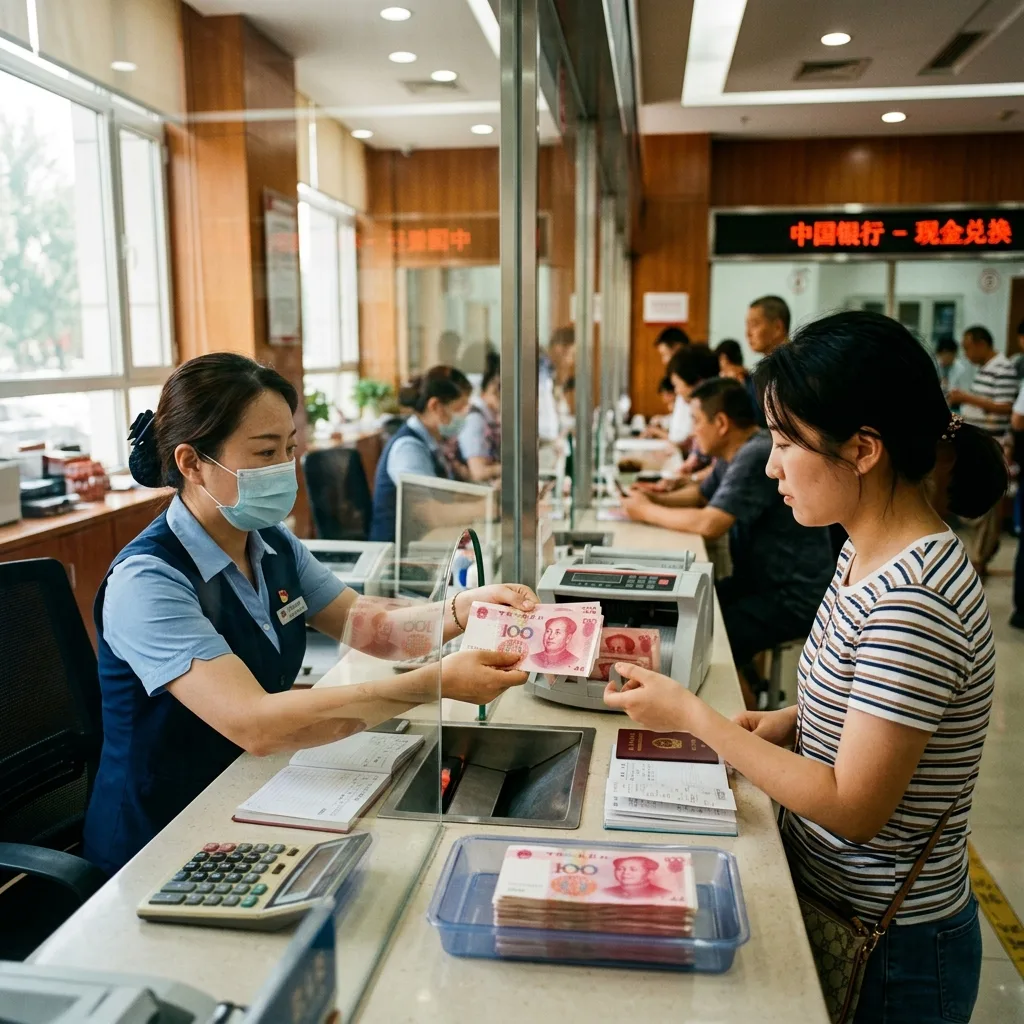
Major banks: The safest and most reliable places to exchange foreign currency are major Chinese banks such as Bank of China, ICBC (Industrial and Commercial Bank of China), China Construction Bank, and Agricultural Bank of China. Bank of China generally has the most experience with foreign exchange services for international visitors and tends to have dedicated counters or staff for it.
- Process: Exchange requires patience. You'll typically need your original passport (a photocopy is usually not accepted) and potentially your entry/arrival card. Be prepared for queues, especially during peak hours, and some paperwork to fill out. Exchange rates are usually fair, competitive, and transparent, with official exchange rates posted. Fees are generally minimal or clearly stated. Keep your exchange receipt, as you'll need it to convert any remaining RMB back to your home currency when you leave.
- Hours: Banking hours are generally Monday to Friday, 9:00 AM to 5:00 PM, with a lunch break. Some major branches in commercial districts might have extended hours or be open on weekends, but don't count on it universally. Always check local branch hours.
Airports and Major Hotels
Airports: You'll find currency exchange counters (often operated by major banks or independent exchange services) at international airports upon arrival in cities like Beijing, Shanghai, and Guangzhou. While incredibly convenient for immediate cash needs (e.g., a taxi to your hotel), the exchange rates here are often less favorable than at downtown bank branches. It's advisable to exchange only a small amount—enough to cover initial transportation and a meal—and save larger exchanges for more favorable rates later. Hotels: Many larger, internationally branded hotels (e.g., Marriott, Hilton, Shangri-La) offer currency exchange services, primarily for their guests. The rates are usually comparable to airports, meaning slightly worse than banks, but the convenience can be worth it if you only need a small amount and don't want to deal with bank queues. This is a good option for a quick top-up of cash.
ATMs (Automated Teller Machines)
ATMs are widely available in urban areas and are generally the most convenient way to withdraw cash at competitive rates. Look for ATMs with logos like Visa, Mastercard, Plus, or Cirrus, which indicate they accept international cards.
- Location: You'll find ATMs at bank branches (often in a dedicated vestibule accessible 24/7), airports, train stations, and large shopping centers. Stick to ATMs associated with major banks for security and reliability. Some smaller, standalone ATMs in convenience stores or less reputable locations might not accept international cards or could have higher fees.
- Withdrawal Limits: Be aware that there may be daily withdrawal limits imposed by both the Chinese bank (e.g., 2,500-5,000 RMB per transaction, or a daily limit) and your home bank. Plan accordingly.
- Fees: This is where you need to be smart. You'll typically encounter:
- Your home bank's foreign transaction fee: This is a percentage (often 1-3%) of the withdrawal amount. Check with your bank before traveling.
- The Chinese bank's ATM fee: Many Chinese banks charge a flat fee per international transaction (e.g., 15-30 RMB). Some international banks with branches in China, like HSBC or Citibank, might waive these fees for their own customers.
- Dynamic Currency Conversion (DCC): Crucially, always decline DCC if offered. When the ATM asks if you want to be charged in your home currency or RMB, always choose RMB (local currency). If you choose your home currency, the ATM provider (not your bank) will convert the money at an often unfavorable exchange rate. By choosing RMB, your home bank does the conversion, usually at a much better interbank rate.
Using Cards for Purchases
As previously mentioned, international credit and debit cards have limited acceptance and should not be your sole payment strategy.
- Where they work: Your international Visa or Mastercard will be most reliably accepted at major international hotel chains, upscale restaurants catering to tourists and business travelers, large chain stores (e.g., international fashion brands, Starbucks, McDonald's), and duty-free shops in airports. These establishments typically have POS terminals equipped to handle foreign card transactions.
- Where they don't: Local restaurants, street markets, independent small shops, convenience stores, public transport (unless through a linked mobile app as discussed), and many smaller museums or tourist attractions often do not accept international cards. Even if they have a card machine, it might only be set up for UnionPay cards or Chinese QR code payments.
- Always have a backup: Even in places that claim to accept international cards, their machines might occasionally fail, or staff might be unfamiliar with processing foreign cards. It's imperative to have WeChat Pay/Alipay set up and/or some cash as a readily available backup. This flexibility will save you from embarrassing situations and potential missed opportunities.
Tips & Common Mistakes
Navigating the financial landscape in China requires vigilance and a proactive approach. Being aware of common pitfalls and employing smart strategies will enhance your travel experience.
Avoiding Scams and Common Pitfalls
- "Tea Ceremony" or "Art Student" Scam: This is a notorious scam prevalent in tourist areas, especially in cities like Shanghai and Beijing. Friendly, often English-speaking strangers approach you, strike up a conversation, and invite you to a "traditional tea ceremony" or an "art exhibition." You'll end up with an exorbitant bill (sometimes hundreds of dollars) for tea or artwork. Politely but firmly decline any unsolicited invitations, especially from individuals approaching you on the street in tourist hotspots.
- Fake Currency: While less common now due to digital payments, fake RMB banknotes can still circulate, particularly 50 and 100 yuan notes. Be vigilant when receiving change, especially in dimly lit places or from unofficial vendors. Familiarize yourself with the security features of genuine RMB notes (watermarks, security threads, raised ink). The safest places to get cash are major bank ATMs or official exchange counters. If you suspect a fake note, politely refuse it and ask for another.
- Overcharging for Taxis/Tuk-tuks: This is a global issue, and China is no exception. Always insist on the meter (计价器, jìjiàqì) being used, or agree on a price before starting the journey if the meter is "broken" (which often means they want to overcharge). For greater transparency and safety, use ride-hailing apps like Didi Chuxing (滴滴出行, Dīdī Chūxíng), which often integrate with WeChat Pay and Alipay, offer GPS tracking, and display fares upfront.
- Dynamic Currency Conversion (DCC): As highlighted earlier, this is a financial trap. When paying with your international credit card or withdrawing from an ATM, you might be asked if you want to complete the transaction in your home currency (e.g., USD, EUR) or in RMB. Always, without exception, choose to pay in RMB (local currency). DCC allows the merchant or ATM operator to set their own, often highly unfavorable, exchange rate. By choosing RMB, your own bank performs the currency conversion, usually at a much better interbank rate, saving you money.
- Unlicensed Exchange Booths and Street Vendors: Avoid exchanging money with individuals on the street or at unofficial kiosks. These places are not regulated and are high-risk for counterfeit money, shortchanging, or outright theft. Stick to banks, official exchange counters, or reputable ATMs.
- "Foreigner Price": In some local markets (especially souvenir markets) and tourist traps, vendors might quote significantly higher prices to foreigners. Haggling is often expected and part of the shopping culture in these settings. Start by offering 30-50% of the asking price and negotiate upwards. If they don't budge, be prepared to walk away – often they'll call you back with a better offer.
- Data Security for Digital Payments: While WeChat Pay and Alipay are incredibly secure platforms, your personal device security is paramount. Ensure your phone has strong passwords or biometric locks, keep your apps updated, and be extremely cautious about connecting to unsecured public Wi-Fi networks for financial transactions. Avoid scanning QR codes from unknown or suspicious sources, as these could be phishing attempts. Consider using a reputable VPN service for added security and to access blocked foreign apps; you can find more information in our guide about VPN in China: Which Ones Work in 2026 & How to Set Up Before You Go.
Insider Advice
- Prioritize Mobile Payments: This cannot be stressed enough. Make setting up WeChat Pay and Alipay your top financial priority upon arrival, or even before you leave if possible. Even if you encounter initial difficulties linking your foreign card, persist or ask for help at your hotel's concierge desk. These apps are indispensable for virtually all transactions.
- Small Cash Reserve: While digital is king, always keep 200-500 RMB in small bills (10, 20, 50 yuan) for incidental expenses, especially when exploring less touristy areas, for emergency use, or for places that are truly cash-only.
- Notify Your Bank: Always inform your bank and credit card companies about your travel dates to China. Provide them with your travel itinerary to prevent them from flagging your legitimate transactions as suspicious and freezing your cards, which can leave you stranded without access to funds.
- Backup Cards: Carry at least two different credit/debit cards, ideally from different networks (e.g., one Visa, one Mastercard) and from different banks. Keep them in separate, secure locations in case one is lost, stolen, or temporarily compromised. This redundancy is crucial.
- Emergency Fund: Have a small emergency fund (e.g., $100-200 USD or EUR) in a widely accepted foreign currency hidden safely within your luggage. This provides a last-resort option if all electronic methods fail and you need to exchange cash quickly.
- Learn Basic Phrases: Knowing a few basic Mandarin phrases related to money and payments can be incredibly helpful and show respect for the local culture. Phrases like "How much?" (多少钱?, duōshǎo qián?), "Can I pay with WeChat/Alipay?" (可以用微信/支付宝支付吗?, kěyǐ yòng Wēixìn/Zhīfùbǎo zhīfù ma?), or "Cash?" (现金, xiànjīn?) will go a long way.
- Pre-load Essential Apps: Beyond WeChat and Alipay, consider downloading a translation app (e.g., Google Translate with offline Chinese language pack), a map app (e.g., Baidu Maps or Apple Maps, as Google Maps is unreliable), and a ride-hailing app (Didi Chuxing). For more comprehensive preparation, consult our guide on China Travel Planning: Visa, WeChat Pay, High-Speed Rail & Practical Guide.
FAQ
Q1: Is it possible to travel in China without WeChat Pay or Alipay?
A1: While technically possible, it would be extremely difficult and inconvenient, especially outside of major international hotels and tourist-focused areas. You would rely heavily on cash, which many vendors may not accept or be able to make change for. Setting up at least one mobile payment app is highly recommended for a smooth travel experience.
Q2: Can I use my foreign credit card for public transportation?
A2: Generally no, not directly. Most public transportation systems in China (subways, buses) operate with local payment cards or QR codes generated through WeChat Pay or Alipay. However, you can often link your foreign credit card to Alipay or WeChat Pay and then use the integrated public transportation features within those apps (e.g., generating a QR code for subway entry or bus payment). This is often the most convenient way for tourists.
Q3: What is the best way to get Chinese Yuan before I arrive?
A3: It's generally not recommended to exchange large amounts of currency before arriving in China, as rates at your home bank or airport kiosks are often less favorable. Exchange a small amount (e.g., $50-100 equivalent) at your home bank for immediate needs upon arrival. The best approach is to withdraw larger amounts from ATMs in China or exchange at major Chinese banks after you arrive, where you'll typically get better rates.
Q4: Are there any apps that help with exchange rates or financial planning in China?
A4: Yes, many reliable currency converter apps are available (e.g., XE Currency, OANDA Currency Converter) that can help you keep track of real-time exchange rates. For financial planning, sticking to WeChat Pay and Alipay's built-in transaction records is often sufficient, as they provide a clear history of your spending. You might also consider a general budgeting app to track your overall travel expenses.
Q5: Is tipping customary in China?
A5: Tipping is generally not customary in mainland China and can even be considered rude or confusing in many situations, as service charges are often included or service staff are paid a living wage. Unlike in many Western countries, there's no strong expectation to tip for services. In some high-end establishments, for exceptional tour guides, or at certain international hotel bellhops, a small gesture might be accepted, but it's not expected or required. Avoid tipping in local restaurants or for standard services.
Conclusion
Navigating the financial landscape of China in 2026 requires preparation and an understanding of its unique digital-first approach. By prioritizing the setup of WeChat Pay and Alipay, carrying a small reserve of cash, knowing where to safely exchange currency, and being aware of common scams, you can ensure your trip is financially seamless and enjoyable. China's efficiency in mobile payments offers incredible convenience once you're set up, allowing you to focus on experiencing its rich culture and breathtaking sights without monetary worries. Embrace the digital shift, and you'll unlock a truly modern travel experience.
Word Count: 2785