Night Market Guide Jeju: What to Eat at Dongmun Market and Beyond

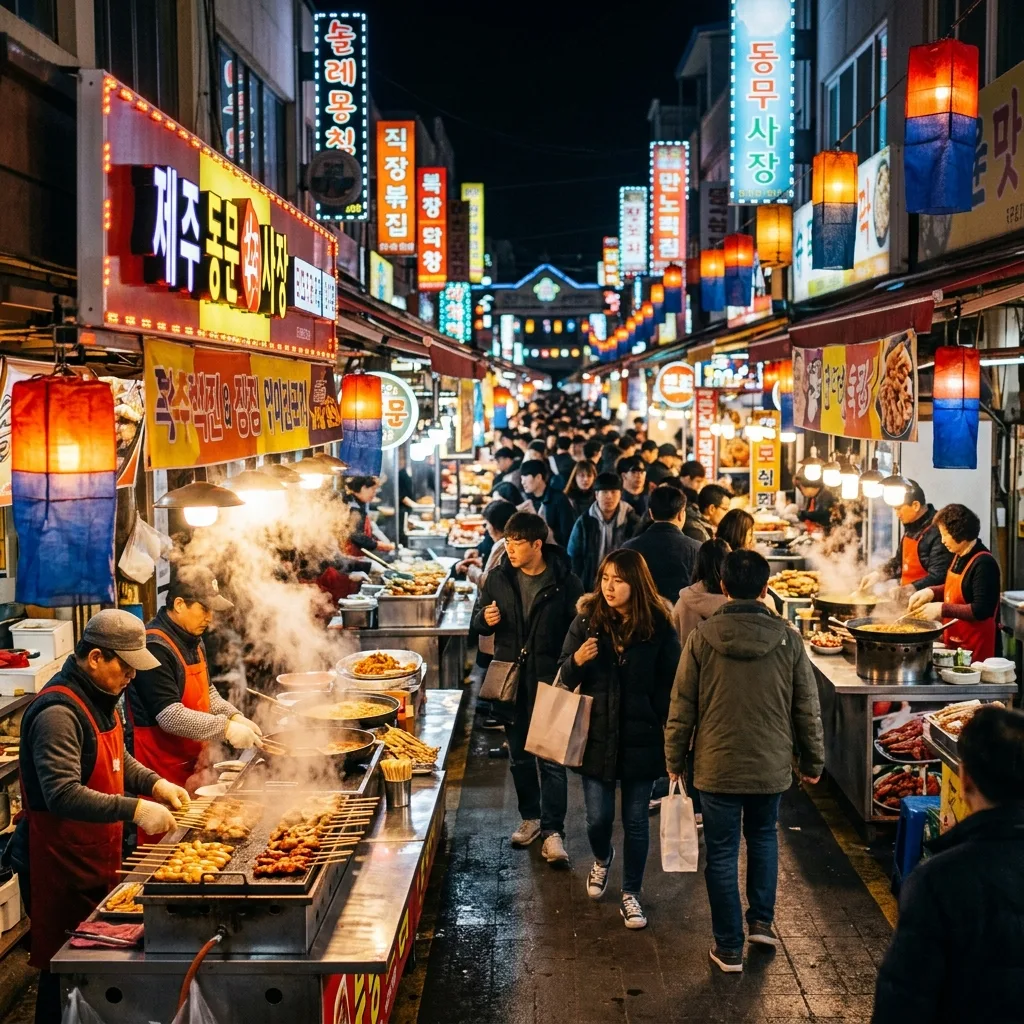
Jeju Island after dark is a different beast entirely. The same island that draws visitors for Hallasan hikes and volcanic beaches transforms at dusk into a labyrinth of sizzling pans, tangerine-scented steam, and vendors who have been perfecting their single dish for decades. If you land on Jeju without a plan for the evenings, you'll end up eating at a hotel restaurant — and that would be a genuine shame.
This guide covers every worthwhile night market on Jeju Island: the big ones, the overlooked ones, and the one most tourists skip entirely. You'll know what to order, when to arrive, how much to budget, and how to get there without a car. Whether you're in Jeju City or Seogwipo, the best eating on the island happens after 6 PM — and most of it costs under 5,000 won.
Dongmun Traditional Market: Jeju's Most Famous Night Market
Dongmun Market (동문재래시장) is the first stop on almost every Jeju food itinerary, and for good reason. Established in the early 1900s, it is the oldest surviving traditional market in Jeju City, and the night market that operates inside it is now the most visited in the province. On any given Friday evening in summer, thousands of people pack the narrow aisles shoulder to shoulder — locals doing their weekly shopping while tourists work through a mental checklist of Jeju snacks.
The market occupies a covered arcade stretching roughly 500 meters near Jeju's old downtown. During the day (8 AM to 8 PM), it functions as a traditional wet market: stalls selling fresh tangerines, dried seafood, vegetables, and haenyeo-caught abalone by the kilo. The night market runs separately — in winter from around 5 PM to 10 PM, in summer from 6 PM to 11 PM, though popular vendors often extend well past official closing time on weekends.
Entrance is free. You simply walk in.
What to Eat at Dongmun Night Market
Tangerine Hotteok (귤 호떡) is the non-negotiable starting point. Jeju's famous Hallabong and Cheonhyehyang tangerines are pressed into the filling of these crispy-edged pancakes, producing a citrus-forward sweetness that you won't find anywhere on the mainland. Expect to pay 1,000–2,000 won per piece; lines at the best stalls can stretch 20 minutes, but they move fast.
Haenyeo-caught seafood is the marquee ingredient at Dongmun. Look for stalls selling fresh abalone (전복), sea urchin (성게), and turban shell (소라). Abalone porridge (전복죽) is a Jeju staple available at multiple vendors — a bowl runs 10,000–15,000 won and is one of the most satisfying cold-weather meals you can eat in Korea.
Galchi (갈치) — hairtail fish is the other dish Jeju is unapologetically proud of. The silver, scabbard-like fish is pan-fried or braised with radish and dried chili. Several stalls at Dongmun sell grilled galchi skewers as a snack, which gives you the flavor profile without committing to a full restaurant sit-down.
Omegi Tteok (오메기떡) is a Jeju-origin rice cake made from job's tears (율무) rather than standard glutinous rice, coated in red bean paste and often rolled in toasted sesame or black bean powder. Texture-wise it is denser and chewier than mainland tteok. A pack of five goes for 5,000–8,000 won and keeps well for a day or two.
Segyeongt-ang (성게국) — sea urchin soup — is polarizing in the best possible way. The broth is briny, oceanic, and deeply savory without being fishy in an off-putting sense. Most visitors either love it immediately or need a second bowl to come around. It's worth trying at least a cup.
For the sweet-toothed, there are also stalls selling Hallabong soft-serve, tangerine candy, and various chocolate-covered citrus confections. These make convenient omiyage-style souvenirs, and Dongmun prices are genuinely cheaper than the airport duty-free shops.
Dongmun Practical Details
- Address: 18 Gwaneumsa-ro, Ildoil-dong, Jeju-si (동문재래시장)
- Day market hours: 8 AM – 8 PM daily
- Night market hours: Winter 5 PM – 10 PM / Summer 6 PM – 11 PM
- Admission: Free
- Getting there: From Jeju City bus terminal, take local bus 36 or 37 to Dongmun Market stop (10–15 min). On foot from Jeju Airport it's about 25 minutes.
Arrive by 5:30 PM in summer if you want first pick before lines form. Weekends are significantly more crowded than weekdays; the market on a Tuesday evening has a more relaxed, local feel.
Seogwipo Maeil Olle Market and the Olle Night Market
If Dongmun is Jeju's tourist-facing showpiece, Seogwipo's market scene is what the island actually eats. Seogwipo Maeil Olle Market (서귀포매일올레시장), the largest traditional market in Seogwipo, sits at 18 Jungang-ro 62beon-gil and has been operating in some form since the early 1960s. Day hours run 7 AM to 9 PM in summer, 7 AM to 8 PM in winter.
The night market component — called the Olle Night Market (올레 야시장) — is housed inside the same complex and bills itself as the only daily night market on the Seogwipo side of the island. Around 20 food vendors set up each evening, cooking with Jeju-sourced ingredients in a setting that feels considerably less hectic than Dongmun.
What to Eat at the Olle Night Market
Tangerine Hotteok appears here too, but the Seogwipo version tends toward larger, more generously filled pancakes. Competition between stalls is stiff, which keeps quality high.
Grilled eel (뱀장어구이) is more prominent in Seogwipo than Jeju City — the south coast's freshwater streams historically supported eel fishing, and local vendors still source locally. A plate with dipping sauce runs around 12,000–18,000 won.
King crab (킹크랩) makes an appearance at several stalls in the Olle Night Market, typically steamed to order. Prices are negotiable and depend on weight; budget 20,000–40,000 won for a reasonable portion. This is not cheap by Korean standards, but significantly less than what you'd pay at a sit-down restaurant.
Black pork yakisoba is a fusion dish that would make a purist wince and a hungry traveler very happy: Jeju black pork (흑돼지) stir-fried with buckwheat noodles, cabbage, and a sauce that splits the difference between Japanese yakisoba and Korean gochujang. It's a night market original, not found in restaurants.
Barley bread (보리빵) and squid pao (오징어 찐빵) are the experimental snacks worth trying at least once. The squid pao is a steamed bun stuffed with a savory-sweet squid filling — odd on paper, oddly compelling in practice.
For reference, if you've eaten your way through Seoul's food markets and want a useful comparison, The Ultimate Korean Street Food Guide: Tteokbokki to Tornado Potato covers the mainland staples — many of which also appear at Jeju night markets, though with island-specific twists.
Olle Night Market Practical Details
- Address: 18 Jungang-ro 62beon-gil, Seogwipo-si, Jeju-do
- Day market hours: 7 AM – 9 PM (summer) / 7 AM – 8 PM (winter)
- Night market hours: Varies by vendor; generally 6 PM – 10 PM
- Admission: Free
- Getting there: From Seogwipo Intercity Bus Terminal, walk 10 minutes north on Jungang-ro. From Jeju City, intercity bus 600 runs to Seogwipo (40–50 min).
The Seogwipo market is a strong reason to base yourself in the south of the island rather than Jeju City — especially if you plan to visit Cheonjiyeon Falls or hike the southern Olle trails during the day.
Jeju's Other Night Markets Worth Knowing
Jeju Dongmun Sumokwon Night Market Experience
Adjacent to Dongmun, the Sumokwon park area sometimes hosts pop-up evening markets and food festivals, particularly in spring and autumn. These are less predictable than the permanent markets — worth checking current event schedules on Visit Jeju's official website closer to your travel dates.
Five-Day Markets (오일장)
Jeju runs traditional five-day markets (오일장) on a rotating schedule at several locations: Jeju City (1st, 6th, 11th, 16th, 21st, 26th of each month), Seogwipo, Hallim, Daejeong, and others. These are daytime affairs, but they offer a different experience from the permanent night markets — more agricultural produce, traditional crafts, and a demographic that skews heavily local. The Jeju City five-day market is the largest and most accessible.
If you're building a multi-day Jeju itinerary, timing one day to coincide with a five-day market near your accommodation is worth the minor planning effort. For broader itinerary structure, Jeju Island Itinerary: The Ultimate Road Trip Guide covers how to sequence Jeju's major attractions with eating stops built in.
Jeju Night Market Food on a Budget
Night markets in Jeju are among the most accessible eating options on the island. Here's a realistic per-person budget breakdown:
| Item | Price Range |
|---|---|
| Tangerine Hotteok | 1,000–2,000 won |
| Omegi Tteok (pack of 5) | 5,000–8,000 won |
| Abalone porridge | 10,000–15,000 won |
| Sea urchin soup | 8,000–12,000 won |
| Grilled galchi skewer | 3,000–5,000 won |
| Soft-serve (Hallabong) | 3,000–4,000 won |
A reasonable two-hour eat-through of Dongmun Night Market — hitting four or five stalls — will cost most visitors 15,000–25,000 won. The Olle Night Market in Seogwipo skews slightly higher given the seafood-heavy options, but it's still inexpensive by any European or American reference point.
Payment is predominantly cash. Several stalls now accept card or mobile payment (Kakao Pay, Samsung Pay), but having 30,000–50,000 won in small bills removes friction entirely.
How to Get the Most Out of Jeju Night Markets
Arrive Early or Very Late
The dead zone at both Dongmun and Olle Night Market is 7–8 PM on weekends — this is peak congestion, and popular stalls may run out of signature items. Arriving at 5:30 PM (summer) or 5 PM (winter) gets you the full spread. Alternatively, showing up at 9:30–10 PM, when tourists have cleared out, gives a more relaxed atmosphere and vendors who are more inclined to chat.
Eat Small, Eat Often
Night market etiquette in Korea is snack-and-move, not sit-and-linger. Order one item per stall, eat while walking, then move to the next vendor. You'll cover more ground, try more things, and avoid the awkwardness of occupying limited seating for too long.
Look for the Longest Lines (Selectively)
In Korean street food culture, a line is generally a reliable quality signal — but not always. At Dongmun, some stalls with lines are simply more visible or better-positioned, not better. Use the line heuristic for items where freshness is critical (hotteok, fish pancakes), but don't dismiss a quiet stall just because it lacks a queue.
Skip the Tangerine Souvenirs at the Airport
Virtually everything sold in Jeju's airport gift shops — Hallabong chocolate, tangerine candy, dried citrus products — is cheaper at Dongmun Market. If you're buying gifts, do it at the market and pack them in your carry-on. The airport markup on Jeju-branded food items runs 20–40%.
Know the Seasonal Difference
Jeju's food market scene shifts noticeably between seasons. Winter (November through February) is when haenyeo seafood peaks, abalone is at its best, and the tangerine harvest fills every stall with fresh citrus. Summer months bring longer operating hours, more visitors, and vendors catering more explicitly to tourists. Spring and autumn are the sweet spots — manageable crowds, good product diversity, and weather that makes walking between stalls enjoyable rather than sweaty.
Tips and Common Mistakes
Don't eat dinner before the night market. This sounds obvious, but travelers who have a restaurant dinner at 6 PM and then swing by Dongmun "just to look" reliably end up overeating and regretting it. Build the night market into your dinner plan, not as an add-on.
Do not confuse Dongmun Traditional Market with the shopping mall nearby. There is a newer commercial building adjacent to the traditional market arcade that sells the same souvenir products at inflated prices. The traditional market itself is the covered arcade section — if the floor is clean tile and the lighting is corporate, you're in the wrong building.
Check for closures around major holidays. Chuseok (Korean Thanksgiving, late September) and Seollal (Lunar New Year, January or February) see many market stalls close for several days. The permanent markets stay partially open, but operating hours shrink significantly.
Bring a light bag. Dongmun Market in summer is warm and crowded. Large backpacks are a source of friction for you and everyone around you. A small crossbody bag or nothing at all is the right call.
Don't skip Seogwipo. Most first-time Jeju visitors concentrate their eating in Jeju City, which is understandable given the accommodation density there. But Seogwipo's Olle Night Market, smaller and more local in character, often produces better meals per stall. If your itinerary includes the south coast at all — and it should — plan to eat dinner there at least once.
Comparing Jeju's market scene to Seoul's is instructive. A Foodie's Guide to Seoul: Top 15 Must-Try Street Foods covers the mainland reference points — Gwangjang Market, Namdaemun, Myeongdong's outdoor corridor — and many of those vendors' product categories overlap with Jeju's, making the comparison useful for understanding what's Jeju-specific versus standard Korean street food fare.
FAQ
Is Dongmun Night Market open every day? Yes. The main traditional market operates daily 8 AM–8 PM, and the night market section runs every evening (winter: 5 PM–10 PM; summer: 6 PM–11 PM). Some vendors take individual days off, but the market as a whole does not close.
Do I need cash for Jeju night markets? Cash is strongly recommended. While mobile payment adoption is increasing, many smaller stalls are cash-only. Carrying 30,000–50,000 won in small denominations (1,000 and 5,000 won bills) handles almost everything.
What is the best night market in Jeju for first-time visitors? Dongmun Market for sheer variety and the classic Jeju-snack experience; Seogwipo Olle Night Market if you want a quieter, more local atmosphere with better seafood options. Ideally, visit both on separate evenings.
Can I get to Dongmun Market without a car? Yes. Local buses connect Jeju City's bus terminal and airport to Dongmun Market; the ride from the terminal is 10–15 minutes. Taxis from Jeju Airport run 10–15 minutes and cost approximately 7,000–10,000 won.
What Jeju-specific foods should I prioritize at night markets? Tangerine hotteok, abalone porridge (전복죽), omegi tteok, and sea urchin soup (성게국) are the four items most specific to Jeju and hardest to find well-made anywhere else in Korea. These are the non-negotiables.
Conclusion
Jeju's night markets are not an optional evening activity — they are the most direct way to eat what the island actually produces. Dongmun Traditional Market's night section covers the full range of Jeju flavors in one walkable arcade, while Seogwipo's Olle Night Market offers a quieter, seafood-forward alternative on the island's south coast. Between the two, you have enough material for two or three excellent evenings of eating.
The practical reality: come hungry, bring cash, arrive early or late (never at 7:30 PM on a weekend), and let the lines tell you where the serious vendors are. Jeju's food identity — haenyeo seafood, tangerine everything, black pork, citrus-laced pastry — shows up most honestly here, at 2,000 won per skewer, eaten standing on concrete while someone's grandmother argues price with a fish vendor behind you.
That's Jeju at its best.