A Photographer’s Guide to Nami Island and Gapyeong

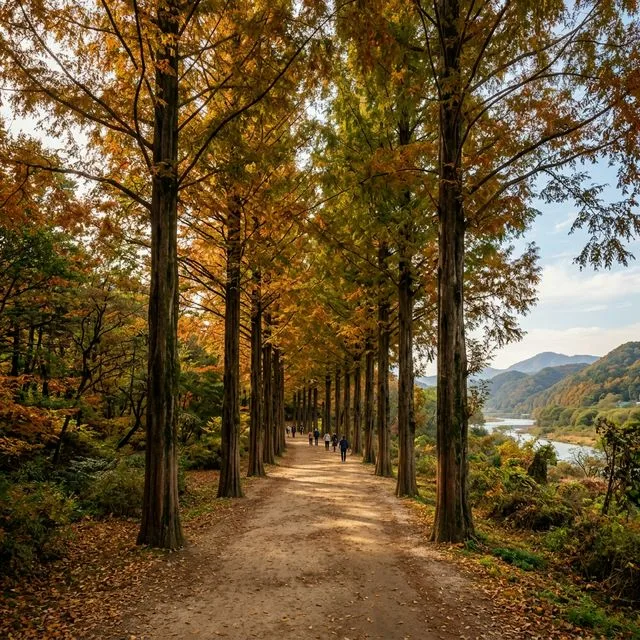
You’ve seen the photo: a perfectly symmetrical avenue of towering Metasequoia trees, their branches forming a gothic arch of green, gold, or snow-white, with not a single tourist in sight. It’s the "holy grail" of South Korean travel photography. But when you actually arrive at Nami Island at 11:00 AM on a Saturday, that dream evaporates into a sea of selfie sticks and tour groups. Capturing the magic of Gapyeong requires more than just a good lens; it requires a tactical plan, an understanding of light, and a willingness to explore the "empty" spaces that others ignore.
Introduction: Chasing the Perfect Shot in Gapyeong
Gapyeong County, located just a short train ride from the bustling streets of Seoul, is effectively the photography capital of South Korea. It is a region where nature has been meticulously curated into art. From the half-moon-shaped river island of Nami to the manicured European aesthetic of Petite France and the sprawling botanical mastery of The Garden of Morning Calm, Gapyeong offers a density of visual "hero shots" that is unmatched elsewhere in the country.
For the serious photographer, however, Gapyeong is a challenge. The lighting can be harsh under the dense canopy of the tree tunnels, the crowds are relentless, and the sheer scale of the attractions can lead to "shutter fatigue." This guide is designed to help you navigate those challenges. We will move beyond the standard "I was here" snapshots and dive into the technicalities of perspective, timing, and composition that turn a travel photo into a piece of art. Whether you are carrying a professional mirrorless setup or the latest smartphone, this is your roadmap to capturing Gapyeong’s soul.
The One-Day "Golden Route" Circuit
To capture the best light and avoid the worst crowds, you must follow a strict itinerary. This "Golden Route" is optimized for a one-day trip starting from Seoul, ensuring you hit the most light-sensitive spots at the right times.
07:30 AM: The Early Bird Ferry to Nami Island
The secret to Nami Island photography is the first ferry. Typically departing at 07:30 or 08:00 AM depending on the season, this ferry carries the photographers, the joggers, and the island staff. If you are on this boat, you have exactly 45 minutes of "clean" paths before the first major tour buses arrive from Seoul.
As you step off the ferry, ignore the shops and the central plaza. Head straight for the Metasequoia Lane. In the early morning, a soft mist often clings to the ground near the Bukhan River, and the low-angled sun filters through the trees, creating dramatic light rays (God rays) if there’s a bit of humidity in the air. This is your window for wide-angle shots with leading lines that actually lead somewhere rather than just into a crowd of people.
11:00 AM: European Vibes at Petite France & Italian Village
By mid-morning, Nami Island will be swarming. This is the perfect time to head to Petite France and the neighboring Pinocchio & Da Vinci Village. These locations are less dependent on "empty" paths and more about colorful architectural details and sweeping vistas.
The pastel-colored buildings of Petite France pop beautifully under the high, bright sun of late morning. While mid-day sun is usually a photographer's enemy, the vibrant blues, yellows, and pinks of this French-themed village benefit from the punchy saturation that bright light provides. Use a telephoto lens to compress the layers of colorful rooftops against the backdrop of the mountains and the river.
14:00 PM: The Moving Frame: Gapyeong Rail Park
After a lunch of local Dakgalbi (spicy stir-fried chicken), head to the Gapyeong Rail Park. Photography from a moving railbike is a lesson in shutter speed and anticipation. Unlike a stationary tripod shoot, you are constantly in motion, and the landscape is shifting around you. You’ll be pedaling across the Bukhanggang Iron Bridge, which offers a stunning 360-degree view of the river valley.
To capture this without motion blur, keep your shutter speed at 1/1000s or higher. The bridge itself is a masterpiece of industrial symmetry. Frame your shot looking down the tracks to utilize the iron girders as a repetitive framing element. If you’re riding with a partner, have them pedal while you focus on the "Zelkova Tree Tunnel" section, where the tracks disappear into a dense canopy of leaves. This is a great spot for "burst mode" photography—holding down the shutter to capture a sequence of frames as you pass through the tunnel. You can later select the one with the most perfect light flickering through the branches. Don't forget to look behind you; the receding tracks of the bridge against the mountain backdrop is one of the most underrated shots in the entire Gapyeong circuit.
16:30 PM: The Grand Finale: Garden of Morning Calm
The Garden of Morning Calm is best saved for last. As the sun begins its descent, the light softens, turning the garden into a painterly landscape. The Seohwayeon Pond is the crown jewel here. The traditional Korean pavilion reflected in the still water during golden hour is a quintessential Korean image. The "Sunken Garden," viewed from the higher walking paths, also takes on a new dimension in the late afternoon, as the long shadows highlight the contours of the manicured flower beds.
If you are visiting in the winter, this is when the transformation begins. As the sun set, over 30,000 lights flicker to life for the Lighting Festival. This is where your tripod becomes essential. The transition from golden hour to the "Blue Hour" (the period of twilight when the sky turns a deep, saturated blue) is the best time to capture the lights without the foreground becoming a pitch-black void. This "overlap" of natural and artificial light creates a magical, surreal quality that is much more visually interesting than a shot taken in total darkness.
Masterclass: Nami Island’s Iconic Frames
Nami Island is more than just a single tree line. To truly document the island, you need to vary your perspective across its different "zones."
Metasequoia Lane: Mastering Leading Lines
The Metasequoia trees are the giants of Nami. Because they are so tall and the path is relatively narrow, they provide the perfect "leading line" composition.
- Technical Tip: Get low. Placing your camera just a foot off the ground makes the trees appear even more imposing and stretches the leading lines of the path.
- Crowd Strategy: If the path is crowded, use a long focal length (85mm or 200mm). This compresses the scene, and you can often find a "gap" in the crowd that looks like an empty path through the lens, even if it’s only ten feet long. Alternatively, the "look up" technique—shooting straight up into the canopy—removes people entirely and focuses on the geometric patterns of the branches.
The Gingko Lane: Capturing the Yellow Carpet
In the autumn, the Gingko Lane turns into a corridor of pure gold. The challenge here is color balance. The yellow is so intense that it can trick your camera’s auto-white balance into making the image look "muddy."
- Technical Tip: Set your white balance to "Daylight" or "Cloudy" to preserve the warmth of the yellow leaves. Look for contrast—a person in a red coat or the deep blue of a clear autumn sky provides the perfect counterpoint to the monochromatic yellow. Chasing the Maple: A 10-Day Autumn Foliage Itinerary provides more context on the timing for this seasonal peak.
The Riverside Walk: Finding Serenity
Most tourists stay in the center of the island. The Riverside Walk, which circles the perimeter, is where you’ll find the best reflections. The Bukhan River is often glass-calm in the early morning.
- Composition Tip: Use the overhanging willow trees to frame shots of the distant mountains. This adds depth and a sense of "place" that the enclosed tree tunnels lack.
K-Drama Aesthetics: Beyond "Winter Sonata"
Nami Island rose to fame through the drama Winter Sonata. While the statues are popular, they can be difficult to photograph without looking like a tourist cliché.
- Creative Tip: Instead of a direct shot of the statue, try a "through-the-leaves" shot or a reflection in a nearby puddle. Capture the vibe of the drama—long shadows, soft focus, and romantic lighting—rather than just the monuments themselves. This subtle approach creates a more professional, "cinematic" feel that resonates with modern social media aesthetics while maintaining artistic integrity.
Beyond the Island: The Architecture of Gapyeong
Gapyeong’s man-made attractions are designed for the camera. They are essentially giant outdoor studios that offer a stark contrast to the natural lines of Nami Island.
Petite France: A Telephoto Playground
Petite France is a maze of stairs, alleys, and balconies. It is very easy for your photos to look cluttered here because of the sheer density of the buildings and the varied color palette.
- Technical Tip: Use a telephoto lens (70-200mm) to isolate specific buildings or windows. The compression of a long lens makes the village look denser and more "European." Look for the "Little Prince" murals—they make for excellent, flat-lay style shots if you frame them straight-on.
- Layering: Try to find a frame within a frame—perhaps shooting through a flower-covered archway toward the distant blue roofs. This adds a sense of discovery to your images.
Garden of Morning Calm: The Sunken Garden
The Sunken Garden is a massive floral display shaped like the Korean Peninsula. To capture this shape, you need height and a steady hand.
- Location Tip: There is an observation deck located near the entrance to the Sunken Garden. From here, a wide-angle lens (16mm or 24mm) will allow you to capture the entire layout.
- Macro Photography: The garden is home to thousands of species of wildflowers. If you have a macro lens, spend an hour in the "Morning Calm" section. The morning dew on the petals, combined with the soft early light, creates stunning close-up imagery. This is also a fantastic place to practice "bokeh" photography, using a wide aperture (f/1.8 or f/2.8) to create a soft, blurred background that isolates a single vibrant blossom.
Post-Processing: Enhancing the "K-Drama" Glow
The final step in your photography journey happens in the editing room. The "K-Drama" aesthetic is characterized by soft, glowing light, pastel colors, and a clean, high-key look.
- White Balance: Don't be afraid to lean into warmer tones. Increasing the temperature slightly can give your Nami Island photos that nostalgic, sun-drenched feel.
- Shadows and Highlights: In the tree tunnels, you will often have high contrast. Bring up the shadows to reveal the texture of the tree bark, but keep the highlights under control so the sky doesn't become a white "blown-out" mess.
- Clarity and Dehaze: Use these tools sparingly. Too much clarity can make the natural beauty of the gardens look "crunchy" and artificial. For the winter lights, a small amount of "Dehaze" can help clear up any lens flare or atmospheric haze, making the colors of the LEDs more vibrant.
- The "Orton Effect": For a truly dreamy look, try a subtle Orton Effect—a slight blur layered over a sharp image. This mimics the soft-focus cinematography often used in Korean romantic dramas, giving your landscapes a fairy-tale quality that sets your work apart from standard travel snapshots.
Seasonal Photography Cheat Sheet
Gapyeong is a four-season destination, but each season requires a different photographic approach.
Spring (April): The Pink Awakening
Spring is all about the cherry blossoms and the Magnolia trees. The Garden of Morning Calm is spectacular during this time.
- Key Shot: The "Cherry Blossom Tunnel" near the Nami Island ferry wharf.
- Timing: Mid-April is usually the peak. For a full itinerary, check out Chasing the Pink Wave: A 7-Day Cherry Blossom Itinerary from Jinhae to Seoul.
Summer (June-August): The Lush Deep Green
Summer is the most difficult season due to the heat and humidity, but it offers the most vibrant greens.
- Key Shot: The Lotus ponds in the Garden of Morning Calm.
- Technical Tip: Use a circular polarizer (CPL) filter. This removes the glare from the waxy green leaves and the surface of the water, making the colors look much richer and deeper.
Autumn (Late Oct - Early Nov): The 10-Day Window
This is the high season. The colors are breathtaking, but the crowds are at their peak.
- Key Shot: The Gingko and Maple lanes on Nami Island.
- Advice: Be prepared for long waits for the ferry and the bus. Pack light, as you will be doing a lot of walking. See The Ultimate South Korea Packing List (2026 Edition): Don't Forget the Essentials for tips on gear bags.
Winter (Dec - Feb): The Serene Silence
Winter in Gapyeong is magical, especially after a fresh snowfall.
- Key Shot: The snow-covered Metasequoia trees on Nami Island.
- Night Photography: The Lighting Festival at the Garden of Morning Calm is the premier winter event. Bring extra batteries; cold weather drains them twice as fast. For more winter travel tips, see Frozen Fun: The Ultimate Guide to Winter in South Korea.
Technical Tips for the Traveling Photographer
Lenses & Gear: Why a 24-70mm is Your Best Friend
If you can only bring one lens, make it a 24-70mm f/2.8 (or equivalent). This range allows you to capture the wide landscapes of the river and the tight portraits in the tree tunnels. A fast aperture is helpful for blurring out the crowds in the background.
Tripod Rules
While tripods are generally allowed in public spaces in Korea, some areas like the Garden of Morning Calm may have restrictions during peak festival hours if they block the paths.
- Pro Tip: Use a lightweight travel tripod or a monopod. If you are challenged by staff, simply explain that you are a hobbyist (not commercial). Most locations are very photographer-friendly as long as you aren't setting up a full lighting rig.
Managing the Midday Sun
The "dappled light" inside the tree tunnels can be a nightmare for your camera’s sensor, creating "hot spots" of bright light and deep shadows.
- Technical Tip: Underexpose your shots slightly (by -0.3 or -0.7 EV) to ensure you don't "blow out" the highlights on the leaves. You can always bring up the shadows in post-processing, but you can’t recover lost highlight detail.
Logistics for Photographers (2026 Update)
Transportation: ITX-Cheongchun vs. The Tour Bus
For photographers, the ITX-Cheongchun train from Yongsan or Cheongnyangni Station to Gapyeong Station is the only way to go. It is faster and more reliable than the bus, and it has plenty of room for your gear bags. Once at Gapyeong Station, the Gapyeong City Tour Bus (A-Course) is convenient, but it can be very crowded.
- The Taxi Hack: If you are chasing the light and the bus is 20 minutes away, take a taxi. The distance between Nami Island and Petite France is relatively short, and a $10-15 taxi ride can be the difference between catching the golden hour and missing it.
Don't forget to have your Mastering the T-Money Card: Your Key to Korea's Transit (and More) ready for the local buses and taxis, and consult The Ultimate Guide to Public Transportation in Korea (2025 Edition) for the most up-to-date fare information.
Updated 2026 Entry Fees
- Nami Island: 16,000 KRW (includes round-trip ferry).
- Petite France & Italian Village: 12,000 KRW (combo ticket available).
- Garden of Morning Calm: 11,000 KRW (additional fees for some special exhibitions).
Digital Essentials
Make sure you have Naver Map or KakaoMap downloaded. Google Maps is famously unreliable for walking directions and bus schedules in South Korea. These local apps will give you real-time data on when the next Gapyeong Tour Bus is arriving.
Conclusion: Patience is the Photographer's Best Lens
Gapyeong is a place that rewards the patient. It’s easy to get frustrated by the crowds or the changing weather, but the most iconic shots are often captured in the quiet moments between the "waves" of tourists. Whether it’s waiting for that five-second gap in the Metasequoia Lane or standing in the cold to catch the exact moment the lights turn on at the Garden of Morning Calm, the effort is always reflected in the final frame.
Pack your gear, charge your batteries, and set your alarm for that 07:30 ferry. The perfect shot of Nami Island is waiting—you just have to be there to meet it.
Related Articles
- Chasing the Maple: A 10-Day Autumn Foliage Itinerary
- Frozen Fun: The Ultimate Guide to Winter in South Korea
- Chasing the Pink Wave: A 7-Day Cherry Blossom Itinerary from Jinhae to Seoul