Traditional Korean Teahouses vs. Modern Espresso Bars

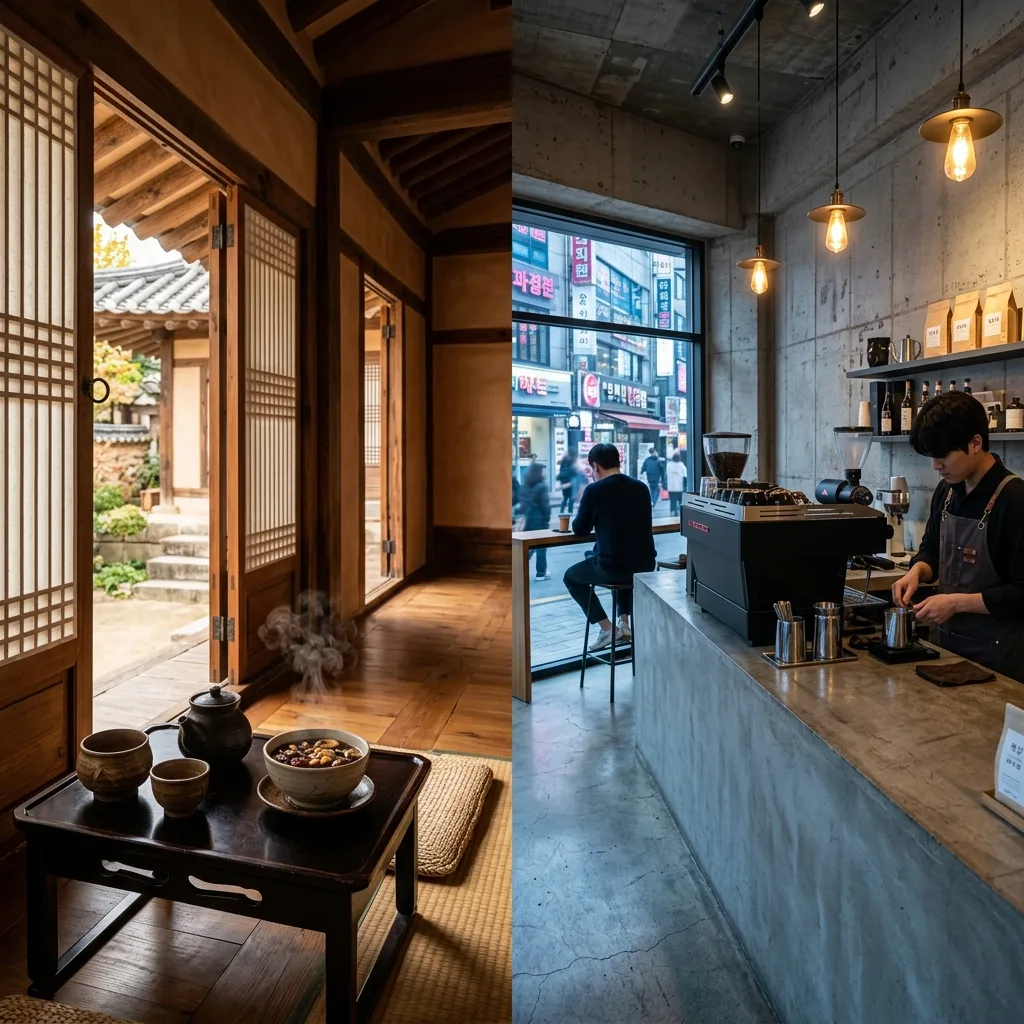
Seoul is a city that somehow holds six centuries of Joseon-era calm and the relentless energy of a 24-hour metropolis in the same breath. Nowhere is that tension more delicious than in its drink culture. Step into a centuries-old Hanok courtyard on a Tuesday morning — heated floors, earthenware cups, a pot of Ssanghwa-cha steaming in the cold air — and you could be in the Joseon dynasty. Step out, walk two subway stops, and you're ordering a perfectly pulled ristretto at a standing espresso bar while a DJ set pours in from the store next door. Both are genuinely, unmistakably Korean. Both are worth your time.
This guide breaks down the two poles of Seoul's beverage scene — what they look like, where to find them, what to order, and how to photograph them — so you can build an itinerary that captures the full spectrum of Korean drink culture.
Zen in the City: Traditional Korean Teahouses
A traditional Korean teahouse — dawon (茶院) or 다원 — is not a café in the Western sense. It is closer to a meditative practice with a menu attached. The architecture, the service tempo, the tea vessels, and even the silence are all deliberate. Understanding that framework transforms a simple cup of barley tea into something that feels ceremonial.
The Hanok Experience
The defining feature of a traditional teahouse is its setting inside or adjacent to a Hanok — a traditional Korean wooden structure built around a central courtyard, with curved tiled eaves and interior spaces arranged around the maru (wooden-floored common area). For a deep dive into what makes these buildings special, the guide on Best Hanok Cafes in Seoul covers the architectural details and the best addresses across the city.
The most prized amenity in a traditional teahouse is ondol — underfloor radiant heating that has been used in Korea for over two millennia. Guests sit on thin cushions at low lacquered tables, legs folded, warmth rising from below. In winter this is sheer luxury. The effect is drowsiness, contentment, and a strange reluctance to leave. Most teahouses keep the indoor lighting dim and rely on natural light filtering through hanji (Korean mulberry-bark paper) doors. The aesthetic is deliberately minimal: raw wood, celadon pottery, the occasional scroll painting.
Insadong and Bukchon: The Heartlands
The two neighborhoods most associated with traditional teahouses are Insadong and Bukchon Hanok Village. They are a ten-minute walk apart and often visited together.
Insadong (인사동) is a narrow commercial street lined with antique shops, celadon galleries, and traditional tea rooms that have occupied the same buildings for decades. The most iconic is Suyeon Sanbang (수연산방), a Hanok that was once the home of the novelist Lee Tae-jun, now operating as a teahouse. The courtyard garden is one of the most photographed spots in central Seoul. Less famous but equally serene is Cha Masineun Teul (차 마시는 뜰), a two-story Hanok with a rooftop deck where guests can look out over neighboring grey tile roofs while sipping Omija-cha.
Bukchon Hanok Village (북촌한옥마을) sits on the hillside between Gyeongbokgung Palace and Changdeokgung Palace. While most of Bukchon is a residential preservation zone — not a tourist attraction — several private Hanoks have been converted into teahouses accessible by appointment or walk-in. The experience here feels more private than Insadong, partly because the neighborhood is quieter and partly because many teahouses have a capacity of just eight to twelve guests.
For a comparison of Bukchon with the larger Jeonju Hanok Village, see Bukchon Hanok Village vs. Jeonju Hanok Village.
Must-Try Teas and Traditional Snacks
Korean traditional tea (jeontong cha, 전통차) is a broad category that includes:
-
Ssanghwa-cha (쌍화차) — A dark, intensely medicinal herbal blend made from white peony root, rehmannia, jujube, licorice root, cinnamon, and ginger. It arrives in a stone cup, sometimes topped with a raw egg yolk and pine nuts, and it looks like midnight. The taste is bitter-sweet and warming. This is the tea Koreans drink when they feel a cold coming on, and it is unlike anything you can find in a Western tea shop.
-
Omija-cha (오미자차) — A vibrantly pink tea made from schisandra berries, whose name translates literally as "five-flavor berry." A single sip delivers sweetness, sourness, bitterness, saltiness, and a faint pungency in sequence. Served cold in summer, warm in winter.
-
Boricha (보리차) — Roasted barley tea: nutty, slightly smoky, entirely caffeine-free. This is Korea's everyday table water, often served at room temperature or chilled. It is the most approachable starting point for anyone new to Korean tea.
-
Yuja-cha (유자차) — A citron tea made by stirring a spoonful of preserved yuja (yuzu) marmalade into hot water. Sweet, citrusy, and loaded with Vitamin C.
Traditional snacks (dasik, 다식) that typically accompany tea include: songpyeon (half-moon rice cakes), jeon (savory pan-fried pancakes, usually in miniature form), yaksik (a sticky rice dessert with nuts and jujubes), and hangwa (traditional Korean confections made from honey, rice flour, and sesame seeds).
Most teahouses present these on a small lacquered tray alongside the tea, and the ritual of eating and drinking slowly — without a phone in hand, without background music louder than a murmur — is itself the point.
For context on the formal tea ceremony that underpins teahouse culture, the post on how to experience a traditional Korean tea ceremony is an excellent companion read.
The Jolt of Life: Modern Standing Espresso Bars
If the teahouse is a slow exhale, the standing espresso bar is a sharp intake of breath. Seoul's specialty coffee scene evolved at extraordinary speed after the first third-wave roasters opened around 2012. By 2026 the city has more specialty coffee shops per square kilometer than almost any city on earth, and the standing espresso bar — a format borrowed from Italian bar culture and then aggressively redesigned — is its most distinctly Seoul expression.
The "Standing" Trend and Why Seoul Made It Its Own
The standing espresso bar is exactly what it sounds like: no chairs, no tables, counter service only, in and out in five minutes. The Italian original — the caffè where locals down a one-euro espresso before the morning commute — arrived in Seoul through third-wave importers who were fascinated by the ceremony of espresso extraction without the sprawl of the sit-down café.
Seoul's version, however, almost immediately became more elaborate. Local designers turned small spaces into architectural statements. Baristas here typically hold international certifications and treat extraction parameters with the precision of a laboratory. The coffee may be gone in three sips, but the cup, the counter, and the espresso itself are all photogenic objects. The format resonates with Seoul's fast-moving urban culture: you get the best possible coffee, you experience a beautifully designed space, and you leave without occupying a table for two hours.
Seongsu-dong and Hannam-dong: The Twin Poles
Seongsu-dong (성수동), once a light-industrial district on the north bank of the Han River, is now Seoul's most design-forward neighborhood. Its standing espresso bars tend toward exposed concrete, raw steel, and massive windows — a deliberate contrast between the neighborhood's industrial past and its current creative present. Seongsu-dong: The Brooklyn of Seoul covers the full neighborhood, but for coffee specifically: look for Namusairo (나무사이로), a roastery and standing bar that occupies a repurposed leather factory building, and Anthracite Coffee, which operates out of a former shoe factory with ceilings high enough to echo.
Hannam-dong (한남동) is richer, quieter, and more boutique. The espresso bars here lean into a "silent luxury" aesthetic: all-white interiors, single-origin beans sourced from micro-lots in Ethiopia and Colombia, and a clientele that includes gallery directors and off-duty K-pop stylists. Prices are higher. Portions are equally small. The experience feels more curated gallery than neighborhood café.
What to Order
The standing espresso bar menu is typically short by design — a philosophy statement as much as a practical decision.
-
Ristretto / Espresso — The baseline. A 20–25ml pull at around 9 bars of pressure. Seoul baristas often use a slightly lower extraction ratio than Italian tradition to highlight the acidity and floral notes of light-roasted East African beans.
-
Con Panna — Espresso with a small cloud of whipped cream. The whipped cream in Seoul's specialty bars is never from a can; it is hand-whipped to a just-set softness that melts slowly into the shot. The contrast between the bitter espresso and the cool cream is particularly good with a natural-process Ethiopian bean.
-
Cacao-Infused or Compound Blends — An innovation that has spread from a handful of experimental bars to mainstream menus. Cacao nibs are added to the portafilter alongside ground coffee, or the espresso is extracted directly over cacao butter. The result is a shot that has the richness of a mocha without any added sweetener. Some bars also offer espresso blended with hojicha (Japanese roasted green tea) powder for a local-meets-Japanese-diaspora mashup.
-
The Espresso Stack — A visual trend that started as an Instagram moment and became a legitimate order. The barista builds the drink in layers — typically espresso over a cube of ice over a small amount of cold milk, served in a clear glass — so you see three distinct strata before you stir. The flavor after mixing is closer to a lightly sweetened cold espresso than a traditional latte. The photography potential, however, is exceptional.
Side-by-Side: Which Should You Choose?
The honest answer is: both, on the same day, if your schedule allows. But if you need to prioritize, here is a practical framework.
For the Morning: The Espresso Bar
Standing espresso bars are the right choice before 10am. They are built for speed and most of them open at 8am or earlier to catch the morning commute. You will be in and out in under ten minutes, caffeinated, and ready to walk. The caloric density is low — you are not sitting down to a pastry-heavy breakfast — which leaves room for a proper Korean breakfast elsewhere.
For the Afternoon: The Teahouse Retreat
Between 2pm and 5pm, a traditional teahouse shifts from pleasant to genuinely restorative. The afternoon light through hanji paper doors is at its warmest, the tourist rush has thinned slightly, and the combination of herbal tea and dasik snacks bridges the gap to dinner without making you heavy. If you have been on your feet since breakfast touring palaces and markets, the teahouse is also the most comfortable place to sit — cushions and ondol heat are superior to most café seating.
Cultural Nuances
The teahouse asks something of you: slowness. Speaking loudly, using speakerphone, arriving in a large group and rearranging furniture — all of these are considered poor form. Most teahouses have a de facto no-laptop policy enforced not by signage but by the weight of ambient expectation. This is a feature, not a constraint.
The espresso bar, by contrast, implicitly welcomes the urban rush. Standing side by side with strangers, making eye contact with the barista, tapping your phone pay before the cup has even cooled — this is the social texture that makes Seoul feel kinetic and alive.
They are not competing for the same moment of your day.
Photography Tips: Capturing the Contrast
Seoul's teahouses and espresso bars are two of the most photogenic environments in the city, but they reward completely different camera approaches.
Shooting in Traditional Teahouses
Light in a Hanok teahouse is soft, directional, and often dramatically warm. The hanji paper doors act as a natural diffusion panel, scattering whatever is coming in from the courtyard into an even, shadow-free glow. In practical terms this means:
- Shoot in RAW if your camera allows. The dynamic range between the lit courtyard and the interior shadows is wide enough that JPEG processing will clip highlights or block shadows.
- Use a slightly slower shutter speed than you think you need — the interior is dimmer than it looks to the eye.
- The most compelling compositions tend to place the tea vessel in the foreground with an out-of-focus Hanok screen or courtyard in the background. The layering of textures — wood grain, celadon glaze, roof tiles — creates visual depth.
- Earth tones dominate: ochre, deep green, grey tile, walnut brown. Color grading toward warm shadows and cool, desaturated highlights will match what your eye sees in the space.
Avoid using flash. It is disruptive to other guests and it destroys the atmospheric quality of the light entirely.
Shooting in Modern Espresso Bars
The aesthetic here is nearly the opposite: high contrast, graphic, architectural.
- The "Espresso Stack" shot works best with a neutral background — a white tile wall or bare concrete — and side lighting from a window. Shoot from slightly above, not straight on, to capture all three layers through the glass.
- Wide-angle shots of the interior emphasize the spatial drama that Seoul's designers have built into these spaces. The collision of raw industrial materials with precision espresso equipment is the visual story.
- Black-and-white conversion works better here than in the teahouse — the graphic lines of the architecture and the monochrome colour palette of most espresso bars translate cleanly.
- In Seongsu-dong and Hannam-dong, look for the relationship between exterior signage and interior finishes. Many of these bars were designed as total compositions, and the exterior-to-interior visual flow is often worth capturing as a diptych.
Practical Information
Getting to Insadong and Bukchon
- Insadong: Exit 6 of Anguk Station (Line 3)
- Bukchon: Exit 2 of Anguk Station (Line 3), then a 10-minute walk uphill
- Best time: Weekday mornings (10am–1pm). Weekend afternoons get extremely crowded in Bukchon.
- Teahouse prices: ₩8,000–₩15,000 (approximately USD 6–11) for tea plus a dasik set.
Getting to Seongsu-dong and Hannam-dong
- Seongsu-dong: Seongsu Station (Line 2), Exit 3
- Hannam-dong: Hangangjin Station (Line 6), Exit 1 or 2
- Best time: Both neighborhoods are lively seven days a week; Seongsu-dong in particular draws large weekend crowds after 11am.
- Espresso bar prices: ₩4,500–₩9,000 (approximately USD 3.50–6.50) for a single shot or specialty drink.
A Suggested Itinerary
| Time | Activity |
|---|---|
| 8:30am | Standing espresso bar in Seongsu-dong — morning shot, quick in-out |
| 10:00am | Gyeongbokgung Palace tour |
| 1:00pm | Lunch in Insadong |
| 2:30pm | Traditional teahouse in Insadong or Bukchon — Ssanghwa-cha, dasik, 45–60 min |
| 4:00pm | Walk through Bukchon residential lanes |
| Evening | Hannam-dong for dinner; revisit a standing bar for a post-dinner ristretto |
Conclusion: Korea's Two Liquids
Seoul's traditional teahouses and modern espresso bars are not competing industries. They address fundamentally different human needs — the need to slow down and the need to accelerate — and Korean culture has found room for both without either feeling like a compromise.
The Ssanghwa-cha steaming in a stone cup at a Hanok table is a thread connecting you to centuries of Korean herbal medicine and the specific genius of building a culture of contemplation in one of Asia's most densely populated cities. The ristretto standing at a concrete counter in Seongsu-dong is a thread connecting you to the relentless creative energy that made South Korea one of the world's most culturally influential countries in the span of a single generation.
If you have a week in Seoul, drink both. The contrast is the point.
For a broader look at why Korea's café culture developed this way, the post on The Rise of Korean Cafe Culture offers the cultural context that makes both experiences make sense.
Have a teahouse or standing bar in Seoul that deserves more attention? Leave a recommendation in the comments — the best suggestions will make it into our next update.