Tongdosa Temple: One of Korea's Three Jewel Temples Explained
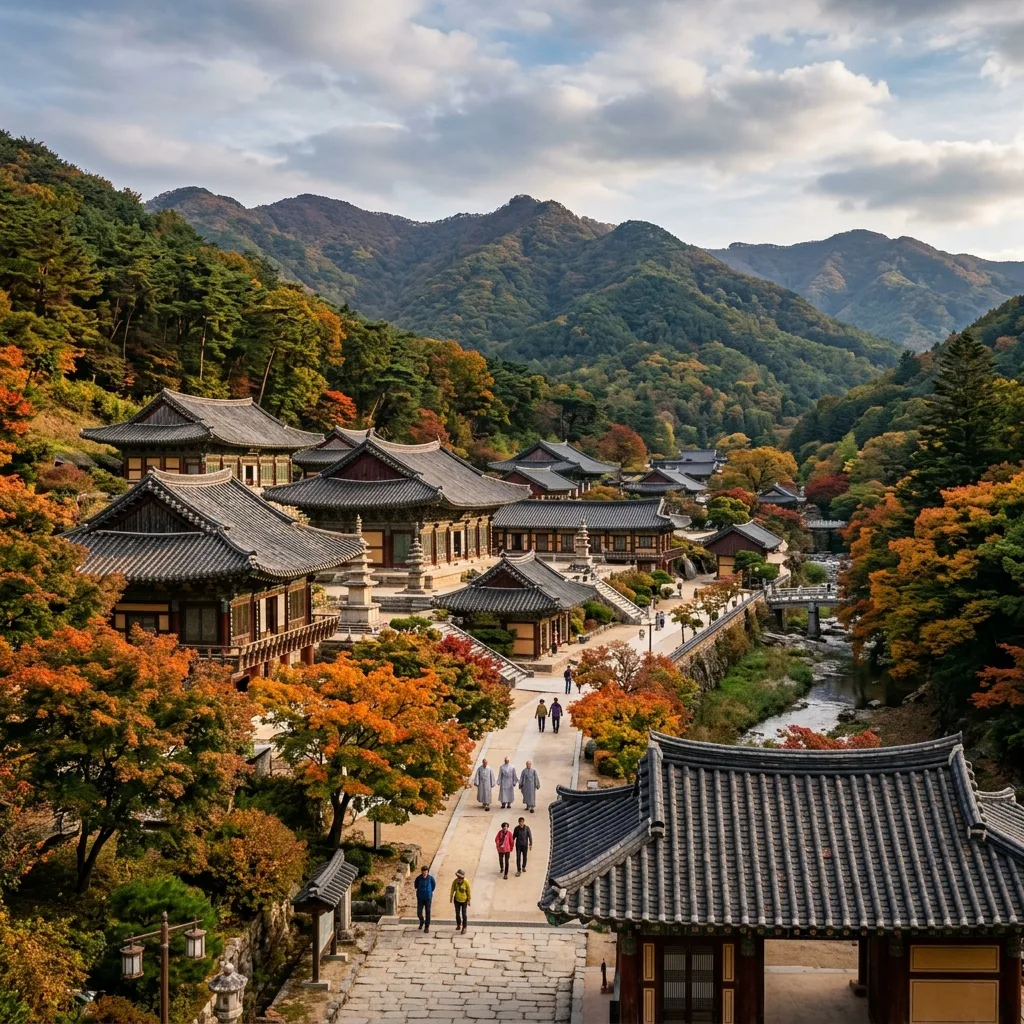
Most visitors to Korea's temples walk in, bow to the golden Buddha statue in the main hall, and move on. At Tongdosa Temple, that routine breaks down immediately: there is no statue. The main hall's altar stands empty — deliberately, defiantly — because the founders believed the relics of the historical Buddha himself, enshrined beneath the courtyard, made any sculpture redundant. That single architectural decision, made over 1,400 years ago, tells you everything you need to know about why Tongdosa is different from every other temple in Korea.
If you're planning to understand Korean Buddhism beyond the surface level — or if you simply want to visit one of the country's most atmospherically complete sacred sites — Tongdosa belongs on your itinerary. This guide covers everything from its founding mythology and UNESCO designation to current admission prices, how to get there from Busan, and what most visitors miss on their first trip.
What Are Korea's Three Jewel Temples?
The concept of the Three Jewel Temples (삼보사찰, Sambo sachal) is central to Korean Buddhism and a useful framework for anyone building a deeper understanding of the country's spiritual landscape.
In Buddhist tradition, the Three Jewels — also called the Triple Gem — are the Buddha (the enlightened teacher), the Dharma (his teachings), and the Sangha (the monastic community). Korean Buddhism elevated three specific temples to embody each jewel, giving each an irreplaceable role within the national religious fabric. These are not just prestigious monasteries; they are conceptual anchors. Any serious temple pilgrim in Korea eventually visits all three.
The three temples are:
- Tongdosa (통도사) — The Buddha Jewel Temple (불보사찰). Located in Yangsan, South Gyeongsang Province. Represents the Buddha because it houses his authentic relics.
- Haeinsa (해인사) — The Dharma Jewel Temple (법보사찰). Located in Hapcheon, South Gyeongsang Province. Represents the teachings because it is home to the Tripitaka Koreana, the world's most complete surviving collection of Buddhist scriptures carved on 81,258 wooden printing blocks.
- Songgwangsa (송광사) — The Sangha Jewel Temple (승보사찰). Located in Suncheon, South Jeolla Province. Represents the monastic community because it has produced sixteen nationally revered teachers (guksa) throughout its history.
For a broader overview of Korea's most significant temple sites, see Korea's Most Sacred Buddhist Temples: A Complete Visitor's Guide.
Tongdosa's History: The Monk Who Brought Back Buddha's Relics
Tongdosa was founded in 646 CE by the monk Jajang Yulsa (자장율사), one of the most consequential figures in the history of Korean Buddhism. The story of the temple's founding is inseparable from the story of his journey.
Jajang traveled to Tang Dynasty China in search of teachings and sacred objects. According to Korean Buddhist tradition, he received a vision of Manjushri, the bodhisattva of wisdom, who directed him to a specific site. There he obtained what are described as physical relics of Shakyamuni Buddha — including a robe, an alms bowl, a begging staff, and a portion of the Buddha's sarira (sacred bone fragments).
When Jajang returned to the Silla Kingdom in 643 CE, he carried these objects with him and eventually enshrined them in a stone reliquary stupa at the site that would become Tongdosa. The stupa is called the Geumgang Gyedan (금강계단), or Diamond Ordination Platform, and it stands at the center of the main compound to this day.
Because the relics themselves represent the Buddha's physical presence, there was no theological need for a carved image. The main hall, the Daeungjeon (대웅전), was built around the stupa's axis — its altar faces the Geumgang Gyedan through an open window rather than toward a conventional statue. This layout, unique in Korea, makes Tongdosa one of the most philosophically unusual temple complexes in all of East Asia.
The temple survived Mongol invasions, the destruction campaigns of the Imjin War (the Japanese invasions of 1592–1598), and the turbulence of Korea's twentieth century. Many of its structures date to reconstructions after the Imjin War, but the Geumgang Gyedan platform itself is believed to be original to Jajang's founding — making it more than 1,370 years old.
In 2018, Tongdosa was inscribed as a UNESCO World Heritage Site as part of the collective designation "Sansa, Buddhist Mountain Monasteries in Korea," which recognized seven mountain monasteries for their living Buddhist traditions, architectural harmony with their natural settings, and continuous cultural significance.
What to See at Tongdosa: A Walking Tour
The temple complex sits on the southwestern slopes of Yeongchuksan Mountain (영축산) and is considerably larger than most visitors expect. The main compound contains 33 buildings, and the wider complex includes over 60 sub-temples and 19 hermitages (암자, amja) scattered through the surrounding mountains. A focused visit to the main compound takes about two hours; a full day allows for exploring the forest paths to several hermitages.
The Pine Forest Approach
The experience of Tongdosa begins before you enter any gate. A long pine forest path — the sol (소나무) grove — runs from the ticket entrance to the temple's first gate. Walking this path, flanked by centuries-old Korean red pines, is one of the most genuinely meditative stretches of road in the country. Take your time. Most tour groups rush through it.
Iljumun: The One Pillar Gate
The first formal gate is the Iljumun (일주문), or One Pillar Gate. The gate's name refers to its architectural form: the columns appear aligned in a single row when viewed from the front, symbolizing the singularity of truth. Passing through signals the transition from the secular world into sacred space.
Cheonwangmun: The Gate of the Four Heavenly Kings
The second gate houses enormous painted statues of the Four Heavenly Kings (사천왕), the guardians of the four directions. These painted wooden figures stand several meters tall and are deliberately terrifying — their role is to deter malicious spirits from entering the temple precincts. The contrast between their ferocity and the serenity beyond the gate is intentional.
Geumgang Gyedan: The Heart of the Temple
The Diamond Ordination Platform is the single most important structure in Tongdosa, and arguably one of the most sacred spots in Korean Buddhism. It is a stone platform topped by a bell-shaped reliquary stupa, enclosed within a low stone wall. Entry to the platform area itself is restricted, but you can walk around the perimeter and view it clearly.
What makes this place remarkable is what it represents: the Buddhist ordination ceremonies conducted here — the formal vows taken by monks entering the sangha — are considered uniquely legitimate because they occur in the presence of the Buddha's own relics. Tongdosa was historically the most important site for monastic ordination in Korea.
Daeungjeon: The Hall With No Statue
The main hall of any Korean Buddhist temple is normally dominated by a large gilded Buddha statue on the central altar. Tongdosa's Daeungjeon (대웅전) has no such statue. The altar is present; offerings are placed; incense burns. But the focal point is an open window behind the altar, through which the Geumgang Gyedan is directly visible. The relics in the stupa are the Buddha — the hall merely frames the view.
This is one of those moments in travel where context completely changes what you see. Without knowing the backstory, the empty altar is just puzzling. Once you understand it, the architectural logic is profound.
Yeongsanjeon and Other Secondary Halls
Beyond the main compound, a series of secondary halls (전, jeon) serve different liturgical functions. The Yeongsanjeon (영산전) contains a painting of the historical Buddha delivering the Lotus Sutra sermon on Vulture Peak — one of the finest examples of Buddhist painting in the region. The Nahan Hall (나한전) houses 500 arhats, the enlightened disciples of the Buddha, depicted in individual ceramic and painted sculptures.
Tongdosa Museum (통도사 성보박물관)
Housed in a purpose-built building near the main entrance area, the Tongdosa Museum is one of the finest temple museums in Korea. Its collection includes ritual objects, Buddhist paintings (taenghwa), calligraphy, wooden printing blocks, and reliquaries accumulated over the temple's 1,400-year history. Many items are designated National Treasures or Important Cultural Properties.
The museum is closed on Mondays and on Seollal (Lunar New Year) and Chuseok (Chuseok holiday) days. Plan your visit accordingly.
Practical Guide: Hours, Admission, and Getting There
Admission Fees
As of 2026, the admission fees to enter the Tongdosa temple grounds are:
| Category | Fee |
|---|---|
| Adults (19–64) | 3,000 KRW |
| Teenagers (13–18) | 1,500 KRW |
| Children (7–12) | 1,000 KRW |
| Seniors (65+) | Free |
| Yangsan residents | Free (with resident registration card) |
The fee is collected at the ticket booth near the main entrance. Museum entry may have a separate fee depending on special exhibitions — check the notice board at the entrance.
Operating Hours
The temple grounds are accessible year-round from early morning (around 5:30–6:00 AM for the first Buddhist service) through the late afternoon. There is no fixed closing time for the outer grounds, but most visitors aim to arrive by 9:00 AM and allow 2–4 hours. Early morning visits are strongly recommended for a quieter atmosphere.
The Tongdosa Museum typically operates from 9:00 AM to 5:00 PM (closed Mondays).
For the most current hours — particularly around major Buddhist holidays like Buddha's Birthday (석가탄신일, Seokga Tanshin-il), when special ceremonies alter the normal schedule — call the temple directly at +82-55-382-7182 or check the official site at tongdosa.or.kr.
Getting There from Busan
Tongdosa Temple is located in Yangsan, roughly 30–40 minutes from central Busan by bus. If you're visiting from Busan — and most international travelers to this region are — see Exploring Busan: A Complete Guide to South Korea's Coastal Gem for help orienting yourself in the city before making the trip out.
By public bus (recommended):
- Take Busan Subway Line 1 (Orange Line) to Nopo Station (노포역) — this is the last station at the northern end of the line.
- From Nopo, take Bus 12 or Bus 13 toward Tongdosa. Buses run approximately every 20 minutes from around 6:30 AM to 9:00 PM.
- Alight at the Tongdosa bus stop. From there, walk approximately 10 minutes west along the pine forest path to the temple entrance.
Total journey time from central Busan (Seomyeon or Nampo area): approximately 60–75 minutes.
By taxi or car: From Nopo Station, a taxi to Tongdosa takes about 20–25 minutes. Parking is available at the temple. By car, take National Highway 35 and follow signs to 통도사.
From Seoul or Gyeongju: Tongdosa is also a reasonable side trip if you're exploring the southern region. Bulguksa Temple in Gyeongju: History, Hours & How to Get There makes for a logical pairing on a two-day Gyeongnam temple circuit.
Guided Tours
Several tour operators run half-day and full-day trips to Tongdosa from Busan, often combining it with two hermitage walks and a traditional Korean lunch. These are worth considering if you want context and narration rather than a self-guided wander. Check platforms like MyRealTrip or Klook for current availability and pricing.
Tips and Common Mistakes
Arrive early, not late. Most group tours arrive between 10:00 AM and noon. The early morning atmosphere — monks performing chanting ceremonies, the pine forest still cool, the courtyards quiet — is dramatically better than midday.
Don't skip the pine forest walk. The 10-minute approach path through the old-growth pine grove is part of the experience. Visitors who rush through it or bypass it entirely miss one of the most calming stretches of ground in all of Korea.
Check the Buddhist calendar before you go. Buddha's Birthday (the 15th day of the fourth lunar month, usually falling in May by the solar calendar) transforms Tongdosa into a sea of lanterns and ceremony. It's spectacular and worth specifically targeting — but also extremely crowded. Plan for crowds and arrive before 9:00 AM.
Know the photography rules. Outdoor architectural photography is generally unrestricted and encouraged. Inside individual halls, check for posted signs — photography may be restricted near altars during active ceremonies.
Dress appropriately. Tongdosa is an active monastery. Shorts, sleeveless tops, and loud clothing are technically discouraged in the inner temple precincts. Light trousers and a layer are sensible anyway given the mountain setting.
The museum is worth a separate hour. Many visitors burn their energy in the main compound and rush through the museum. The taenghwa Buddhist paintings and reliquary collection are among the finest in the country — treat the museum as a destination, not an afterthought.
Learn basic etiquette before you go. Knowing how to behave in the presence of monks, when to bow and when not to, and how to conduct yourself during an active ceremony makes the difference between being a tourist and being a respectful guest. The Sound of Silence: Essential Etiquette for a Korean Temple Stay covers the fundamentals in detail.
FAQ
Why does Tongdosa's main hall have no Buddha statue? The Daeungjeon (main hall) at Tongdosa was deliberately designed without a Buddha statue because the temple enshrines physical relics of the historical Buddha in the adjacent Geumgang Gyedan (Diamond Ordination Platform). The relics themselves represent the Buddha's presence, making a carved image theologically unnecessary. This is unique in Korea.
What does "Three Jewel Temple" mean? The Three Jewels (삼보) in Buddhism are the Buddha, the Dharma (teachings), and the Sangha (monastic community). Korea designated three temples to embody each jewel: Tongdosa for the Buddha, Haeinsa for the Dharma, and Songgwangsa for the Sangha.
Is Tongdosa a UNESCO World Heritage Site? Yes. In 2018, Tongdosa was inscribed as part of the collective designation "Sansa, Buddhist Mountain Monasteries in Korea," along with six other mountain monasteries including Haeinsa and Beopjusa.
How long does a visit take? A focused visit to the main compound takes 1.5–2 hours. Adding the museum adds another hour. Walking to one or two of the nearby hermitages (Seoun-am or Baengnyeonam are the most accessible) adds another 1–2 hours. Budget a half-day minimum; a full day if you want to go slowly.
Can I do a temple stay at Tongdosa? Tongdosa does offer templestay programs, though availability and scheduling change seasonally. Contact the temple directly or check the Korea Templestay official booking platform (eng.templestay.com) for current programs, pricing, and registration.
Is Tongdosa suitable for children? Yes. The spacious grounds, decorative gates with the Four Heavenly Kings, lotus ponds, and varied architecture hold children's attention reasonably well. The museum may be less engaging for young children but is worth a quick pass. The pine forest path is ideal for families.
Conclusion
Tongdosa is not Korea's most famous temple — Haeinsa often gets that label for the Tripitaka Koreana, and Bulguksa in Gyeongju captures most tourist photographs. But in terms of living Buddhist significance, architectural integrity, and sheer scale, Tongdosa has a strong claim to being the most important active monastery in the country.
The empty altar in the Daeungjeon, the ancient stones of the Geumgang Gyedan, the pine forest that greets you on arrival — each element compounds into something that takes time to absorb and longer to forget. Whether you arrive as a Buddhist pilgrim, a history traveler, or simply someone looking for a day out from Busan that feels genuinely meaningful, Tongdosa delivers.
The practical logistics are straightforward: an hour from Busan by bus, a 3,000 KRW admission fee, and a few hours of your morning. What you make of the space is up to you.