Bulguksa Temple in Gyeongju: History, Hours & How to Get There

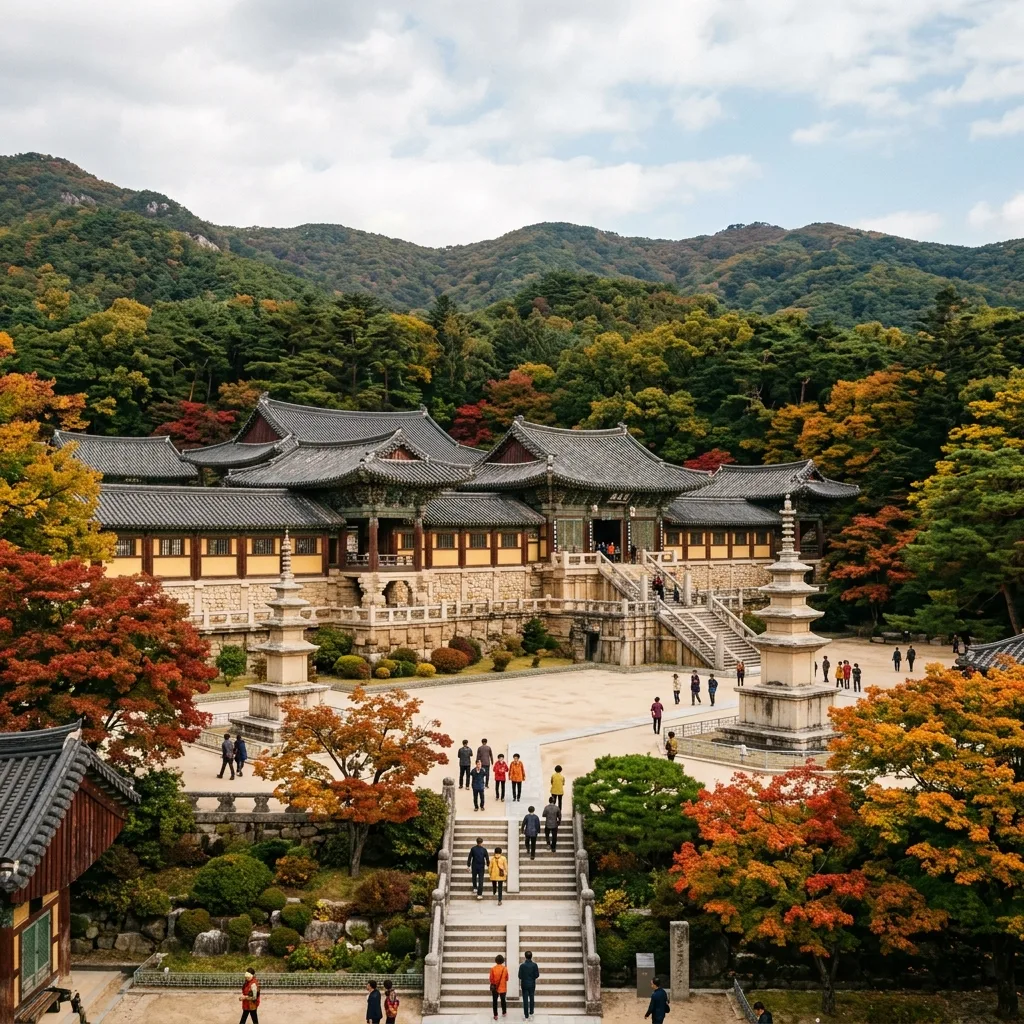
There is a moment, halfway up the stone staircase at Bulguksa Temple, when you stop and realize the steps beneath your feet have been worn smooth by more than a thousand years of pilgrims. The blue-gray granite, the lotus-carved balustrades, the golden rooftiles catching the morning sun — none of it looks like a museum exhibit. It looks alive. Bulguksa is South Korea's most visited UNESCO World Heritage Site for a reason: no photograph has ever done it justice, and no visit ever ends without the urge to turn around and walk back through the gates one more time.
This guide covers everything a first-time visitor needs: the temple's 1,300-year history in plain terms, the specific hours and admission fees for 2026, and the fastest routes from Seoul and Busan using trains and local buses. It also includes the insider details that shorter guides skip — the best time of year to visit, which areas most travelers miss, and how to pair Bulguksa with its mountain companion, Seokguram Grotto, in a single day.
A Brief History of Bulguksa Temple
Bulguksa — which translates loosely as "Temple of the Buddha Land" — was founded in 528 CE during the Silla Kingdom, making it nearly fifteen centuries old. The original structures were modest, but the temple was dramatically expanded in 751 CE under Prime Minister Kim Daeseong during the reign of King Gyeongdeok. Legend holds that Kim Daeseong commissioned Bulguksa to honor his parents from his current life, and the adjacent Seokguram Grotto to honor his parents from a previous life — a story that captures the deep Buddhist sensibility behind every stone here.
The complex was razed during the Japanese invasions of the 1590s (the Imjin War), which destroyed most of the wooden structures. Reconstruction continued fitfully over subsequent centuries, with major government-led restoration campaigns in the 1960s and 1970s restoring the temple to its approximate Unified Silla-era grandeur. In 1995, Bulguksa and Seokguram Grotto were jointly inscribed on the UNESCO World Heritage List as Gyeongju Historic Areas.
What survives from the original 8th-century construction includes some of the most significant stone architecture in Korea: the twin pagodas Dabotap and Seokgatap, two stone bridges (Cheongungyo and Baegungyo), and a set of stone lanterns that are among the oldest and most refined examples of Silla craftsmanship in existence.
The UNESCO Designation and Why It Matters
Bulguksa is part of the broader Gyeongju Historic Areas, a UNESCO World Heritage Site recognizing five distinct zones across the city. The designation specifically cited Bulguksa's outstanding example of Silla Buddhist architecture and its collection of irreplaceable stone artifacts. The two pagodas within the temple grounds — Dabotap and Seokgatap — are individually classified as National Treasures of Korea, along with the stone staircases, the golden seated Buddha, and a stone lantern on the main courtyard.
For travelers, this matters practically: the site is protected, meaning no structures have been commercialized, photography of the main buildings from the courtyard is permitted, and the overall atmosphere remains contemplative rather than tourist-circus. If you have visited crowded Buddhist temples in Thailand or Cambodia and found them overwhelming, Bulguksa's scale and calm will surprise you.
What to See Inside Bulguksa Temple
Cheongungyo and Baegungyo (The Stone Bridges)
The approach to the main hall, Daeungjeon, crosses two stone staircases that function as ceremonial bridges. Cheongungyo (Blue Cloud Bridge) and Baegungyo (White Cloud Bridge) together span 33 steps and were constructed in the Unified Silla period. They represent the passage from the secular world into the realm of the Buddha. Visitors walk up them; in ancient practice, only monks made this crossing on foot.
The bridges are among the finest examples of stone engineering in East Asia. Look closely at the arch underneath — the keystone construction predates most comparable European examples by several centuries.
Dabotap and Seokgatap (The Twin Pagodas)
Standing in the main courtyard, you face two pagodas of radically different characters. Seokgatap (석가탑), the Pagoda of Sakyamuni, is severe and geometric — three tiers of unadorned white granite, its lines so clean they look architectural rather than religious. Dabotap (다보탑), the Pagoda of Many Treasures, is its philosophical opposite: elaborate, asymmetrical, decorated with stone lions and lotus motifs, its layered platforms suggesting something built by craftsmen who were showing off.
Both date to 751 CE. Dabotap appears on the South Korean 10-won coin. When you find a coin in your pocket later, you will recognize it immediately.
Daeungjeon (The Main Hall)
The main worship hall houses a gilded seated Buddha and remains an active religious space. Monks conduct morning prayer here, and on major Buddhist holidays the hall fills with worshippers. Dress modestly and speak quietly when entering. Photography of the interior Buddha is generally not permitted — follow posted signage or defer to what you observe other visitors doing.
Gwaneumjeon and the Eastern Complex
Most visitors spend their time in the main courtyard and miss the eastern wing of the complex, which houses Gwaneumjeon (Hall of the Bodhisattva of Compassion) and several smaller shrines set against the forested hillside. This section feels like a separate temple — quieter, more overgrown, with stone steps leading up through pine trees to smaller halls with sweeping views of the valley below. Budget at least 30 extra minutes here.
Museoljeon (The Hall Without Words)
Near the eastern complex, a stone foundation with no structure above it marks Museoljeon — the Hall Without Words. The name refers to the Buddhist concept that the highest truth is beyond language. The hall was destroyed in the 1590s invasions and was never rebuilt. The empty foundation, framed by the surrounding trees, is unexpectedly moving.
Bulguksa and Seokguram Grotto: One Day, Two Sites
Bulguksa and Seokguram Grotto are typically visited together since they are located 4 km apart on the same mountain (Tohamsan). Seokguram sits higher on the slope and requires an additional shuttle bus or a 3 km uphill walk from Bulguksa.
Seokguram Grotto is an 8th-century artificial stone cave housing a seated granite Buddha regarded as one of the masterpieces of East Asian Buddhist art. The Buddha is 3.5 meters tall, carved from a single piece of granite, and faces east toward the sea — positioned so the first light of the winter solstice falls directly on its forehead. Visitors view the statue through a glass partition (added in the 1960s to halt humidity damage), but the scale and serenity of the figure are fully visible.
Logistics for visiting both in one day:
- Arrive at Bulguksa when it opens (7:00 AM or 9:00 AM depending on season)
- Spend 1.5–2 hours at Bulguksa
- Take shuttle bus #12 from Bulguksa parking area up to Seokguram (runs every 30–40 minutes, fare ~1,200 KRW each way)
- Spend 45 minutes at Seokguram
- Return to Bulguksa parking area and take Bus #711 back into Gyeongju city
This itinerary fits comfortably before lunch, leaving the afternoon for the royal tumuli at Daereungwon or Anapji Pond (Donggung and Wolji). For a full Gyeongju day-trip plan, see Exploring Gyeongju: How to Visit Korea's Open-Air Museum City.
Practical Guide: Hours, Admission, and Getting There
Operating Hours (2026)
Bulguksa Temple is open year-round. Hours vary slightly by season:
| Season | Hours |
|---|---|
| Spring / Summer (Mar–Oct) | 07:00 – 18:00 |
| Autumn / Winter (Nov–Feb) | 08:00 – 17:30 |
The temple grounds are at their quietest between 7:00 AM and 9:00 AM on weekdays. Weekends in cherry blossom season (late March to mid-April) and autumn foliage season (October) draw significant crowds by mid-morning.
Admission Fees (2026)
| Category | Fee |
|---|---|
| Adults (18+) | 5,000 KRW |
| Teenagers (13–17) | 3,500 KRW |
| Children (7–12) | 2,500 KRW |
| Children under 7 | Free |
Note: Admission to Seokguram Grotto is priced separately (around 5,000 KRW for adults) and requires a separate ticket. Buying a combined Bulguksa + Seokguram ticket at the entrance is the most straightforward option.
Getting to Bulguksa from Seoul
Step 1: Take KTX or SRT to Singyeongju Station
From Seoul Station, KTX trains depart frequently for Singyeongju Station. The journey takes approximately 2 hours. Standard fares range from 49,300 KRW (economy) to 69,000 KRW (special class). SRT from Suseo Station is slightly cheaper — around 42,700 KRW standard — with a similar travel time.
Book in advance, especially for weekend travel. For a complete booking walkthrough, see Mastering the KTX: How to Book High-Speed Trains in Korea.
Step 2: Transfer to Gyeongju City
Singyeongju Station is not in central Gyeongju — it sits about 12 km outside the city. From the station, take the connecting commuter train (Mugunghwa line) to Gyeongju Station proper (about 12 minutes, ~2,600 KRW), or take a taxi (~15,000–18,000 KRW directly to Bulguksa).
Step 3: Bus from Gyeongju Station to Bulguksa
Bus #711 departs from Gyeongju Station approximately 10 times per day. Key departure times: 7:07, 8:08, 10:21, 11:17, 13:17, 14:27, 16:16, 17:04. The ride takes 30–35 minutes and uses the standard T-money card fare (~1,500 KRW). Check the schedule at the station as it is subject to seasonal changes.
A taxi from Gyeongju Station to Bulguksa costs around 12,000–15,000 KRW and takes 20 minutes.
Getting to Bulguksa from Busan
Busan is the closest major city to Gyeongju, and the trip is fast.
Option 1: KTX (Fastest) KTX from Busan Station to Singyeongju Station takes approximately 25–30 minutes. Then follow the same transfer steps described above. Total door-to-door time from central Busan is around 90 minutes.
Option 2: Intercity Bus Intercity buses depart from Busan's Nopo-dong Bus Terminal to Gyeongju Intercity Bus Terminal roughly every 30 minutes. The journey takes 50–70 minutes depending on traffic, and costs around 4,500–5,000 KRW. From Gyeongju Bus Terminal, Bus #711 or a taxi continues to Bulguksa.
Option 3: Organized Day Tour Several operators on Klook and GetYourGuide offer Gyeongju day tours departing from Busan that include Bulguksa, Seokguram, and the royal tumuli with a guide. These run roughly 12,000–35,000 KRW per person depending on group size and inclusions. Worth considering if you prefer not to navigate local buses.
Parking (for drivers)
A large paid parking lot operates at the temple entrance. Fees are typically 2,000–3,000 KRW for 2 hours. The lot fills by 10:00 AM on weekends during peak seasons; arriving before 9:00 AM guarantees a space.
Best Time to Visit Bulguksa
Cherry Blossom Season (Late March – Mid-April)
The path from Gyeongju to Bulguksa passes through avenues of cherry trees, and the temple's courtyard has its own blossoms framing the pagodas. Late March to mid-April is the most photogenic window, but also the most crowded. Go on a weekday and arrive at opening time.
Autumn Foliage (Mid-October – Mid-November)
The mountain setting means Bulguksa gets excellent fall color — ginkgo and maple surround the outer walls, and the pine forest above Gwaneumjeon turns copper and gold. Crowds are lighter than cherry blossom season, mornings are cool, and the afternoon light is superb for photography.
Summer (June – August)
Green and lush, but hot and humid. Rain is common in July and August (monsoon season). The upside: far fewer international tourists. Best visited early morning.
Winter (December – February)
Occasional snow transforms the temple grounds completely. A light dusting on the pagodas against a gray winter sky is one of the more striking photographs you can make in Korea. The temple is rarely crowded outside of the Lunar New Year period.
Tips and Common Mistakes
Don't skip the eastern complex. The section past the main courtyard toward Gwaneumjeon is quieter and contains some of the temple's most interesting stone structures. Most tour groups don't go there.
Wear comfortable shoes. The temple grounds involve significant walking on uneven stone surfaces and multiple stair flights. Flat-soled shoes or trail sneakers work better than sandals.
Check the bus schedule before you rely on it. Bus #711 runs only about 10 times per day. If you miss the last convenient bus, you are looking at a taxi. Download the Kakao Map app and search "불국사" for live bus schedules and departure times from Gyeongju Station.
The 10-won coin detail. Once you know Dabotap appears on the 10-won coin, you will find it impossible not to look for one. They are increasingly rare (most are discontinued from circulation) but you may find one in change. It makes for a simple and free souvenir.
Early morning is always better. The difference between Bulguksa at 7:30 AM and Bulguksa at 11:00 AM on a Saturday in October is the difference between a spiritual experience and a crowded plaza. The temple opens early specifically for morning devotees. Use that window.
Combine with the city properly. Gyeongju deserves a full day or an overnight stay. The royal tumuli at Daereungwon are 15 minutes from central Gyeongju by bicycle, Anapji Pond (Donggung and Wolji) lights up at night, and the Hwangnidan-gil street has excellent food and coffee. If Bulguksa is the only thing on your Gyeongju itinerary, you are seeing about a third of what is available. For a fuller picture of the city, the guide to Gyeongju's ancient history and open-air landmarks covers the city's other major sites.
Frequently Asked Questions
Is Bulguksa Temple worth visiting? Yes — it is one of the most significant historical sites in East Asia, and the quality of the stone architecture is unmatched anywhere in Korea. Even travelers who are not particularly interested in Buddhist culture find the setting and the age of the structures impressive. Allow at least 2 hours.
How long does it take to visit Bulguksa? A thorough visit, including the main courtyard, both pagodas, the eastern complex, and Gwaneumjeon, takes 1.5 to 2 hours. Combining with Seokguram Grotto adds another 1–1.5 hours including shuttle time.
Can I visit Bulguksa as a day trip from Seoul? Yes, though it makes for a long day. Take the first available KTX from Seoul (departures begin around 5:30–6:00 AM), arrive in Gyeongju by 8:00–9:00 AM, visit Bulguksa and Seokguram, and return to Seoul by evening. A more comfortable option is to stay overnight in Gyeongju. For a broader Korea trip structure, the ultimate 10-day South Korea itinerary includes Gyeongju as a recommended overnight stop.
Is Bulguksa Temple free? As of 2026, admission is 5,000 KRW for adults. Some sources reported a brief free-admission period in 2023, but paid admission has since been reinstated. Confirm current fees at the ticket booth on arrival.
Do I need to book tickets in advance? No advance booking is required. Purchase tickets at the entrance gate on arrival. For guided English-language tours of Bulguksa or combined Gyeongju day tours, booking through platforms like Klook or GetYourGuide 1–2 days in advance is recommended, especially in spring and autumn.
Is Bulguksa appropriate for children? Yes. Children enjoy the scale of the pagodas and the stone bridges. The terrain involves steps and uneven surfaces, so strollers are impractical — a carrier or having older children walk independently works better. Children under 7 enter free.
Conclusion
Bulguksa Temple is not just the most-visited UNESCO site in Korea — it is the clearest single window into what the Silla Kingdom built at the height of its power. The twin pagodas, the stone bridges, the worn granite staircases: each of these is older than most European cathedrals, and none of them sits behind glass in a climate-controlled room. You walk among them, stand in the same courtyard as the architects who drew the plans, and look at the same mountain the morning-prayer monks have faced for thirteen centuries.
Getting there is genuinely straightforward: KTX from Seoul or Busan to Gyeongju, then Bus #711 or a short taxi to the gate. Arrive early, stay longer than you planned, and save time for the eastern complex that most visitors miss. If you have a second day, the rest of Gyeongju — the royal tumuli, Anapji Pond, Seokguram above the treeline — will fill it completely.
Plan the trip. The stones will be there when you arrive.