Seoul's Five Grand Palaces: A Complete Visitor's Guide
Seoul is, on a structural level, a Joseon dynasty city beneath its modernity. The street grid of central Seoul still follows the logic of the palace-centered capital planned in 1394, and five of the royal palaces commissioned by that dynasty are still standing — not as ruins, but as active heritage sites that together form the most concentrated complex of East Asian court architecture still surviving in any city on Earth.
The Five Palaces: Quick Reference
| Palace | Hangul | Founded | Admission | Closed | Subway |
|---|---|---|---|---|---|
| Gyeongbokgung | 경복궁 | 1395 | 3,000 KRW | Tuesdays | Gyeongbokgung (Line 3) |
| Changdeokgung | 창덕궁 | 1405 | 3,000 KRW (+5,000 Secret Garden) | Mondays | Anguk (Line 3) |
| Changgyeonggung | 창경궁 | 1484 | 1,000 KRW | Mondays | Hyehwamun (Line 4) |
| Deoksugung | 덕수궁 | 1593* | 1,000 KRW | Mondays | City Hall (Lines 1/2) |
| Gyeonghuigung | 경희궁 | 1617 | Free | Mondays | Seodaemun (Line 5) |
Free admission for: Visitors wearing hanbok; children under 18; seniors aged 65+; last Wednesday of the month (Culture Day).
2026 Integrated Palace Pass: Now 10,000 KRW (updated for 2026). It covers Gyeongbokgung, Changdeokgung, Deoksugung, Changgyeonggung, and Jongmyo Shrine for 3 months. Note: It still does not include the Changdeokgung Secret Garden tour, which must be booked separately.
🏛️ Palace Architecture 101: What to Look For
Before you walk through the gates, understanding a few key architectural motifs will transform how you see these buildings.
- Dancheong (단청): The vibrant, multicolored paint patterns on the wooden eaves. These aren't just decorative; the minerals in the paint (mercury, lead, and arsenic in the past) protect the wood from insects and rot. Look for the five cardinal colors: blue (east), white (west), red (south), black (north), and yellow (center).
- Japsang (잡상): Small clay figurines lined up on the corner of the roof hips. They are typically characters from the Chinese classic Journey to the West (including the Monkey King). Their purpose is to ward off evil spirits and protect the buildings from fire. The more important the building, the more figurines it has (Gyeongbokgung's main hall has 11).
- Ondol (온돌): Look for the raised stone floors and the chimneys (Gulttuk) behind the buildings. This is Korea's unique underfloor heating system. Even the King’s throne hall was heated this way in winter.
- Deoseok (Stone Rings): In the main courtyards, you’ll see iron rings set into the stone. These weren't for horses; they were used to tie down massive awnings during royal ceremonies to protect officials from the sun and rain.
1. Gyeongbokgung Palace (경복궁) — The Grand Palace
Founded: 1395 Hours: 9:00–18:00 (Jun–Aug until 18:30); closed Tuesdays Admission: 3,000 KRW; free in hanbok Best for: Scale, grandeur, and the Gyeonghoeru Pavilion
Gyeongbokgung — "Palace Greatly Blessed by Heaven" — is the largest and most ceremonially important of Seoul's five palaces. Built as the primary palace of the Joseon dynasty's founders in 1395, it was burned and abandoned during the Japanese invasions of 1592–1598, left empty for 270 years, and reconstructed in the 1860s under the흥선대원군 (Heungseon Daewongun, the regent of the child king Gojong).
Today about 30% of the original buildings have been reconstructed; the overall scale is still immense — 410,000 square meters containing hundreds of structures arranged along a central ceremonial axis.
What to See
Gwanghwamun Gate (광화문): The main southern gate — the primary entrance to the palace and one of the most recognized landmarks in Korea. Immediately behind it is Heungnyemun (the second gate), and then the main courtyard opens.
Geunjeongjeon Throne Hall (근정전): The main throne hall — the largest wooden building in Korea, elevated on a two-tiered stone platform. The surrounding stone terraces with their carved guardian animals (haechi) and the view toward Bugaksan Mountain behind the hall create Seoul's most iconic traditional composition.
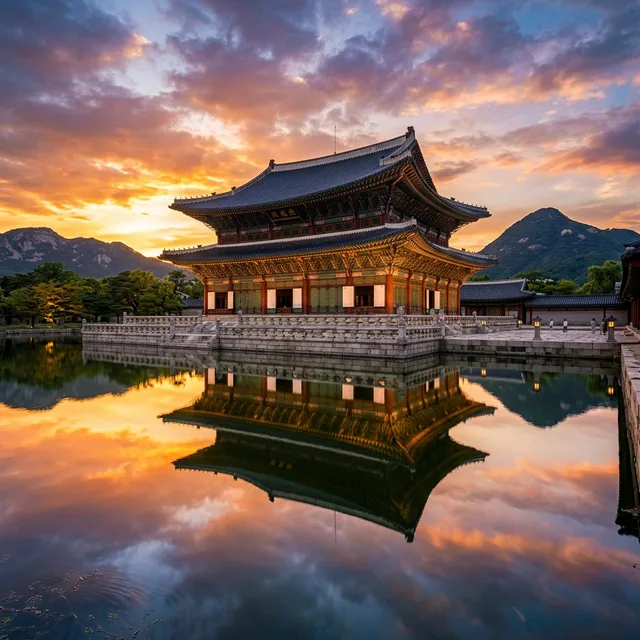
Gyeonghoeru Pavilion (경회루): A grand two-story banquet pavilion built on a square island in an artificial lake within the palace grounds. Views of the pavilion reflected in the lake, with the palace walls and mountains beyond, are among the most beautiful in Seoul. After the main gate and throne hall, this is the must-see.
Amisan Garden: A small ornamental garden in the rear of the palace's inner courtyard area, featuring traditional chimney structures decorated with carved patterns.
National Palace Museum of Korea (on grounds): Excellent collection of palace artifacts, furniture, clothing, and historical documents. Free admission. Worth 1–1.5 hours additional.
Changing of the Guard: Performed at Gwanghwamun Gate four times daily; elaborate historical costume ceremony lasting about 20 minutes.
Photography Tips
- Best light: Morning (9–11 AM) for front-facing Geunjeongjeon shots; late afternoon (4–6 PM) for the west-facing Gyeonghoeru Pavilion
- Avoid: Late morning and weekend afternoons — significant crowd density on the main axis
- Hanbok + Gwanghwamun: The gate courtyard is the classic hanbok photo location
2. Changdeokgung Palace (창덕궁) — The UNESCO Palace
Founded: 1405; UNESCO World Heritage 1997 Hours: 9:00–18:30 (seasonal); closed Mondays Admission: 3,000 KRW + 5,000 KRW (Secret Garden, separate guided tour) Best for: Architecture, harmony with nature, the Secret Garden
Changdeokgung served as the primary working palace for most of the Joseon dynasty — where the actual business of governing happened, as opposed to Gyeongbokgung's ceremonial function. It is smaller than Gyeongbokgung but widely considered more architecturally rewarding — its buildings respond organically to the terrain, integrating with ridgelines, streams, and valleys rather than imposing on them.
The Secret Garden (Huwon/Biwon)
The rear garden of Changdeokgung — 300,000 square meters of cultivated forest, moon bridges, lotus ponds, ancient trees, and pavilions — is accessible only on guided tours, which run several times daily and are limited in size. Tours typically last around 90 minutes.
Book Secret Garden tours in advance at the official Changdeokgung website or via the palace box office — they sell out frequently, particularly during spring festival season (cherry blossoms, traditionally early April) and autumn foliage (mid–late October).
The garden's beauty is seasonal: cherry and magnolia in spring, water lilies and irises in early summer, full canopy green in late summer, and the extraordinary red-gold maple and ginkgo forest in autumn. Many people who have visited Seoul multiple times still name the Changdeokgung Secret Garden in autumn as the finest natural sight the city offers.
Main Palace Highlights
- Donhwamun Gate: The oldest surviving gate in Seoul's palace system
- Injeongjeon Throne Hall: Smaller and more intimate than Gyeongbokgung's throne hall; the cedar ceiling and stone flooring are in excellent condition
- Huijeongdang Hall: Gyeongbokgung served formal ceremony; Changdeokgung served daily life — Huijeongdang was the king's actual residence and working space
3. Deoksugung Palace (덕수궁) — The Modern History Palace
Founded: 1593 (retrofitted); UNESCO on the Korean Heritage list Hours: 9:00–21:00 (last entry 20:00); closed Mondays Admission: 1,000 KRW Best for: Modern architecture contrast, evening visits, accessible location
Deoksugung is historically anomalous — it wasn't built as a royal palace but became one when Gyeongbokgung was destroyed in the 1592 invasions. It served as the emergency royal residence for over a century, then fell out of use.
It became dramatically significant again in the late 19th and early 20th century: this is where Emperor Gojong received foreign dignitaries as Korea attempted to navigate the collision between its traditional order and the imperial pressures of Japan, China, and Western powers. The palace contains Seokjojeon, a Western-style neoclassical building (1910) housing the National Museum of Contemporary History.
What to See
Daehanmun Gate: The main gate facing the plaza between City Hall and Deoksugung — one of the few palace gates still surrounded by modern city life rather than palace grounds
Junghwajeon Throne Hall: The main throne hall; compact and well-preserved
Seokjojeon Hall: The Western neoclassical building — granite facade, European-style rooms — built for King Gojong to receive Western diplomats. Contains the National Museum of Contemporary History (free within the palace admission)
Deoksugung Stone Wall Road (돌담길): The path running along the outside of the palace's stone wall, between Deoksugung and the US Embassy, is one of Seoul's most beloved walkways — shaded, tree-lined, and historically atmospheric. Open until late evening.
Changing of the Guard at Daehanmun Gate: One of the most accessible guard ceremonies in Seoul (location: directly at City Hall plaza).
Evening Advantage
Deoksugung is open until 9 PM — later than any other palace. Evening visits, particularly in autumn when the trees are backlit against the palace walls and the stone road is quiet, are a genuinely special Seoul experience.
4. Changgyeonggung Palace (창경궁) — The Quiet Palace
Founded: 1484 Hours: 9:00–21:00; closed Mondays Admission: 1,000 KRW Best for: Fewer crowds, Japanese-colonial history, the greenhouse
Changgyeonggung is the least-visited of the five grand palaces — which makes it, for many visitors, the most enjoyable in terms of atmosphere. Originally built to house Queen Dowagers (mothers and grandmothers of the reigning king), it was dismantled and converted into a public zoo and botanical garden by the Japanese colonial administration in 1909 (adding the specific humiliation of renaming it Changgyeong Park).
The zoo and amusement park were removed in 1983 and the palace was partially restored; the original botanical greenhouse from the colonial period survives and has become an unlikely heritage landmark — an early 20th-century iron and glass structure housing tropical plants.
What to See
Honghwamun Gate: The oldest and smallest of the palace main gates; elegant simplicity
Myeongjeongjeon Throne Hall: The oldest wooden throne hall surviving in Seoul (late 17th century reconstruction); east-facing (unusual for a Korean throne hall)
Tongmyeongjeon Hall: The original Queen Dowager's residence
Botanical Greenhouse (대온실): The 1909 Japanese-colonial greenhouse; an anachronism that has acquired its own historical significance
Spring Cherry Blossoms: Changgyeonggung hosts one of the most beautiful cherry blossom events in Seoul each April, with evening lighting of the blossoms a major cultural event
Physical Connection to Changdeokgung
Changgyeonggung and Changdeokgung physically adjoin each other and share the Huwon (rear garden) area. Your admission to Changgyeonggung gives access to the shared garden space (separate from the Secret Garden, which requires a separate ticket from the Changdeokgung side).
5. Gyeonghuigung Palace (경희궁) — The Free Palace
Founded: 1617 Hours: 9:00–18:00; closed Mondays Admission: Free Best for: Relaxed budget option; city view; history of Japanese colonial removal
Gyeonghuigung is the most modest of the five surviving palaces — and the one with the most melancholy history. The Imperial Japanese colonial government systematically dismantled most of the palace between 1915 and the 1920s; buildings were moved, sold, or destroyed to build a Japanese school on the grounds (now Seoul High School).
What survives — the Heunghwamun Gate (relocated back to the grounds in 1988 from where it had been moved to Yeongchoosa Temple), the Sungjeongjeon Throne Hall (reconstructed in 1994), and Heungbokjeon Hall — represents a fraction of the original 1,500-room palace.
For the modern visitor, Gyeonghuigung is quiet, free, largely uncrowded, and a 10-minute walk from the historic Cheonggyecheon Stream and Gwanghwamun. It is a good capstone to a day of heavier palace visiting — somewhere to walk without crowds, free of charge.
👑 Comparison: The Five Grand Throne Halls
| Palace | Throne Hall Name | Vibe | Uniqueness |
|---|---|---|---|
| Gyeongbokgung | Geunjeongjeon | Imposing & Royal | Massive scale; 2-story tiered platform |
| Changdeokgung | Injeongjeon | Elegant & Intimate | European-style chandeliers added in 1908 |
| Deoksugung | Junghwajeon | Modern Transition | Surrounded by skyscrapers & neoclassical buildings |
| Changgyeonggung | Myeongjeongjeon | Ancient & Austere | The oldest surviving hall (late 17th century) |
| Gyeonghuigung | Sungjeongjeon | Quiet & Reconstructed | Almost always crowd-free; tucked into the hills |
🌙 2026 "Moonlight" and "Starlight" Tours
In 2026, the night opening programs have been significantly expanded. These are separate, premium tickets that must be reserved months in advance on the K-Heritage app.
- Changdeokgung Moonlight Tour: A 90-minute evening walk through the Secret Garden by lantern light, ending with a traditional tea ceremony and a gayageum (zither) performance.
- Gyeongbokgung Starlight Tour: An evening tour that includes a "Royal Banquet" experience inside the Sojubang (royal kitchen) area, where you eat a multi-course meal modeled after what the King ate in the 19th century.
- Deoksugung "Gyeongun-gung" Night: A more casual night opening (open until 9 PM daily) that requires no special booking, famous for its lighted stone wall path.
🌸 Seasonal Events & Royal Holidays
- Seollal (Lunar New Year) & Chuseok: During these major holidays, all five palaces are traditionally free for everyone. Expect traditional games (like Tuho or Yutnori) in the main courtyards and special ritual re-enactments.
- Royal Culture Festival (May & October): The biggest event of the year. Each palace hosts a week of unique performances, from digital projection mapping to open-air royal weddings.
- Cherry Blossom Night (April): Specifically at Changgyeonggung, where the blossoms around the pond are illuminated with soft spotlights.
Which Palaces to Visit (Prioritization)
If you have 1 day:
- Visit Gyeongbokgung (the grandest and most photographed); combine with the National Palace Museum, the National Folk Museum, and Bukchon Hanok Village nearby. Wear hanbok for free entry.
If you have 2 days:
- Day 1: Gyeongbokgung (morning) + Bukchon Hanok Village (afternoon)
- Day 2: Changdeokgung + Secret Garden (book the Secret Garden tour in advance; this is the most architecturally rewarding palace)
If you have 3+ days:
- Add Deoksugung (easiest evening option; Stone Wall Road is beautiful)
- Add Changgyeonggung in spring for cherry blossoms
Budget visitors: Get the Integrated Palace Pass (6,000 KRW) — it pays for itself if you visit 3+ palaces and is valid for 3 months.
Final Thoughts
Seoul's five grand palaces are the city's most direct link to the 500 years of Joseon history that formed the shape of modern Korean culture. Together they constitute a remarkable open-air museum of East Asian court architecture, ceremonial life, and political history — one that is still actively tended, intelligently restored, and beautifully maintained.
Visit more than one if you can. Each has a distinct character, and the cumulative understanding you build across multiple visits creates a richness that any single palace visit cannot convey. Pair your palace exploration with an understanding of proper Korean social customs and etiquette to deepen your cultural appreciation, or consider extending the historic ambiance by booking a stay in a traditional hanok village. For those bringing loved ones, weaving these majestic palaces into a well-rounded kid-friendly itinerary ensures a memorable journey into Korea's past for the entire family.
📱 2026: The "Digital Palace" Revolution
In early 2026, the Cultural Heritage Administration launched the "K-Heritage Mobile Hub."
- NFC Integrated Pass: You no longer need a physical paper ticket for the 10,000 KRW pass. You can buy it in the Visit Korea app and simply tap your phone at the gate of any of the five palaces.
- AI Audio Guides: Every palace now features QR codes on information boards that link to AI-generated audio tours in 12 languages. They are immersive, featuring traditional music and 3D soundscapes of what the palace sounded like 300 years ago.
- Holographic Guardians: At Gyeongbokgung's Gwanghwamun gate, look for the designated "AR Spots." Using your phone, you can see a digital 3D Haechi (mythical lion) guarding the entrance alongside the real-life guards.
After exploring the royal history, continue your cultural journey with our guide to South Korea's UNESCO World Heritage Sites or see the National Museum of Korea for the artifacts that once lived inside these palace walls. To dress the part, read our tips on Hanbok Rental in Korea. Finally, coordinate your visit with our Ultimate 10-Day South Korea Itinerary.