Don't Be 'That' Tourist: A Guide to Korean Social Customs

You know about Korean BBQ and K-Pop. But do you know where not to sit on the subway? Or why the room suddenly went quiet when you started eating?
Korea is a high-context society built on Confucian values of respect and hierarchy. While locals are generally forgiving of foreigners, knowing the basic rules will earn you genuine respect and open doors that remain closed to the average tourist.
Here is your crash course in Korean etiquette—how to navigate the culture without being "that" tourist.
Understanding the Confucian Foundation
Before we get into the specific rules, it helps enormously to understand why they exist. Korean social customs are not a random collection of quirks. They are the living expression of over 600 years of Neo-Confucian philosophy that took root during the Joseon Dynasty (1392–1897) and never really left.
Four concepts form the invisible architecture of Korean social life:
- Jeong (정): A deep emotional bond that develops between people over time. It is the reason Koreans feel such fierce loyalty to close friends and family—and why strangers who show genuine effort are welcomed so warmly. Jeong is not given lightly, but once you earn it, you have a connection for life.
- Nunchi (눈치): The art of reading the room. We will come back to this at the end, but it is the single most important social skill you can develop as a visitor to Korea.
- Kibun (기분): Literally "mood" or "atmosphere," but with a deeper social weight. Kibun is the collective emotional temperature of a room that must be maintained and protected. Disrupting someone's kibun—through bluntness, rudeness, or social clumsiness—is a serious social misstep.
- Hoobae / Sunbae (후배 / 선배): The system of juniors (hoobae) and seniors (sunbae) that governs virtually every social and professional context in Korea. This is not about age alone—it is about who entered a company, school, or social group first. Sunbae gives guidance and pays for meals; hoobae shows deference and does the grilling at KBBQ.
Understanding these four pillars makes every rule in this guide feel logical rather than arbitrary. A foreigner who demonstrates genuine comprehension of this framework will be received not as a tolerated outsider, but as a guest who has done their homework. That is a meaningful distinction in Korean culture.
1. The Art of the Bow (Insa)
Bowing is the handshake of Korea. It is used for greetings, goodbyes, apologies, and gratitude.
- The "Nod" (15°): A slight tilt of the head. Use this for convenience store clerks, taxi drivers, or people you see frequently.
- The "Respect" (30-45°): Bending from the waist with your hands at your side or clasped in front. Use this for elders, meeting someone for the first time in a formal setting, or when apologizing.
- The Handshake: If a hand is offered (usually by an older male), shake it with your right hand while supporting your right forearm with your left hand. Never shake hands with one hand in your pocket.
Age and the Honorific Language System (Banmal vs. Jondaemal)
The bow is the physical expression of respect. The language is the verbal one. Korean has two distinct speech modes that reflect the same hierarchy:
- Banmal (반말): Informal speech, used with close friends, children, or people definitively younger than you. Think of it as the equivalent of calling someone by their first name and dropping all formality.
- Jondaemal (존댓말): Formal, polite speech, used with strangers, elders, bosses, and anyone you do not have a close established relationship with. As a tourist, this is your default mode for almost every interaction.
You do not need to master Korean grammar to make a good impression. A handful of polite phrases delivered with sincerity will go remarkably far:
- Annyeonghaseyo (안녕하세요): Formal hello.
- Gamsahamnida (감사합니다): Formal thank you. This is the one to use at restaurants, shops, and any time someone helps you.
- Joesonghamnida (죄송합니다): Formal, sincere apology. Use this if you bump into someone, make a mistake, or cause any inconvenience. It lands much better than "sorry."
Koreans are acutely aware of when foreigners make an effort with the language. Even a clumsily pronounced "gamsahamnida" will earn you a genuine smile in return.
Oppa, Unnie, Hyung, Noona — The Social Family
Korean does not use names or generic titles the way English does. Instead, relationships are described with specific words that encode the age and gender relationship between two people:
- Oppa (오빠): Used by women to address an older brother or an older male friend/acquaintance.
- Hyung (형): Used by men to address an older brother or older male friend.
- Unnie (언니): Used by women to address an older sister or older female friend.
- Noona (누나): Used by men to address an older sister or older female friend.
These terms are used freely between near-strangers. If a young woman at a bar calls you "oppa," she is using a familiar social address—it signals warmth and comfort, not romance. Similarly, if staff at a restaurant call you "unnie" or "ajumma" (아줌마, used for middle-aged women), it is a form of social placement, not an insult. Context matters.
2. The Shoe Rule (Floor Culture)
Koreans live on the floor. The traditional heating system, Ondol, warms the floor, making it the center of life. Therefore, the floor must be kept pristine.
- The Rule: You MUST remove your shoes when entering a home, a temple, a guesthouse, and traditional restaurants with raised floor seating.
- The Porch (Hyeon-gwan): This is the lower area at the entrance where you leave your shoes. Step up into the house in your socks.
- Pro Tip: Wear clean socks without holes. You will be taking your shoes off constantly.
3. Dining Etiquette: The Hierarchy of Eating
Korean dining is a communal experience, but it follows a strict order.
- The Eldest Eats First: Do not pick up your chopsticks until the oldest person at the table has started eating.
- The "Two-Hand" Pour: Any exchange of liquids follows the two-hand rule.
- Pouring: Hold the bottle with your right hand and support your right elbow/wrist with your left hand.
- Receiving: Hold your cup with two hands.
- Never Pour Your Own: It is bad luck. Fill your neighbor's glass, and they will fill yours.
- Chopstick Taboos:
- Sticking Vertical: Never stick chopsticks vertically into a bowl of rice. This resembles incense burned at funerals for the dead. It is highly offensive.
- Pointing: Do not point at people or dishes with your chopsticks.
The Korean BBQ Protocol
KBBQ is not just dinner. It is a full social ritual with its own code of conduct.
- Who Manages the Grill: Traditionally, the youngest person at the table grills for the elders. This role is now more loosely shared, especially in casual groups, but if you are the youngest or newest guest, stepping up to manage the grill is a gesture of respect that will be noticed and appreciated.
- Sauce Discipline: Do not put sauces directly on the grill unless they are explicitly designed for it (like the sesame oil and salt mixture for some meats). Marinades belong on the meat before it hits the grill, not added mid-cook from the side dish bowl.
- The Ssam (쌈): Assembling a lettuce wrap for someone else—placing grilled meat, rice, garlic, and sauce into a leaf and handing it to them—is an act of warmth and care. If someone makes a ssam for you, accept it graciously and eat it in one bite if possible. Breaking it apart or dissecting it before eating reads as rejection.
- Anju (안주): This is the food consumed alongside alcohol. In Korea, drinking without food on the table is unusual to the point of being vaguely suspicious. Snacks and dishes always accompany drinks, and ordering anju is part of the social contract when you order the first round.
Spoon vs. Chopsticks — Korea's Unique System
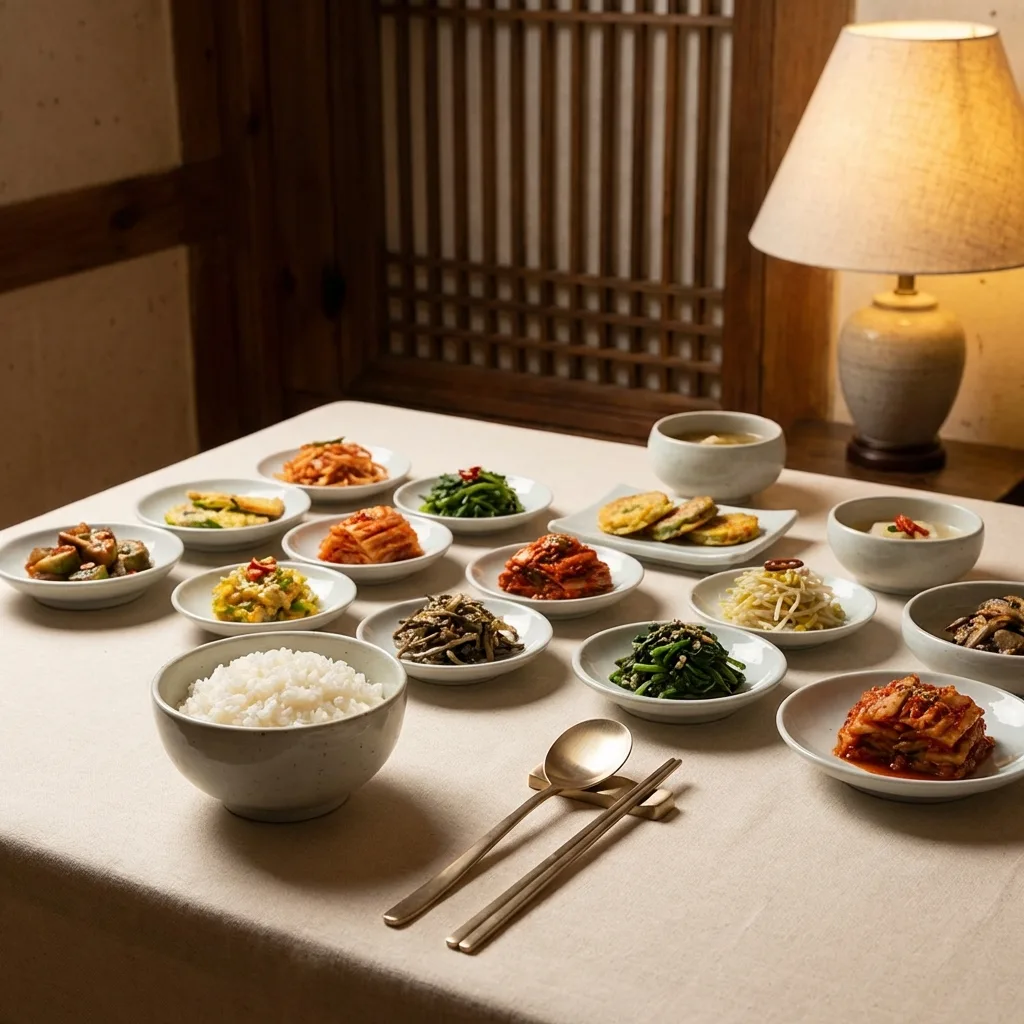
Here is something that surprises many visitors: Koreans use a spoon for rice, not chopsticks. Unlike Chinese or Japanese custom, the spoon is the primary utensil for eating rice and soup. Chopsticks handle the banchan (side dishes) and meat.
The unwritten rules:
- Never hold both the spoon and chopsticks simultaneously. Set one down before picking up the other.
- The spoon goes in your right hand when eating from a bowl of rice or soup.
- Lifting the rice bowl up to your mouth (as is common in Japan) is not standard Korean practice. The bowl stays on the table; you lean slightly and bring the spoon to your mouth.
The Bill-Fighting Culture
Few things are more Korean than the moment when a meal ends and three people simultaneously lunge for the bill. The ritualized contest over who pays is a genuine expression of generosity and social positioning.
The general rules:
- The senior person (by age or status) is expected to pay, particularly in formal or business settings.
- If someone insists on paying, the correct move is a brief, genuine resistance ("Please, let me—") followed by gracious acceptance if they persist.
- Forcing a Dutch split (더치페이, "Dutch pay") with older Koreans in a traditional setting can create awkwardness. Among younger Koreans, especially in casual settings, splitting is increasingly normal.
- The person who was treated last time often insists on paying this time. The cycle of reciprocal generosity is how Jeong is maintained over years.
4. Public Transport: The Sacred Pink Seat
This is the most common mistake unsuspecting tourists make.
- The Pink Seat: Every subway car has designated pink seats at the ends. These are for pregnant women only.
- The Rule: Even if the train is completely empty and you are exhausted, DO NOT SIT THERE.
- The Why: Many pregnancies are not visible in the early stages. The seat must remain open for them. If you sit there, you will be silently judged by the entire car (or loudly scolded by an older lady).
- The Elderly Seats: The seats at the far ends of the car (usually grey or red) are for the elderly and disabled. Leave them be.
- Noise: The subway is for commuting, not loud conversations. Keep your voice down.
The Escalator Rule
Stand on the right side of escalators throughout Seoul and most of Korea. The left side is a passing lane for people walking up or down. This is not a suggestion—it is the unspoken social law of every major subway station and shopping center. Planting yourself on the left while holding a coffee and staring at your phone is a reliable way to generate silent (or not-so-silent) irritation from every Korean commuter behind you.
Queue Culture — Pali-pali Meets Orderly Waiting
Korea operates on "Pali-pali" (빨리빨리) time. This literally means "hurry hurry," and it describes the national culture of urgency and efficiency. Koreans move fast, eat fast, and have remarkably little patience for dawdling.
And yet, queuing is completely orderly. Yellow painted footprint markers on subway platforms indicate exactly where to stand for each train door. Passengers form two neat columns at each door, wait for exiting passengers to clear, and then board in turn. There is no pushing, no cutting, no casual drift to the front. The speed of daily life and the orderliness of queues coexist without contradiction—it is a very Korean balance.
Do not push past people to board. Do not step around the yellow markers. Wait your turn, and you will fit in seamlessly.
5. Giving and Receiving (The Two-Hand Rule)
This applies to everything—credit cards, business cards, gifts, and even passing a side dish.
- The Rule: Always use two hands (or the right hand supported by the left) to give or receive an item.
- Why: Giving something with one hand (especially the left) feels dismissive, like you are tossing it away.
6. Essential Taboos
- Red Ink: Never write a living person's name in red ink. Historically, this color was used to record the names of the deceased in family registers. Doing it to a living person is considered a curse.
- Blowing Your Nose: Blowing your nose loudly at the dinner table is considered disgusting. Sniffling is tolerated, but if you need to blow, excuse yourself to the bathroom.
7. Gift-Giving Culture
Gifts matter in Korea. Bringing one when visiting someone's home is not optional—it signals that you value the relationship and the invitation.
What to bring:
- Fruit baskets (premium Korean fruit is genuinely expensive and always well-received)
- Pastries or cakes from a well-known bakery
- A bottle of wine, premium soju, or a quality whisky for adult hosts
- High-quality snacks or specialty food items from your home country
What to avoid:
- Sets of four: The number 4 (사, sa) sounds identical to the word for "death" in Korean. Avoid giving anything in a set of four—four bottles of wine, four of anything. Sets of six, eight, or ten are fine.
- Shoes: Giving someone shoes implies you want them to "walk away" from you and out of your life. Leave the footwear gifts at home.
- Sharp objects: Knives and scissors are thought to symbolically sever relationships.
How gifts are received: Do not be surprised if your gift is set aside without being opened. Koreans typically do not open gifts immediately in front of the giver—doing so can feel like you are evaluating the gift's worth on the spot, which creates pressure for everyone. The gift will be opened later and appreciated privately. This is not indifference; it is social grace.
Wrapping matters. Careless or disheveled wrapping signals a lack of care about the gesture itself. Take the time to wrap thoughtfully, or have the item gift-wrapped at the store.
8. The Drinking Culture Rules
Korea's drinking culture is one of the most elaborate and enjoyable social institutions in the country—but it comes with rules that go well beyond the two-hand pour covered earlier.
- Pour for Others First: Never fill your own glass before filling the glasses of everyone around you. This is the baseline expectation.
- The First Toast: The eldest or most senior person at the table typically proposes the first toast. Common toasts are Geonbae! (건배!), which means "cheers" literally "empty glass," and Wihayeo! (위하여!), which means "for the sake of [whatever we are celebrating]." Wait for the senior person to raise their glass before drinking.
- The First Drink: Refusing the first drink offered in a social setting—especially by a host or senior colleague—is considered quite rude. You do not have to drink deeply or quickly. Touching the glass to your lips and taking a small sip is perfectly acceptable. What matters is the gesture of participation.
- Turning Your Glass Upside Down: Once you have genuinely had enough, placing your glass face-down on the table is the universally understood signal that you are done for the evening. It is clean, clear, and completely respected.
- The Bomb Shot (Bomb cocktail): The "somek" (소맥)—a mixture of soju poured into beer—is the most popular drink combination in Korea. Pouring it has its own ritual: the soju is typically dropped into the beer glass in a specific way (some groups stir with a chopstick in a very particular motion). Watch what your Korean companions do and follow their lead. Getting it wrong will generate laughter, not offense.
9. The Secret Weapon: Nunchi
Nunchi literally translates to "eye-measure." It is the art of reading the room—sensing the mood, the hierarchy, and what is expected of you without being told.
- Example: If everyone is walking fast (the "Pali-pali" culture), don't block the escalator. If a meeting feels serious, don't crack a joke.
- Having "fast nunchi" is the highest compliment a foreigner can receive.
Nunchi in practical tourist situations looks like this:
- At a busy restaurant: If the waitstaff are clearly swamped, do not wave aggressively or call out. Make eye contact, give a small nod, and wait. Aggressive flagging is jarring; a patient, clear signal is appreciated.
- At a temple or cultural site: When the guide's tone shifts from light to reverent, yours should too. If other visitors are moving quietly through a space, match that energy. The space is reading you, and so is everyone in it.
- At a Korean home: If your host says "you don't need to remove your shoes," look at their feet. If their own shoes are off, remove yours. The invitation may have been offered to spare you social discomfort, not because they mean it literally.
- In a business or formal meeting: If the most senior Korean at the table has not laughed at a joke, no one else will—regardless of how funny it was. Humor defers to hierarchy. Wait for a social signal from the top before reading the room as relaxed.
Kibun: The Art of Maintaining Harmony
Closely tied to nunchi is the concept of Kibun (기분)—the mood, face, and emotional atmosphere of a social situation that all participants are collectively responsible for maintaining.
Kibun is why Koreans often avoid direct conflict and rarely give blunt negative answers. The goal is always to preserve the harmony of the group and protect everyone's dignity. Learning to read indirect communication will save you enormous confusion:
- "It might be difficult" (어렵겠는데요): This almost always means no.
- "I'll think about it" (생각해볼게요): Usually means no.
- "That's interesting" (흥미롭네요): May indicate polite indifference, not genuine enthusiasm.
- A long intake of breath through the teeth: This is a universal Korean signal for "this is a problem" or "that request is impossible." Take it seriously.
None of this is deception. It is a communication style designed to protect everyone in the conversation from embarrassment or conflict. Once you understand that "no" in Korea often sounds like a vague "maybe," you will stop misreading polite deflections as genuine openings.
Korea is welcoming, but it thrives on order. Show that you respect the order, and you will be treated like family.
Korea is welcoming, but it thrives on order. Show that you respect the order, and you will be treated like family. For more specific situations, dive into our tipping and payments guide, master the etiquette for staying at a Korean temple, or learn the slow art of a traditional tea ceremony. For a comprehensive overview, see our tips for international travelers.