Jjimjilbang Stay: Can You Really Sleep at a Korean Sauna?
Imagine you've just landed at Incheon Airport at 11:00 PM. Your hotel check-in isn't until the next afternoon. You're exhausted, but you don't want to blow $150 on a single night's sleep. Or perhaps you're backpacking through Busan and looking for the most "authentic" local experience possible.
Enter the Jjimjilbang.
Part bathhouse, part social club, and part budget "hotel," the Jjimjilbang (literally "heated room") is a cornerstone of Korean culture. For a fee ranging from 15,000 to 25,000 KRW ($11 to $20 USD), you get access to hot baths, steamed saunas, and a common area where you are legally allowed to sleep for up to 24 hours.
But before you pack your bags and head to the nearest sauna, there are some things you need to know. The experience is deeply rewarding, but it requires a willingness to shed both your clothes and your Western expectations of privacy.
1. The Step-by-Step Experience: From Arrival to "Bed"
For a first-timer, the Jjimjilbang can feel like a labyrinth of social rules. Here is exactly how the process works.
Step 1: The Entrance and the Shoe Locker
When you enter, you’ll pay your admission fee at the front desk. You’ll be handed two things:
- A uniform: A set of loose-fitting shorts and a t-shirt (usually in a specific color like orange or beige).
- An electronic wristband: This is the most important item. It is the key to your lockers and your "tab" for any food or services inside. Never lose this.
First, you’ll be directed to a small shoe locker area. Put your shoes in, lock it, and take the key (which is often the same as your wristband).
Step 2: The "Nudity Hurdle" (The Bath Area)
You will then head to the gender-segregated locker rooms (Men's is Nam-tang, Women's is Yeo-tang). Here, you strip completely.
- The Golden Rule: You must shower thoroughly before entering any of the communal pools.
- The Vibe: This area features various pools of different temperatures (from ice cold to scorching hot), as well as dry saunas and steam rooms.
- Photography: Absolutely no cameras or phones are allowed in the bath area. This is a serious rule enforced by both staff and other patrons.
Step 3: Changing into the Uniform
Once you’ve soaked to your heart's content, you dry off and put on the provided pajamas. You are now ready to enter the Common Area, which is co-ed. This is where the "staying" part happens.
Jjimjilbang Hygiene: Behind the Scenes
Many foreigners worry about the cleanliness of communal baths. In Korea, jjimjilbangs are strictly regulated:
- Water Quality: The water is constantly circulated and filtered. Public health officials conduct regular inspections for pH levels and bacteria.
- The "Cleaning Hour": Most 24-hour saunas have a dedicated cleaning window (usually between 2:00 AM and 4:00 AM) where the main pools are drained and scrubbed. You can still use the saunas and common areas during this time, but the baths are off-limits.
- Laundering: The pajamas and towels are industrially laundered and usually smell faintly of mild, unscented detergent.
The Social Heart of the Neighborhood
The Jjimjilbang isn't just for sleeping; it's where families come together. On weekends, you’ll see three generations—grandparents, parents, and children—all relaxing together. It’s a space where the strict social hierarchies of Korea are momentarily suspended. In the common area, everyone is wearing the same clothes, eating the same eggs, and sweating in the same heat.
6. Solo Traveler Safety & Tips
Korea is one of the safest countries for solo travelers, and Jjimjilbangs are no exception.
- For Solo Women: Many saunas offer expanded women-only sleeping quarters. These are monitored by CCTV (in the hallways) and have female staff members on duty.
- The "Key Strategy": Your electronic key is usually a plastic bracelet. Always wear it on your wrist or ankle. Leaving it on your mat while you go to the bathroom is the easiest way to lose it.
- Luggage Storage: If you’re traveling with a backpack or suitcase, jangan (don't) worry. Most front desks will store your large bags for free or a small fee while you stay.
The Ultimate Jjimjilbang Packing List
While the sauna provides the basics, bringing these will upgrade your stay:
- Personal Toiletries: Most baths provide communal soap and toothpaste, but for shampoo, conditioner, and moisturizer, bring your own travel sizes.
- Standard Socks: Not for the pools, but for the very hot charcoal kilns where the floor can burn your soles.
- Moisturizer: The hot saunas and scrub will leave your skin ready to absorb hydration—don't miss this opportunity!
- Charger & Power Bank: As mentioned, power outlets are scarce. A fully charged power bank is essential.
7. Life Hacks: Mastering the Jjimjilbang
- The "Wall Spot": When choosing a sleeping spot, always aim for a wall. It provides a backrest and protects one side of your "private space."
- The "Sheep Head" Symbolism: Beyond being cute, the Yang-meori (sheep head) has become a symbol of being "off the clock." In a society that values hard work above all else, wearing the sheep head is a signal that you are officially in "recovery mode."
- Traditional Hanbang: Many saunas incorporate Hanbang (Traditional Korean Medicine) by infusing the water with mugwort, red ginseng, or sulfur. Each has different benefits, from reducing inflammation to improving skin conditions like eczema.
8. Summary Comparison Table
2. Sleeping in a Jjimjilbang: The Reality Check
Can you actually sleep at a Korean sauna? The answer is yes, but it’s not "sleeping" in the way you're used to.
The Floor Culture
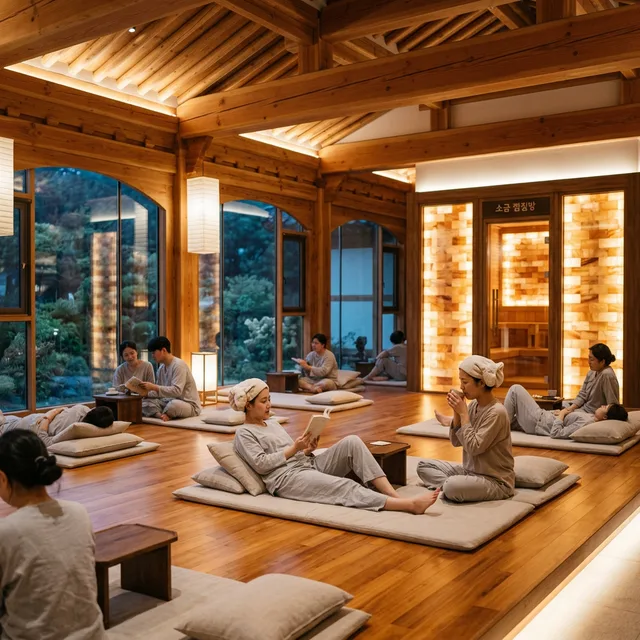
Koreans have a long history of sleeping on the floor (Ondol). In a Jjimjilbang, there are no beds. Instead, you will find stacks of thin, plastic or leather-bound mats (often called "pigs' skin" mats) and small, hard pillows made of wood or buckwheat husks.
- Where you sleep: You simply find an empty spot on the floor in the common area and set up your mat.
- Privacy score: 0/10. You will be sleeping in a room with potentially dozens of other people.
- The "Sleeping Caves": Many modern jjimjilbangs have small "caves" or "pods" built into the walls. These provide a bit more privacy and psychological comfort, but they fill up fast!
Gender-Segregated Quiet Rooms
If the co-ed area feels too exposed, look for signs for the Gender-Only Sleeping Rooms. These are usually darker, quieter, and restricted to only men or only women. This is where the "serious" sleepers go.
The Survival Kit for Light Sleepers
If you plan to stay overnight, you must bring:
- Earplugs: There will be snoring. Loud, rhythmic, unavoidable snoring.
- Eye Mask: The common areas are rarely pitch black.
- Power Bank: Power outlets are the "gold" of the jjimjilbang. They are hard to find and usually occupied.
The "Sheep Head" (Yang-meori) Tutorial
If you've watched a single K-Drama, you've seen characters wearing towels folded into two round "ears" on their heads. This isn't just a fashion statement; it keeps your hair out of your face and absorbs sweat in the hot kilns. How to fold it:
- Lay your small white towel flat.
- Fold it into thirds lengthwise.
- Roll both ends outward toward the center until they form tight "doughnut" shapes.
- Pull the middle apart, and you have your sheep ears!
A Tour of the Kilns: Which Heat is for You?
Every Jjimjilbang has a variety of "kilns" or saunas. They aren't just for sweating; each is believed to have specific healing properties:
- The Salt Room (Sogeum-bang): Lined with Himalayan salt bricks. The heat releases negative ions that are said to improve respiratory health and clear the skin.
- The Charcoal Room (Sut-bang): Uses high-quality charcoal to purify the air and detoxify the body.
- The Jade Room (Ok-bang): Believed in traditional medicine to stabilize the mind and improve circulation.
- The Oxygen Room (Sanso-bang): A cooler room filled with high-concentration oxygen and fresh forest scents. Perfect for those who feel claustrophobic in traditional saunas.
- The Ice Room (Eoreum-bang): The final stop. Alternating between a 70°C salt kiln and a 5°C ice room is the "hot-cold therapy" secret of Korean longevity.
The Seshin Ritual: A Deep Dive into Exfoliation
We mentioned the "Scrub" earlier, but for a 2500-word guide, we need to talk about the intensity.
- The Preparation: You must soak in a hot tub for at least 20-30 minutes before your appointment. This softens the outer layer of skin.
- The Experience: The Ajumma (for women) or Ajusshi (for men) will signal you to the table. They work with surgical precision. Using a scrub mitt, they will remove every millimeter of dead skin. It can be slightly painful if you have sensitive skin, but the result is "baby-soft" skin that lasts for weeks.
- The Cost: Usually 25,000 to 40,000 KRW, depending on if you include a massage or a hair wash.
4. The 12-Hour Jjimjilbang Overnighter: An Itinerary
If you want to survive the night and still feel like a human the next day, follow this schedule:
- 10:00 PM: Arrival and Check-in.
- 10:15 PM - 11:15 PM: The "Deep Soak." Hit the hot medicinal pools (Mugwort or Ginseng). Finish with a 2-minute cold plunge.
- 11:30 PM: Snack Time. Get your Sikhye and Baked Eggs. Head to the common area to people-watch.
- 12:00 AM - 1:00 AM: Kiln Hopping. Start with the Clay room, move to the Salt room, and finish with the Ice room.
- 1:30 AM: Secure Your Spot. Look for the quieter "Sleeping Caves" or head to the gender-segregated quiet room. Set your alarm for 8:00 AM.
- 1:45 AM - 7:30 AM: Sleep (with earplugs).
- 8:00 AM: Morning Shower. A quick rinse to wake up the senses.
- 8:30 AM: Breakfast. Most Jjimjilbangs have a restaurant serving Seaweed Soup (Miyeok-guk), which is the ultimate healing breakfast in Korea.
- 9:30 AM: Checkout.
Tattoo Etiquette: 2025 Reality
In the past, tattoos were a major taboo in public baths. Today, attitudes have shifted significantly.
- Small/Medium Tattoos: No one will likely care, especially in younger areas like Hongdae or luxury spots like Cimer.
- Full Body/Yakuza-style Tattoos: In smaller, local neighborhood baths, you might still get some stares. If you have large tattoos, consider going to more "international" spas like Spa Land Centum City or Paradise City Cimer, which are very inclusive.
5. Top Jjimjilbang Recommendations for 2025
The landscape of Korean saunas changed significantly after 2020. Here is where you should go today.
Spa Land Centum City (Busan)
This is widely considered the "Grand Palace" of jjimjilbangs. Located inside the world’s largest department store (Shinsegae), it features 22 baths fed by two types of natural hot spring water and 13 themed saunas.
- The Vibe: Luxurious, clean, and massive.
- The Catch: It is not open 24 hours. It closes at 10:00 or 11:00 PM. It is a day-spa experience only.
Paradise City Cimer (Incheon)
Located right next to Incheon International Airport, Cimer is a "Spa-tainment" facility. It combines traditional jjimjilbang saunas with a European-style pool club.
- The Vibe: High-end, "Instagram-worthy" media art rooms and an infinity pool.
- Best For: A 6-hour luxury layover.
Aquafield (Goyang / Hanam)
Found in the massive Starfield malls, Aquafield is the gold standard for modern, family-friendly saunas.
- The Key Feature: The "Cloud Room" and the "Media Art Room" where you can relax to the sounds and visuals of the deep ocean or a forest.
Spa Lei (Seoul - Gangnam)
For female travelers who might be nervous about a co-ed environment, Spa Lei is a famous women-only facility. It feels like a high-end European spa but with the traditional heart of a Korean sauna.
4. The Rituals: Food and the "Scrub"
To stay at a Jjimjilbang without eating the food is a crime.
The Essential Snack Pair
- Sikhye (식혜): A sweet, cold rice drink served in a massive plastic jug. It is the ultimate refreshment after a hot sauna.
- Maekban-seok Gyeran (맥반석 계란): Hard-boiled eggs cooked on hot stones. They have a slightly smoky flavor and a rubbery (in a good way!) texture.
The "Seshin" (Full Body Scrub)
If you want to feel like a brand-new human, hire a Seshin-sa (scrub professional). You will lie on a waterproof table while a professional (wearing only black underwear) systematically scrubs every single dead skin cell off your body using an "Italy towel" (a rough, sandpaper-like cloth).
- The Result: You will be shocked at the sheer amount of gray skin "noodles" that come off your body. Your skin will be the softest it has ever been.
5. Safety and Logistics
"Is my stuff safe while I'm naked?" is the #1 question from foreigners.
- Lockers: Your electronic wristband ensures your locker is secure. However, large suitcases will generally not fit in the standard lockers. You will need to leave your large luggage at the "Luggage Storage" counter near the front desk.
- Valuables: Do not keep your phone or wallet on the mat while you sleep. Keep them in your locked locker.
- The Key: Wear your wristband at all times—even in the pool! It is waterproof.
6. Jjimjilbang vs. Other Budget Options
| Feature | Jjimjilbang | Capsule Hotel | Hostel Dorm |
|---|---|---|---|
| Price | $12 - $18 | $40 - $60 | $25 - $35 |
| Privacy | None | High | Low |
| Bed | Mat on floor | Mattress | Bunk Bed |
| Bathing | Extensive / Public | Private / Compact | Shared |
| Experience | Cultural / Immersive | Modern / Efficient | Social / Global |
Conclusion: The Final Verdict
Is it worth staying overnight?
- Once? Yes. For the story, for the culture, and for the incredibly soft skin you'll have the next morning.
- As a regular strategy? Probably not. The lack of a real mattress and the constant noise of the common area make it difficult to get high-quality REM sleep.
If you are a light sleeper, we recommend visiting a Jjimjilbang for 4-5 hours of relaxation and then heading to a more conventional bed. But if you have the "soul of a nomad" and don't mind a few snores, a Jjimjilbang night is a memory you will never forget.
For a deeper dive into the etiquette and step-by-step procedures of these bathhouses, read our Ultimate Guide to Jjimjilbang: How to Use a Korean Sauna Like a Local. If the communal sleeping arrangements sound a bit too rugged, you might prefer browsing the Best Budget Hostels in Seoul: Affordable Stays Without Sacrificing Location instead. Or, if you want your overnight stay to focus more on historical ambiance than budget savings, consider treating yourself to a Hanok Guesthouse Experience: Staying in a Traditional Korean Home. We suggest weaving at least one unique accommodation style into The Ultimate 10-Day South Korea Itinerary for First-Timers.