Ultimate Guide to Jjimjilbang: How to Use a Korean Sauna Like a Local
The jjimjilbang (찜질방) is perhaps the most unique cultural institution in South Korea. Part bathhouse, part sauna, and part community social hub, it is a place where people of all ages come to scrub away the stresses of the week. For about $15, you get access to hot mineral pools, themed heated rooms, restaurants, and a place to sleep. It is the ultimate budget-friendly wellness experience.
However, for a first-timer, the process can be overwhelming. Where do your shoes go? Why is everyone wearing the same clothes? Can you actually sleep on a heated floor? This guide will take you through the entire experience, from the moment you take off your shoes to the final bill.
Phase 1: Entry and Setup (The First 15 Minutes)
Your jjimjilbang journey begins at the entrance.
- The Shoe Locker: Before you reach the desk, find a small locker for your shoes. Lock them up and take the key to the reception.
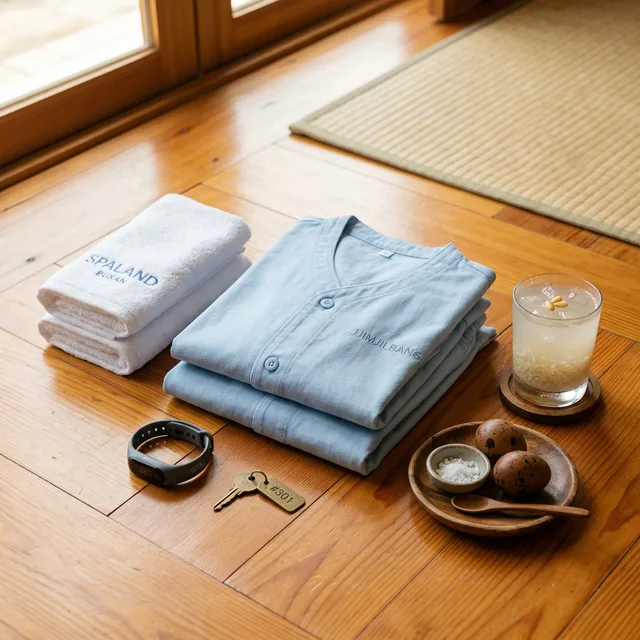
- Payment and the "Kit": Hand over your shoe key and pay the admission. You will receive an electronic wristband, two small towels, and a jjimjilbang uniform (usually a baggy cotton T-shirt and shorts).
- The Wristband: This is your life. It opens your clothing locker and acts as your "credit card" for snacks and services. Do not lose it!
- Changing: Head to the gender-segregated changing rooms (marked 남 for men, 여 for women). Find the locker that matches your wristband number, strip down, and put on your uniform.
What Does It Actually Cost?
The jjimjilbang is one of the great travel bargains of Asia, but the price structure has a few layers worth understanding before you walk in.
Standard day admission at a mid-range facility runs 10,000–15,000 KRW (roughly $7–11 USD). This covers the wet bathhouse area, all sauna rooms, the communal lounge, and your uniform kit. If you want to stay overnight, facilities typically charge an overnight surcharge of 3,000–5,000 KRW on top of the base entry fee — a small premium for access to sleeping space and 24-hour facilities. Premium destination spas like Aquafield in Hanam or Siloam Sauna near Seoul Station price their tickets at 18,000–25,000 KRW, but they justify it with outdoor pools, spectacular views, and a far more curated selection of themed rooms.
What is not included in your entry fee — and where the costs can quietly add up — are the premium services. A professional body scrub (때밀이) typically costs 15,000–30,000 KRW for about 20 minutes of thorough exfoliation. A full-body massage from a trained therapist in the massage rooms will run 30,000–60,000 KRW depending on duration and facility tier. And all food and beverages you consume inside — from a 1,000 KRW egg to a full bowl of ramen — are billed to your wristband and settled at the end of your visit.
Typical budget for a 24-hour jjimjilbang stay:
| Item | Estimated Cost (KRW) |
|---|---|
| Entry + overnight surcharge | 15,000–20,000 |
| Snacks (eggs, sikhye, ramen) | 5,000–10,000 |
| Optional body scrub | 15,000–30,000 |
| Optional massage | 30,000–60,000 |
| Total (without premium services) | ~20,000–30,000 |
| Total (with scrub + massage) | ~60,000–110,000 |
The Wristband System in Detail
The electronic wristband is the nerve center of your entire stay, and understanding how it works prevents both confusion and an awkward moment at checkout.
The moment you walk in, your wristband is linked to a running tab. Every time you order food from the snack bar, grab a massage at reception, or purchase anything from the vending areas, the staff simply scan your wristband. You never handle cash or cards during your visit. It is genuinely seamless and a little bit addictive — you stop thinking about money and just enjoy the experience.
The critical thing to remember is that you cannot simply walk out. You must present your wristband at the front desk before leaving so that staff can tally your charges and you can pay the total. Attempting to exit without settling is not possible in practice — the turnstile or door system at most facilities requires a cleared wristband scan to open.
If you lose your wristband, notify staff immediately. Because the wristband tracked your locker and your tab but the facility cannot audit exactly what you consumed, most jjimjilbangs charge a flat penalty fee of 20,000–30,000 KRW to cover the administrative headache. It is not punitive, but it is annoying. The practical advice is to keep the wristband on your wrist at all times — it is waterproof and comfortable enough that there is no reason to remove it.
What to Bring: The Ideal Jjimjilbang Packing List
The facility will provide the essentials, but "essential" and "comfortable" are two different things. Here is what seasoned jjimjilbang veterans actually pack:
- Clean underwear — The facility provides a uniform for the common areas, but you will want fresh underwear to change into after your bathhouse session. Pack one clean set.
- Personal toiletries — Basic shampoo and body wash are usually provided at the shower stations, but the quality is firmly no-frills. If you have a specific shampoo or skincare routine, bring travel sizes.
- A personal face towel — The two small towels in your kit serve double duty, which leaves them damp and marginally useful. A compact microfiber face towel from home makes a real difference.
- Earplugs — Non-negotiable for overnight stays. The communal sleeping area is genuinely lived-in: distant TV murmur, the shuffle of late arrivals, occasional snoring. Good earplugs transform a restless night into a surprisingly decent one.
- Downloaded entertainment — The communal TV runs Korean variety shows, which is fun for about an hour. After that, having a downloaded podcast, audiobook, or show on your phone is a blessing during the quiet hours. The Wi-Fi is often spotty.
- Flip flops — Some facilities provide them; many do not. A pair of simple rubber sandals makes moving between the wet areas and the dry lounge much more comfortable and is sound hygiene practice.
- A small padlock — Rare to need, but locker locks occasionally malfunction at older facilities. Bringing your own gives you peace of mind for leaving valuables overnight.
Phase 2: The Art of the Soak (Mokyeoktang)
Before you hit the saunas, most people visit the mokyeoktang (wet area).
Step 1: The Scrub-down. You must shower thoroughly with soap before entering any communal pools. Standing and sitting shower stations are provided. Failure to do this is a major social faux pas.
Step 2: The Pools. Enjoy the various mineral baths. High-end spas like Aquafield feature pools with specialized salts or herbs. Most people alternate between "Hot" (40°C) and "Cold" (15°C) to boost circulation.
The Italy Towel Body Scrub: Korea's Most Famous Beauty Ritual
Before you settle into the pools, there is one experience in the mokyeoktang that stands apart from anything you will find in a Western spa: the Italy Towel scrub (이태리 타올, pronounced "i-tae-ri ta-ol").
The Italy Towel is a viscose exfoliating mitt with a texture somewhere between a loofah and a kitchen scouring pad — which sounds alarming but is, in fact, one of the most satisfying things a human body can experience. After you have been soaking in the hot pool for 10–15 minutes and your skin has softened completely, you take the mitt and scrub firmly along your arms, legs, and torso in long, brisk strokes. What comes off — dark gray ribbons of dead skin called 때 (ddae) — is strangely, profoundly satisfying in the way that only complete strangers on the internet seem to understand until you try it yourself. Your skin underneath is visibly softer, brighter, and genuinely luminous.
To do it yourself: Soak in the hot tub for at least 10–15 minutes first (the skin must be thoroughly softened). Put on the wet Italy Towel mitt and scrub in firm, linear strokes — not circular — starting from the arms and working toward the torso. Focus on elbows, knees, and the backs of the calves, where dead skin accumulates fastest. Allow another 5 minutes in the hot pool after, then shower it all off.
To have a professional do it (highly recommended for first-timers): Visit the 때밀이 station, staffed by experienced technicians who have been performing this service for decades. For 15,000–30,000 KRW (around $11–22 USD) and approximately 20 minutes, they will perform a head-to-toe exfoliation that goes considerably deeper than you would dare on yourself. Book at the bathhouse reception or simply approach the station — most are walk-in. Note that the service is always gender-segregated.
The one non-negotiable etiquette rule: Never enter a communal pool without rinsing at the shower station first. This is not optional and is treated as seriously as it sounds.
The Hot-Cold Cycle: The Science of Maximum Relaxation
Simply lying in a hot pool is pleasant. Alternating between hot and cold pools in a deliberate protocol — known as 온냉 교대욕 (on-naeng gyodae-yok) — is transformative, and it is what separates the casual visitor from someone who truly uses the jjimjilbang as intended.
The optimal protocol is straightforward:
- Soak in the hot pool (40–42°C) for 3–5 minutes until you feel thoroughly warmed through.
- Move directly to the cold plunge (15–18°C) and stay for 1–2 minutes. Do not ease in — commit fully.
- Rest in ambient air for 2–3 minutes before repeating.
- Complete 3–4 full cycles.
The cold plunge is where most first-timers hesitate. The first entry genuinely takes nerve. But the physiological reward is immediate: a sharp narrowing of blood vessels followed by a flooding sense of warmth and clarity as you exit. By the second and third repetitions, the shock eases and the contrast begins to feel deeply satisfying rather than frightening.
The benefits are well-documented: improved peripheral circulation, reduced post-exercise muscle soreness, a brief but measurable boost in immune function, and — perhaps most importantly for weary travelers — a profound reset of the nervous system that no amount of hotel minibar wine can replicate.
The Full Spectrum of Pool Types
Larger jjimjilbangs offer considerably more variety than a simple hot-cold binary:
- Carbonated Water Pool (탄산욕): Mildly effervescent, these pools look like a very gentle sparkling water bath. The CO₂ is absorbed through the skin and is said to improve circulation and skin tone. The sensation is gently tingly and genuinely pleasant.
- Ginseng/Herbal Pool (약초탕): Steeped with medicinal herbs, these pools run a darker amber-brown and carry a distinctly earthy, botanical scent. A genuine traditional wellness experience.
- Salt Mineral Pool: Elevated salinity increases buoyancy slightly and the mineral content is said to soften and nourish the skin. Popular at mid-to-high-end facilities.
- Outdoor Hot Tubs: Available at premium venues like Aquafield, these pools overlook either mountain ridges or city skylines. Sitting in 40°C water while winter air bites at your face is one of the great simple pleasures that Seoul has to offer.
Phase 3: Exploring the Saunas (The Common Area)
Once you're clean and wearing your uniform, head to the communal area where men and women can relax together.
The rooms are clearly marked with their temperature and material:
- Salt Room: Great for skin and respiratory health (Usually 50°C).
- Charcoal/Oxygen Room: For purification and relaxation (Usually 40°C).
- Bulgama (Fire Kiln): The traditional high-heat experience (80°C+).
- The Ice Room: Every sauna session should end here to tighten the pores and reset your body temperature.
Full Sauna Room Guide: Temperatures, Times, and What to Expect
Most visitors wander between rooms randomly, which is fine. But if you want to approach the sauna section with some intentionality, here is a room-by-room breakdown of what you will actually encounter:
| Room | Korean Name | Temperature | Suggested Time | Notes |
|---|---|---|---|---|
| Ice Room | 얼음방 | 10–15°C | 5–10 min | Start here before heat rooms to acclimatize or use between sessions |
| Loess/Hwangto Room | 황토방 | 45–55°C | 15–20 min | Far-infrared warmth from yellow clay; the most popular room in most facilities |
| Salt Room | 소금방 | 50–60°C | 10–15 min | Hygroscopic salt draws moisture; excellent for skin; slightly drier feel than other rooms |
| Charcoal Room | 숯방 | 45–55°C | 10–15 min | Activated charcoal walls; negative ion claims; the air has a faint, clean mineral quality |
| Jade/Crystal Room | 옥방 | 40–50°C | 15–20 min | Heavy thermal mass from jade or crystal tiles; even, sustained heat with very low humidity |
| Bulgama (Fire Kiln) | 불가마 | 80–100°C | 5–8 min MAX | The original traditional dome kiln; extreme dry heat; respect the time limit |
Suggested rotation for a 2-hour sauna session:
Start in the Ice Room for 5 minutes to set your baseline. Move to the Loess Room for 15–20 minutes — this is the entry point most locals recommend, as the far-infrared heat warms deeply without feeling overwhelming. Take a 10-minute rest in the communal lounge (lie flat, hydrate). Move to the Salt Room for 10–15 minutes. Rest again. Finish with a 5–8 minute session in the Bulgama if you dare, followed immediately by the Ice Room. The contrast after the Bulgama is the sharpest and most invigorating you will experience all day.
Critical rule for the Bulgama: The 80–100°C temperature in the fire kiln is genuinely extreme. Five to eight minutes is the absolute maximum for most people, and there is zero shame in stepping out at three. Watch the locals — they typically sit in short, focused bursts and exit with controlled calm. Match that energy.
The Yang-meori Towel Fold: Step-by-Step Tutorial
The 양머리 (yang-meori), or "lamb's head," is the signature look of the jjimjilbang. If you walk into the common area without one of these on your head, you will immediately be identifiable as a first-timer. Here is how to construct it in under 30 seconds:
- Lay your small towel flat on the floor in front of you (landscape orientation).
- Starting from one of the short ends, roll the towel tightly toward the center into a firm, even tube.
- Fold the tube in half so the two ends point upward.
- Place the folded center on the crown of your head and let the two rolled ends stick up like ears on either side.
It is both functional — it protects your hair from the dry heat of the kiln rooms and absorbs sweat on your brow — and a quiet social signal that you are comfortable in this space. When a foreigner walks into a Korean sauna wearing the yang-meori with confidence, it is reliably met with approving smiles from the regulars.
Phase 4: Jjimjilbang Life (Snacks and Socializing)
The common area is the heart of the jjimjilbang. You'll see people reading, watching TV, or simply chatting on the floor.
- The Food: You must try Sikhye (a sweet rice drink) and Baked Eggs. They are the classic jjimjilbang fuel. For a full meal, Miyeok-guk (Seaweed Soup) is the traditional choice for health and recovery.
- The "Lamb Head" (Yang-meori): Fold your small towel into a tube, roll the ends into "ears," and wear it on your head. It protects your hair from the dry heat and is a rite of passage for any visitor.
The Full Jjimjilbang Food Menu, Decoded
Eating inside a jjimjilbang is not an afterthought — it is a genuine part of the ritual. The snack bar is typically open until midnight and from 6 AM, and the selection is a time-honored canon that has barely changed in decades. Here is what you will find on virtually every menu:
- 맥반석계란 (Maekbanseok Gyeran / Sauna Eggs) — 1,000 KRW each: These are arguably the most iconic jjimjilbang food item. Hard-boiled inside the Bulgama kiln, the eggs emerge with a slightly darker, mottled brown-gray shell and a more savory, almost nutty flavor compared to a standard boiled egg. The Maillard reaction at high heat caramelizes the proteins slightly. Order two as a minimum.
- 식혜 (Sikhye) — 2,000–3,000 KRW: A cold, mildly sweet rice punch made with malt water and cooked rice grains. Served in a plastic cup with floating grains. It is refreshing, gently restorative, and the canonical jjimjilbang beverage — the equivalent of a cold beer at a ballpark. Drink it.
- 미역국 (Miyeok-guk / Seaweed Soup) — 5,000–7,000 KRW: The recovery food of Korea. A clean, mineral-rich broth loaded with silky seaweed, traditionally eaten on birthdays and after physical stress. After a long night of heat cycling, a bowl of miyeok-guk in the morning is genuinely restorative in a way that is hard to overstate.
- 라면 (Ramen) — 3,000–4,000 KRW: Instant ramen cooked in the facility kitchen and served in a large metal bowl. It is precisely the midnight comfort food that the jjimjilbang setting calls for. Do not overthink it.
- 아이스크림 (Ice Cream Bars) — 1,500–2,500 KRW: The contrast between ambient heat and a cold red bean ice cream bar is a Korean tradition that sounds odd and delivers completely. After an hour in the sauna rooms, biting into a frozen bar while sitting on a warm floor is one of the most satisfying sensory experiences the jjimjilbang offers.
- 수정과 (Sujeonggwa) — 2,000 KRW: A traditional cinnamon and ginger punch, served cold, with a floating dried persimmon and pine nut. The spice is forward and aromatic, and the sweetness is restrained. Order one if it is available — it is becoming less common as younger jjimjilbangs modernize their menus.
The Social Life of the Jjimjilbang
The communal lounge area is where you realize that the jjimjilbang is not really about health — or not only about health. It is about people, proximity, and the particular ease that comes from sharing a warm floor with strangers.
On any given evening, you will see: groups of university students lying in a circle doing face masks together, a family with children watching a Korean variety show on the mounted flat-screen while eating eggs, elderly men playing baduk (Go) on a folding board in the corner, a pair of women in their fifties having an animated conversation while wrapped in towels, teenagers FaceTiming from the sleeping area with yang-meori hats askew on their heads.
The jjimjilbang is one of the genuinely democratic spaces that modern Korean life has preserved. Inside these walls, the salary-man and the university student and the grandmother occupy the same floor and wear identical uniforms. There is a social leveling that happens when everyone looks the same and no one can display their wealth through clothing. It is, in its own way, a remarkably egalitarian institution.
Additional services worth knowing about:
- Massage chairs: Many common areas have coin-operated massage chairs (typically 1,000 KRW for 10 minutes) or free chairs at premium facilities. Worth using between sauna sessions.
- Professional massage rooms: Book at reception for a dedicated massage session (30,000–60,000 KRW). Quality is highly variable — ask staff which therapist is available and how long the wait is.
- Hair dryers and skin care stations: Available in the changing rooms post-bathing. Premium facilities stock complimentary moisturizers, cotton swabs, and hair serums at shared vanity stations. Bring your own products if you have preferences.
Phase 5: Staying the Night (The 24-Hour Experience)
Many travelers use jjimjilbangs as an affordable alternative to hotels.
- The Sleep Setup: Most facilities provide thin mats and plastic "wooden" pillows. You find a spot on the heated ondol floor and settle in.
- Choice of Spot: Larger spas have dedicated "Sleeping Rooms" which are dark and quiet.
- Survival Tip: If you are a light sleeper, bring earplugs. Jjimjilbangs can be noisy with the sound of distant TV or occasional snoring.
Is It Actually Comfortable? An Honest Assessment
Let us be direct about this: a jjimjilbang night is not equivalent to sleeping in a hotel bed, and pretending otherwise would be dishonest. The ondol floor is warm — pleasantly, steadily warm — but it is also a floor. The thin mat provided raises you approximately one centimeter above the tile. The plastic "wooden" pillow is shaped for a Korean standard of comfort that most Western necks find puzzling at best and untenable at worst.
Here is what actually works:
- Fold your towel(s) into a makeshift pillow. A folded bath towel under your neck creates several inches of cushioning and is the single most impactful comfort upgrade available to you.
- Bring a travel neck pillow from your bag. If you have one in your luggage (stored in the locker), retrieve it. This is the move that separates an okay night from a genuinely good one.
- Use your clothing bundle as a mattress supplement. Your day clothes, rolled into a bundle and slid under your torso, can meaningfully reduce the hard-floor effect.
- Embrace the floor warmth. The ondol radiant heat is genuinely the best part of sleeping in a jjimjilbang. It is the heat that Koreans grew up sleeping on. Once you stop fighting the firmness and let the warmth do its work, sleep comes more readily than you expect.
The honest verdict: after 4–5 hours of heat cycling that has genuinely exhausted your body in the best possible way, the floor feels considerably more accommodating than it would cold. Most travelers report sleeping better than they anticipated.
Overnight Logistics
When to claim your sleeping spot: Arrive in the sleeping area before 10 PM on weekends. Popular facilities fill completely by 11 PM, and the best spots — along the walls, away from the TV, with space on either side — disappear first. On weeknights, midnight is generally fine.
Keeping valuables secure: Everything of value goes in your locker before you enter the common areas. The wristband is the only thing that leaves the locker with you, and it stays on your wrist. Do not leave a phone, wallet, or passport unattended on the floor, even in the sleeping area.
Morning routine: The bathhouse area is open 24 hours at most facilities. A shower between 6 and 7 AM — when the space is at its quietest — is a genuine pleasure. The snack bar typically reopens at 6 AM with fresh seaweed soup and rice, which serves as a restorative and deeply Korean breakfast before you head back out into the city.
The Economics of Overnight at a Jjimjilbang
This is where the jjimjilbang argument for budget travelers becomes genuinely compelling. A full jjimjilbang stay — entry fee plus overnight surcharge — runs approximately 15,000–20,000 KRW ($11–15 USD). For that price, you receive: unlimited access to hot mineral pools, 6–10 themed sauna rooms, a sleeping space on a heated floor, a uniform and towels, a shower, a morning breakfast option, and — crucially — a genuinely memorable cultural experience.
The cheapest Seoul guesthouse dorm bed, by comparison, runs 25,000–35,000 KRW ($18–26 USD) for a mattress in a shared room with no additional amenities. The jjimjilbang is not just the cheaper option — it is the more interesting one.
For travelers with early morning flights or train departures, the calculation becomes even more obvious. Rather than paying for a full hotel night just to sleep for four hours and taxi to the airport at 5 AM, a jjimjilbang near the transit hub offers a functional, affordable, and culturally rich alternative. Siloam Sauna, a short walk from Seoul Station, exists essentially for this purpose.
Phase 6: Sample 24-Hour Itinerary
| Time | Activity |
|---|---|
| 6:00 PM | Check-in, store luggage, and head to the bathhouse for a 60-minute soak. |
| 8:00 PM | Change into uniform. Spend 90 minutes exploring 3 different saunas. |
| 9:30 PM | Snack time! Sikhye and eggs while watching Korean variety shows. |
| 11:00 PM | Grab a mat and find a quiet corner in the sleeping hall. |
| 7:00 AM | Wake up, take a final refreshing shower, and have seaweed soup for breakfast. |
| 9:00 AM | Settle your wristband bill and head out for a day of sightseeing. |
Conclusion
The jjimjilbang is more than just a spa; it's a living museum of Korean social life. It might feel a bit strange at first, but by your second hour, you'll likely find yourself lying on a heated floor, sipping sweet rice drink, and feeling more relaxed than you ever have.
Ready for more? You can narrow down your choices by reading our Best Jjimjilbangs in Seoul: Honest Reviews for Travelers. If you want to know exactly what kind of heat you're signing up for before you go, our guide on Hanjeungmak vs. Jjimjilbang: What's the Difference and Which to Choose? provides a technical breakdown. Before embarking, it's also wise to review our Korean Spa Etiquette: Do's and Don'ts for International Visitors to ensure a smooth, respectful visit.