Hidden Alleys of Euljiro: A Retro Photography Walk
Forget the glossy, futuristic facade of Gangnam. To truly capture the soul of Seoul, you need to peel back the layers of modernity and dive into its gritty, vibrant past. There's no better place to do this than Euljiro, an industrial district that has unexpectedly transformed into "Hipjiro" – a mecca for artists, trendsetters, and photographers seeking authentic retro aesthetics. This isn't just a place to visit; it's an experience, a journey through time where the echoes of Seoul's industrious past blend seamlessly with its buzzing, creative present. Prepare your camera, because the hidden alleys of Euljiro offer an unparalleled canvas for retro photography, promising unique shots that tell a story far deeper than any postcard, and reflecting the city's complex layers of history and progress.
Introduction: Euljiro's Unexpected Renaissance
Euljiro, once the beating heart of Seoul's manufacturing industry, filled with printing presses, metal workshops, and machinery parts suppliers, has undergone a fascinating metamorphosis. For decades, it was overlooked by guidebooks and tourists, a place of grime and graft rather than glamour. Its narrow streets were synonymous with the clatter of machinery, the scent of metal and ink, and the diligent labor that fueled South Korea's rapid industrialization. Yet, in recent years, this very grittiness became its allure. Young artists, designers, and entrepreneurs, drawn by affordable rents and the raw, untouched aesthetic of its aging infrastructure, began to set up shop. They repurposed old workshops into minimalist cafes, speakeasy bars, and independent galleries, creating a unique subculture that reveres the old while innovating the new. This blend of industrial heritage and contemporary cool has birthed "Hipjiro," a nickname that perfectly encapsulates its newfound charm. It’s a place where vintage aesthetics are not merely mimicked but authentically preserved, offering a refreshing counterpoint to Seoul's otherwise hyper-modern landscape. For photographers, especially those with a penchant for retro or vintage styles, Euljiro is a treasure trove, offering stark contrasts, rich textures, and a profound sense of history in every frame. The "Old Seoul" aesthetics here aren't manufactured; they're genuine, worn into the very fabric of the buildings and streets, making for incredibly compelling visual narratives that are taking social media by storm. Each alleyway, each storefront, each weathered sign tells a piece of Seoul's grand narrative, offering endless opportunities for a unique Euljiro retro tour.
Euljiro's unique blend of vintage industrial charm and modern artistic innovation makes it a prime destination for photographers seeking authentic "Old Seoul" aesthetics and a distinct retro vibe, attracting a new generation of trend-seekers and offering a rich tapestry for street photography.
🏢 The View from Above: Sewoon Plaza (Arcade)
Our retro photography walk begins at Sewoon Plaza, an architectural marvel from the 1960s that serves as a perfect symbol of Euljiro's transformation. This sprawling multi-story complex was originally envisioned as Seoul's first mixed-use residential and commercial building, a beacon of modernity in its time, designed to be a grand urban renewal project. It was a vision of the future, a self-contained city within a city, complete with residential units, commercial spaces, and public walkways connecting various blocks. Today, it stands as a testament to brutalist architecture, its concrete facade softened by years of weathering and the bustling activity within. From street level, the plaza might appear imposing, a relic of a bygone era, but its true photographic magic lies higher up, revealing layers of history and urban planning.
The juxtaposition here is extraordinary and forms the core of its visual appeal. Look down, and you see the intricate, almost chaotic network of Euljiro's workshops, tiny alleyways, and aging storefronts – a dense urban fabric that has evolved organically over decades. This is the realm of the artisan, the small business owner, the backbone of Seoul's craft and manufacturing. Look up, and the gleaming skyscrapers of modern Seoul pierce the sky, creating a dramatic contrast between past and present, between the human-scale grit and the towering ambition of a global metropolis. Capturing this blend requires a keen eye for composition – framing the weathered concrete of Sewoon Plaza against the backdrop of a sleek glass tower offers a powerful visual commentary on Seoul's rapid development and its ongoing conversation between tradition and progress. Photographers can experiment with wide-angle lenses to encompass this vast urban duality or zoom in to highlight specific elements that epitomize this contrast.
The highlight for any photographer is undoubtedly the Public Rooftop of Sewoon Plaza, often considered the ultimate Sewoon Plaza rooftop experience. Accessible via various elevators and stairwells, these open spaces were originally designed as pedestrian decks and have been revitalized into elevated promenades offering truly panoramic shots of Jongno and Euljiro. From here, the sprawling city unfolds beneath you in a breathtaking vista. You can clearly see the Cheonggyecheon Stream weaving through the urban landscape, a ribbon of nature amidst the concrete jungle. In the distance, the traditional tiled roofs of Bukchon Hanok Village hint at Seoul's ancient past, while the endless sea of buildings defines its contemporary identity. Timing is crucial for optimal shots: Early morning light casts long shadows and soft hues over the industrial landscape, creating a moody, atmospheric feel. Sunset, however, bathes the city in a spectacular golden glow, silhouetting the skylines and making for breathtaking, high-contrast images that pop with drama. Don't forget to capture the details of the rooftop itself – the geometric patterns of the railings, the sometimes-faded signs, and the occasional rooftop garden or art installation add to its unique retro charm and offer foreground interest for your panoramic shots. This vantage point is indispensable for anyone wanting to encapsulate the full scope of Euljiro's unique visual identity, showcasing its vastness and intricate details.
☕ Stepping Back in Time: The Hidden Cafe Run
One of the most captivating aspects of Euljiro's renaissance is the emergence of its hidden cafes, nestled within the very workshops they've inherited. These aren't your typical storefront coffee shops with polished facades and predictable menus; finding them is part of the adventure, a delightful scavenger hunt that rewards you with an authentic taste of "Hipjiro." They embody the spirit of discovery, a secret world waiting behind unassuming doors. For those immersed in a foodies guide to Seoul and interested in unique culinary experiences, these establishments offer a truly distinctive journey.
Our first essential stop is Coffee Hanyakbang, a name that itself conjures images of tradition and remedy. To call it "hidden" is an understatement; it’s an integral part of the Euljiro mystique. Tucked away in a blink-and-you'll-miss-it alley barely a meter wide, finding it feels like discovering a secret portal to another era. The entrance itself is unassuming, often just a subtle sign or a barely-there doorway, easily missed if you're not paying attention. Inside, the decor is meticulously crafted to evoke a 16th-century apothecary, complete with antique furniture, worn wooden floors, dim, warm lighting from Edison bulbs, and the rich, comforting aroma of hand-dripped coffee. Every corner offers a photographic opportunity, from the vintage scales and medical instruments repurposed as decor to the intricate patterns of traditional Korean motifs on cups and walls. The challenge here is capturing the cozy, intimate atmosphere without disrupting its tranquility or encroaching on the privacy of other patrons. The "no sign" rule, prevalent in many Euljiro hidden gems, adds to the thrill of the discovery and makes the eventual reward – a perfectly brewed cup amidst such unique surroundings – all the more satisfying. It’s an exercise in patience and observation for photographers, rewarding those who can subtly frame its unique charm.
Adjacent to Coffee Hanyakbang, often sharing the same narrow passageway, you'll find Eulji Dabang. This establishment embodies a more traditional Korean coffee culture, a "dabang" being an old-school Korean coffee house that predates the modern cafe craze. It's less about the modern artisan brew and more about the experience – often serving simple, classic coffee, traditional Korean teas (like ssaenggangcha or yujacha), and sometimes even a nostalgic snack like a hard-boiled egg or toast with butter and sugar. The interior might feature worn vinyl seats, classic floral patterns on wallpaper, and a general air of faded elegance, transporting visitors to a mid-20th-century Korean living room. Photographing here is about capturing the quiet moments, the older patrons enjoying their routines, reading newspapers, or engaging in unhurried conversation, and the timeless rituals that define this unique space. Both cafes offer incredible insights into different facets of Seoul's past and present, making them ideal subjects for a retro-themed photo series. The subtle, often diffused lighting and rich, aged textures demand careful attention to detail and patience from the photographer, allowing for a deep dive into the visual narrative of Korean coffee culture.
⚙️ The Industrial Canvas: Alleys of Printing & Metal
Beyond the charming cafes, the true industrial soul of Euljiro resides in its endless labyrinth of narrow alleys, still teeming with active printing presses, metal fabrication shops, and tool suppliers. This is where the district's retro charm truly shines, offering a raw, unfiltered glimpse into a rapidly disappearing way of life. For a photographer, these alleys are an industrial canvas, rich with textures, patterns, and the stories of countless hands that have shaped Seoul's material culture. This is the heart of Seoul street photography with a distinct industrial edge.
The beauty here lies in the unexpected and the ephemeral. A splash of vibrant paint on a rusted metal door, a stack of meticulously arranged printing plates, the intricate wiring of old machinery, coils of steel, mountains of scrap metal, or the vibrant hues of stacked paper – these are the details that tell Euljiro's story of enduring craftsmanship. The faded signs, often hand-painted with charmingly outdated fonts and sometimes in multiple languages, add a layer of vintage authenticity and a sense of historical continuity. Look for patterns in the way tools are hung on pegboards, the organized chaos of raw materials awaiting transformation, or the discarded remnants of production that create unintentional still lifes. Early morning light filtering through the narrow gaps between buildings can create dramatic shafts of light and shadow, highlighting dust motes dancing in the air and adding to the atmospheric quality of your shots, emphasizing the passage of time and the ceaseless activity. The constant hum of machinery, the rhythmic clang of metal, and the occasional whir of a printing press provide an auditory backdrop to the visual feast, a reminder that this is still a living, working district, not just a curated museum. These elements provide a gritty, authentic backdrop that is increasingly rare in other modernized parts of the city.
However, it's crucial to remember that these are active workplaces. Respecting the workplace is paramount, not just for ethical reasons but also for your own safety and to ensure the longevity of Euljiro's photographic accessibility. Always be mindful of the people working and their space. Avoid pointing your camera directly into shops without permission, and never block pathways or disrupt their operations. A friendly nod, a polite gesture, or even a brief conversation (if language permits) can go a long way in fostering goodwill. The goal is to capture the essence of their work subtly, focusing on the environment, the tools, the processes, and the atmosphere rather than intrusive portraits. Photographing safely during active hours means staying alert to moving forklifts, heavy machinery, busy workers carrying materials, and the general flow of activity. The aim is to be an observer, capturing the candid beauty of their daily grind while ensuring you don't impede their livelihood or create a nuisance. This thoughtful approach will not only yield better, more authentic photographs but also ensure a positive experience for everyone involved, preserving the unique character of Euljiro for future generations of photographers.
🍺 Neon Nights: The Nogari Alley Experience
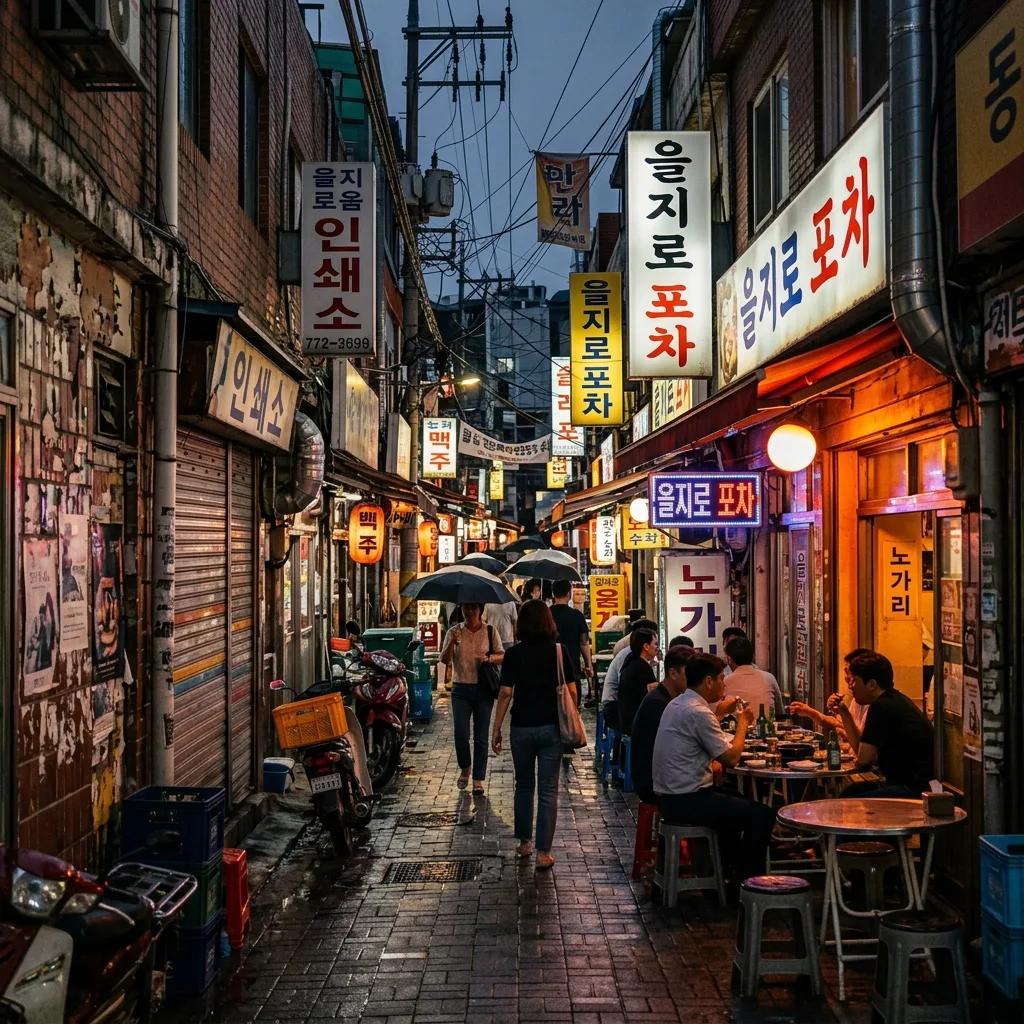
As dusk descends upon Euljiro, a different kind of magic awakens, transforming the industrial alleys into a buzzing hub of nocturnal activity. This is the domain of Nogari Alley, a legendary strip of pubs and outdoor seating where locals gather for cheap beer, grilled pollack (nogari), and lively conversation. For photographers, especially those keen on capturing urban nightlife, this area is an absolute spectacle, pulsating with energy and bathed in the quintessential glow of neon signs. It's a sensory overload in the best possible way, offering endless visual narratives under the cover of night.
Capturing the grit and energy of the evening "beer party" requires embracing the chaos and finding order within it. The alley becomes a vibrant, sprawling open-air pub, with tables and chairs spilling out onto the narrow streets, encroaching on what was once purely pedestrian space. The air is thick with the aroma of grilled food – the smoky scent of nogari, dakbal (chicken feet), and other Korean street foods – the joyous clinking of beer glasses, and the excited murmur of countless conversations. Focus on the candid interactions: friends laughing heartily, strangers sharing a drink and a story, the vendors expertly flipping nogari over charcoal grills with practiced ease, creating plumes of flavorful smoke. The warmth of the incandescent bulbs hanging overhead, strung between buildings, combined with the cool, electric glow of the neon signs, creates a rich, complex lighting environment that is challenging yet incredibly rewarding to photograph. Look for leading lines created by the rows of tables and chairs, the juxtaposition of old, weathered brick walls against the modern, vibrant neon, and the dynamic human element that brings this scene to life. The interplay of light and shadow, the warm tones from the food stalls contrasting with the cool blues and reds of the neon, provides a painterly quality to your compositions.
Tips for low-light street photography with neon signs are essential here to translate the vibrant atmosphere into compelling images. A fast lens (f/1.8 or wider aperture) will be your best friend, allowing you to gather more available light without pushing your camera's ISO settings to extreme levels, which can introduce excessive digital noise. However, don't be afraid to increase your ISO; a little grain can actually add to the retro, gritty, and authentic feel of Euljiro nights, enhancing the mood rather than detracting from it. Experiment with shutter speed – a slightly slower shutter speed (e.g., 1/30s or 1/15s) can introduce a subtle motion blur to moving subjects, like people walking or hands gesticulating, enhancing the sense of dynamism and activity, while still keeping static elements, like the neon signs, relatively sharp. White balance is crucial; the mix of neon, incandescent, and sometimes fluorescent lights can be incredibly tricky to balance. You might find setting a custom white balance or shooting in RAW format (for more flexible post-processing adjustment) to be highly beneficial. Lastly, embrace the reflections – wet streets after a light rain can turn the alley into a mesmerizing tapestry of mirrored neon and blurred lights, offering incredibly artistic and abstract photographic opportunities. This is where a foodies guide to Seoul will also include these late night eats, but the photographic opportunities are equally rich.
🗺️ Walking Route & Logistics
To fully experience the photographic delights of Euljiro, a well-planned route and understanding of logistics are key. Starting your journey at Euljiro 3-ga Station (Lines 2 & 3) is the most convenient and practical approach. This station places you right in the heart of the district, with easy access to both the industrial alleys and the hidden cafes, serving as an ideal gateway to your exploration. From here, you can easily navigate to Sewoon Plaza, the cafes, and then the industrial blocks.
From the station, you can begin by heading north towards Sewoon Plaza. Allow ample time, perhaps 1-2 hours, to explore its various levels, pedestrian decks, and especially the public rooftop, for those sweeping panoramic shots of the city's contrasting skyline. From Sewoon, you can then descend into the maze of alleys that lie just east and south, navigating towards Coffee Hanyakbang and Eulji Dabang. Remember, finding these spots is part of the charm and the adventure; don't be discouraged if you need to wander a bit or ask locals for subtle directions. The beauty of Euljiro is in its unplanned discoveries and the joy of uncovering hidden gems. Keep an eye out for small signs or even just an open door that hints at a cafe within.
Recommended time of day: To maximize your photographic opportunities and capture the diverse moods of Euljiro, aim to start your walk in the early afternoon, ideally between 1 PM and 3 PM. This timing allows you to capture the industrial alleys in good daylight, showcasing their textures, the intricate details of workshops, and the daily life of the artisans. As the afternoon progresses, you can then transition to the cafes, where the softer, more intimate lighting will enhance their retro atmosphere, perfect for cozy interior shots. Staying until dusk or early evening (between 5 PM and 8 PM) is highly recommended to experience the dramatic transformation of Nogari Alley. The shift from daylight to neon-lit nights offers two distinct photographic moods within the same area, providing a comprehensive visual narrative of Euljiro's dynamic character. Pack light, wear comfortable walking shoes, and keep your camera ready for the unexpected, as photographic moments often appear without warning. For those planning a broader trip, consider how Euljiro fits into a comprehensive Seoul travel guide to fully immerse yourself in the city's diverse offerings and unique districts. Also, remember to carry a portable power bank for your camera or phone, as extensive shooting can drain batteries quickly.
Conclusion
Euljiro is more than just a district; it's a living, breathing museum of Seoul's industrial past and a vibrant canvas for its creative future. From the brutalist grandeur of Sewoon Plaza, offering unparalleled urban panoramas, to the intimate charm of its hidden cafes like Coffee Hanyakbang and Eulji Dabang, the raw, unpolished beauty of its industrial workshops, and the electric, communal energy of Nogari Alley at night, every corner offers a unique story waiting to be captured through your lens. This retro photography walk isn't just about taking pictures; it's about experiencing the "Real Soul of Seoul," a blend of resilience, creativity, and unapologetic authenticity that is both visually stimulating and culturally enriching. So, grab your camera, embrace the journey of discovery, and allow the hidden alleys of Euljiro to inspire your next masterpiece. You'll leave not just with stunning photographs that stand out from the typical tourist shots, but with a deeper understanding of a city that constantly reinvents itself while holding steadfast to its remarkable heritage and unique character. It's an unforgettable journey for any photography enthusiast or cultural explorer.