Beyond Seoul: 7 Best Nature Destinations in Korea
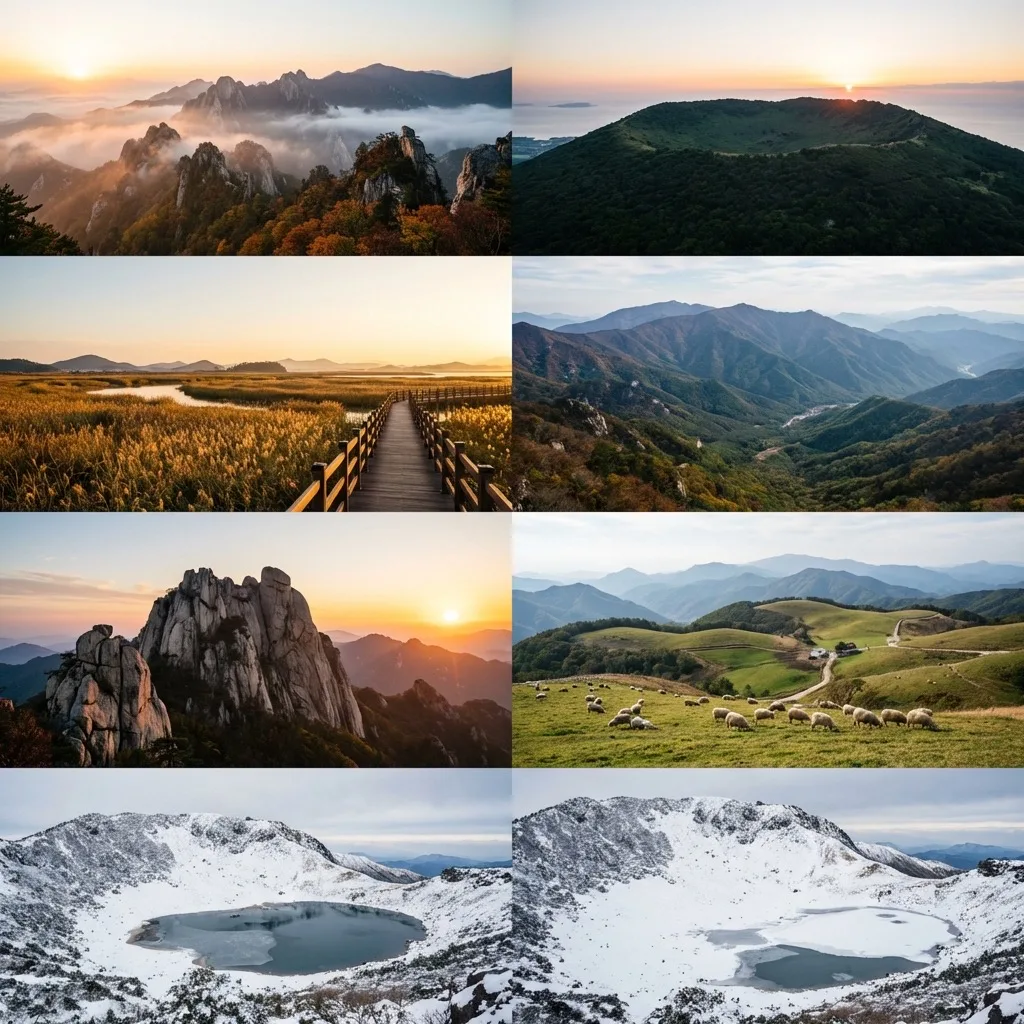
South Korea is technically a peninsula, but in reality, it is a spine of mountains rising from the sea. 70% of the country is mountainous.
If you only visit Seoul and Busan, you are seeing the neon skin of the country but missing its green lungs. To truly experience the "Land of the Morning Calm," you need to leave the subway lines behind.
Here are the 7 best regional destinations to trade skyscrapers for starlight.
The Best Season for Each Destination
Before you book your tickets, know that Korea's regions each have a moment when they are absolutely at their best. Timing your visit correctly makes the difference between a good trip and a transcendent one.
| Season | Best Destinations | What You'll See |
|---|---|---|
| Spring (March–May) | Jirisan (Hwaeomsa Temple), Boseong, Gyeongju | Red plum blossoms, the Green Tea Festival, cherry-blossomed fortress walls |
| Summer (June–August) | Suncheon Bay, Damyang, Geoje beaches | Vivid green reeds on the boardwalks, cool bamboo forest bathing, turquoise coastal waters |
| Autumn (Sep–Nov) | Suncheon Bay, Jirisan, Damyang Metasequoia Road | Golden reed fields at peak, dramatic fall foliage on ridge trails, a tunnel of amber redwoods |
| Winter (Dec–Feb) | Jeju (Hallasan), Pohang Homigot | Snow-dusted volcanic crater, the most famous sunrise on the Korean peninsula |
A useful rule of thumb: autumn and spring are the most rewarding seasons overall, as the weather is mild, the skies are clear, and the landscapes are at their most photogenic. Summer is excellent for the coastal and forested destinations where heat is less of a problem. Winter rewards the dedicated traveler with solitude, reduced crowds, and the stark beauty of snow on ancient stone.
1. Suncheon Bay Wetland Reserve (The Golden Sea)
Located on the southern coast, Suncheon Bay is one of the world's few coastal wetlands listed by UNESCO. It is famous for its vast fields of reeds that turn a shimmering gold in the autumn.
- The Highlight: The wooden boardwalks wind through the reeds, leading you into a sea of grass.
- The Wildlife: It is a sanctuary for the rare Hooded Crane. Bring your binoculars.
- The View: Hike up to the Yongsan Observatory just before sunset. You will see the S-shaped river winding through the mudflats, glowing orange under the dying sun.
More to See Around Suncheon Bay
Suncheon is a city that rewards a full two-day visit rather than a rushed day trip. Right next to the Wetland Reserve is the Suncheon National Garden — Korea's first and only national garden, built on the grounds of the 2013 Suncheon Bay Garden Expo. It is a vast, designed landscape featuring themed international gardens, a forest walking trail, and a reed maze. It is connected to the Wetland Reserve by a tram, so you can sensibly combine both in a single day.
On your way into the city, consider stopping at the Suncheon Folk Village (Naganeupseong Folk Village), a remarkably well-preserved walled town that still has residents living inside its 14th-century stone fortress walls. Unlike reconstructed folk villages, Naganeupseong is the real thing — families cook, hang laundry, and tend gardens inside the same thatched-roof homes their ancestors occupied centuries ago.
Getting There: Take the KTX from Seoul Station to Suncheon Station. The journey takes approximately 2.5 hours and costs around ₩35,000–₩50,000 depending on the train time. From Suncheon Station, local buses run to the Wetland Reserve entrance (Bus 66, about 20 minutes), or a taxi will cost roughly ₩5,000–₩7,000.
2. Boseong Green Tea Fields (The Emerald Waves)
You have likely seen this on Instagram. Daehan Dawon is the oldest and most famous tea plantation in Korea.
- The Landscape: Millions of tea bushes are planted in perfect, manicured rows that roll over the hills like green waves.
- The Experience: Walk to the top of the hill to see the ocean in the distance. Then, head back down to the cafe to eat Green Tea Ice Cream and Green Tea Churros.
- Best Time: May (Green Tea Festival) for the brightest green, or early summer.
Going Deeper at Daehan Dawon
Most visitors arrive, take photos, and leave within two hours. The travelers who stay longer discover something the Instagram crowd misses entirely. In summer evenings, Daehan Dawon opens for a Night Green Tea Experience: the rows of tea bushes are illuminated with soft atmospheric lighting, and the hills glow a deep, otherworldly emerald against the dark sky. It is genuinely unlike anything else in Korea, and the crowds thin dramatically after dark.
The plantation also runs tea tasting sessions at its main hall. This is worth your time. Korean green tea has three primary grades worth knowing: Ujeon (first harvest, plucked before April 20th — the rarest and most delicate, with a grassy, almost floral sweetness), Sejak (second harvest, plucked before May 5th — slightly more robust), and Jungjak (third harvest — fuller-bodied and more affordable). Ask for the tasting flight, which gives you all three side by side. The difference is immediately apparent.
Getting There: There is no direct KTX to Boseong, so plan the logistics carefully. Take the KTX from Seoul to Gwangju Songjeong Station (approximately 1.5 hours, around ₩28,000). From Gwangju, an intercity bus runs to Boseong Bus Terminal (approximately 1 hour). From there, take a local taxi to Daehan Dawon (about 10 minutes, ₩3,000–₩4,000). The total journey from Seoul to the tea fields is around 3 hours. Factor this into your planning — Boseong works best as an overnight stay or a long day trip combined with nearby Suncheon.
3. Damyang Juknokwon (The Bamboo Ocean)
Damyang is Korea's bamboo capital. Juknokwon is a massive 310,000 sqm bamboo forest cultivated by the town.
- Forest Bathing (Juklimyok): The dense bamboo blocks out the sun and the heat. The temperature inside is always a few degrees cooler. It is said that the oxygen levels here reduce stress.
- Nearby: Don't miss the Metasequoia Road, a stunning 8.5km avenue lined with towering redwood trees that turn a rusty orange in late autumn.
Damyang's Food Culture and Hidden Gardens
Damyang has a culinary identity as distinctive as its landscape. The town is the birthplace of Tteok Galbi — a Korean dish of minced short rib meat pressed back onto the bone and grilled over charcoal until caramelized. It is richer and more unctuous than ordinary galbi, and Damyang's version, seasoned with local herbs, is the definitive preparation in Korea. The main restaurant strip along the Juknokwon entrance is lined with Tteok Galbi specialists; look for the places with the longest queue. Another local specialty is Bamboo Rice (Juktong Bap) — glutinous rice steamed inside a sealed bamboo cylinder, which imparts a faint vegetal sweetness to the grains.
A short drive from Juknokwon, the Soswaewon Garden is one of the finest surviving examples of a Joseon-era private garden. Built in the 16th century by a scholar-official who retreated from political life, it is a masterpiece of deliberately natural design: a small stream runs through the property, passing under pavilions, over stepping stones, and past ancient plum and bamboo trees. The garden is modest in size but extraordinarily serene. It represents a philosophy — the idea that beauty should feel effortless and unforced — that is central to the Korean aesthetic tradition.
Getting There: From Gwangju Songjeong KTX Station, local buses to Damyang depart regularly (approximately 20 minutes, ₩1,500). Gwangju is also a useful base: it is a vibrant, underrated city with excellent restaurants and the Gwangju Biennale art complex, and it sits at the center of the Jeollanam-do region's greatest natural attractions.
4. Jirisan National Park (The Hiker's Paradise)
Seoraksan gets all the fame, but Jirisan is the grandfather of Korean mountains. It was the first designated national park.
- The Vibe: Unlike the jagged, rocky peaks of Seoraksan, Jirisan is vast, rolling, and deep. It feels wilder.
- Nogodan Peak: Accessible by a shorter hike (reservation required). It offers a "sea of clouds" view that makes you feel like an immortal.
- Hwaeomsa Temple: An ancient temple at the base known for its Red Plum Blossoms in early spring.
Hiking Jirisan: A Practical Guide
Jirisan rewards planning. For day hikers, the two best objectives are Nogodan Peak (1,507m) via the trail from Seonghamsajji, which takes about 3–4 hours round trip, and Cheonwangbong (1,915m), the highest peak on the Korean mainland, accessible via the Jungsan-ri trail (approximately 8–9 hours round trip — an early start is essential). Both require advance online reservation through the Korea National Park Service website during peak seasons.
For those with more time, the Jongju ridge traverse is considered the greatest multi-day hike in Korea. The full traverse from Nogodan to Cheonwangbong covers approximately 36km along the main ridge and is typically done over 2–3 days, staying at mountain shelter huts (산장, sanjang) along the route. The most well-established shelters are at Daepichong, Byeoksoryeong, and Beopgyeongsa. Sleeping bags are not required — the huts provide bedding — but you must book in advance, especially in autumn, when every bunk sells out weeks ahead.
Jirisan is also the last refuge of the Asiatic Black Bear (반달가슴곰, Bandal Gaseumgom) in Korea. The National Park Service runs an ongoing reintroduction program, and the population has grown from a near-extinct handful to over 70 individuals. You are unlikely to see one, but the knowledge that they are out there — in the deep valleys below Nogodan — adds a genuine wildness to the experience.
Getting There: Take the KTX to Gurye Station (near the southern entrance) or Namwon Station (near the northern entrance). Both are served by the Jeolla Line. Local buses and taxis connect these stations to the main trailheads.
5. Geoje Island (The Botanical Garden)
Known as the "Naples of Korea," Geoje is the second-largest island after Jeju but is connected to the mainland by bridges.
- Oedo Botania: A European-style marine botanical garden built on a tiny rock island. You have to take a ferry to get there. It feels like the Mediterranean lost in the East Sea.
- Windy Hill: A grassy cliff with a solitary Dutch windmill overlooking the turquoise ocean. It is the classic K-Drama filming location.
History, Ferries, and the Best Time to Visit
Geoje has a layer that most tourists overlook entirely. During the Korean War, the island was the site of the UN POW Camp — the largest prisoner of war camp in the conflict, which held over 170,000 North Korean and Chinese prisoners at its peak. The Geoje POW Camp Historic Park is a serious, well-presented museum that covers the full arc of the camp's history, including the famous 1952 prisoner uprising that embarrassed the UN command. It is sobering and important, and it makes Geoje feel far more three-dimensional as a destination.
The best time to visit Oedo Botania is spring (March–May), when the island's camellia and rose gardens are in full bloom and the ferry ride through the Hallyeo Maritime National Park is brilliantly clear. Late autumn (October–November) is the second-best window: the crowds thin, the coastal light turns golden, and the gardens take on a quieter, more melancholy beauty.
Getting There from Busan: This is the most common access point. Express buses from Busan's Nopo Terminal reach Geoje Bus Terminal in approximately 1.5 hours (around ₩9,000). Alternatively, take the scenic coastal route via Tongyeong — a worthwhile detour in itself (see the bonus section below). A taxi from Geoje Bus Terminal to Windy Hill takes about 30 minutes and costs around ₩20,000.
6. Jeju Island (The Volcanic Wonder)
The obvious choice, but essential. Jeju is a UNESCO World Heritage site formed by volcanic eruptions.
- Hallasan: The shield volcano at the center of the island. In winter, its snow-covered crater is breathtaking.
- Seongsan Ilchulbong: A tuff cone crater rising straight from the ocean. It looks like a giant green crown.
Going Beyond the Postcard Shots
Jeju's UNESCO World Heritage status covers three sites: Hallasan, Seongsan Ilchulbong, and the Geomunoreum Lava Tube System — and most visitors see only the first two. The lava tubes are the most extraordinary geological experience on the island, and they are criminally undervisited.
Manjanggul Lava Tube is the centerpiece: at 7.4km in total length, it is one of the longest lava tubes in the world. The accessible section (approximately 1km) takes you deep into a cave of perfect cylindrical darkness, its walls formed when the outer shell of a lava river cooled and solidified while the molten interior drained away. The scale is humbling. At the far end, a 7.6-meter lava column — one of the world's tallest — rises from the floor. Bring a jacket; the cave maintains a constant temperature of around 11°C regardless of the season.
On the western side of the island, Hallim Park pairs beautifully with a visit to Hyeopjae Beach, one of Jeju's finest stretches of white sand, backed by a casuarina pine forest. The park itself contains two natural lava tube caves — Hyeopjaegul and Ssangyonggul — as well as a folk village and a bonsai garden. It makes for an excellent half-day loop: beach in the morning, caves and gardens in the afternoon.
For the serious walker, the Jeju Olle Trail is a transformative experience. Established in 2007, it is a 437km network of coastal and inland walking paths divided into 26 numbered routes, each approximately 15–20km long. The trails hug cliff edges, pass through fishing villages, cross basalt lava fields, and wind through tangerine orchards. Route 1, beginning near Seongsan Ilchulbong and ending in Sida Village, is the most celebrated and encapsulates everything that makes Jeju special in a single long day's walk.
7. Pohang Homigot (The Hand of Harmony)
Located on the easternmost "tail" of the Korean peninsula tiger shape.
- The Icon: A giant bronze hand rising from the sea.
- The Meaning: It represents coexistence. It is famous for sunrise photos where the sun sits perfectly in the palm of the hand.
Bonus: Tongyeong (The Most Beautiful City You've Never Heard Of)
If there is one destination on this list that consistently surprises first-time visitors, it is Tongyeong. Often called the most beautiful coastal city in Korea, it sits at the tip of the Southern Sea coast, where dozens of islands and inlets create a seascape of staggering complexity. The comparison to Naples is apt: steep hills drop sharply to a working harbor, fishing boats crowd the waterfront, and the food is exceptional.
Tongyeong is the gateway to the Hallyeohaesang National Marine Park, Korea's first marine national park, a labyrinth of 68 islands and hundreds of islets stretching between Geoje and Yeosu. Ferries depart from Tongyeong Harbor to various islands within the park, including the same ferry route to Geoje's Oedo Botania — which means Tongyeong makes an ideal base for combining both destinations.
Within the city, the Dongpirang Mural Village is one of the most heartening urban stories in Korea. In the mid-2000s, the hillside neighborhood was slated for demolition. Local activists launched a public art project, inviting artists to cover the village's alleyway walls with murals. The murals were so popular that the demolition was cancelled, and the neighborhood is now one of the most-visited destinations in the South Sea region. The murals have been refreshed and updated multiple times since, and the walk up through the narrow lanes — with views of the harbor below — is one of the finest urban walks in the country.
Tongyeong is also the oyster capital of Korea. The surrounding waters produce the majority of the country's oyster harvest, and eating a bowl of Gulgukbap (oyster rice soup) at a harbor-side restaurant, with the fishing boats visible through the window, is a genuinely perfect experience.
Getting There: Take the KTX to Masan Station (approximately 2.5 hours from Seoul), then transfer to an express bus to Tongyeong (approximately 1 hour). Alternatively, Tongyeong is served by direct express buses from Seoul's Nambu Terminal (approximately 4 hours).
Practical Tips for Rural Travel
- Transport: The KTX (High-Speed Train) doesn't go everywhere. To reach Damyang, Boseong, or the deep mountains, you will need to use the Intercity Bus system. It is cheap, punctual, and comfortable.
- Language: English is less common in rural areas. Have Naver Map ready to show taxi drivers where you want to go.
The Intercity Bus System: A Step-by-Step Guide
The bus network is the backbone of regional Korea travel, and it is far less intimidating than it appears. Here is how to use it with confidence.
In Seoul, the two main departure points are Seoul Express Bus Terminal (고속버스터미널, served by subway lines 3, 7, and 9) for destinations south and west, and Dong Seoul Bus Terminal for eastern destinations. Nambu Terminal (남부터미널) handles some Jeolla Province routes. All three are large, clearly signposted, and modern.
At the terminal, head to the automated ticketing kiosks — most now have an English language option and accept international credit cards. You can also book tickets in advance through the Kobus (kobus.co.kr) website (Korean intercity routes) or the Bustago app, which covers a wider network. Advance booking is strongly recommended for weekend travel and during public holidays (Chuseok and Seollal in particular, when buses run at full capacity for days in advance).
On board, expect assigned, numbered seating in reclining seats, air conditioning, and USB charging ports on newer coaches. For journeys over two hours, coaches typically stop at a highway rest area (휴게소, hyugeso) — these Korean motorway service stations are themselves a minor attraction, selling excellent food, regional snacks, and fresh coffee at low prices. Luggage goes in the hold beneath the bus, and the driver will load and unload it for you.
Accommodation Outside Seoul
Stepping outside Seoul opens up accommodation options that are genuinely distinctive and, in many cases, dramatically more affordable.
In historic cities like Jeonju and Gyeongju, Hanok stays (traditional wooden pavilion guesthouses) are widely available. Sleeping in a Hanok — on a floor-level yo mattress, in a room heated by the underfloor ondol system, with paper screen doors opening onto a stone courtyard — is one of the most culturally immersive experiences Korea offers. Prices range from ₩60,000–₩150,000 per night, and several Hanok guesthouses in Jeonju's Hanok Village are managed by English-speaking hosts who can arrange traditional breakfast.
Minbak (민박) are informal family-run guesthouses common in rural villages, fishing communities, and island destinations. They are inexpensive (₩30,000–₩70,000), almost always include a home-cooked breakfast, and offer a window into local life that no hotel can replicate.
Pensions (펜션) are a uniquely Korean institution that confuses many foreign travelers. The Korean "pension" is not a retirement fund — it is a private rental guesthouse, typically a standalone building or cluster of cabins, often set in scenic countryside. Pensions are extremely popular with Korean families and couples. They often feature private barbecue decks, fireplaces, and mountain or coastal views. Prices typically run ₩80,000–₩200,000 per night. They are best booked through Naver (naver.com) — search for the destination name plus 펜션 — or through the Yanolja app, which is the dominant accommodation platform for non-Seoul stays.
Finally, Glamping sites (글램핑) have proliferated near national parks and coastal areas over the past decade. These are fully furnished tent or dome structures with proper beds, heaters, and often a private deck with a fire pit. They combine the atmosphere of camping with a level of comfort that makes them genuinely appealing for travelers who want proximity to nature without roughing it. Prices range from ₩100,000–₩250,000 per night.
Venturing into Korea's regional heartland reveals a landscape that is both dramatic and deeply peaceful. Whether you're timing your trip for the best national parks for fall foliage or the ephemeral guide to cherry blossom season, the rewards of rural travel are well worth the extra effort. For the ultimate freedom to explore these hidden valleys and coastal reserves at your own pace, we highly recommend checking our practical guide to renting a car as a foreigner in Korea.