A Guide to Seoul's Nightlife: Hongdae vs. Itaewon vs. Gangnam

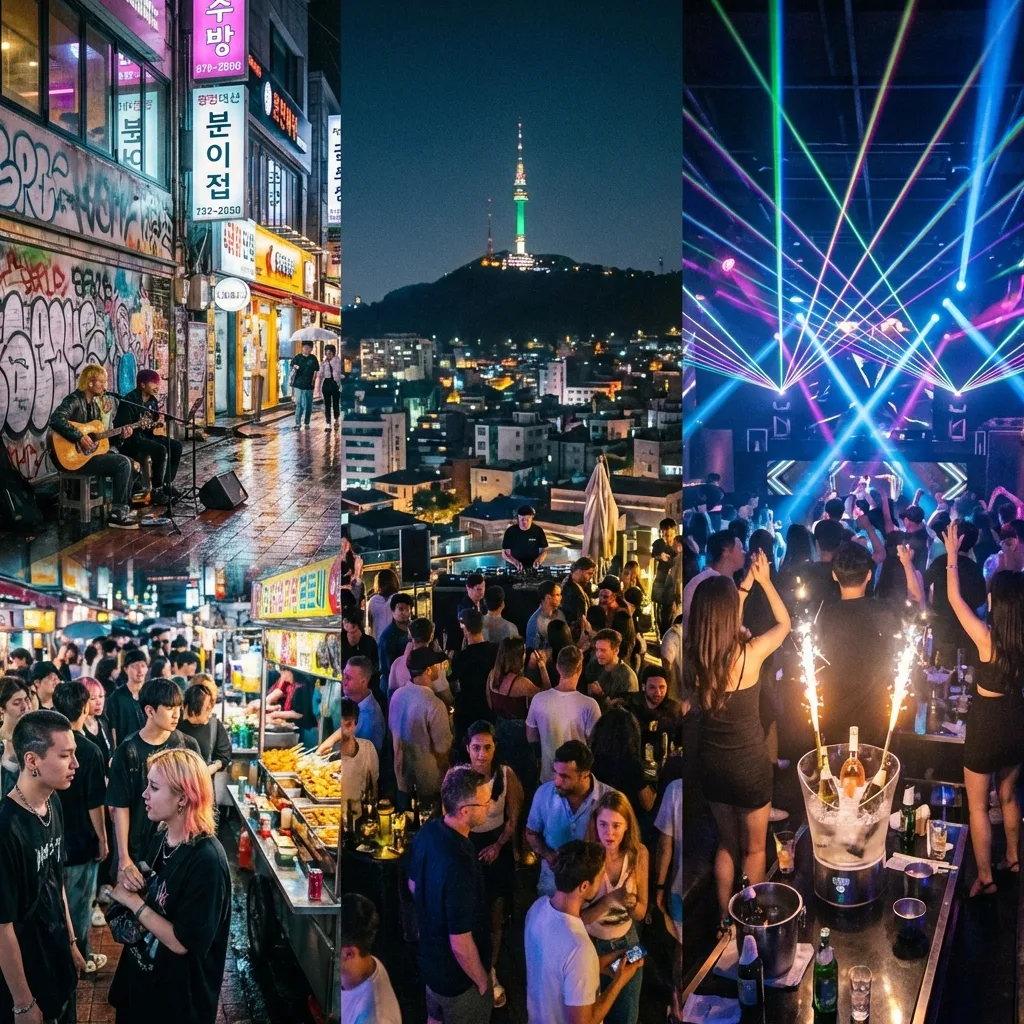
Seoul at 2 AM is a tale of three cities. While the rest of the world might be winding down, the South Korean capital is just hitting its stride. But where you choose to spend your midnight hours will define your entire Korean experience.
Are you looking for the raw, youthful energy of an underground indie club? The sophisticated, multicultural pulse of a rooftop lounge? Or the high-octane luxury of a mega-club with world-class EDM? In Seoul, these aren't just different vibes; they are different districts.
To help you navigate the neon-lit maze of the capital, we've put together the definitive showdown between the big three: Hongdae, Itaewon, and Gangnam.
Understanding the "soul" of each district is the key to planning the perfect night out. Here is everything you need to know about the vibes, the costs, and the crowds of Seoul's legendary nightlife hubs.
Hongdae: The Youthful Energy of the Underground
Hongdae is the creative heart of Seoul. Centered around Hongik University, it's a district that values authenticity over polish.
- The Vibe: Creative, grassroots, and high-energy. It's where you'll find street performers (buskers), basement clubs, and affordable "pojangmacha" (street food tents).
- Best for: Travelers in their 20s, budget-conscious partiers, and anyone who wants to see the "pre-debut" side of Korean talent.
- Music Scene: A mix of everything—indie rock, hip-hop, and mainstream K-Pop.
- Cost: $ (Budget-friendly). You can have a great night out for under ₩70,000.
Don't Miss: The Hongdae Street Performances that happen every weekend evening.
The Geography: Finding Your Way Through Club Road
Hongdae's nightlife is more compact than it looks on a map, which is both its strength and its curse on a busy Friday. The beating heart of the district runs along what regulars call Club Road — the alley that stretches between Exit 9 of Hongdae Station and the Hongdae playground park. You will know you've found it when the bass starts reverberating through the pavement and the smell of tteokbokki hits you from both sides.
Flanking this central artery are the pojangmacha tents — orange-tarpaulin street stalls serving fried fish cakes, odeng soup, and cheap soju. They are not an afterthought; they are an integral part of the pre-club ritual. Learn to love them. Weaving off Club Road into the side streets reveals a labyrinth of smaller live music bars, karaoke (노래방) rooms, and vintage clothing stores that have somehow stayed open until 3 AM. Hongdae rewards the explorers who resist the pull of the main drag.
The Venues: What to Expect
The best way to understand Hongdae's venue landscape is not to hunt down a specific address on a tourist list, but to understand the archetypes. The district has a personality for every mood.
The indie basement club archetype — think exposed concrete, a tiny stage, and a sound system that has definitely seen better days — is where you'll encounter Seoul's underground music ecosystem at its most raw. These are the rooms where acts play before their names appear on festival posters, and the door charge is typically ₩10,000–₩15,000 with a drink ticket included. Venues in the mold of Club FF are the template: small, dark, and loud in the best possible way, with indie rock and electronic sets that go until dawn.
The hip-hop club archetype, best represented by legendary venues like NB2, is its own cultural institution. Korean hip-hop has a ferociously dedicated domestic fan base, and these clubs are where that culture breathes. Expect crews, cyphers at the edge of the dancefloor, and DJs who command genuine reverence. The crowd is younger, the energy is competitive, and the fashion is a serious sport.
For something that contradicts every expectation Hongdae sets, seek out the rooftop garden bar archetype — outdoor spaces strung with fairy lights, potted plants, and a cocktail list that actually has ambition. Venues of the Cocco variety have carved out a quieter, more conversational niche in a district that generally favours volume over subtlety. If your group is not quite ready to commit to a sweaty dancefloor but wants something more interesting than a standard bar, this is your answer.
And then there is the internationally recognised underground techno category. Venues operating in the Cakeshop tradition sit in a different ecosystem entirely — they book international DJs, maintain strict no-photography policies inside, and have built a reputation that extends far beyond Seoul's borders. The door policy tends to be more curated, the crowd more intentional, and the music selection will satisfy anyone who has spent time in the serious club scenes of Berlin, London, or Chicago.
The Pre-Drinking Culture: 집에서 한잔 (Let's Have a Drink First)
One of the most important things to understand about Hongdae — and Seoul nightlife in general — is that clubs do not seriously fill up until midnight or later. What do Koreans do in the meantime? They pre-drink, and they have industrialised it into an art form.
The GS25 and CU convenience stores that dot every corner of Hongdae are not just shops; they are the unofficial pre-game venue of the entire district. Both chains provide outdoor plastic tables and chairs specifically for this purpose. A 500ml can of Kloud or Terra will set you back around ₩2,500, and a bottle of soju is approximately ₩1,800. Compare this to the ₩15,000–₩20,000 you will spend on a single cocktail inside a mid-range club, and the economics of the Korean pre-drinking ritual become immediately clear.
There is a social logic to it too. Korean nightlife is deeply communal — the idea of showing up to a club solo or in pairs and immediately hitting the dancefloor is not really how it works. People gather, eat, drink slowly, and build momentum across multiple locations before committing to a venue. Respect the process, and your night will be dramatically better for it.
Itaewon: The Global Crossroads
Itaewon has long been Seoul's most international district. It's a melting pot where Korean culture meets global trends.
- The Vibe: Sophisticated, inclusive, and diverse. It's the home of Seoul's best rooftop bars and a legendary electronic music scene.
- Best for: Expats, travelers aged 25-35, and the LGBTQ+ community.
- Music Scene: High-quality DJ sets focusing on tech-house, techno, and deep house.
- Cost: $$ (Mid-range). Expect slightly higher drink prices than Hongdae, but with a more polished atmosphere.
The Highlight: Itaewon is the most foreigner-friendly district, with most staff speaking English and a very welcoming door policy for international visitors.
The New Itaewon: Post-2022 Reinvention
The Itaewon many long-term Korea visitors remember — the neon-lit "foreigner strip" of souvenir shops and expat bars clustered around the main street — has largely given way to something more interesting. The district has gone through a profound reinvention, and the new focal point of its nightlife energy is Gyeongnidan-gil (경리단길), the winding street that climbs the hill toward Namsan.
Gyeongnidan-gil is dense with boutique cocktail bars where the bartenders are treating mixology as a genuine craft, wine bars running by-the-glass lists of natural and biodynamic pours, and intimate live music venues that seat maybe forty people and book jazz trios or experimental electronic acts. This is the Itaewon that the Seoul creative class actually inhabits, and it rewards those who arrive with curiosity rather than a checklist. Reservation or walk-in — either works — but arrive before 9 PM if you want the best seats for a live set.
Haebangchon (HBC): The Expat's Village
If Gyeongnidan-gil is the stylish hill, Haebangchon (해방촌) — known universally as HBC — is the residential counterweight, and it is beloved for exactly that reason. Tucked into the quieter slopes above Itaewon, HBC has the feel of a genuine neighborhood bar scene: craft beer taps, affordable international food, and the kind of place where you can actually hear the person across from you.
The crowd here skews heavily expat — teachers, NGO workers, long-term residents — and the atmosphere is correspondingly relaxed and unpretentious. You are less likely to encounter a door charge or a dress code, and more likely to find yourself in a three-hour conversation with a table of strangers from four different countries. If that sounds like your idea of a good night, HBC should be your first stop in the Itaewon area rather than your last.
The Electronic Scene and the Rooftop Bars
Itaewon's serious electronic music venues are a known quantity on the global circuit. The clubs operating in this space tend to enforce no-photography policies inside the dancefloor — a norm borrowed directly from Berlin's club culture. This is not pretension; it is a genuine effort to create an environment where people dance without performing for their phones. Respect the policy. The door selection at these venues is curated, which means presenting yourself well and arriving in a small group works better than rolling up in a large, loud party of ten.
The rooftop bar scene is a different proposition entirely. Several venues in the Itaewon area offer elevated terraces with clear sightlines to Namsan Tower — the illuminated landmark that defines Seoul's skyline from this angle. These are the spots for the first drink of the evening, when you want the skyline to remind you that you are, in fact, in one of the most extraordinary cities on earth. Cocktail prices run ₩16,000–₩22,000, which feels steep until you factor in the view.
The LGBTQ+ Scene
Itaewon's Rainbow Street area has historically been the anchor of Seoul's LGBTQ+ nightlife, and it remains a significant and welcoming space. Venues here range from bars to full clubs, and the community is tightly knit. That said, Seoul's LGBTQ+ scene is dynamic and venues do open and close, rebrand, or shift focus. The strong advice from anyone who has been navigating this scene for more than a few years is simple: check current venue status online before you go. Community forums, Instagram accounts, and local expat Facebook groups are far more reliable than any printed guide for up-to-date information on what is open, what is thriving, and what is currently the spot.
Gangnam: The High-End Posh Parade
If you've seen the music video, you know the name. Gangnam is the epitome of Korean luxury and high fashion.
- The Vibe: Posh, exclusive, and high-octane. This is the land of mega-clubs, bottle service, and "Signiel-level" luxury.
- Best for: Big spenders, EDM lovers, and those who want to experience the absolute peak of Seoul's high-end social scene.
- Music Scene: Massive EDM floors with world-class sound systems and laser shows.
- Cost: $$$ (Luxury). A night here can easily exceed ₩500,000 if you're looking for a table or bottle service.
The Gangnam Club Triangle
Gangnam's mega-club scene is not a loose collection of venues — it is a clearly defined ecosystem with three venues that dominate the conversation. Octagon, Arena, and Club Mass form the unofficial triangle of Gangnam nightlife, and each has a distinct identity despite operating at roughly the same scale and price point.
All three operate on broadly similar terms for walk-in entry: expect a cover charge in the ₩30,000–₩50,000 range, which typically includes one drink. Dress code is enforced — smart casual is the baseline expectation, and this means no sportswear, no sandals, and no athletic slides regardless of how fashionable they might be everywhere else in Seoul. The door staff at Gangnam clubs are polite but firm, and a dress code rejection is not a negotiation.
The smarter move — and one that separates experienced visitors from first-timers — is the guest list system. All three major clubs maintain guest lists that you can access through their official Instagram accounts or websites. Signing up in advance typically secures free or heavily discounted entry, sometimes with an additional drink included. It takes five minutes and can save you ₩40,000. Do it before you leave your accommodation.
The MD System: Know Before You Go
Inside any Gangnam mega-club, you will encounter the MD — the Merchandising Director. This is a specific role in Korean club culture: MDs are employed by the club to sell table packages and bottle service directly to guests on the dancefloor. They are typically well-dressed, confident, and very good at their job.
When an MD approaches your group, they will present bottle packages — premium spirits with mixers, fruit platters, and table reservation for the evening. These packages start at roughly ₩300,000 and scale upward without a visible ceiling. If you are not interested, the correct move is a polite but firm decline: "괜찮아요, 감사합니다" (it's okay, thank you) delivered with a smile and a slight bow. They will move on. Do not be rude; the MD is doing their job in a system their customers built and sustain.
If you do want a table — and for a large group, a bottle package can actually be reasonable value per person — engage the MD directly, negotiate calmly, and clarify exactly what is included before you agree to anything. The listed price is rarely the final price for groups who ask politely.
The Sinchon Alternative
A note for those who want a taste of Gangnam's energy without fully committing to the price tag: Sinchon (신촌), located near Yonsei University, occupies an interesting middle position in Seoul's nightlife geography. It is younger and cheaper than Gangnam proper, with a more diverse music mix that covers everything from R&B to mainstream K-Pop to the occasional live DJ set. It is often overlooked in the standard Hongdae–Itaewon–Gangnam conversation, which makes it exactly the kind of discovery that feels genuinely rewarding when you stumble upon it.
Side-by-Side Showdown: Which is Right for You?
| Feature | Hongdae | Itaewon | Gangnam |
|---|---|---|---|
| Primary Age | 19–25 | 25–40 | 23–45 |
| Vibe | Authentic / Gritty | International / Chic | Luxurious / Posh |
| Music | Indie / Hip-Hop | Techno / Lounge | EDM / House |
| Foreigner Entry | Moderate | Excellent | Selective |
| Typical Cost | Affordable | Mid-Range | Expensive |
The Non-Negotiable: The ID Crisis
Regardless of which district you choose, there is one rule that applies to all: You must have a physical ID.
- Passports: A physical passport is the gold standard.
- ARC Cards: If you are a resident, your Alien Registration Card is accepted.
- Warning: Photos of your passport on your phone are almost never accepted at major clubs. Don't risk a long taxi ride only to be turned away at the door!
Logistics: Getting Home at 3 AM
Navigating Seoul after the subway stops (around midnight) requires a plan:
- KakaoT: The Korean version of Uber. It's essential for booking a taxi during the 2 AM rush.
- The Owl Bus: Seoul's incredible night bus network. Look for buses with an "N" prefix (e.g., N13, N62). It's the most affordable way to move between districts late at night.
The Full Night-Out Timeline: How a Seoul Night Works
One of the genuinely disorienting things about Seoul nightlife for first-time visitors is the pacing. By the standards of most Western cities, things start very late and run very long. Here is the architecture of a full Seoul night, broken down by hour.
6–8 PM: First Dinner (1차, Il-cha) The night begins with food, always. A Korean BBQ dinner of 삼겹살 (samgyeopsal, grilled pork belly) or a shared plate of 치킨 (Korean fried chicken) with beer is the standard opening move. This is not just eating — it is the social foundation for everything that follows. Korean drinking culture is built on the principle of 1차 (first round), 2차 (second round), and so on, each escalating in intensity. The first round almost always involves food.
8–10 PM: The Bar Round (2차, I-cha) After dinner, the group migrates to a bar — a 호프집 (hof, draft beer bar) or increasingly a craft beer venue or cocktail bar. The conversation deepens, the soju flows, and the group's energy starts building. This is the round where plans for the rest of the night crystallise.
10 PM–Midnight: Street Food and the Convenience Store Pre-Party (3차, Sam-cha) This is where the pre-drinking culture described in the Hongdae section becomes literal. Groups migrate to pojangmacha stalls for tteokbokki and fish cakes, or post up at a GS25 with armfuls of convenience store beer. Clubs are technically open, but a savvy Seoul nightlifer would never arrive before midnight. The first hour of any club is an empty room with overpriced drinks.
Midnight–2 AM: Clubs Fill Up This is when it actually starts. By 12:30 AM, the queues outside major venues have formed. By 1 AM, the dancefloors are operating at full capacity. The energy peaks somewhere around 2–3 AM in most districts.
2–4 AM: Peak Energy Do not make the mistake of leaving at 2 AM. In Seoul, this is the apex. The DJ sets are at their most committed, the crowd is fully released, and the city outside is still alive with taxis, street food vendors, and the general hum of a metropolis that has decided sleep is optional.
4 AM: The First Train Option Seoul's subway system reopens around 5:30 AM on weekdays, slightly earlier on weekends. The strategic play for budget-conscious night owls is to ride out the club until 4 AM, grab 순대국밥 (sundae gukbap, blood sausage soup) at one of the 24-hour restaurants near any major station — an institution of post-club Korean culture — and then catch the first train home as dawn breaks. It is cheaper than a taxi, and it is one of those experiences that will live rent-free in your memory for years.
The 4차 (Sa-cha) Principle The concept of 차 (cha, meaning "round") is central to understanding how Koreans structure a night out. Each round is expected to escalate — in venue type, in energy, in intimacy. A night that reaches 4차 is a night that has gone well. Foreigners who understand this rhythm and lean into it rather than fighting it will consistently have better nights than those who try to compress everything into a two-hour club visit.
Practical Safety and Respect Tips
Seoul is one of the safest major cities in the world for nightlife, but "safe" does not mean "consequence-free." A few practical principles will ensure your night stays in the good category.
Entry Etiquette
Queue without pushing. This sounds obvious, but the queues outside popular Gangnam clubs can be slow and frustrating, and the temptation to edge forward exists. Don't. Korean queue culture is orderly and jumping it will not speed up your entry — it will only irritate the people around you and potentially attract the attention of door staff in a way you do not want.
Do not negotiate at the door. If you are rejected — for dress code, because the club is at capacity, or for any other reason — accept it without argument. Door staff are doing their jobs. Arguing will not change the outcome and will make your night considerably worse.
Drink Safety
Solo travelers should apply standard global nightlife safety principles here. Do not leave drinks unattended. In mixed company, keep your glass with you or covered. Seoul's nightlife is overwhelmingly safe by international standards, but the basics of drink safety are not optional regardless of where you are in the world.
The No-Photography Policy
Many underground clubs in Itaewon and Hongdae — and some in Gangnam — maintain strict no-photography policies inside the dancefloor area. This is not arbitrary. These policies protect the privacy of attendees, many of whom have professional reasons to keep their after-hours lives separate from their public ones in a society where social judgment can be swift and harsh. Beyond privacy, the policy preserves the atmosphere. A dancefloor full of phone screens pointed outward is not a dancefloor — it is a content farm. Respect the policy. Your memory will hold the night better than a video clip would anyway.
Handling Touts
Near the entrances of popular club areas, particularly in Hongdae and around Itaewon's main strip, you will encounter touts — people actively recruiting pedestrians into specific venues, sometimes with promises of free entry or discounted drinks. Exercise judgment. Not every tout is operating in bad faith, but the venues that resort to sidewalk recruiting are frequently not the venues worth entering. If a place is worth your time, it typically does not need someone physically pulling people in from the street.
Medical Emergencies
If you or someone in your group feels unwell at any point during the night, know your immediate resources. Every district has 24-hour convenience stores stocked with basic medical supplies — rehydration salts, pain relief, bandages. Taxis are always running and can get you to a hospital quickly; Seoul's major hospitals have English-language assistance lines. If you are in a club and something feels wrong, find the staff immediately — Korean club staff are trained to handle medical situations and will take them seriously.
The cash rule: Carry at least ₩20,000 in physical cash at all times when you are out. KakaoT is excellent, but card machines fail, apps crash, and at 4 AM when you desperately need a taxi home, cash is the difference between a minor inconvenience and a genuinely bad situation.
Conclusion
Seoul's nightlife is not a one-size-fits-all experience. From chasing viral energy in Hongdae to sipping cocktails in Itaewon or experiencing the high-end polish of Gangnam, the city guarantees a night you won't forget. Navigating these bustling districts safely is paramount, so reviewing our dedicated tips on Nightlife Safety in Korea will help you confidently enjoy the after-hours scene. These nocturnal adventures are just one facet of what the capital offers; The Ultimate Seoul Travel Guide: Where to Stay & What to See can help you piece together the daytime counterparts to your evening plans. When mapping out a larger 10-Day South Korea itinerary, be sure to leave at least one morning free so you can firmly sleep in after a legendary Seoul night out.