A Guide to Hiking Seoraksan National Park: Stunning Peaks and Temples
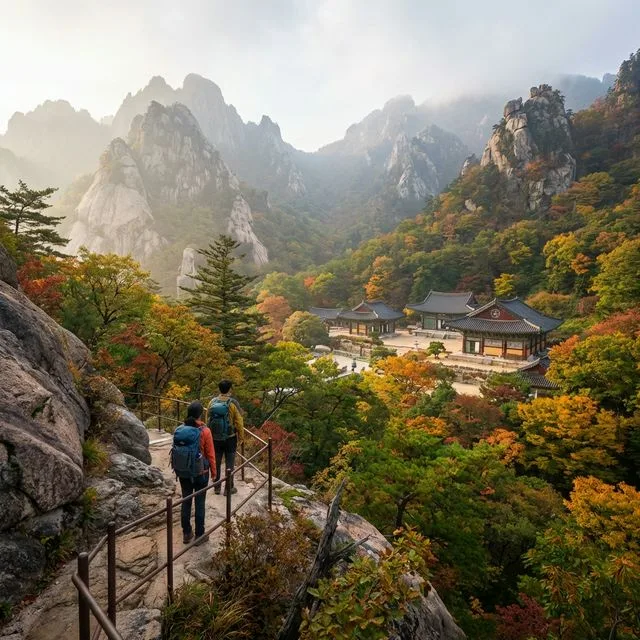
If you ask any Korean which mountain is the most beautiful in their country, the answer is almost always Seoraksan (설악산).
Located in the northeast province of Gangwon-do, Seoraksan National Park is a UNESCO Biosphere Reserve that looks like it was carved by the gods. Jagged granite peaks pierce the clouds, waterfalls cascade into crystal-clear pools, and ancient Buddhist temples sit quietly in the valleys. While Hallasan in Jeju is higher, Seoraksan is far more dramatic.
Whether you are a hardcore mountaineer looking to conquer the "Dinosaur Ridge" or a casual traveler wanting a scenic cable car ride, this mountain delivers.
Why Seoraksan is Korea's Crown Jewel
Seoraksan means "Snowy Crags Mountain," named because the snow here lasts longer than anywhere else. But its beauty isn't limited to winter.
- Rugged Beauty: Unlike the rolling hills of Seoul's Bukhansan, Seoraksan features sharp, imposing stone formations.
- Accessibility: It offers trails for literally everyone, from wheelchair-accessible paths near the entrance to expert-level multi-day treks.
- Cultural Depth: It is home to Sinheungsa, one of the most historically significant Zen temples in Korea, instantly recognizable by its massive bronze Buddha statue.
For many travelers, a trip to Korea is incomplete without seeing these peaks.
Best Time to Visit: Timing Your Hike
Choosing when to go is as important as choosing which trail to hike.
Autumn (Mid-October to Early November) 🍁
This is the Golden Window. The entire mountain explodes into vibrant shades of crimson, burnt orange, and gold.
- Pros: The scenery is world-class.
- Cons: The crowds are insane. The road to the park entrance can become a parking lot. If you go in late October, start your day at 6:00 AM or earlier.
- Related: The Perfect 10-Day Autumn Itinerary for Foliage Lovers in Korea
Spring (Late April to May) 🌸
Sokcho (the gateway city) dazzles with cherry blossoms, and the mountain is lush green.
- Warning (Fire Season): From March 1st to mid-May, many higher-elevation trails (like Daecheongbong Peak) are closed for forest fire prevention. Always check the Korea National Park website for closures before you go.
Summer (June to August) 🌿
Deep green forests and rushing waterfalls.
- Pros: Great for valley hikes like Biryong Falls.
- Cons: It is hot and humid. Bring twice as much water as you think you need.
Winter (December to February) ❄️
A snowy wonderland that looks like a traditional ink wash painting.
- Note: You must have crampons (spikes) for your boots. The trails become sheets of ice.
Getting There: From Seoul into the Mountains
Seoraksan is located near the coastal city of Sokcho. You cannot take a train directly there; the bus is king.
Step 1: Seoul to Sokcho (Bus)
You have two main terminals in Seoul to choose from:
- Seoul Express Bus Terminal (Gangnam): Takes ~2 hours 20 mins. Buses are frequent (every 20-30 mins).
- Dong Seoul Bus Terminal (East Seoul): Takes ~2.5 to 3 hours. Good if you are staying in Jamsil or eastern Seoul.
Cost: 20,000 - 30,000 KRW (Premium buses with lie-flat seats are worth the extra $5).
Step 2: Sokcho City to Seoraksan Entrance
Once you arrive at the Sokcho Express Bus Terminal or Intercity Terminal:
- Walk to the bus stop located just outside.
- Take Bus 7 or 7-1.
- Cost: ~1,500 KRW (Use your T-Money card).
- Duration: 30-40 minutes.
- Stop: Get off at the final stop, Sogongwon (Seoraksan Entrance).
Pro Tip: Many travelers choose to stay in Sokcho for a night to get an early start. Sokcho is famous for its seafood and traditional market. Related: Hidden Gems of Gangwon-do: Sokcho, Gangneung, and Beyond
Choose Your Battle: Top 4 Hiking Courses
Seoraksan has dozens of trails, but these four cover 90% of visitors' needs, ranked from easiest to hardest.
1. The Cable Car & Gwongeumseong Fortress (Easy)
- Difficulty: ⭐ (Walk in the park)
- Time: 1 hour total
- Best For: Families, seniors, non-hikers, photographers.
This is the most popular attraction in the park. The cable car whisks you up the mountain in 5 minutes. At the top, a 10-minute walk brings you to Gwongeumseong Fortress, a rocky peak with panoramic views of the East Sea and the jagged mountain ridges.
- Note: You cannot book tickets in advance. You must buy them at the ticket office on the ground floor. In autumn, tickets can sell out by noon, so arrive early!
2. Biryong Falls & Towangseong Observatory (Moderate)
- Difficulty: ⭐⭐ (Stairs involved)
- Time: 1.5 - 2 hours round trip
- Best For: Nature lovers who want a nice walk without killing their legs.
The trail to Biryong Falls ("Flying Dragon Waterfall") starts flat, winding through bamboo forests and over scenic bridges. The final section involves some stairs, but the view of the tall, slender waterfall is rewarding.
- Extension: If you have energy, continue up the 900 stairs to the Towangseong Falls Observatory for a view of one of Korea's longest waterfalls.
3. Ulsanbawi Rock (Hard)
- Difficulty: ⭐⭐⭐⭐ (Steep!)
- Time: 3-5 hours round trip
- Best For: Instagrammers and fit hikers.
This is THE hike. Ulsanbawi is the massive, unique granite formation that looks like a folding screen. The hike starts easy, passing the fascinating Heundeulbawi (Teetering Rock)—a boulder you can rock with a push but never push over.
- ** The Challenge:** The final kilometer is affectionately known as the "Stairs of Doom"—over 800 steep metal steps bolted into the sheer cliff face.
- The Reward: The view from the top is arguably the best in Korea, overlooking the ocean, the city of Sokcho, and the inner mountain range.
- Gear Check: Wear proper hiking shoes or sneakers with good grip.
- Related: Essential Gear for Hiking in Korea: Prepare for the Terrain
4. Biseondae Rocks (Easy/Moderate)
- Difficulty: ⭐⭐
- Time: 2 hours round trip
- Best For: A relaxing valley walk with dramatic scenery.
This gorgeous trail follows the jade-green waters of the valley. The path is largely flat and paved, making it accessible for casual walkers. It ends at Biseondae, large flat rocks where legends say heavenly beings once descended. This is also the gateway for the expert-level trails deeper into the park.
5. The Expert Zone: Daecheongbong & Dinosaur Ridge
- Difficulty: ⭐⭐⭐⭐⭐ (Expert)
- Time: 10-14 hours
- Best For: Experienced mountaineers only.
Daecheongbong is the highest peak (1,708m). Most hikers start at 3:00 AM from the Osaek entrance to reach the summit for sunrise. Dinosaur Ridge (Gongnyong Ridge) is the holy grail of Korean hiking. It involves endless ups and downs along a jagged spine that resembles a dinosaur's back. It is grueling, technical, and dangerous in bad weather. Do not attempt this in casual sneakers.
Visiting The Temples
Right near the entrance, even before you start hiking, you will encounter the Great Unification Buddha (Tongil Daebul). This 14.6-meter tall bronze statue symbolizes the Korean people's wish for reunification.
Just past it is Sinheungsa Temple. It's a perfect place to breathe in the mountain air and observe the serene architecture. Many hikers stop here to offer a quick prayer for safety before ascending.
Practical Tips for Seoraksan
1. Entrance Fees
Great news! As of 2024, the entrance fee to Seoraksan National Park (formerly for the temple) has been abolished. Entry is free.
2. Food & Water
The park entrance is well-stocked with restaurants, convenience stores, and cafes (there's even a uniquely designed Starbucks). However, once you pass Biseondae or start climbing Ulsanbawi, there are no food vendors. Bring plenty of water.
3. Navigation
Google Maps does not work well for hiking trails in Korea. Download Naver Map or KakaoMap. They have detailed trail maps that show your GPS location even deep in the mountains.
4. Trash
"Leave No Trace" is strictly enforced. There are no trash cans on the trails. You must carry all your wrapper and bottles back down with you.
Sokcho: The Gateway City Worth Exploring
Most visitors treat Sokcho as a transit hub — arriving at the bus terminal, taking Bus 7 to Seoraksan, and leaving the following day. This misses one of Korea's most underrated coastal towns.
Sokcho's highlights:
Seokchomarket (속초 관광수산시장) The city's main covered market is famous for its dried seafood, pickled squid (오징어젓갈), and steamed buns (jjinppang). The inner market is lined with vendors selling raw seafood by the bucket — a vivid sensory experience even if you're not buying.
Abai Village (아바이마을) A neighborhood settled by North Korean refugees after the Korean War. Accessed by a cable-pulled ferry across a narrow channel for 200 KRW — one of Korea's most charming 30-second journeys. The village is famous for Abai sausage (a thick, stuffed pork sausage) and sundae (blood sausage).
Sokcho Beach A long, clean beach south of the city center. Good for a post-hike walk. The beach is flanked by a lighthouse park and a sculpture-lined promenade — calm and uncrowded compared to Korea's southern coast beaches.
Daepo Port (대포항) A working fishing port 3 km south of Sokcho. Famous for its raw live fish restaurants — a cluster of seafood restaurants where the fish are pulled from tanks at your table. The specialty is hoe (raw fish sliced fresh) — if you're an adventurous eater, this is one of the great raw seafood experiences in Korea.
Where to Stay Near Seoraksan
In Sokcho (Most Practical)
Sokcho has a full range of accommodation from budget motels to mid-range hotels. Staying in Sokcho gives you the flexibility of the city while being 30 minutes from the park entrance.
- Budget: Sokcho near the terminal area has affordable yeogwan (traditional Korean motels) for ₩40,000–₩70,000/night
- Mid-range: Several business hotels and pension-style guesthouses operate near Sokcho Beach at ₩80,000–₩150,000/night
- Best online search term: "속초 숙박" (Sokcho accommodation) on Naver, or "Sokcho hotel" on Booking.com
Inside the Park (Camping Only)
Seoraksan has designated backcountry camping spots for multi-day trekkers (primarily used for the Daecheongbong summit hike starting at Osaek). These require advance booking through the Korea National Park Service website (knps.or.kr) and are accessible only to overnight hikers with valid permits.
Osaek Area
For hikers doing the dawn summit approach to Daecheongbong, staying at accommodation in the Osaek Valley area (south entrance of the park) allows a 3–4 AM departure without the long drive from Sokcho. Several traditional pension-style guesthouses operate here; search "오색 숙박" on Naver.
2026 Practical Updates
Entry is free: The entrance fee to Seoraksan National Park (previously charged as a temple entrance fee) was abolished in 2024 and remains free in 2026.
Cable car: Advance booking for the cable car is now available via the Seoraksan cable car official app and website, which can reduce waiting time during peak season (autumn especially). On-site queue times in late October can exceed 2 hours.
Trail closures: Spring fire prevention closures (typically March 1–May 15 for higher trails) apply annually. Check knps.or.kr before your visit for current closure status.
Emergency contact: The national park mountain rescue number is 119 (combined with all emergency services). Cell phone coverage is good throughout Seoraksan except in the deepest valley sections.
Seasonal Packing List for Seoraksan
Packing correctly is as important as picking the right trail.
| Season | Must-Have | Nice-to-Have |
|---|---|---|
| Spring (April–May) | Layers, light jacket, KF94 mask (yellow dust) | Trekking poles for wet trails |
| Summer (Jun–Aug) | 2x water (2L minimum), quick-dry shirt, rain layer | Electrolyte tablets, head net |
| Autumn (Sep–Nov) | Warm mid-layer, crampons if late October snow | Gloves, buff/neck warmer |
| Winter (Dec–Feb) | Crampons (mandatory), thermal base layer, insulated jacket | Hand warmers, balaclava |
Footwear rule: For anything beyond the Biryong Falls trail — and absolutely for Ulsanbawi — you need shoes with grip. Sandals and flat-soled shoes are genuinely dangerous on wet rock or metal stairs. Many park rangers will informally turn back hikers in inappropriate footwear at the Ulsanbawi checkpoint.
Frequently Asked Questions
Can I do Ulsanbawi in a day trip from Seoul? Yes — the bus from Seoul Express Bus Terminal takes approximately 2.5 hours; first buses leave from 6 AM. If you arrive at the park by 10 AM, complete Ulsanbawi by 3 PM, and catch an afternoon bus back, you'll arrive in Seoul by 9 PM. It's a long day but entirely feasible.
If Seoraksan feels like the right benchmark, compare it with the sea-view routes in 10 Best Coastal Trails in South Korea for Breathtaking Sea Views. Before you go, review the social rules in Hiking Etiquette in Korea: What to Wear and How to Behave. And if you want a gentler nature day after a hard ascent, use Healing Stays: Best Wellness Retreats and Forest Therapy in Korea for the recovery side of the trip.
Is Seoraksan suitable for children? The cable car + Gwongeumseong trail is excellent for children (and strollers up to the cable car base). The Biryong Falls trail is manageable for active children over 6. Ulsanbawi's final section (800 metal steps) is not recommended for young children or those with a fear of heights.
When should I book KTX or bus tickets for Sokcho? Sokcho is accessible only by bus (not KTX). Book weekend departure buses 2–4 weeks in advance during peak autumn and spring seasons via the Kobus app or at Seoul Express Bus Terminal's automated machines. Online advance booking is strongly recommended for October travel.
What is the best restaurant near the park entrance? The strip of restaurants just outside the Seoraksan entrance gate has dozens of options. The local specialty is dak-galbi (spicy stir-fried chicken) from the Chuncheon/Gangwon-do tradition, available at several restaurants along the main approach road. For seafood, head back to Sokcho — the 30-minute bus ride is worth it for the fresh catch at Daepo Port.
Are there lockers at the park entrance? Yes — coin-operated lockers are available at the main park entrance area for storing heavy bags during day hikes. This is useful if you're arriving from the bus station with luggage before heading to your accommodation later. Bring 500 KRW and 1,000 KRW coins — the locker area has no change machine, and exact change is required for entry. Most lockers fit a 65L hiking backpack with room to spare.
Final Thoughts
Seoraksan is more than just a mountain; it's a spiritual recharge. The mix of convenient amenities and raw, wild nature makes it unique. Whether you just sip coffee at the foot of the mountain or pull yourself up the final cables of Ulsanbawi, you will leave with a sense of awe. Because the park is geographically distant from Seoul, many travelers combine it with coastal exploration; our East Coast Road Trip guide covers how to seamlessly link Seoraksan with Gangneung and Sokcho. If you fall in love with Korea's peaks here but only have limited time, you can experience fantastic mountain trails right within the capital by Hiking Bukhansan National Park. Be sure to carefully plot out travel time to these remote eastern regions while drafting your 10-Day South Korea itinerary.