Shanghai airport arrival: choosing a transfer after a long flight

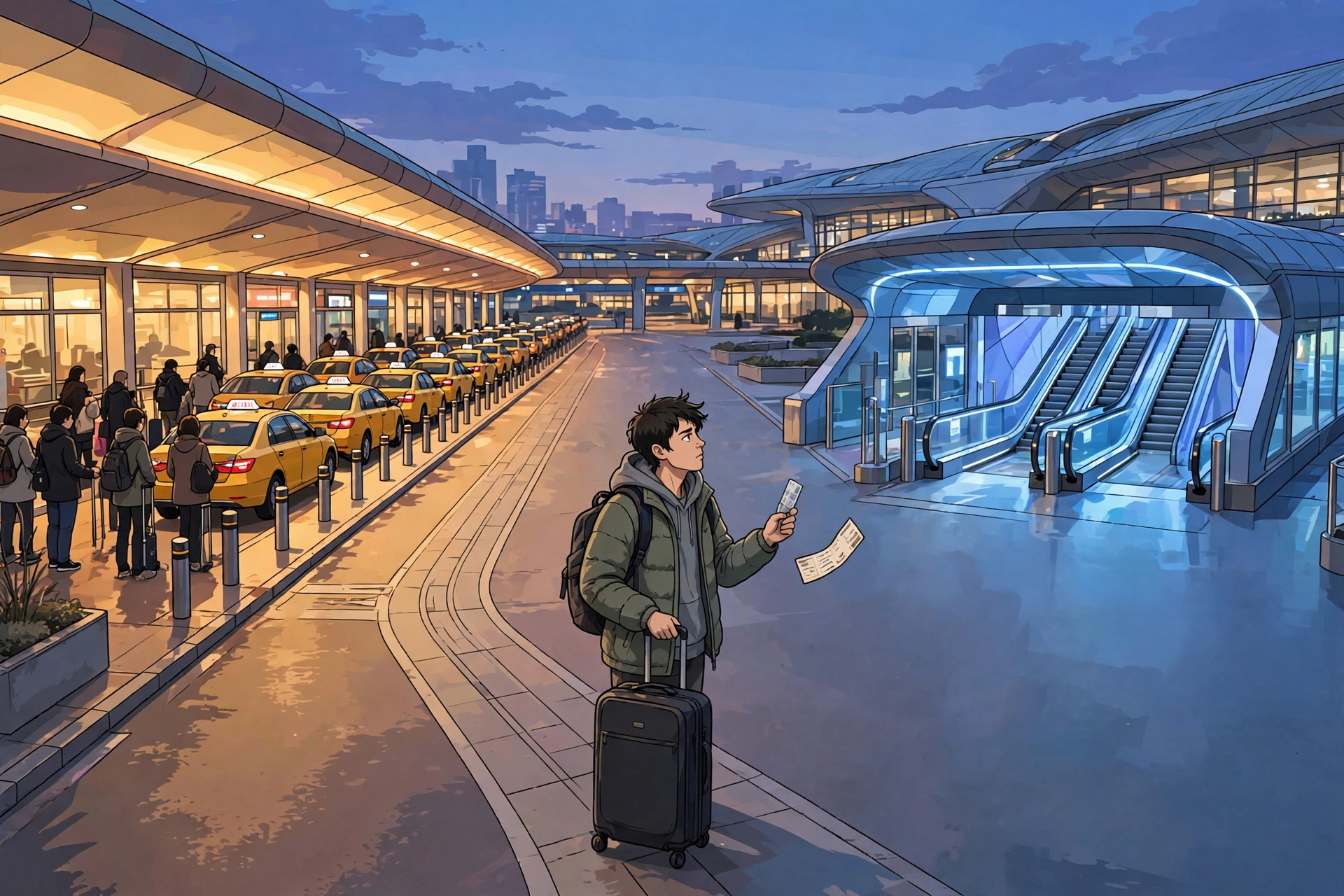
Pudong vs Hongqiao: which airport your flight actually uses
Shanghai has two airports and they demand different transfers: Pudong (PVG) handles most international flights about 40 km east of downtown, while Hongqiao (SHA) sits about 13 km west and is much closer to the city. Check your ticket first — the two airports need completely different transfer math.
That's the whole framing of this guide: not a list of every vehicle in Shanghai, but a decision tree for someone who's tired, possibly jet-lagged, and standing in an arrivals hall. Work through these four questions in order and one option will be obvious.
1. Which airport — PVG or Hongqiao? If Hongqiao: you're close to the city and the decision mostly reduces to metro vs. taxi based on luggage. If Pudong: the 40 km distance from downtown makes your choice matter, so keep going.
2. What time do you land? Metro Line 2's airport trains run roughly 06:00 to around 22:00–23:00 depending on direction, and the maglev runs about 06:45 to 21:40 (schedules shift, so confirm before you count on them). Inside those windows, rail options are real. After about 23:00, rail is off the table — your choice is taxi, DiDi, or a night bus.
3. How much luggage, and how many of you? One backpack or a single rolling case: the metro is completely manageable. Two heavy suitcases after a 12-hour flight: a taxi or DiDi buys you a direct door-to-door trip when your legs are gone. Three or four people together: the economics flip — a taxi fare split four ways from Pudong works out close to the per-person cost of the maglev, with zero transfers.
4. Where exactly are you staying? Lujiazui, the Bund/Puxi side, the French Concession, Jing'an, or near Hongqiao — each answers differently. Metro wins when your hotel sits on Line 2 (People's Square, Nanjing East Road, Lujiazui) or needs only one easy transfer. Taxi wins when your final stop is far from any metro station or your arrival involves stairs and late-night walking you won't enjoy while tired.
A worked example. Say you land at Pudong at 21:40 on a Friday, two suitcases, hotel near People's Square. Question 1 says Pudong (long distance, choice matters). Question 2 says the maglev is closed and the metro is nearly done. Question 3 says heavy luggage. Question 4 says your hotel is on Line 2 — but it's Friday night and you're exhausted. The tree gives you: taxi. Roughly ¥200, about an hour, door to door. No transfers, no sprinting for the last train, no dragging bags through a crowded carriage. That's the whole point of the tree — it makes the right call when you're too tired to reason about it.
The Pudong maglev question. The maglev deserves its own callout because it seduces tired travelers: Pudong Airport to Longyang Road in about eight minutes, touching 431 km/h during the day (slower early and late), single ticket around ¥50. But it does not go downtown — it goes to Longyang Road, where you transfer to Line 2 or 7 for the rest. Total door-to-downtown time ends up comparable to taking Line 2 all the way. It makes sense if you're staying in Pudong or want the ride itself; it does not make sense as a pure time-saver to the city center, and it's closed for late arrivals. The maglev has decent luggage space and a smooth ride, so the comfort factor is real — just don't let the speed headline trick you into thinking it solves the whole transfer.
Hongqiao Airport's downtown advantage: the 20-minute transfer most guides skip
Hongqiao is the transfer most guides skip, and it's the easier one. The airport is close to downtown — a taxi to central Puxi (People's Square, Jing'an) runs roughly ¥60–90 and takes 20–35 minutes. Metro Line 2 and Line 10 both serve the airport, and the ride to People's Square is about 30–40 minutes.
Because the distances are short, the decision tree collapses:
- Light luggage, daytime, hotel near Line 2 or 10: take the metro. Cheap, fast enough, done.
- Heavy luggage, group, or late night: take a taxi. At Hongqiao distances the fare is small enough that there's no meaningful debate.
- Staying near Hongqiao itself (the transportation hub area, or western Shanghai): taxi or metro are both trivially short.
The 20-minute transfer, concretely. The headline number in this section's title is the off-peak taxi ride from Hongqiao to central Jing'an or People's Square: roughly 20 minutes when the elevated highways are clear, which is most of the midday and late evening. Compare that with the same trip from Pudong — 45 to 70 minutes by taxi — and you see why Hongqiao arrivals barely think about transfers. The practical consequence: if you're choosing between two flights and one lands at Hongqiao, the transfer alone can be worth an hour of your evening. Most guides treat the two airports as interchangeable and bury the difference in a comparison table; after a long flight, an hour is the difference between dinner in the city and room service.
The one trap: if you're connecting to a high-speed train at Hongqiao Railway Station, note that the railway station is directly connected to Terminal 2 — a long but signposted indoor walk. Give yourself more time than the map suggests, because the complex is enormous and tired travelers misjudge distances here constantly.
The reverse case is worth one line for the itinerary planners: flying into Pudong but staying near Hongqiao (or vice versa) is the one scenario where a Pudong–Hongqiao cross-airport transfer matters. Metro Line 2 connects the two airports directly (about 90 minutes); a taxi between them runs roughly ¥200+ depending on traffic. Allow 3–4 hours between flights if one leg uses each airport.
DiDi vs taxi at 1am: what actually works when the metro is closed
Land after metro and maglev hours and your options narrow to taxi, DiDi, or night bus — but the logic changes a bit.
The taxi queue at night is still the default. It operates 24 hours at both airports. The line is usually short late at night, and the regulated meter means no nighttime price games from official cars. From Pudong to central Shanghai (People's Square, the Bund, Jing'an), a metered taxi runs roughly ¥180–220 depending on traffic, 45–70 minutes. From Hongqiao, roughly ¥60–90, 20–35 minutes. After a long flight with heavy luggage, this is the option most travelers quietly wish they'd taken.
How the official queue actually works. Follow the signs from arrivals — the official queue is outside the terminal, clearly signed, usually with railings and an orderly line. Ignore anyone inside the terminal offering "taxi, taxi": these are touts, not the queue. An attendant assigns you to the next car. The driver starts the meter — in Shanghai official taxis always run the meter; a fixed-price quote from the curb is a signal you're not in the official queue. Keep the receipt or photograph the taxi's license plate card on the dashboard; it's your recourse if anything goes wrong. At busy hours the Pudong queue can look long but moves fast because cars arrive constantly. Four people with luggage: tell the attendant — they may direct you to a larger car rather than splitting you across two.
DiDi at 1–3 a.m. works but can mean waiting. DiDi is China's dominant ride-hailing app, and it's worth setting up before you fly, not after you land: the app has an English version and accepts foreign cards, but install it, log in, and test it while you still have reliable internet and patience. Ride-hailing pickups at PVG are in designated zones — the walk is longer than the taxi queue, and availability at 1–3 a.m. is thinner than daytime. DiDi shines when you want a fixed upfront price and don't want to negotiate anything; the taxi queue shines when you want the shortest path to a car. If your app is set up and you're patient, DiDi is fine; if you're standing in the terminal with 5% battery, take the taxi queue.
One detail that catches people out: DiDi pickup zones at Pudong are not at the curb. Follow the ride-hailing signs to the designated parking areas — the walk can be 5–10 minutes from arrivals, and the app's pin sometimes lands you at the wrong exit level. Give yourself that buffer, especially late at night when the terminal is quiet and signposting feels harder to follow.
Night buses from Pudong run to several city points after metro hours at low fares. They're cheap and reliable, but they're buses — slow, fixed routes, and you still need a final leg to your hotel. Choose this only if your hotel sits near a night-bus stop and you're genuinely on a budget.
Book nothing in advance that you can't cancel. Pre-arranged airport pickups exist, but they cost a multiple of the taxi fare for little added value. The official taxi queue at both Shanghai airports is functional around the clock.
Metro Line 2 with luggage: elevator exits and rush-hour reality
Line 2 runs from Pudong Airport through the city — Longyang Road, Lujiazui, People's Square, Jing'an, all the way to Hongqiao Airport and Hongqiao railway station. It costs about ¥7–8 to reach the center and takes 70+ minutes to People's Square from Pudong. If you're arriving during daytime with light bags and your hotel is on or near Line 2, this is the default answer: no decisions, no negotiation, no traffic.
The catch for tired travelers is the physical part. Pudong Airport station sits in the same complex as the terminal, but several Line 2 stations in central Shanghai require escalators, long transfers, or exit navigation while carrying bags. Rush hours (roughly 07:30–09:30 and 17:00–19:00) turn the train into a standing-room crowd where luggage becomes everyone's problem. If you land during rush hour with big suitcases, the taxi option above is worth a second look before you commit to the train.
Elevator exits: check before you need one. Major stations generally have elevators, but some exits don't — and at 23:00 with two suitcases, the wrong exit is genuinely unpleasant. Look up your destination station's elevator exits while you still have airport wifi. Travelers who need step-free routing should also read our guide on China airport wheelchair assistance for connecting flights, which covers how to arrange help in advance. Wheelchair and mobility-needs travelers should bias toward taxi or DiDi regardless of cost math — the official queue and ride-hailing pickups are the step-free paths.
The group rule of thumb, restated for the metro case: two or more people with real luggage splits a taxi to roughly the per-person cost of the maglev while removing every transfer. Four people in one taxi from Pudong is one of the clearest wins in Shanghai travel math.
What to prepare before the flight
Four small things, handled before you board, make every option above work better.
A data connection. You'll need maps, the DiDi app if you chose it, and your hotel's Chinese address. Set up whatever eSIM or roaming you plan before landing — sorting connectivity out while jet-lagged in a terminal is a reliable way to burn your first hour.
Your hotel address in Chinese characters. Taxi and DiDi drivers in Shanghai generally can't read romanized addresses reliably. Save the hotel name and address in Chinese on your phone (your booking confirmation usually has it) and show the screen. This single preparation removes most arrival-day friction.
Small cash for the taxi. Mobile payment (Alipay/WeChat Pay) is dominant in China, and foreign cards now work in both apps, but cash still works in taxis and is the zero-setup fallback. Keep some small bills for the ride; nobody wants to troubleshoot an app payment at midnight.
An offline map of Shanghai. Download the city in your map app before you fly. Subway routing, walking directions, and your hotel's location all work without data — so even if your eSIM activation hiccups at the worst moment, you can still navigate the airport-to-hotel leg.
Long layovers: when you don't go to the city at all
Not every arrival needs a city transfer. If your layover is under about 6 hours, staying at the airport is usually the right call — the round trip to downtown from Pudong eats 3–4 hours before you see anything.
Pudong Airport has the more developed amenity set for long waits: lounges, rest areas, and food options across both terminals. If your layover is long enough to leave but too short for the city (roughly 6–8 hours), a common compromise is the maglev round trip to Longyang Road — you get the novelty ride without committing to downtown logistics, and the ticketing is straightforward at the station.
Luggage storage exists at both airports if you want to leave bags and move freely. At Pudong, storage counters sit in the terminals; rates are charged by piece and time, so a half-day storage of one suitcase costs less than the taxi fare you'd otherwise spend hauling it around. This matters most for the specific case the decision tree flags: a late arrival with a next-day onward flight. Store the heavy bag, take the metro or taxi light to a transit hotel, and your arrival-day friction drops to nearly zero.
Edge cases worth one sentence each
- Connecting to another flight at the other airport (PVG↔SHA transfer): allow at least 3–4 hours between flights — this is the main reason to double-check which airport each leg uses.
- Traveling with children or elderly travelers: bias toward taxi/DiDi regardless of cost math; elevators, stairs, and long transfers hit harder than the fare difference.
- First-time visitors who don't read Chinese: metro and maglev signage is bilingual and easy to follow; taxis work fine with a Chinese address on your phone — you're not locked out of any option.
- Wheelchair or mobility needs: arrange assistance through your airline in advance, and use the taxi/DiDi option. See our detailed guide on arranging wheelchair assistance at Chinese airports.
The 60-second summary
Which airport you're at decides the shape of the answer. At Hongqiao, take the metro with light bags or a taxi otherwise — distances are short and there's no wrong move. At Pudong, land before 21:00 with light luggage and a hotel on Line 2 → metro. Take the maglev if you're staying in Pudong and want the ride. Land late, carry heavy bags, travel as a group, or stay far from a metro station → taxi or DiDi, from the official queue or a pre-installed app. Set up your data connection, save your hotel address in Chinese, download an offline map, and keep small cash — and the whole arrival becomes one solved decision instead of a tired argument with yourself in the arrivals hall.