Travel Japan hands-free: luggage forwarding and locker strategy

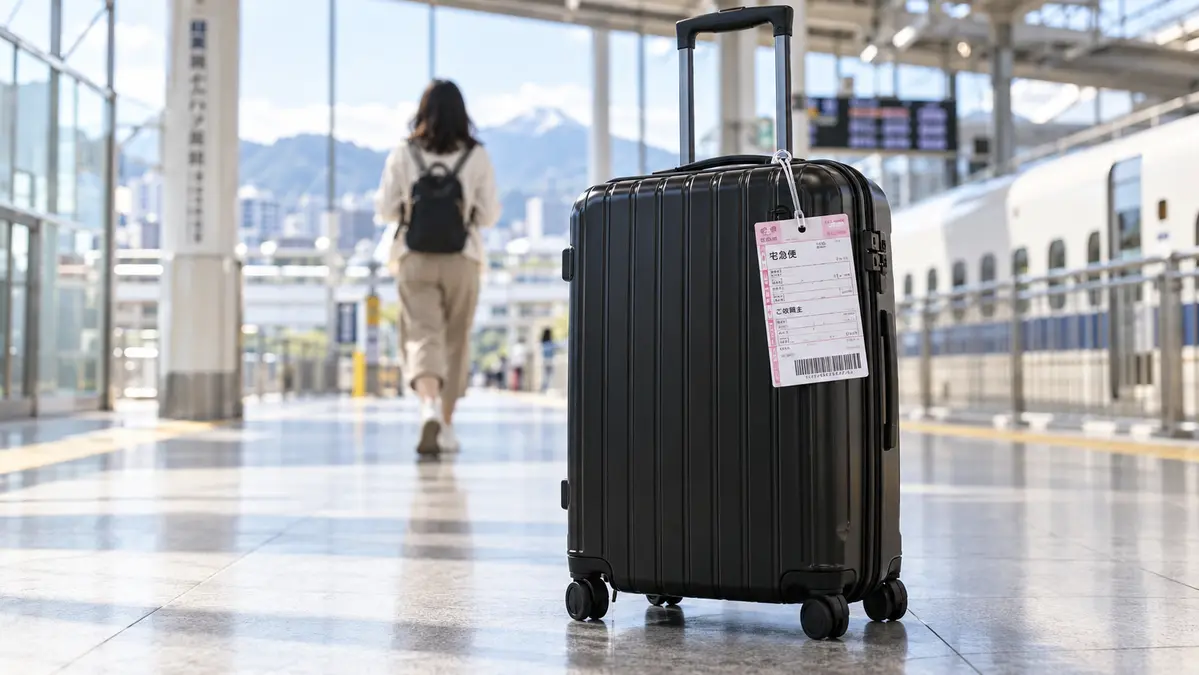
Dragging a 20-kilo suitcase through Shinjuku Station at rush hour is one of the least pleasant rites of passage in Japan travel. The stairs, the crowds, the last train you are sprinting for with a case banging against your shins — none of it is necessary. Japan has one of the best luggage-forwarding networks in the world, and using it well is the difference between moving through the country and being dragged through it.
Takkyubin basics: how same-day and next-day forwarding works
Japan's takkyubin forwarding lets you send your suitcase ahead so it arrives at your next hotel while you travel light. Standard service is next-day delivery after a morning cutoff, with same-day options within cities. Your hotel front desk arranges it all.
Japan's luggage-forwarding system (takkyubin) lets you send your bag ahead so it arrives at your next hotel while you travel light by train. The standard service is next-day delivery: hand your bag to a courier counter or your hotel front desk before the morning cutoff, and it is waiting at your next destination the following day. Within the same city, same-day delivery is often available if you drop the bag off early enough. Your hotel front desk usually arranges everything — they fill out the form, weigh the bag, take payment, and hand it to the courier who picks up daily. This system works because Japan's domestic couriers run dense, reliable networks with consistent cutoffs, so hotel-to-hotel forwarding is routine rather than exceptional. For the full logistics picture that sits around this — visas, IC cards, and rail passes — see our Japan travel planning guide.
To use takkyubin, you do not need an account or a Japanese address. You need the address of your receiving hotel (in Japanese characters if possible, though most front desks can transliterate for you), your check-in date, and your reservation name. The hotel on the receiving end holds the bag for you — confirming in advance that they accept forwarded luggage is a quick email worth sending. Most business hotels and mid-range hotels accept forwarded bags for registered guests, often up to a day or two before your check-in. The one hard rule is timing: bags must be handed over by the morning cutoff for next-day service, which is typically around 10:00 to 11:00. Miss the cutoff and delivery slips a day. Build your itinerary around that cutoff rather than the other way around.
Same-day forwarding exists but is narrower: it generally works for deliveries within the same metropolitan area (Tokyo-to-Tokyo, Osaka-to-Osaka) with a morning drop-off and an evening pickup window. It is not a nationwide service, and you cannot reliably forward from Tokyo to Kyoto and expect it the same evening. The default mental model is simple: one night ahead. Send your bag a day before you need it, carry what you need for one night, and you will never wait around for luggage.
Pricing is distance- and size-based, and it is modest by international standards. A standard suitcase forwarded between two major cities typically costs in the range of what you would pay for two or three one-way train tickets in Tokyo — roughly the price of a casual lunch and a coffee. Oversized bags cost more, and forwarding to remote areas (islands, mountain towns) can add a day and a surcharge. The price is printed on the receipt at the counter, so there are no surprises; you can ask for the quote before committing.
When forwarding beats dragging: the cost-breakdown rule
The decision between forwarding and carrying is a comparison of three costs: money, time, and physical effort. The money cost of forwarding is fixed and low. The effort cost of carrying is variable and spikes hard on certain days. Here is the rule: forward whenever your travel day involves a station transfer, a check-in before noon, or any leg where your bag will be with you for more than two hours of transit.
Work through the math on a typical multi-city day. You check out of a Tokyo hotel at 10:00, spend the day moving to Kyoto, and check in at 16:00. If you carry the bag, you pay roughly 2,000–3,000 yen in locker fees to stash it somewhere during the day (or you haul it through lunch), plus the friction of navigating stations with it. Forwarding that same bag costs roughly 2,000 yen and buys you six hours of hands-free travel. On a day like that, forwarding is cheaper than the lockers you would otherwise need — and that is before accounting for the value of not being tired.
The rule flips on simple days. If you are checking out at 10:00 and checking into another hotel in the same city at 15:00, carrying the bag on the subway once is fine and forwarding adds a day of waiting for no benefit. Similarly, if your route is a straight airport-train-to-hotel leg with no stops, just carry it. The forwarding advantage concentrates on days where your bag would otherwise sit in a locker or ride in your arms while you do something else.
There is also a group multiplier. Two travelers with two bags double the locker cost but the forwarding math stays linear, which usually still favors forwarding. A family of four with four bags forwarding hotel-to-hotel is almost always the right call; wrangling four cases through a morning rush-hour transfer is a reliable way to start a vacation badly.
One more consideration: shinkansen reserved seats. Large suitcases require oversized-baggage areas on shinkansen, which must be reserved. If you cannot get that reservation, your bag becomes a genuine problem on a crowded train. Forwarding sidesteps the issue entirely. This is the quietest argument for the service — it removes a reservation dependency from your rail travel.
Coin lockers: sizes, locations, and the overnight problem
Coin lockers are the other half of the hands-free strategy, and they are for hours, not days. Japan's major stations have hundreds of lockers in three rough sizes: small (a backpack or day bag), medium (a carry-on), and large (a full suitcase). Medium and large lockers empty out first at busy stations, so on arrival days, head straight to the locker bank before sightseeing — or better, forward the big bag and only locker a small day pack.
Locker banks cluster around station ticket gates, shopping arcades attached to stations, and department-store basements. At mega-stations like Tokyo, Shinjuku, and Osaka-Umeda, the locker locations are signed in English and the machines accept IC cards (Suica, ICOCA) as well as coins, which removes the hunt-for-change problem. The payment system typically gives you a receipt with a PIN or an IC-card association; keep it, because the staff desk for lost PINs is not always nearby.
The critical constraint is the overnight rule. Most station lockers must be cleared the same day — the rental period runs until roughly midnight or the station's closing time, and anything left past that is moved to a lost-property office with a surcharge. A small number of lockers at major stations offer multi-day rentals, but they are the exception and fill up immediately. Do not plan to leave a bag in a station locker overnight as a forwarding substitute; it is unreliable and, at some stations, simply not permitted.
Practical locker tactics: on a day trip between cities (Kyoto morning, Nara afternoon, back to Kyoto hotel), drop the day bag at the morning station, not the afternoon one — you want the retrieval on the return leg, not a detour. On checkout days with a late shinkansen, use the departure station's lockers rather than the hotel's bag room if you are leaving the city center early; hotel bag storage is free but requires doubling back. And if you are forwarding the suitcase but need it before the hotel delivery arrives, a large locker near the station can bridge the gap for a few hours — check the bag at the station, explore, retrieve it when the forwarding delivery lands.
Hotel-to-hotel and hotel-to-airport forwarding flows
The two flows you will use most are hotel-to-hotel and hotel-to-airport, and both start at the front desk. For hotel-to-hotel: the night before, or the morning of your travel day, bring the packed bag to your current hotel's front desk and say you want to forward it. They provide the waybill, you give the receiving hotel's name, address, check-in date, and reservation name. The bag typically goes out with the day's courier pickup. You then travel with just a day bag, and your suitcase is at the next hotel's front desk (or bell desk) when you check in the following day.
Timing discipline matters. The morning cutoff for next-day delivery is the constraint everything hangs on. If your travel day involves a late checkout and a same-day arrival expectation, it will not work — you cannot forward at noon and receive at 18:00 in another city. Plan so that you forward on day X, travel light on day X, and receive on day X+1. The cleanest pattern for a two-week multi-city trip is a rolling forward: every time you change cities, the bag goes a day ahead while you carry one night's kit. Your suitcase and you arrive in the same city on offset days, and it feels like the bag is teleporting alongside you.
For hotel-to-airport on your last day: most major airports have courier counters in the departure halls, and hotels can forward bags to the airport a day or two before your flight. You collect the bag at the airport courier counter — not the airline check-in desk — usually on the departure level. Allow an extra 30 minutes in your airport timing for the pickup, and confirm the counter's location in advance; at Narita and Kansai the counters sit in the terminal but require a short walk from the train station end. Forwarding to the airport is especially useful when your last day involves a long layover city visit — the bag rides the courier network while you ride the train.
Confirmations to get in writing (email is fine): that the receiving hotel accepts forwarded luggage for your dates, and the name your bag is held under. In 99 percent of cases this is a non-issue, but a ryokan or small guesthouse with no front desk is the case you are protecting against — which leads to the next section.
Ryokan and minshuku: forwarding to non-hotel stays
Forwarding to a ryokan or minshuku works the same way mechanically, but the receiving end is less standardized. A ryokan is a traditional inn with a host family or small staff; a minshuku is a family-run guesthouse, often in rural or coastal areas. Both will generally accept a forwarded bag if you are a registered guest, but the delivery window is less predictable: couriers in rural areas may deliver only once a day, and a bag addressed to arrive "the morning of check-in" can realistically arrive mid-afternoon.
The fix is to send one day earlier than you would for a city hotel. If you check in on Friday, forward on Wednesday for Thursday arrival, not Thursday for Friday. Rural delivery routes are less frequent, and the cost of the bag arriving late is that you have no clothes for dinner — a ryokan kaiseki dinner in travel-worn day clothes is survivable but not ideal. Ask the ryokan directly (email in simple English is fine; most reply) whether they accept takkyubin and how many days ahead they prefer it.
Remote destinations add one more wrinkle: some island and mountain addresses fall outside same-day or next-day service windows entirely, adding one to two extra days. The courier will tell you the expected delivery date when you hand over the bag — that date is reliable, so plan from it rather than from the standard next-day assumption. If the expected date is after your checkout, do not forward there; carry the bag or re-route it to your following destination.
For the return leg, ryokan and minshuku hosts will forward your bag onward just like a hotel front desk does — they handle takkyubin forms routinely, since domestic travelers use the service constantly. The rural pickup schedule is the same one-day-earlier constraint in reverse. None of this is difficult; it is just a matter of padding the schedule by a day on each side.
What to keep on you: the day bag essentials
When the suitcase travels separately, the day bag becomes your whole world for 24 to 48 hours, so pack it with intent. The kit: one change of clothes (rolled, not folded), basic toiletries in a zip pouch, phone charger and a portable battery, passport or a copy, any medication, the waybill receipt for your forwarded bag, and your IC card loaded for the day. Everything else can ride the courier.
The clothes choice deserves thought. Pick the outfit you would be fine wearing to dinner — because if the bag is a few hours late, you will be. A dark, wrinkle-resistant layer plus a change of base clothing covers nearly every scenario. If you are heading to a ryokan, add the swimsuit-equivalent logic: many ryokan provide yukata and the inn supplies most bathing needs, so the forwarded bag handles the rest.
The waybill receipt is the one item travelers forget. It has the tracking number, and if a bag goes missing — rare, but possible — the receipt is your only proof of shipment. Photograph it too, in case the paper gets wet or lost. Courier tracking sites have English interfaces, so you can check the bag's status from your phone; the status updates are prompt and accurate.
The portable battery earns its place because a forwarding day is a heavy navigation day: maps, translation, train schedules, and tracking, all running while you are nowhere near an outlet. A 10,000 mAh battery is the practical minimum. And the IC card, beyond transit, pays for lockers, vending machines, and convenience stores — it is the single item that most reduces friction on a light travel day.
One last packing principle: the day bag should never need a locker itself. If your "day bag" is so large it needs stashing, you have just recreated the original problem at a smaller scale. A 20-liter backpack is the ceiling. Anything bigger belongs in the forwarded suitcase — that is what the service is for.