Korean convenience stores: what to actually buy at CU, GS25, and 7-Eleven

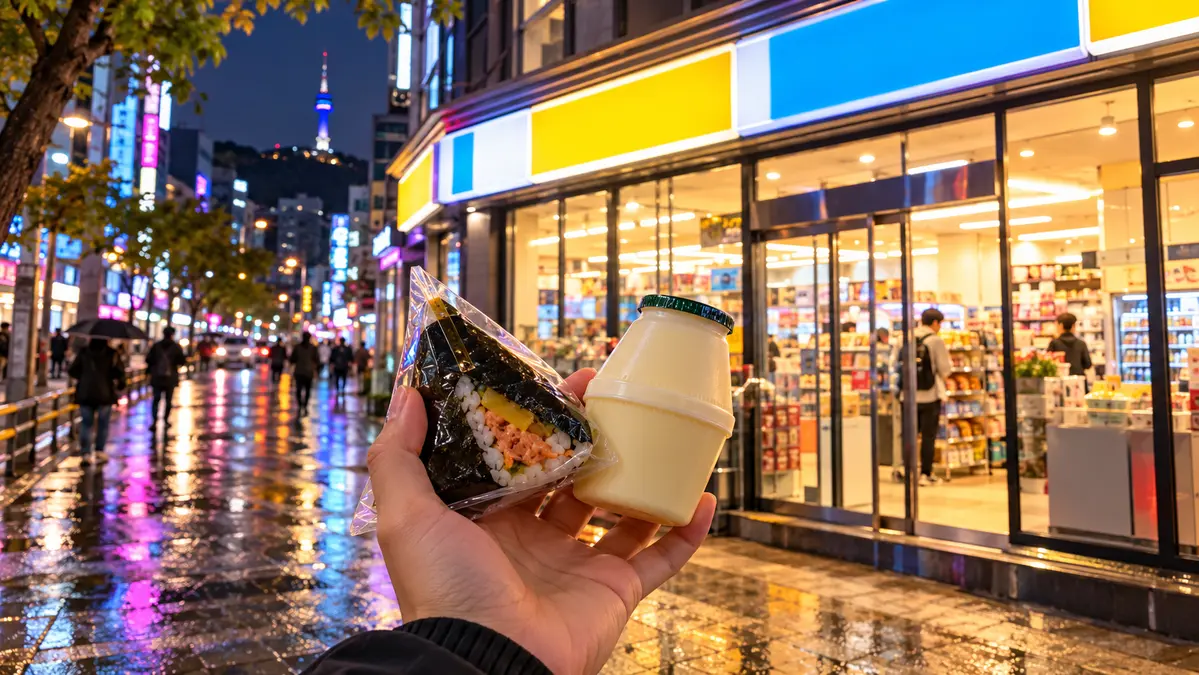
Korean convenience stores are not the sad fluorescent fallback you know from home. In Korea, the conbini — CU, GS25, and 7-Eleven — are a legitimate food destination, a late-night social space, and the backbone of every budget traveler's meal plan. The triangle kimbap alone justifies the trip. By the time you leave Korea, you will understand why locals defend their favorite chain with sports-team loyalty.
This guide covers what to actually buy, how the big three chains differ, and the store mechanics that turn a quick stop into a proper meal.
Why Korean convenience stores are a destination, not a fallback
Korean convenience stores earn their reputation through sheer density and quality. With over 55,000 locations — roughly one per 900 people — you are never more than a two-minute walk from hot food and a place to sit. The prepared-food game is on another level entirely.
The price math is what converts skeptics. Triangle kimbap (samgak gimbap) costs ₩1,100–₩1,800 depending on filling — tuna mayo, bulgogi, kimchi fried rice. A full convenience store meal, kimbap plus instant noodles plus a drink, typically lands under ₩6,000. That is less than a single café latte in Seoul's trendier neighborhoods, and it is actual food.
The stores also function as public living rooms. Every location has a microwave, hot water dispenser, and usually a small seating area with tables. At 2 a.m., the conbini is where delivery drivers, students, and travelers converge over steaming cups of ramen. It is one of the most democratic spaces in Korean cities — everyone eats here, regardless of budget.
What surprises first-timers is the freshness cycle. Unlike Western convenience stores where prepared food sits for days, Korean conbini restock fresh items multiple times daily. Triangle kimbap has a same-day expiration — if it was made in the morning, it is pulled by evening. Dosirak boxes are dated for the day. This rapid turnover means the food you buy at 6 p.m. was likely made that afternoon, not that week.
The seasonal rotation is another differentiator. Korean conbini change their prepared-food lineup with the seasons and with food trends. Summer brings cold noodle cups and bingsu; winter brings oden, hotteok (sweet pancakes), and roasted sweet potatoes. Limited-edition collaborations — with K-pop groups, popular restaurants, even TV dramas — create genuine excitement. Part of the fun is never knowing what new thing will be on the shelf.
The big three: CU vs GS25 vs 7-Eleven differences that matter
CU leads on snack collaborations and limited-edition products. If there is a viral K-pop tie-in snack or a bizarre new chip flavor, it debuts at CU. The chain also tends to have the widest triangle kimbap selection, with 15-20 varieties at larger stores. CU's private-label products are consistently solid, and their dosirak rotation changes seasonally.
GS25 wins on dosirak meal boxes and hot foods. Their lunch boxes — rice, protein, three banchan sides — are the closest thing to a home-cooked meal you will find for under ₩5,000. GS25 also has the best fried chicken lineup among the three, with their crispy chicken boxes drawing genuine lines at lunch. The chain's collaboration with popular restaurants for branded ready-meals is a cut above.
7-Eleven in Korea leans on its global supply chain for imported snacks and drinks you will not find at the other two. Japanese Kit Kats, Taiwanese bubble tea cans, American candy — the import shelf is the draw. Their fresh-food game is slightly weaker than CU and GS25, but the 7-Eleven app has the best coupon system, with regular buy-one-get-one deals on coffee and kimbap.
In practice, you will visit whichever is closest, and that is fine. The differences matter for enthusiasts; for everyone else, any of the three delivers the core experience. If you pass a CU, go in for snacks. If you need a real meal, find a GS25. If you want imported treats, hit 7-Eleven.
The real secret is that Korean convenience stores reward curiosity. Every visit surfaces something new — a limited-edition snack, a seasonal drink, a collaboration product you have never seen before. Make the conbini part of your daily routine: morning coffee, afternoon snack, late-night ramen. By the end of your trip, you will have a list of favorites and a genuine understanding of why Koreans are so proud of their convenience stores. It is not just shopping. It is culture in a fluorescent-lit box.
Store size matters as much as chain. Flagship locations in busy areas (Hongdae, Myeongdong, Gangnam) are twice the size of neighborhood stores, with expanded fresh-food sections, more seating, and sometimes even a small café corner. If you have a choice between a tiny CU and a large GS25 across the street, pick the larger store — the selection difference is significant.
The apps are worth downloading for longer stays. Each chain has its own app with coupons, loyalty points, and pre-ordering. 7-Eleven's app is the most tourist-friendly with an English option; CU and GS25 are Korean-only but navigable with translation apps. Even without the apps, watch for the yellow "1+1" (buy-one-get-one) and "2+1" (buy-two-get-one) stickers on shelves — these promotions are constant and apply automatically at checkout.
Hot foods worth seeking: tteokbokki cups, corn dogs, and fried chicken
The hot-food case is where Korean conbini separate from the global pack. Tteokbokki cups — chewy rice cakes in sweet-spicy gochujang sauce — come in microwaveable bowls for around ₩3,500. They are not a sad imitation of the street version; they are genuinely good, with the right chew and a sauce that builds heat gradually. Add a triangle kimbap on the side and you have a complete meal.
Korean corn dogs (gamja hotteok style, though the conbini version is simpler) are another must-try. The conbini version wraps a sausage — sometimes half sausage, half mozzarella — in a chewy potato-studded batter, then deep-fries it to order or reheats it. At ₩2,500–₩3,500, it is a substantial snack. Ask for the sugar-and-mustard dusting; the sweet-savory combination is the whole point.
Fried chicken at GS25 deserves special mention. Their boneless crispy chicken boxes (₩5,900 for a generous portion) use a craggy, well-seasoned coating that stays crisp even after microwaving. It is not Kyochon, but it is far better than any convenience-store chicken has a right to be. Pair it with the pickled radish cubes from the banchan fridge.
Do not overlook the oden (fish-cake skewers) in winter. The simmering broth pot near the counter holds skewers at ₩1,000–₩1,500 each. The broth is free and unlimited — ladle it into the provided paper cup. On a cold night, standing outside a conbini with hot oden broth is one of Korea's great simple pleasures.
The kimbap variations deserve a deeper look because the range is staggering. Beyond the standard tuna mayo and bulgogi, you will find kimchi fried rice, carbonara, spicy pork, cheese, and rotating limited editions. CU's recent price adjustment brought the basic triangle kimbap down to ₩1,100 — at that price, it is arguably the best value calorie in Seoul. Two kimbap plus a drink is a complete lunch for under ₩4,000.
For the full hot-food experience, time your visit for the evening restock (around 6-7 p.m.) when the fried items are freshest. The chicken, corn dogs, and croquettes sit under heat lamps, and quality degrades noticeably after an hour. Morning is the second-best window — the breakfast items (egg sandwiches, hotteok) are freshly stocked. Mid-afternoon is the dead zone; if the fried chicken looks sad at 3 p.m., it has been sitting since lunch.
The ramen wall: picking noodles by spice level and style
Every Korean convenience store has a ramen wall — an entire shelving unit of instant noodles that can paralyze first-timers. Here is the decoder: Shin Ramyun (red package) is the baseline spicy beef broth, the reference point for all Korean ramen. Jin Ramen comes in mild (blue) and spicy (red) versions — the mild is genuinely gentle, the spicy is a half-step below Shin.
For the full fire experience, Buldak (the black-and-red "fire noodle" package) is the infamous ultra-spicy challenge noodle. It is not a casual meal; it is an event. The carbonara and cheese variants tame the heat slightly while adding richness. Try it once for the story, with milk nearby.
Beyond the famous names: Sesame Ramen (sesame oil richness), Kimchi Ramen (sour-spicy, excellent), and the entire Paldo and Ottogi lines offer regional variations. The cup-noodle versions cost slightly more than bag noodles but include a fork and are designed for the store's hot water dispenser — no kitchen needed.
Pro move: buy a bag-noodle pack and a triangle kimbap, then use the store microwave and hot water to assemble a full meal at the seating area. Total cost under ₩4,000, total satisfaction extremely high. The staff will not mind — this is what the seating area is for.
The cheese and butter additions are a Korean conbini hack worth knowing. Most stores sell single-serve cheese slices and small butter cups near the ramen section. Adding a cheese slice to Shin Ramyun as it finishes cooking — letting it melt into the broth — transforms the soup into something creamy and rich. This is not a tourist invention; it is standard Korean student cooking, and the stores stock the ingredients accordingly.
For noodle maximalists, the "ramen + rice" combo is the power move. Cook your noodles, eat them, then dump a triangle kimbap (unwrapped, crumbled) into the leftover broth and microwave for 60 seconds. You now have a second course — savory porridge — from the same ₩3,000 investment. Korean convenience stores are designed for this kind of creative assembly; the microwave, hot water, and seating exist precisely to enable it.
Drinks and desserts travelers always miss
Self-serve fresh coffee costs ₩1,000–₩1,500 at every store — a fraction of café prices. The machines grind beans to order and produce a genuinely drinkable Americano. At that price, there is no reason to pay ₩5,000 at a café unless you need the WiFi and the ambiance. The 7-Eleven app frequently has buy-one-get-one coffee coupons.
Banana milk (바나나맛 우유) is the iconic Korean conbini drink — a small, chubby bottle of banana-flavored milk that has been a national obsession since the 1970s. It costs around ₩1,800 and tastes like childhood nostalgia in liquid form. The strawberry and melon versions are also worth trying.
For something stronger, the craft beer and soju selection is surprisingly deep. Korean convenience stores stock local craft IPAs, Japanese imports, and the full soju lineup at retail prices — a bottle of Chamisul is around ₩1,900 versus ₩5,000+ at a bar. Many stores have outdoor tables where drinking your store-bought beer is perfectly acceptable.
Desserts: the ice cream freezer hides treasures. Look for Melona (melon-flavored ice bars), Bungeo-ppang (fish-shaped red-bean pastries, available frozen), and the rotating cast of character-branded ice creams. In summer, the bingsu (shaved ice) cups for ₩3,000 are a legitimate dessert, not a sad substitute.
The yogurt and probiotic drink section is enormous and worth exploring. Korea has a deep yogurt-drink culture — small, sweet, tangy bottles that are marketed for gut health but consumed for taste. Yakult-style drinks cost around ₩1,000 and come in dozens of flavors. They are refreshing, not too sweet, and a staple of Korean daily life. Grab a few for your hotel fridge.
Do not miss the traditional drinks either. Sikhye (sweet rice punch) and sujeonggwa (cinnamon persimmon punch) are sold in cans and bottles for ₩1,500–₩2,000. These are the drinks Korean grandmothers make — sweet, warming, faintly spiced — and they taste like history. They are caffeine-free, making them ideal evening drinks when you want something flavorful without the coffee jitters.
Payment, microwaves, and eating inside: store mechanics
Payment is frictionless: every store accepts foreign credit cards, mobile payments (Apple Pay, Google Pay), and cash. T-money transit cards also work if you have one loaded. There is no minimum purchase, and the staff are accustomed to tourists fumbling with unfamiliar currency. If your card is declined, try inserting the chip rather than tapping — some older terminals are finicky about contactless foreign cards.
The microwave is your best friend. Every store has at least one, usually two, free for customer use. Dosirak boxes, tteokbokki cups, and corn dogs all have microwave instructions printed on the packaging — typically 90 seconds to 2 minutes. If the instructions are only in Korean, look for the microwave wattage symbol and the time; 1000W for 90 seconds is the standard. When in doubt, start with 90 seconds — you can always add more time, but you cannot un-explode an overcooked dosirak.
Hot water dispensers (usually next to the microwave) provide boiling water for cup noodles and instant coffee. The button is typically large and obvious; hold your cup under the spout and press. Be careful — the water is genuinely boiling, and the paper cups get hot.
Eating inside is expected and encouraged. Use the tables, dispose of trash in the marked bins (general waste, recyclables, food waste are separated — follow the signs), and wipe your table if you made a mess. Staying for thirty minutes over a ₩4,000 meal is completely normal. The conbini is not a grab-and-go-only zone; it is a dining room that happens to sell everything else too.
Late-night etiquette: after midnight, keep the volume down — the seating area may be shared with tired shift workers. The stores are 24 hours, but the neighborhood is sleeping. This is also when the best people-watching happens: the 2 a.m. conbini crowd is a cross-section of Korean night life, from club-goers sobering up with ramen to taxi drivers on break.
One final tip: the staff will heat items for you if you ask. If the microwave line is long or you are unsure about the settings, hand your dosirak to the cashier and say "dewojuseyo" (데워주세요 — please heat it up). They do this dozens of times a day and will have it steaming in ninety seconds. It is not an imposition; it is part of the service.